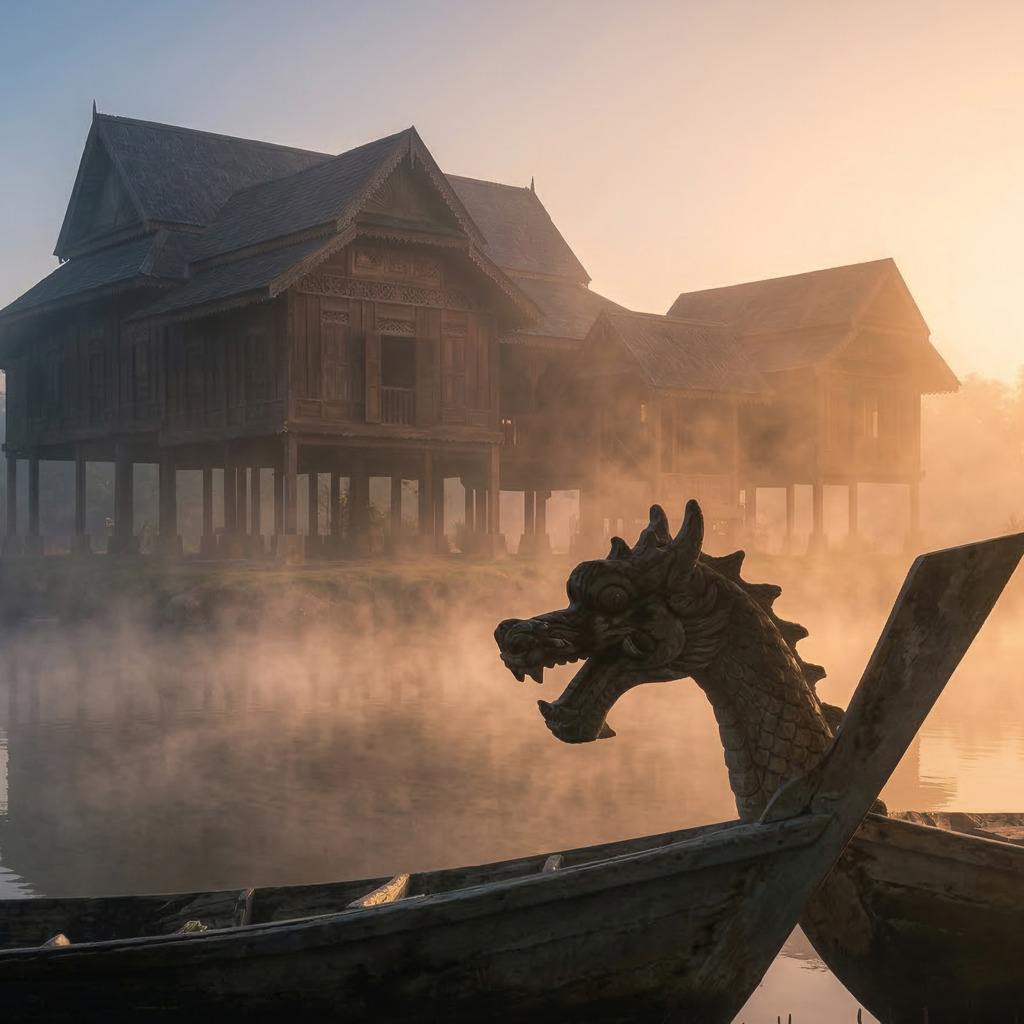

To understand the spirit of Terengganu, one must first look toward the horizon – not just the blue expanse of the South China Sea, but the horizon of time. Long before the modern borders of Malaysia and Thailand were etched into maps, there was a kingdom that existed in the collective memory of the East Coast like a half-remembered dream.
They called it Langkasuka.
For the modern traveller, Terengganu often feels like a beautiful but quiet backwater. We see the colourful perahu (boats), we smell the pungent, wonderful aroma of keropok lekor frying by the roadside, and we marvel at the intricate woodcarvings on a village mosque. But there is a deeper resonance here. It is the architectural and cultural ghost of an empire that once rivalled the greatest powers of Southeast Asia.
The “Malay Atlantis”: A Kingdom Between Two Seas
If you ask a local elder in a stilted house along the Setiu Wetlands about Langkasuka, you might get a knowing nod. It isn’t just a footnote in a history book; it is the “Malay Atlantis.”
According to Chinese chronicles from the 6th century, specifically the Liang Shu, Langkasuka was a land of staggering wealth and sophistication. The annals describe a king who rode an elephant, shielded by a white umbrella, surrounded by guards bearing peacock-feather banners and drums audible for miles. It was a kingdom of “high-walled cities” where the scent of agarwood and sandalwood hung heavy in the humid air, and where the finest silks and ceramics were traded.
Strategically, Langkasuka was a masterstroke of geography. It sat on the narrow neck of the Malay Peninsula, controlling the trans-peninsular trade routes. Instead of braving the pirate-infested waters of the Melaka Straits, ancient traders from India and China would offload their goods on one coast, trek across the jungle-clad interior, and reload on the other.
Langkasuka was the middleman of the ancient world. And with that wealth came an explosion of art that still defines the “East Coast Style” today.
The Architecture of the Void: Where Spirits Dwell
Twenty years of exploring Southeast Asia taught me that a place’s “soul” lives within its wood. In the West, builders use stone to defy time; in the East, they use wood to live with it.
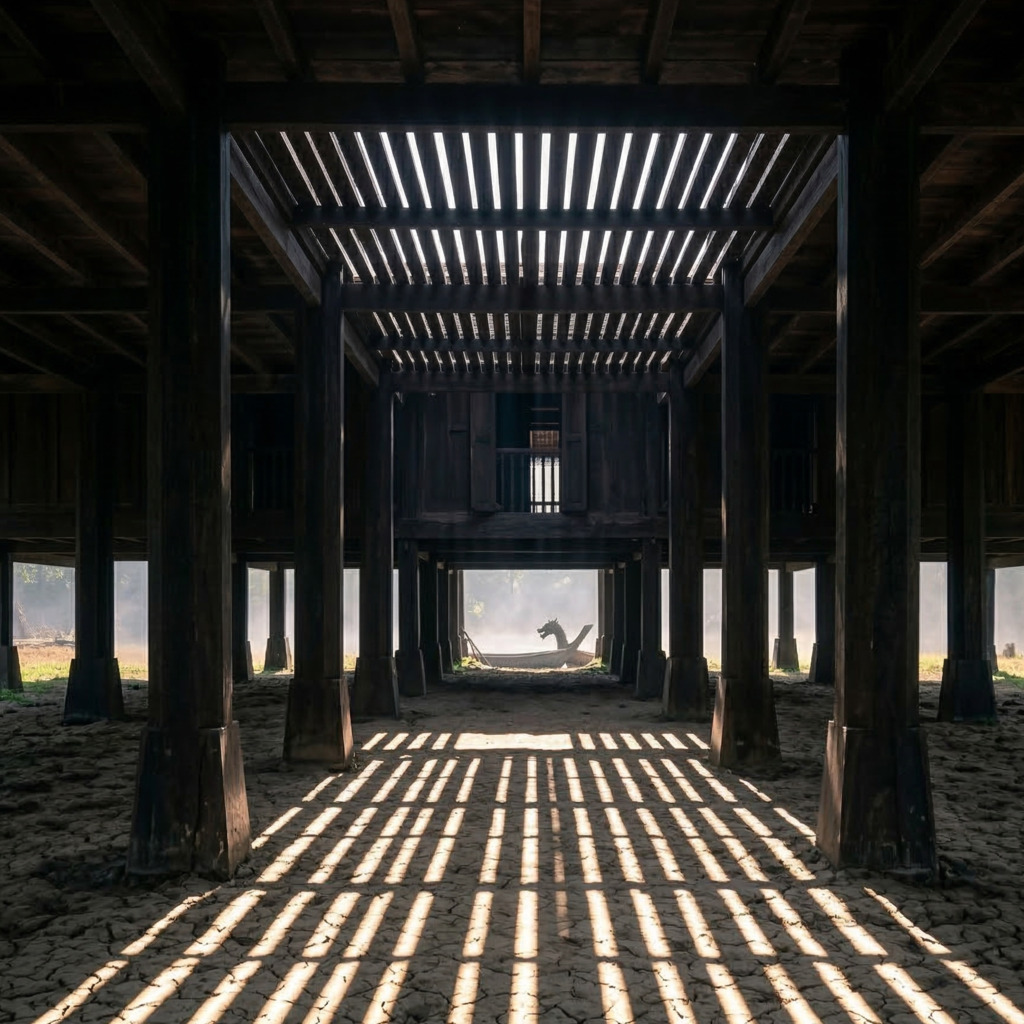
The architecture of the Langkasuka era – and by extension, the traditional Terengganu house – is a philosophy of the “Void.” If you look at a traditional Rumah Bujang or Rumah Limas, you’ll notice they are elevated on high stilts. This isn’t just to avoid the seasonal monsoon floods.
There is a folkloric belief that the space beneath the house belongs to the earth spirits, while the space above belongs to the humans. The house exists in the middle, a sanctuary of air and light.
The “Tebak” System: A Masterclass in Joinery
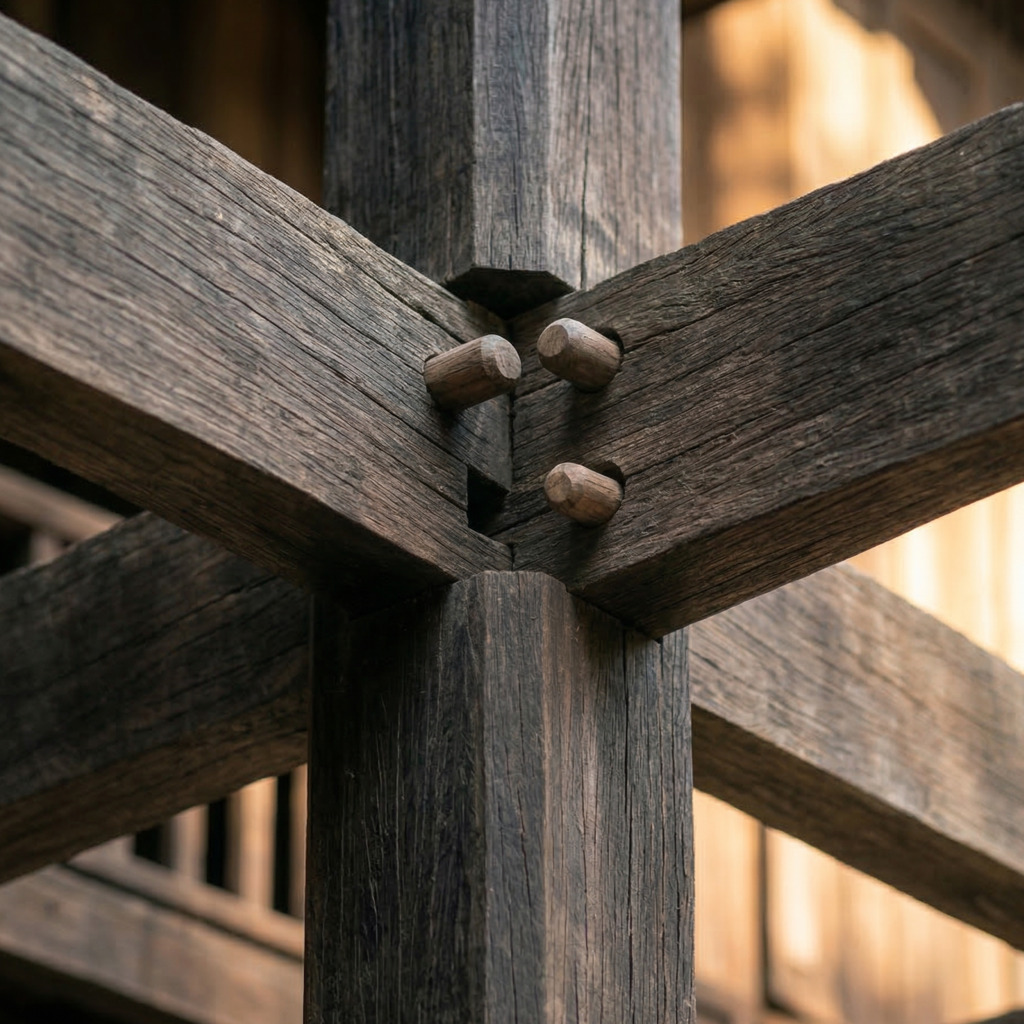
One of the most fascinating anecdotes from local master carvers is the “Nail-less” philosophy. A true heritage house in Terengganu was built using the tebak system – a series of sophisticated mortise-and-tenon joints.
The old masters believed that iron nails were “violent” to the wood. Instead, they used wooden pegs (pasak). This allowed the house to breathe. During a heavy tropical storm, a stone building stands rigid and may crack; a Langkasuka-style wooden house sways, groans, and yields to the wind. It’s an architecture of resilience through flexibility.
The “Semangat” of Wood: A Deep Dive into Ukir
We shouldn’t just mention woodcarving; we should explain the metaphysics of it. In the Langkasuka tradition, wood isn’t a dead material; it has Semangat (soul/life force).
A Tukang Ukir (Master Carver) sitting in a dusty workshop wouldn’t start carving immediately. He’d spend a long time simply running his hands over a massive slab of Chengal – the “King of Woods” in the Malay world. He would explain that a carver’s job isn’t to impose his will on the wood, but to “wake up” the pattern sleeping inside.
The “Awan Larat” Philosophy
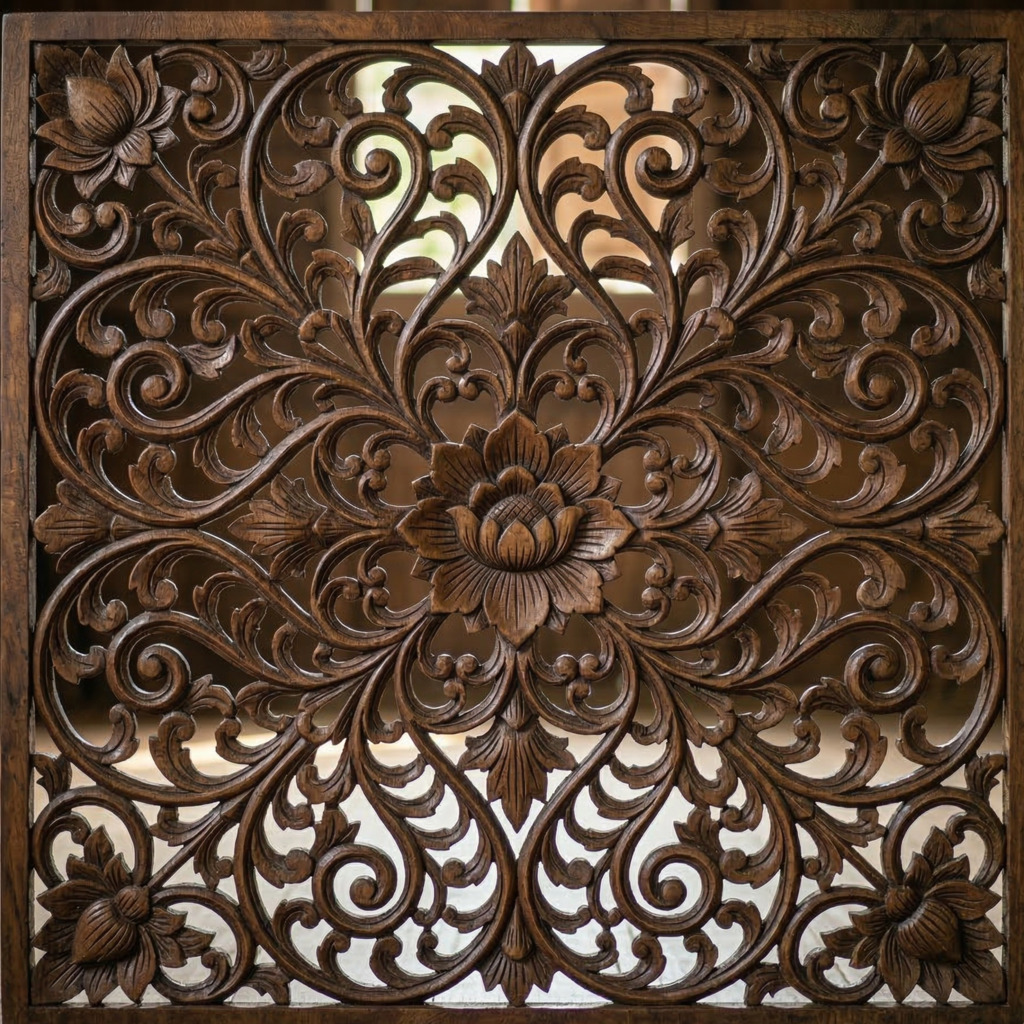
The motifs you set – the Awan Larat (trailing clouds) and the stylised lotus blossoms – are a visual language. Even after the kingdom transitioned from Hindu-Buddhist influences to Islam, the artisans kept the ancient Langkasuka patterns. They simply shifted the focus. The lotus, once a symbol of the Buddha’s purity, became a symbol of the soul’s growth toward God.
The Awan Larat represents the interconnectedness of all things- the way a single stem (representing the Creator) gives life to an infinite variety of leaves and vines (the Creation). When you see these patterns carved into a ventilation panel, you aren’t just looking at decoration; you’re looking at a prayer.
The Monsoon Rituals: Living with the “Musim Tengkujuh”
The East Coast is defined by the Monsoon. To understand Langkasuka, you must understand the Musim Tengkujuh – the season when the sky turns iron-grey, and the South China Sea becomes a wall of white water.
During these months, life in the village shifts. The fishing boats are pulled high onto the sand, and the “Great Indoors” becomes the centre of the universe. I’ve spent afternoons in Terengganu listening to the rhythmic drumming of rain on Genting Senggora (traditional clay tiles). It’s a deafening, hypnotic sound.
Historical storytellers chose this season to recount the “Langkasuka” legends. While women gathered under high-stilted houses to weave songket or dye batik, elders recounted the days of the Elephant Kings. This seasonal retreat into the home refined the architectural details – when you remain indoors for three months a year, you ensure your surroundings stay beautiful.
The “Lost Library” and the Spirit of Literacy
Long before the Jawi script (Arabic-Malay) arrived, the kingdom used the ancient Pallava script, carved into stone and likely onto palm-leaf manuscripts (lontar).
Damp heat and relentless jungle insects destroyed these physical libraries, yet the kingdom’s “literacy” lives on within its buildings. We “read” these houses now because the scrolls have vanished. These carvings represent the literature of a people who refused to let their history disappear.
A local historian once said that the tunjuk langit – the vertical finial on the roof – is actually a “finger pointing to the heavens,” a silent piece of text that every villager could read. It was a bridge between the earthly house and the divine sky.
The Setiu Wetlands: The Edge of the World
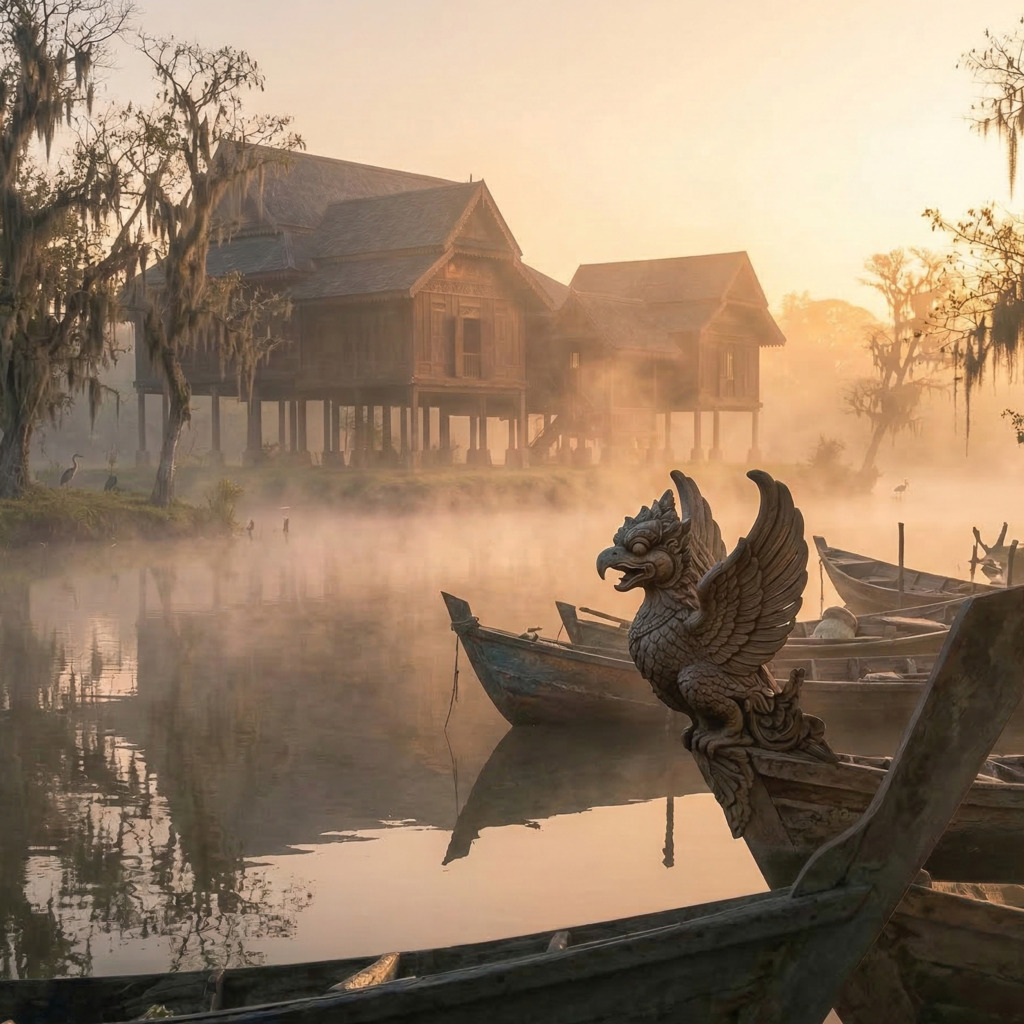
To truly “pivot” into the Terrapuri experience, you have to understand its unique ecological setting. The Setiu Wetlands are where the river meets the sea, creating a brackish, ethereal landscape of mangroves and nipah palms.
This was the backyard of the Langkasuka kings. It’s a place of transition. In the mornings, the mist clings to the water so thickly that the horizon disappears. You can almost see the ancient trading ships – the junk and the perahu – ghosting through the fog.
Ghostly Trees and Mythical Birds
Gelam (paper-bark) trees dominate the wetlands. In the moonlight, their white, peeling bark looks ghostly – fitting for a land of legends. The local fishermen here carry a heavy sense of superstition. You’ll notice their boats, the Bangau, often have carved “necks” that look like mythical birds or dragons. They believe these carvings can “see” the fish that the human eye cannot. It’s this blend of the mystical and the practical that makes the East Coast so intoxicating.
The Modern Renaissance: Why This Matters Now
In our fast-paced world, in a backlash, there’s a deep hunger for the “Authentic.” But “authentic” is a word that has been stripped of its meaning.
Langkasuka represents a time when art, architecture, and nature formed a single, seamless entity. Terengganu stands as the last bastion of this philosophy in Malaysia. While European colonialism heavily shaped the west coast (Penang, Melaka), the east coast remains stubbornly, beautifully Nusantara.
A Personal Anecdote to Close
The “Legend of Langkasuka” isn’t a fairy tale; it’s a framework. It’s the lens through which you should view your stay in Terengganu.
A few years ago, I got lost on a coastal road north of Kuala Terengganu. I pulled over near a cluster of old houses, and an elderly man invited me for tea. He didn’t speak much English.
But he pointed to the intricate carvings on his porch and said one word: “Langkasuka.” He wasn’t talking about a kingdom from a book or talking about his identity. He was proud that his house, despite its age and the peeling paint, carried the DNA of an empire.
Langkasuka Architectural Heritage FAQs
Where was Langkasuka actually located?
While legends often place it broadly across the East Coast, historical records and archaeological findings suggest the heart of Langkasuka was located in the northern Malay Peninsula. It primarily covered the area of modern-day Kedah and the Pattani region of Southern Thailand, serving as a vital trans-peninsular trade hub between the 2nd and 14th centuries.
Why is Langkasuka called the “Malay Atlantis”?
It earned this nickname because, despite being described in ancient Chinese and Indian chronicles as a kingdom of staggering wealth and high-walled cities, its physical structures have largely vanished. Unlike the stone temples of Angkor Wat, Langkasuka’s grandeur was built primarily from wood, which succumbed to the humid tropical climate and the encroaching jungle, leaving it to exist mostly in collective memory and folklore.
Is there a direct link between Langkasuka and Terengganu?
While Terengganu was likely at the periphery of Langkasuka’s direct rule, the “East Coast Style” of art, woodcarving, and architecture is considered the cultural heir to that era. The craftsmanship seen in Terengganu today—specifically the Awan Larat motifs and Nusantara house forms—is a living continuation of the aesthetic spirit born during the Langkasuka period.
What does “Awan Larat” represent in Malay woodcarving?
Awan Larat (Trailing Clouds) is a signature motif consisting of interlocking vines and floral patterns. It symbolises the interconnectedness of all living things. In a spiritual context, it represents the idea that all of creation (the leaves and branches) stems from a single, infinite source (the Creator), with no beginning and no end.
What is the significance of the “Void” in traditional architecture?
The “Void” refers to the deliberate use of high stilts to create space beneath a house. Practically, this protected residents from monsoons and wild animals. Spiritually, it reflects a Malay cosmological belief that the house is a sanctuary suspended between the earth (the realm of spirits) and the sky (the divine), allowing air and “Semangat” (life force) to flow freely.