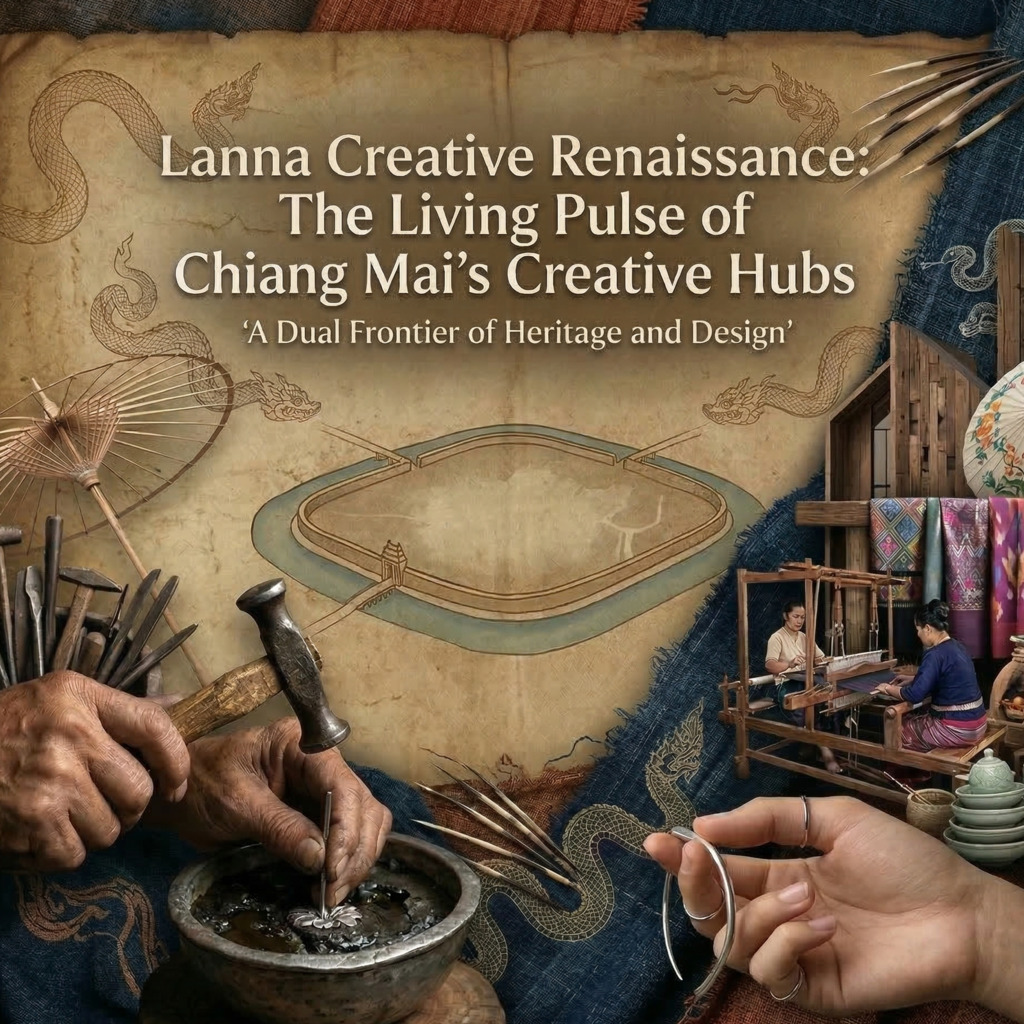

Key Insights
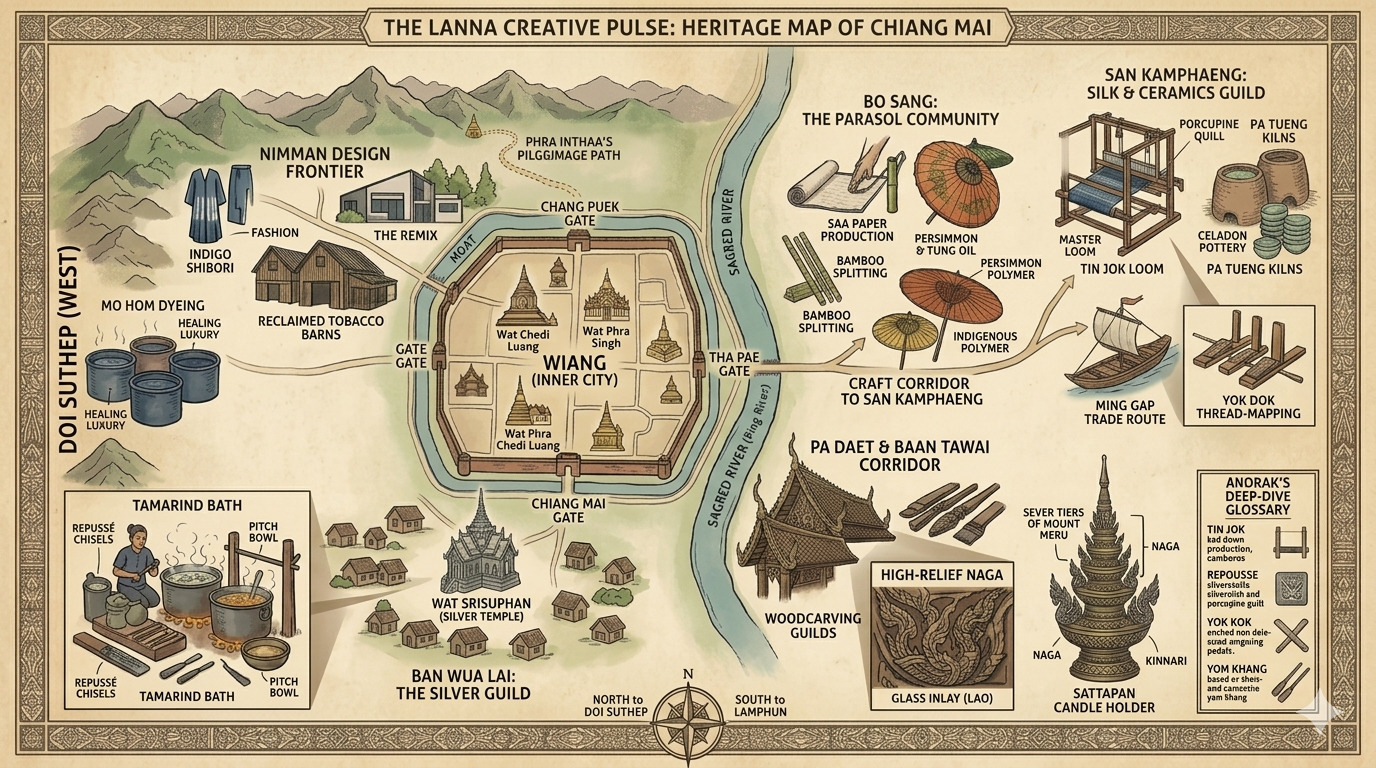
The Lanna Creative Renaissance is the modern evolution of Chiang Mai’s 700-year-old Wiang (City) and Ban (Village) metabolic layout. It bridges ancient guilds – like the Wualai silversmiths and Bo Sang umbrella makers – with a contemporary “Nimman remix” of indigo dyeing and architectural recycling.
Key technical markers include the Ant’s Nest silversmithing motif, the use of Tung seed oil for waterproofing, and the manual Tin Jok weaving test.
For a full glossary of terms used, click here.
While many global destinations isolate their historic remnants inside static glass cases, Chiang Mai preserves its structural and communal identity through participatory cultural action. For contemporary heritage travellers, the city offers profound cultural value that extends far beyond cold, inert monuments.
Instead, a persistent, generational rhythm continuously echoes from localised artisan enclaves. This dynamic creative pulse moves seamlessly between highly specialised urban clusters – extending from the high-relief silversmiths of the Wua Lai district to the traditional silk and cotton weavers of San Kamphaeng.
The Urban Anatomy: Wiang vs. Ban
To understand Chiang Mai’s creative pulse, one must first understand its skeleton. The city was designed around the concept of the Wiang – the walled inner city reserved for the Chao (royalty) and the clergy. Outside these walls lay the Ban, the specialised villages of artisans. This wasn’t merely a class divide; it was a functional, metabolic layout.
Guilds were placed strategically based on craft byproducts. Silversmiths received land outside the South Gate. Their forges needed proximity to trade routes. Open spaces managed smoke, fire, and toxic fumes. This spatial arrangement created a symbiotic relationship.
Royalty inside provided patronage and sacred blueprints. Artisans outside provided the Lanna material identity. This dynamic keeps authentic heritage on the city’s periphery. Today, these experiences exist just outside the tourist-heavy moat.
The Spiritual Forge: The Alchemy of Wua Lai
Walking down Wua Lai Road reveals a lineage of sound. This history stretches back to a strategic talent import. King Kawila restored Chiang Mai after years of Burmese occupation. At that time, the city was a ghost town. To rebuild its soul, he relocated skilled silversmiths. These artisans came from the Salawin River and Shan States. This historical “invitation” brought war captives to the city.
The Chemistry of the Tamarind Bath
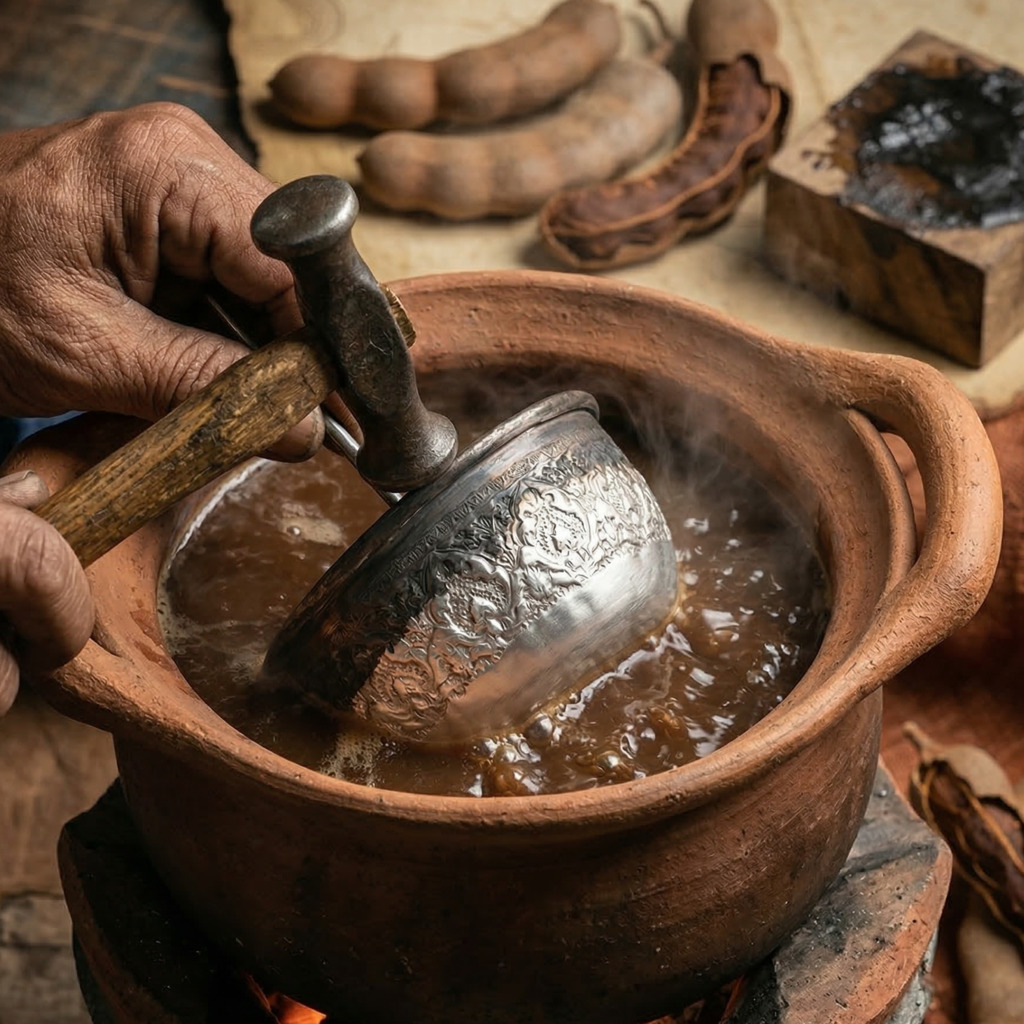
In the Wualai Silver District, traditional Lanna silver undergoes a specific chemical ritual. Artisans shape it in a forge using saltpetre and borax. This process effectively softens the metal for crafting. The piece then enters a boiling tamarind bath. Natural tartaric acid acts as a gentle pickling agent. This cleans the silver and neutralises residual soldering acids. Finally, the bath creates a signature blue-green patina.
The “Ant’s Nest” Philosophy
At Wat Srisuphan, the Silver Temple, the craftsmanship reaches a level of obsessive detail that borders on the divine. Look closely at the metal panels, and you’ll find the Khôm Rang Mod Som (Ant’s Nest) motif.
The Lanna worldview reflects a core truth. Microscopic efforts of a community working in harmony achieve prosperity. Cultural friction still surrounds the Silver Ubosot.
Traditional rules forbid women from entering this ordination hall. These restrictions stem from ancient animist beliefs. The rules protect “Sacred Blueprints” buried beneath the floor. This site highlights the tension between modern values and old traditions.
Chiang Mai’s renaissance is not confined, however to urban studio collectives; it radiates outwards into decentralised craft enclaves that have sustained the valley for decades. South along the Ping River basin, the woodcarving enclave of Baan Tawai exemplifies this resilient craft economy. Here, rice farmers-turned-master carvers preserve ancestral Lanna motifs (Kranok) alongside 24-karat gold-leaf lacquerware, anchoring contemporary architectural provenance directly to the sacred timber traditions of the North.
The Craft Corridor: Seasonal Alchemists of the East
The road to San Kamphaeng is an industrial artery that has long balanced the scales between survival and art. The story of the Bo Sang umbrella begins with Phra Inthaa, a wandering monk who ventured into Burma on a spiritual pilgrimage.
The Technology Transfer of Phra Inthaa
Legend says Phra Inthaa saw a Burmese artisan using a paper parasol that remained dry despite torrential rain. He stayed in the village for months, acting as a “spiritual spy” to learn the alchemy of turning Saa (Mulberry) bark into a waterproof shield. Upon his return, he realised that the villagers in Bo Sang were struggling during the post-harvest dry season. He introduced umbrella making as a “seasonal grace.”
He taught the villagers to harvest the bark, beat it into pulp, and spread it over screens. The real secret was the coating. It used green Persimmon fruit for glue and Tung seeds for waterproofing. The oil oxidises in the sun to create a flexible, plastic-like layer. This indigenous polymer was perfected centuries before the West.
Silk: The Social Resume and the “Ghost in the Loom”
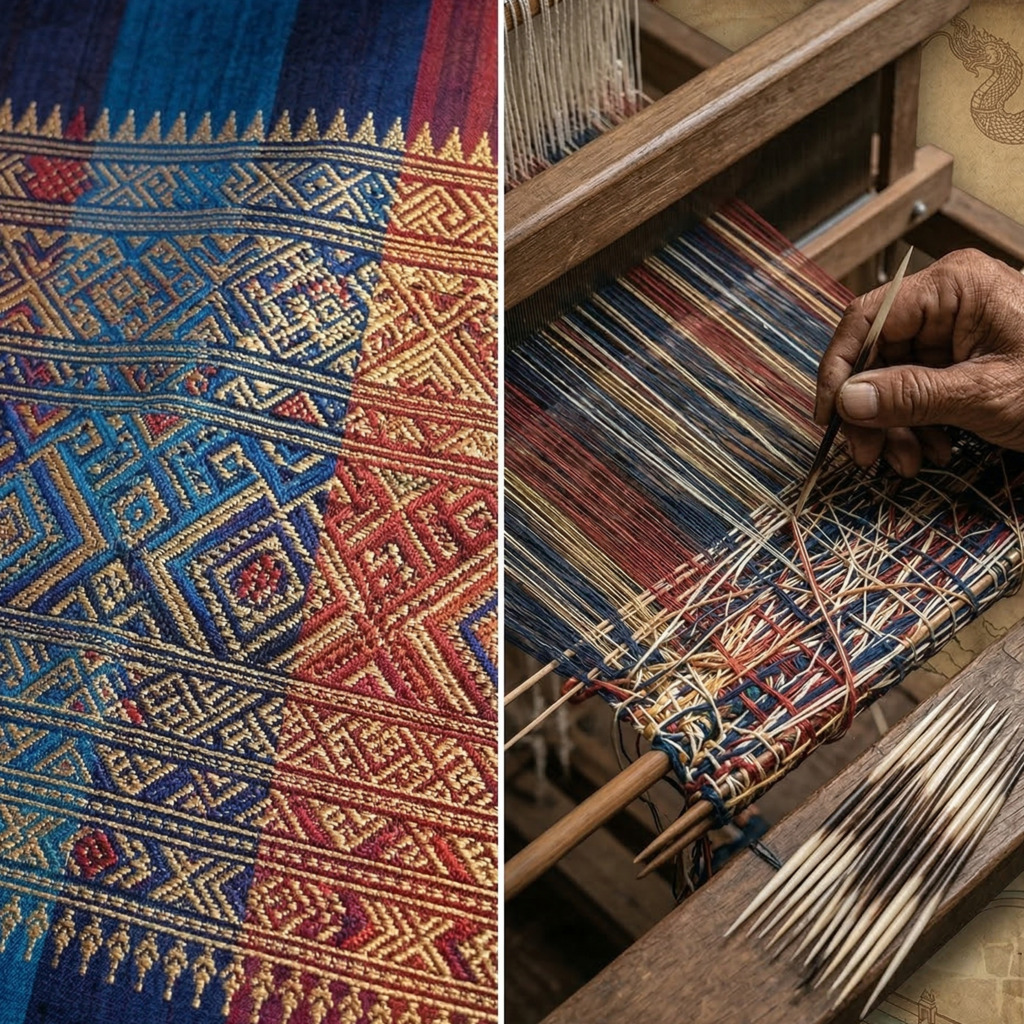
Further down the corridor, silk serves as a social resume. A traditional Lanna Pha Sin (sarong) is a tripartite document: the Hua (head), Tua (body), and Teen (foot).
The Suitor’s Secret Test
In the 19th century, at temple fairs, a young man wouldn’t just look at a girl’s face; he would look at her hem. The Tin Jok (intricate hem) was a visual proof of her character. The technique itself is maddeningly complex. Unlike modern looms, Tin Jok requires the weaver to manually “pick” or “count” the threads using a porcupine quill. The weaver sits at the loom and works from the reverse side.
She cannot see the pattern she is creating until the piece is finished. She is essentially writing a 10,000-line script of thread, and a single mistake in the “count” ruins the entire garment.
The Pa Tueng Kilns: Celadon and the “Ming Gap”
The heritage of San Kamphaeng extends beneath the soil to the ancient Pa Tueng Kilns. Excavations have revealed that this district was a global player in the ceramic trade as early as the 14th century.
The Geopolitical Pivot
During the “Ming Gap” – a period when the Chinese court restricted ceramic exports to the world – the kilns of San Kamphaeng and Sukhothai stepped in to fill the void. Lanna wasn’t just a mountain kingdom; it was an export powerhouse. The signature of this era is Celadon, a high-fired stoneware characterised by its sea-foam green, crackled glaze.
This glaze is made from a mixture of black clay and wood ash from the Hok Fah tree. When fired at 1,260°C, the ash melts into a glass-like finish. The “crackle” isn’t a flaw; it’s the “breath of the dragon” – a result of the glaze cooling faster than the clay body.
The Sattapan: Mapping the Buddhist Cosmos
Artisans today revive Sattapan Cosmology, a profound yet often overlooked Lanna craft. These seven – branched candle holders typically stand before a temple’s principal Buddha image. The intricate carvings represent the seven peaks of Mount Meru. This symbolic structure connects the earthly realm to the divine. The Sattapan is a physical map of Buddhist cosmology.
The seven branches represent the seven mountain ranges (Satta-paribhanda) that encircle Mount Meru, the axis of the universe. In traditional Lanna thought, lighting these candles is a ritual act of “ordering the world” – aligning the human realm with the cosmic moral order.
The true measure of the Lanna Creative Renaissance lies not in static museum exhibits, but in the living, breathing endurance of its material arts. This cultural reclamation is vividly manifested in the region’s ephemeral traditions, where ancient geometric principles and generational craftsmanship converge.
Nowhere is this high-stakes preservation more evident than in the annual Chiang Mai Flower Festival, an event that transcends standard tourism narratives to serve as a massive, community-led monument to Northern Thai sovereignty and artistic resilience.
By looking past the colourful surface of these living displays, we find a profound testament to how the strict design disciplines of the past continue to shape the contemporary creative identity of the North.
The Dual Frontiers: From Nimman to the Southern Corridors
The Lanna Renaissance is characterised by a dual geography. To the Northwest lies Nimmanhemin, the intellectual “remix” zone. However, to the South, in the districts of Pa Daet and Hang Dong, lies the “Production Frontier.”
The Nimman Remix: Gateway to the Mountains
In the Northwest, the focus is on a subculture economy. Designers here are stripping away the ornate complexity of the 19th century to find the “Lanna DNA.”
The Southern Bastion: Pa Daet and the Woodcarving Guilds
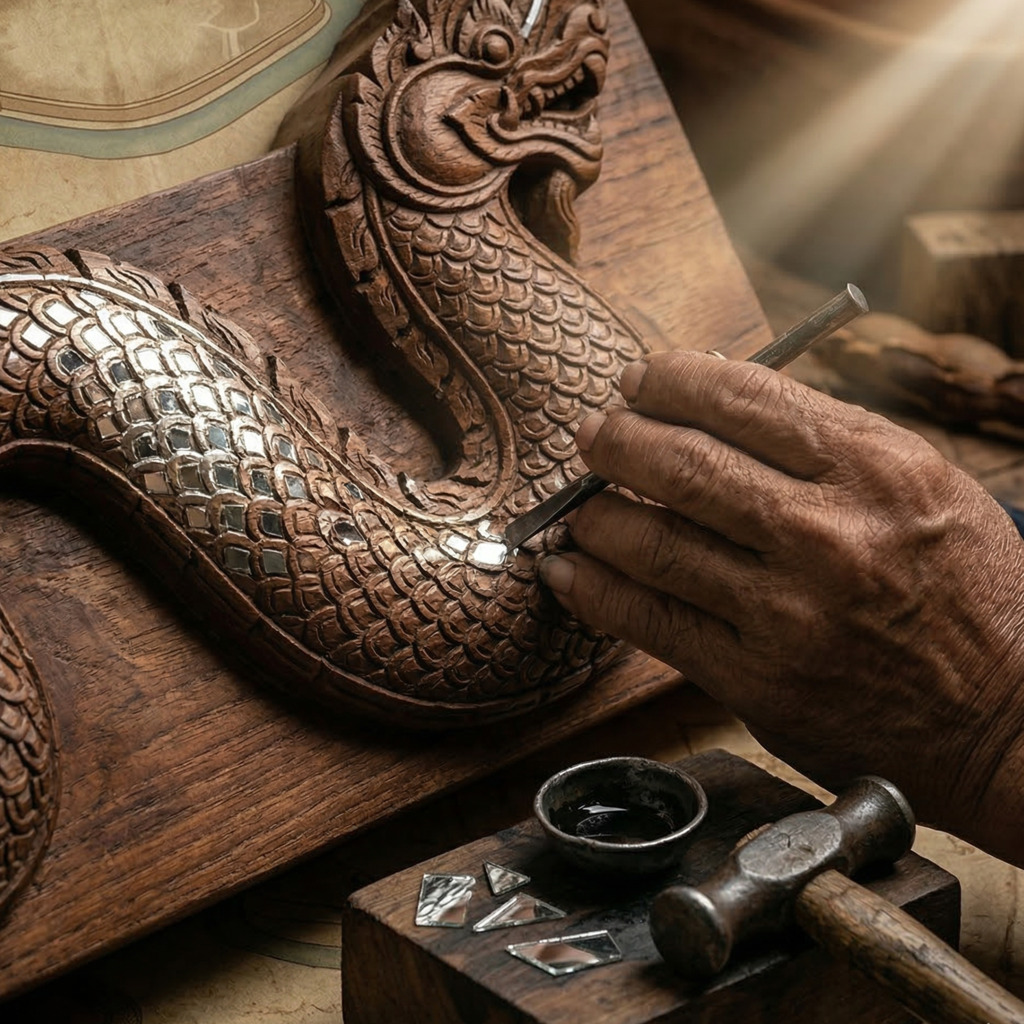
While Nimman designs, the South builds. Stretching from Pa Daet down toward Baan Tawai, this corridor remains the spiritual home of the woodcarving guilds.
The Anorak’s Deep-Dive: A Technical Glossary of Lanna
To truly appreciate the “Rose of the North,” one must learn the language of the maker:
Conclusion: The Resilience of the Rose
Chiang Mai’s true punch lies in its resilience. It survived being abandoned, being occupied, and now, being modernised. The Lanna Creative Pulse remains unbroken in galleries and sawdust-filled workshops. Visiting today reveals a city where valuable things are still made slowly by hand. This ultimate “hidden gem” refuses to trade its soul for speed.
Glossary of Terms
Wiang (City): The walled inner city historically reserved for the Chao (royalty) and the clergy. It served as the administrative and spiritual nucleus.
Ban (Village): The specialised artisan communities located strategically outside the city walls. This layout kept industrial craft byproducts (smoke, fumes) outside the main living quarters while maintaining a trade pipeline into the city.
Lanna: A historic northern Thai kingdom (centred around Chiang Mai) characterised by its 700-year-old culture, distinct architecture, and participatory craftsmanship.
Artisanship, Architecture & Crafts
Chasing: The technique of refining, smoothing, and detailing a metal design from the front. It is usually paired with Repoussé in Wua Lai silversmithing.
Khôm Rang Mod Som (“Ant’s Nest”): A highly intricate silversmithing motif found on metal panels (notably at Wat Srisuphan). It symbolises the microscopic, harmonious efforts of a community working together to achieve prosperity.
Mo Hom (Indigo Shift): Traditional natural indigo dyeing. Reclaimed by modern designers as a “healing luxury” due to the plant’s natural antibacterial and UV-filtering properties.
Pha Sin: A traditional Lanna sarong composed of a distinct tripartite structure: the Hua (head/top), the Tua (body/middle), and the Teen (foot/hem).
Repoussé: The metallurgical process of hammering metal from the reverse side to create a design in raised relief.
Saa Paper: A durable, non-woven textile crafted from the beaten inner bark of the mulberry tree. It naturally maintains its structural integrity even when wet.
Sattapan (Sattapan Cosmology): Ornate, seven-branched candle holders placed in front of a temple’s principal Buddha image. They serve as a physical map of Buddhist cosmology, with the branches representing the seven mountain ranges (Satta-paribhanda) surrounding Mount Meru.
Tin Jok: An incredibly complex technique used to weave the intricate hem (Teen) of a sarong. It requires the weaver to manually pick or count threads using a porcupine quill while working entirely from the reverse side. Historically, a finely crafted hem served as a “visual proof” of a young woman’s character to potential suitors.
Yok Dok: A specialised textile technique where the warp and weft patterns are “lifted” to create a distinct brocade effect. Setting up a Yok Dok loom requires weeks of complex “thread-mapping” to map out foot-pedal movements.
Ceramics & Trade History
Celadon: A high-fired stoneware fired at 1,260°C, renowned for its distinctive sea-foam green, crackled glaze. The glaze is made from a precise mixture of black clay and wood ash from the Hok Fah tree.
Crackle (“Breath of the Dragon”): The spiderweb-like fractured pattern intentionally created on Celadon glaze, caused by the glaze cooling and contracting faster than the ceramic clay body underneath.
Ming Gap: A historical period during which the Chinese court restricted ceramic exports. This geopolitical shift allowed Lanna kilns (like Pa Tueng) and Sukhothai to become global powers in the international ceramic trade.
Natural Chemistry & Processing Agents
Green Persimmon Fruit: A natural ingredient utilised by traditional umbrella makers as an adhesive/glue for securing Saa paper to frames.
Tamarind Bath: A boiling solution infused with natural tartaric acid derived from tamarinds. It is used as a gentle pickling agent to clean newly forged silver, neutralise soldering acids, and give traditional silver a signature blue-green patina.
Tung Seeds: Seeds whose oil is applied to paper parasols. The oil oxidises in the sun to form a flexible, waterproof, plastic-like polymer layer.
Traditional Healing & Rituals
Yam Khang: A traditional northern Thai wellness craft. The healer dips their foot in medicinal oils, presses it onto a red-hot iron ploughshare (khang), and uses the heated foot to massage the patient, invoking the “Fire Element” of Lanna medicine.