
Key Insights
The Chiang Mai Flower Festival is far more than a tourist parade; it is a high-stakes display of Lanna cultural pride and artistry. Over 48 sleepless hours, communities painstakingly hand-apply millions of blossoms to complex, sacred float architectures.
This fierce, intergenerational competition preserves ancient skills, celebrating regional biodiversity and the Buddhist philosophy of beautiful impermanence
Cho Fa: The bird-like finials that crown the ridges of Northern Thai temple roofs, symbolizing the mythical Garuda.
Lanna Kranok: The fluid, flame-like filigree patterns used to border gables and mirrors in traditional regional design.
Naga: A multi-headed serpentine water deity deeply tied to agricultural fertility, rain, and the guardianship of sacred spaces.
Himmapan: A mythical forest inhabited by fantastical creatures, such as the Kinnari (half-human, half-bird beings).
Damask Rose: A heavily petaled, intensely fragrant flower variety that serves as the delicate spiritual heart of Chiang Mai’s botanical identity.
Anicca: The fundamental Buddhist law of impermanence, which underpins the philosophy of creating fleeting, short-lived floral art
The standard travel narrative frames the Chiang Mai Flower Festival as a picturesque, slow-moving carnival. It presents a vibrant weekend of pleasant weather and pretty photo opportunities designed to lure tourists north. While not explicitly wrong, this perspective remains hollow. It misses the urgent, living pulse underneath.
Looking closely reveals a high-stakes, ephemeral monument to Lanna sovereignty, regional artistry, and communal pride. For three days in February, the historic Old City moat hosts a massive display of cultural resilience. This entire spectacle is wrapped in millions of fresh, dying blossoms.
The Architecture of the Floats: Sacred Space in Perishable Mediums
The centrepiece of the festival is Saturday morning’s Grand Floral Float Parade. To the untrained eye, these are just colourful parade entries. To anyone familiar with regional history, they’re scale replicas of sacred architecture and complex theological treatises built from organic matter.
Recreating the Lanna Wat
Northern Thai temple architecture is distinctly different from the glittering, stark-white or deep-red styles found in Bangkok and Central Thailand. Lanna style is characterised by its sweeping, low-slung, multi-tiered wooden roofs that seem to bow toward the earth rather than pierce the sky. Float designers meticulously recreate these structures using intricate frameworks of bamboo, wire, and carved styrofoam. Every architectural element must be accurately represented:
These architectural mockups are not merely painted; they are clad in a mosaic of texture. Every surface is covered with varying seeds, mosses, and petals to create shadows and depth.
Mythology in Bloom
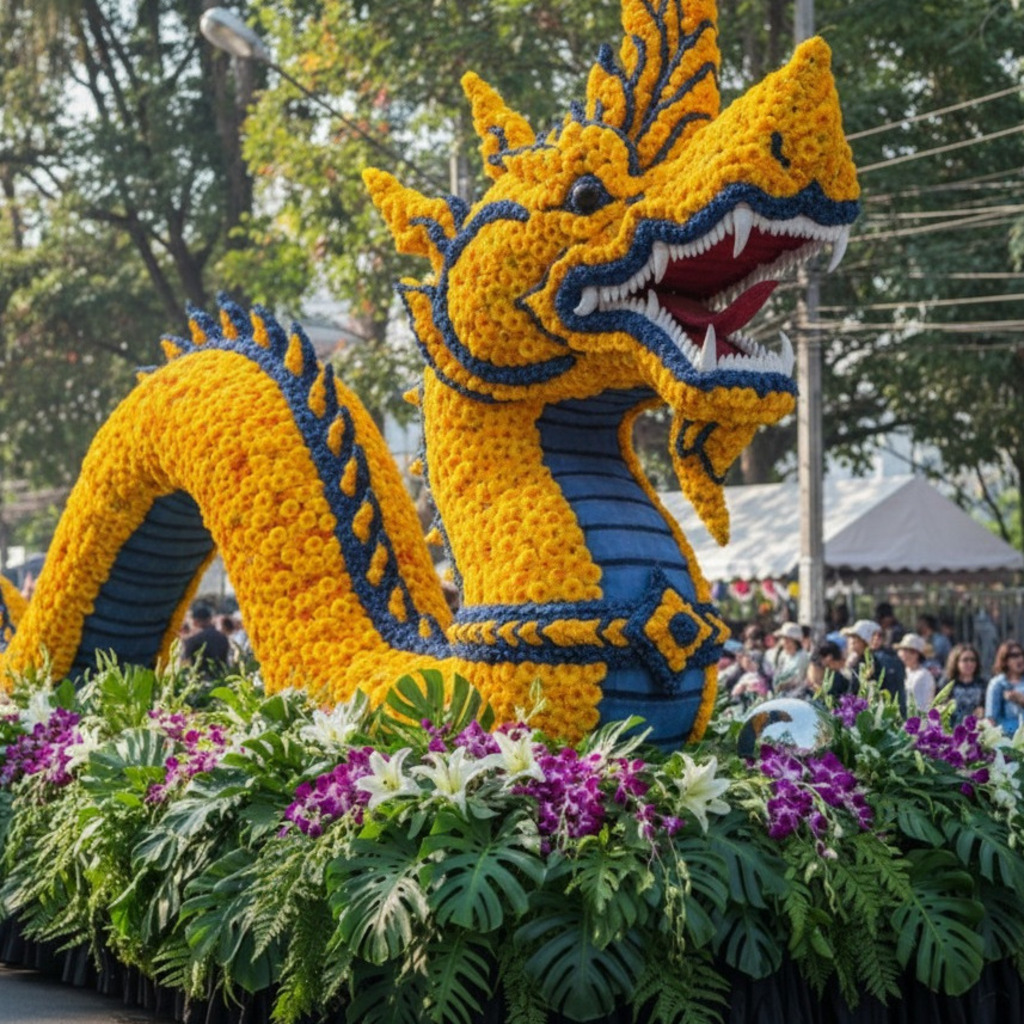
The floats act as mobile stages for Buddhist and animistic cosmology. The most prominent figure on almost every major float is the Naga – the multi-headed serpentine water deity.
In Lanna culture, the Naga is deeply tied to agricultural fertility, rain, and the guardianship of sacred spaces. Artisans use thousands of overlapping, glossy green leaves or individual marigold petals to recreate the shimmering scales of the great serpent, curved along the base of the vehicle.
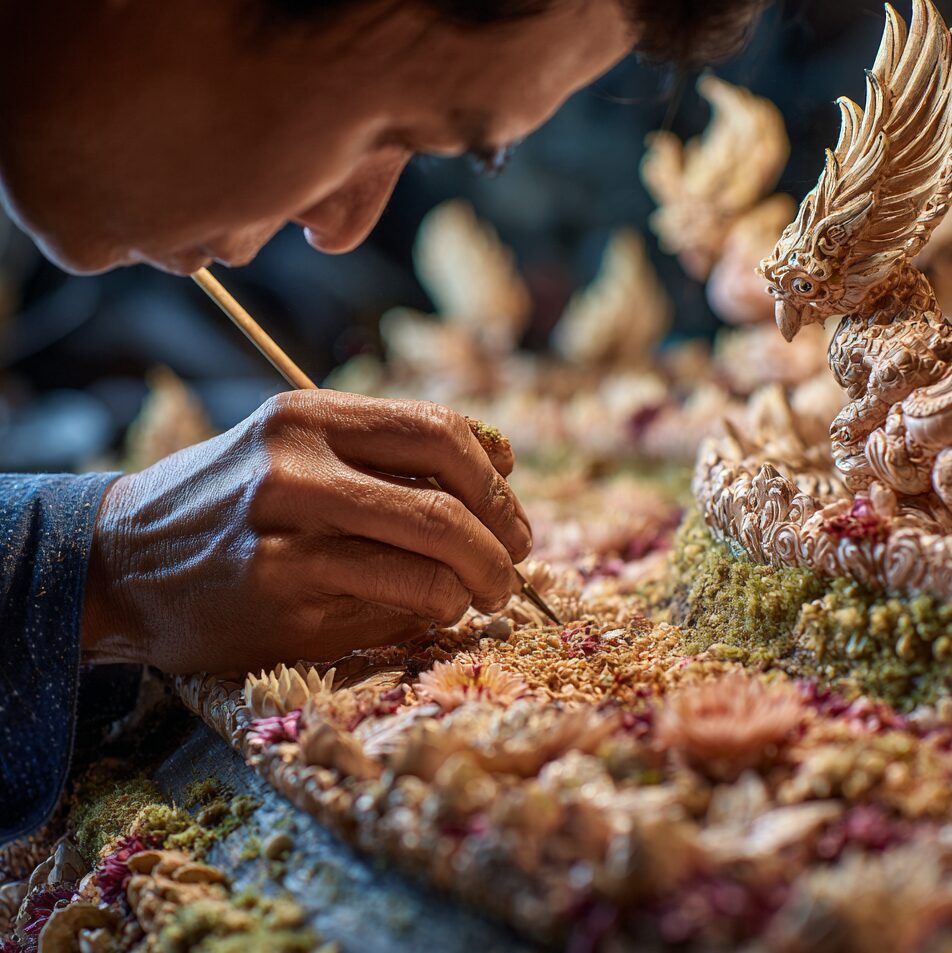
Alongside the Nagas are creatures from the mythical Himmapan forest – such as the Kinnari (half-human, half-bird beings). These figures are sculpted with astonishing anatomical precision, their feathers formed from the delicate bracts of bougainvillea or the velvety petals of purple orchids.
The 48-Hour Sprint
The true genius of these floats lies in the terrifying logistical reality of their construction. While the structural frameworks are built over months, the actual flower application cannot begin until roughly 48 hours before the parade.
Because the tropical sun will mercilessly wilt cut flowers, thousands of community volunteers, monks, students, and elders gather in temple courtyards and warehouses for a gruelling, sleepless two-day marathon.
Using tiny bamboo pins, thread, and organic adhesives, they hand-apply millions of fresh blossoms one by one. The scale of this labour is immense; a single large float can easily require over a million individual blooms.
The air in these staging areas is thick with the scent of crushed stems, wet moss, and the collective anxiety of an entire neighbourhood racing against a ticking clock.
The Social Engine: Inter-District Rivalry and Civic Pride
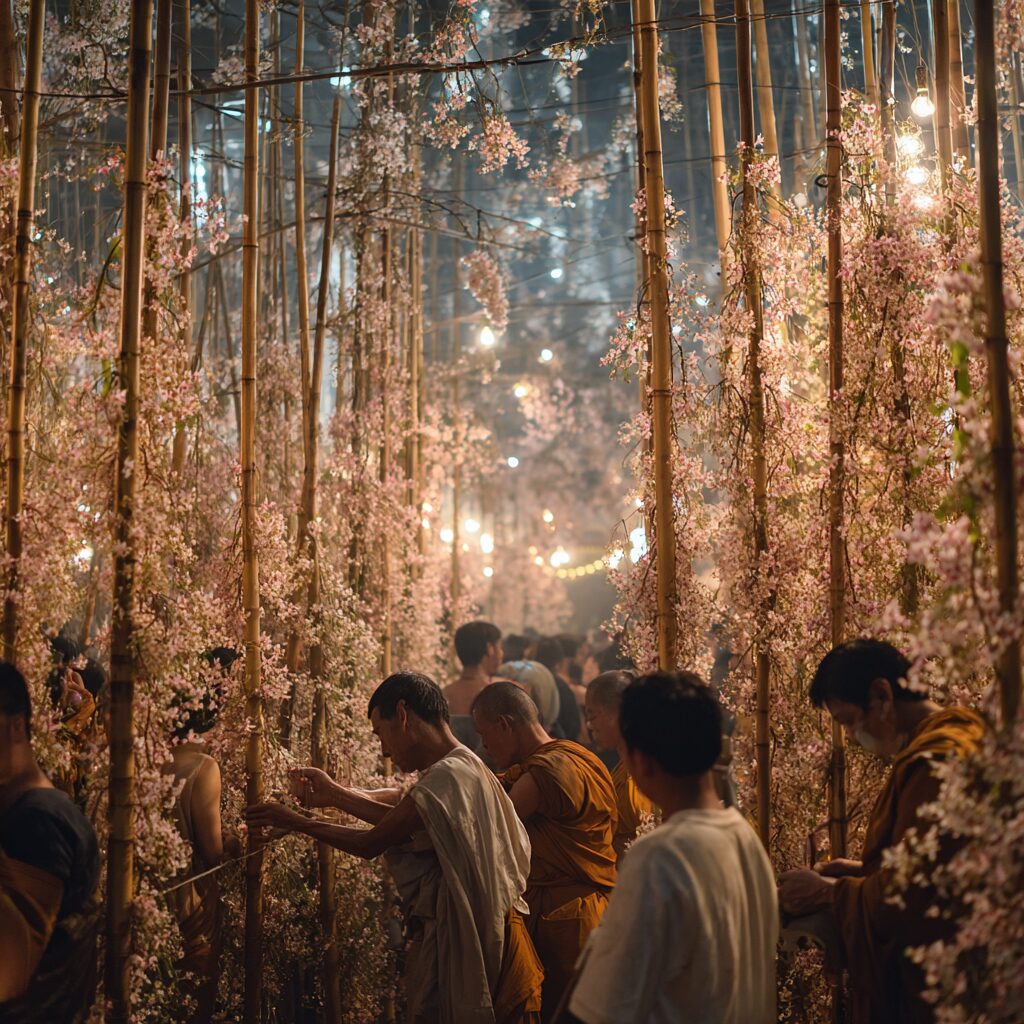
The festival is powered by intense, underlying social competition. The floats and horticultural displays are not corporate marketing projects; they are the physical manifestation of community honour.
The Stakes of the Competition
The Grand Floral Float Parade is a fiercely contested battleground. Entries are divided into distinct categories, including the highly coveted “Most Beautiful Float” and “Best Cultural Presentation.” The competitors are local amphoe (districts within Chiang Mai province), agricultural cooperatives, universities, and traditional neighbourhood collectives.
Winning a trophy from the royal family or municipal government brings massive civic prestige. A win validates a district’s status as a keeper of authentic culture and a powerhouse of agricultural skill. Conversely, a poor showing is a public embarrassment for the local leadership.
Passing Down the Kranok
Because the stakes are so high, the festival serves as a critical mechanism for cultural preservation. The specialised skills required to draft, carve, shape, and decorate these floats are highly complex. They require a deep understanding of traditional Lanna art motifs.
During the preparation months, master craftsmen embed themselves in local schools and community centres. The masters teach teenagers and young adults how to bend bamboo without snapping it.
They demonstrate how to preserve moisture in a floral block. Finally, they reveal the strict geometric symmetry required by Lanna design. This intergenerational bridge ensures that ancient artisanal techniques remain viable, functional skills rather than static museum displays.
This preservation of traditional motifs isn’t a stagnant repetition of the past, but part of a wider, modern cultural awakening taking hold in Northern Thailand. How float builders adapt delicate organic matter to ancient geometric principles mirrors the broader Lanna Creative Renaissance, a contemporary movement that bridges historic artisan guilds – such as the Wualai silversmiths and Bo Sang umbrella makers – with modern design innovation.
By transforming these age-old, village-born crafts into a high-stakes urban spectacle, the festival ensures that the structural and cosmological language of the Lanna kingdom remains a living, breathing component of Chiang Mai’s modern identity.
The Ecological Canvas: Chiang Mai’s Microclimate
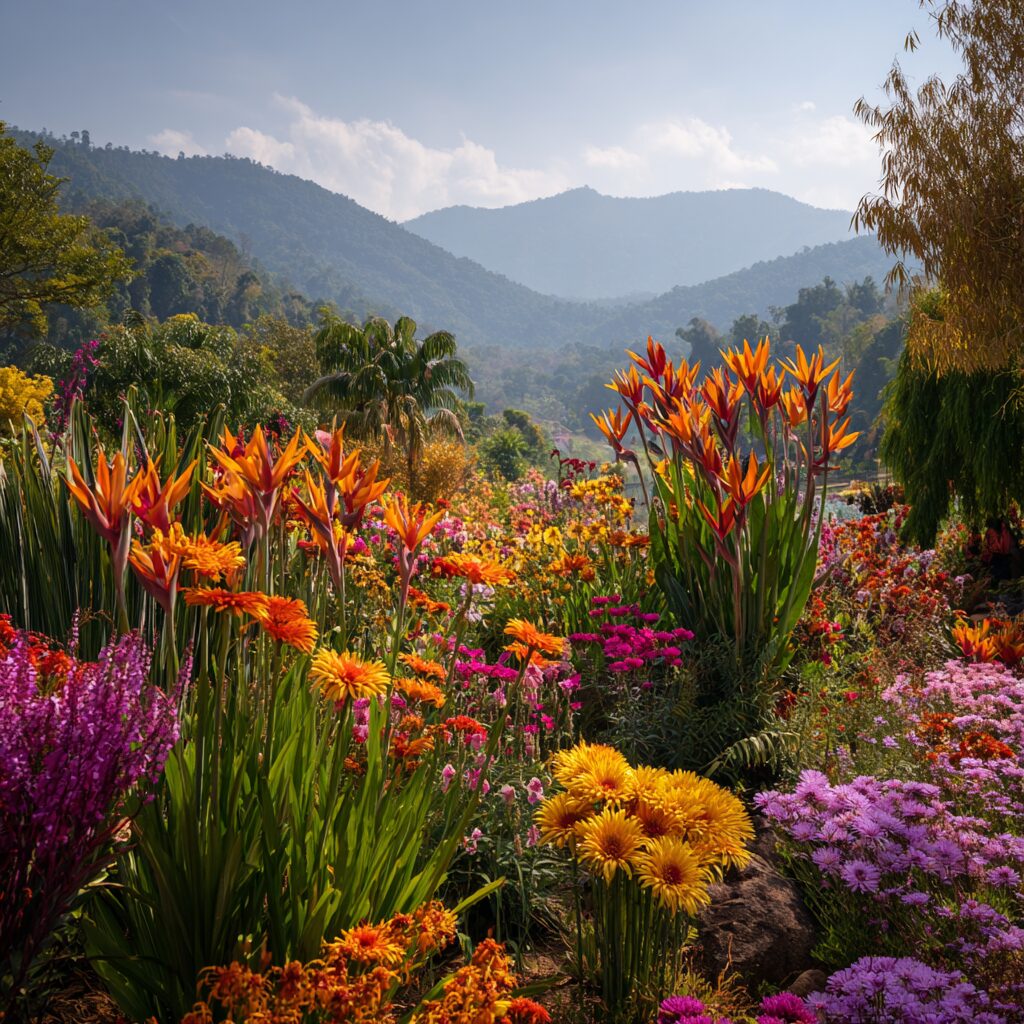
The festival’s timing and existence are dictated by a specific intersection of geography and meteorology. It is a celebration of a very particular ecological window.
The Valley’s Gift
Chiang Mai sits in a sweeping valley surrounded by the highest mountain ranges in Thailand. In December and January, the region experiences the northeast monsoon, bringing cool, dry air down from mainland Asia. Nighttime temperatures drop significantly, creating a temperate microclimate completely distinct from the sweltering heat of Bangkok.
By early February, this climate produces a spectacular phenomenon: temperate European flora (like chrysanthemums, tulips, and lilies) bloom simultaneously alongside native tropical varieties (such as standard Vanda orchids and bird-of-paradise). The festival is a celebration of this precise agricultural bounty.
The Iconography of the Damask Rose
While millions of yellow marigolds form the foundational colour blocks of the floats, the true spiritual heart of the festival belongs to the Damask Rose. Chiang Mai’s historic moniker is “The Rose of the North.”
For centuries, communities in the valleys of Chiang Mai have cultivated the Damask Rose, a heavily petaled and intensely fragrant variety. Because this notoriously temperamental and delicate flower requires careful handling, artisans never use it for broad background colour in traditional float construction.
Instead, they reserve the Damask Rose for the design’s key focal points – the robes of a carved Buddha, the crown of a deity, or the centre of a sacred mandala. This deliberate inclusion explicitly nods to the old kingdom’s pre-modern botanical identity.
Conclusion: The Beauty of the Fleet Art Form
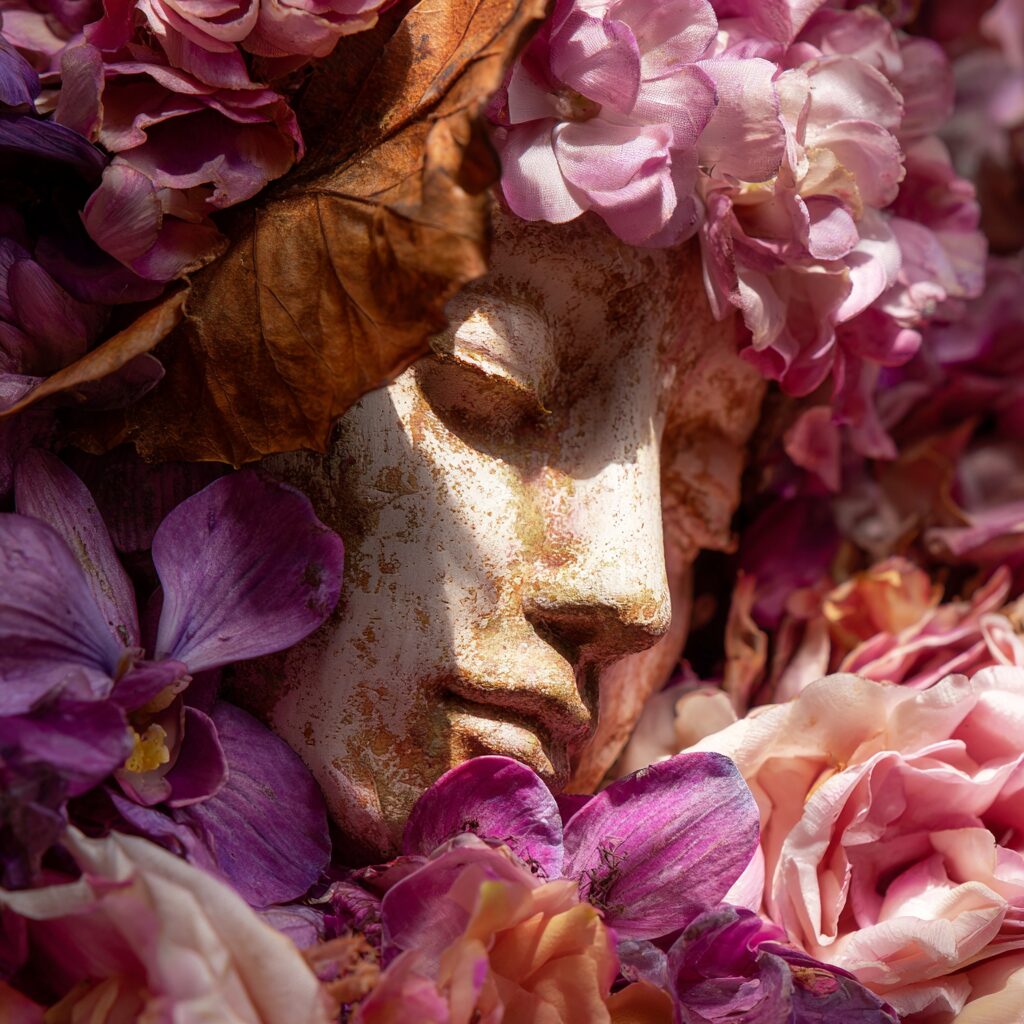
Ultimately, the deepest layer of the Chiang Mai Flower Festival is its philosophical resonance with the very culture that birthed it. Northern Thai Buddhism is deeply rooted in the concept of Anicca – the fundamental law of impermanence.
A community will spend tens of thousands of dollars, log thousands of hours of collective labour, and lose days of sleep to create an object of staggering, unmatched beauty.
Yet, within 48 hours of the parade’s conclusion, the tropical heat takes its toll. The petals brown, the leaves curl, the scent turns from sweet to compost, and the majestic Nagas and pristine temples are dismantled and discarded.
There is no permanence to the art. The value is entirely in the act of creation, the strengthening of community ties, and the temporary manifestation of devotion. It is a stunning visual reminder that in Lanna culture, the most beautiful things are not those that are preserved in stone, but those that bloom brilliantly and fade away.