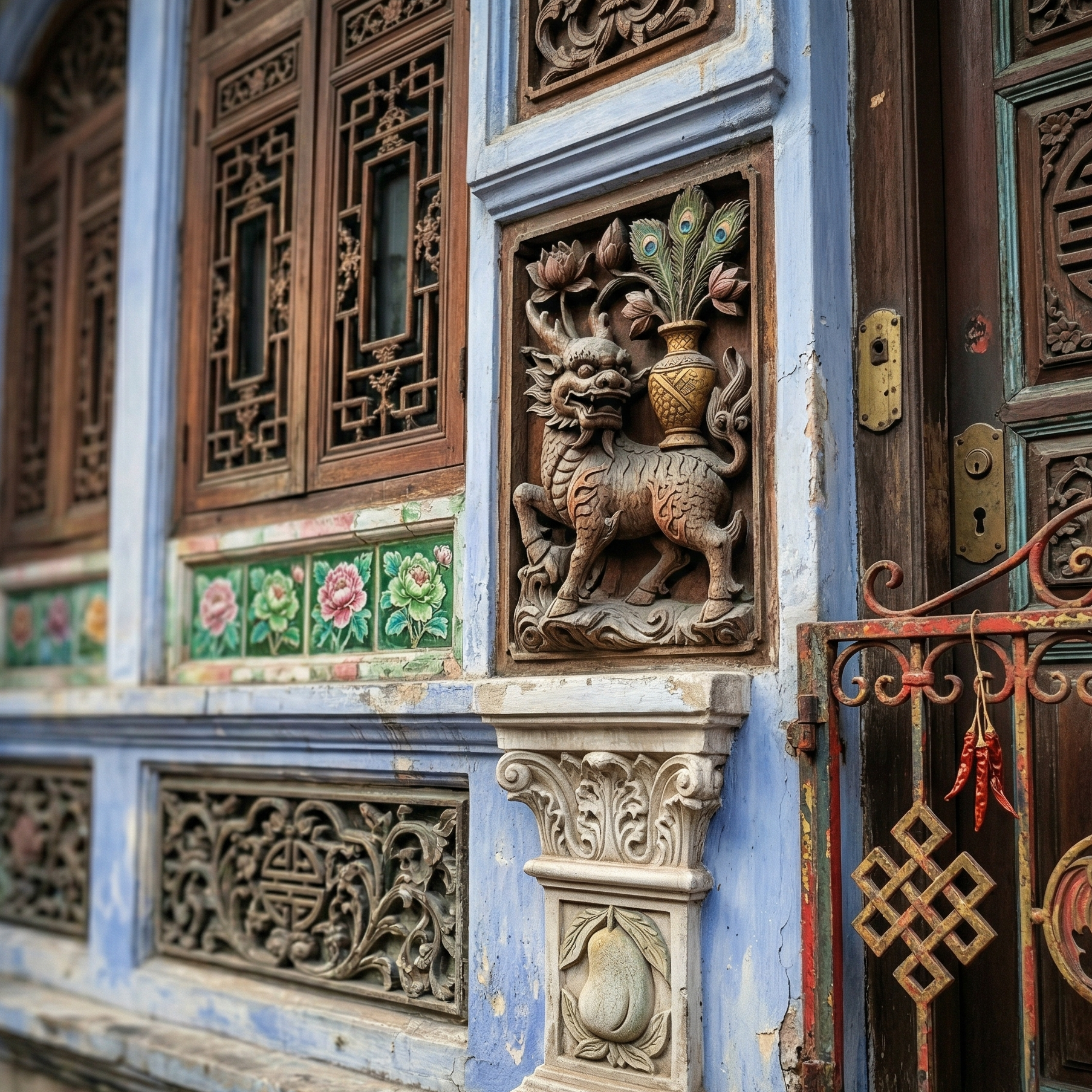

The rain in George Town doesn’t merely fall; it strikes with tropical fury. Inside the Cheong Fatt Tze Mansion, known globally as the “Blue Mansion”, this deluge is an invitation. Water cascades from sloped timber roofs. It funnels into the central courtyard with a rhythmic roar.
To the 19th-century tycoon who built it, it was a calculated harvest of cosmic energy. But to the uninitiated, it was simply clever drainage.
The House That Breathes
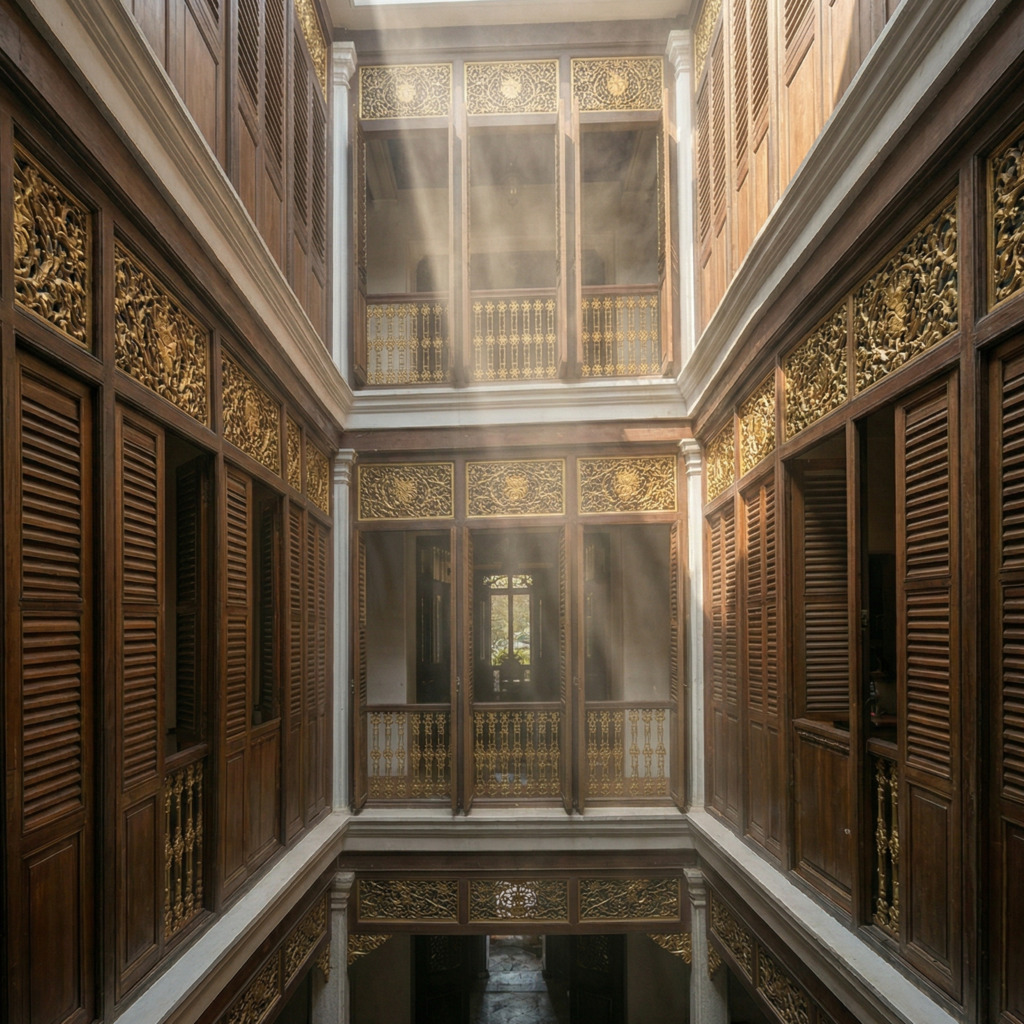
In the heritage hearts of Penang and Phuket, the grand Chinese mansion is a living organism. Its lungs are the Thian Chnee, or Sky Well. These open-air courtyards sit at the centre of the floor plan. They defy the oppressive heat of the Malay Peninsula.
Old builders in the Straits Settlements understood a fundamental truth. A closed house is a dead house. They designed these spaces to “inhale” the cool morning air. As the sun climbs, the warm air rises and escapes through the roof. This creates a natural vacuum. It pulls a constant breeze through ornate floor-to-ceiling shutters.
”You can feel the house sighing on a hot July afternoon,” says one local conservator. This is the first secret of the courtyard. It’s an architectural air conditioner that never requires a plug. The masonry itself acts as a thermal mass. It stays cool while the street outside bakes.
The Physics of Fortune
Feng Shui is often dismissed as mere superstition. However, in the grand mansions of Phuket’s Old Town, it reveals itself as a masterclass in environmental psychology. The central courtyard acts as an “impluvium.”
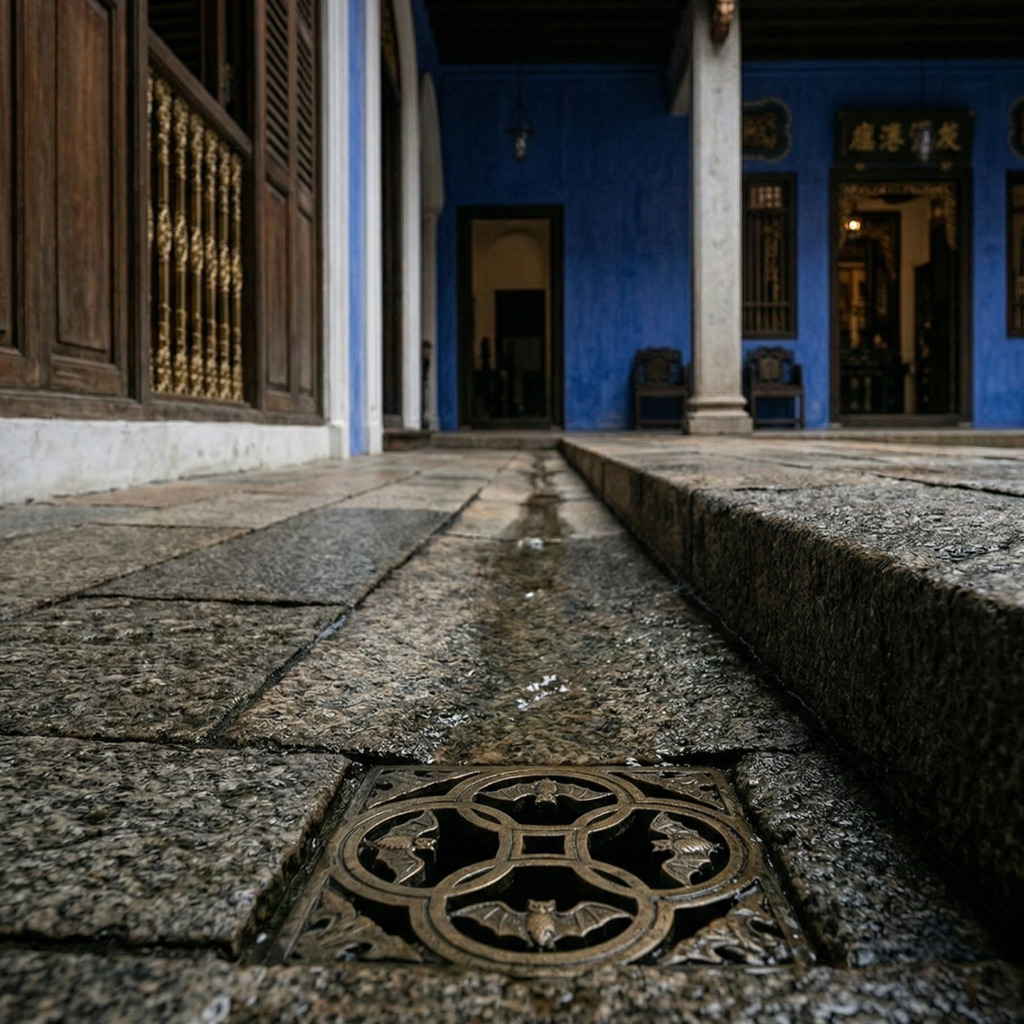
In traditional Chinese belief, water is associated with wealth. When rain enters the Sky Well, it must not escape too quickly. The granite floors are subtly pitched toward specific drainage points. These are never straight lines.
Legend has it of a merchant in Phuket who obsessed over the flow of his courtyard. He believed that if water rushed out, his gold would follow. He installed “money traps.” These were small, decorative obstructions in the pipes. They slowed the water’s exit. This ensured the family’s prosperity remained “pooled” within the walls.
The Vertical Axis: Heaven and Earth
The design of a Straits Chinese mansion is a sophisticated exercise in “capturing” energy. The central courtyard serves as the literal and figurative heart of the home. It acts as a bridge between the celestial and the domestic.
By leaving the centre of the house open to the sky, the architecture creates a direct line to the heavens. This allows Qi, or life force, to descend into the residence. It’s a vertical axis of power.
The interaction of the elements here is vital. Sunlight hits the granite. Rain feeds the air. Wind clears the stagnant heat. The house becomes a microcosm of the natural world. It is a sanctuary from the urban chaos outside.
Spatial Hierarchy and the “Three Halls”
In a similar way to the layouts of the Vernacular Mansions of SE Asia, they follow a strict progression of privacy. It moves from the public street to the private ancestral core.
| Section | Symbolic Meaning |
| Outer Hall | The “Heart”, usually where the ancestral altar is kept, is protected by the layers of the house. |
| The Courtyard | The Transition: a neutral zone where the elements interact. |
| Inner Hall | The “Heart”,; usually where the ancestral altar is kept, is protected by the layers of the house. |
This hierarchy is social as much as it is spiritual. Guests were admitted only as far as their status allowed. A common trader might never see past the Outer Hall. A close relative would be invited into the courtyard for tea. Only the family truly knew the Inner Hall.
The Invisible Shield
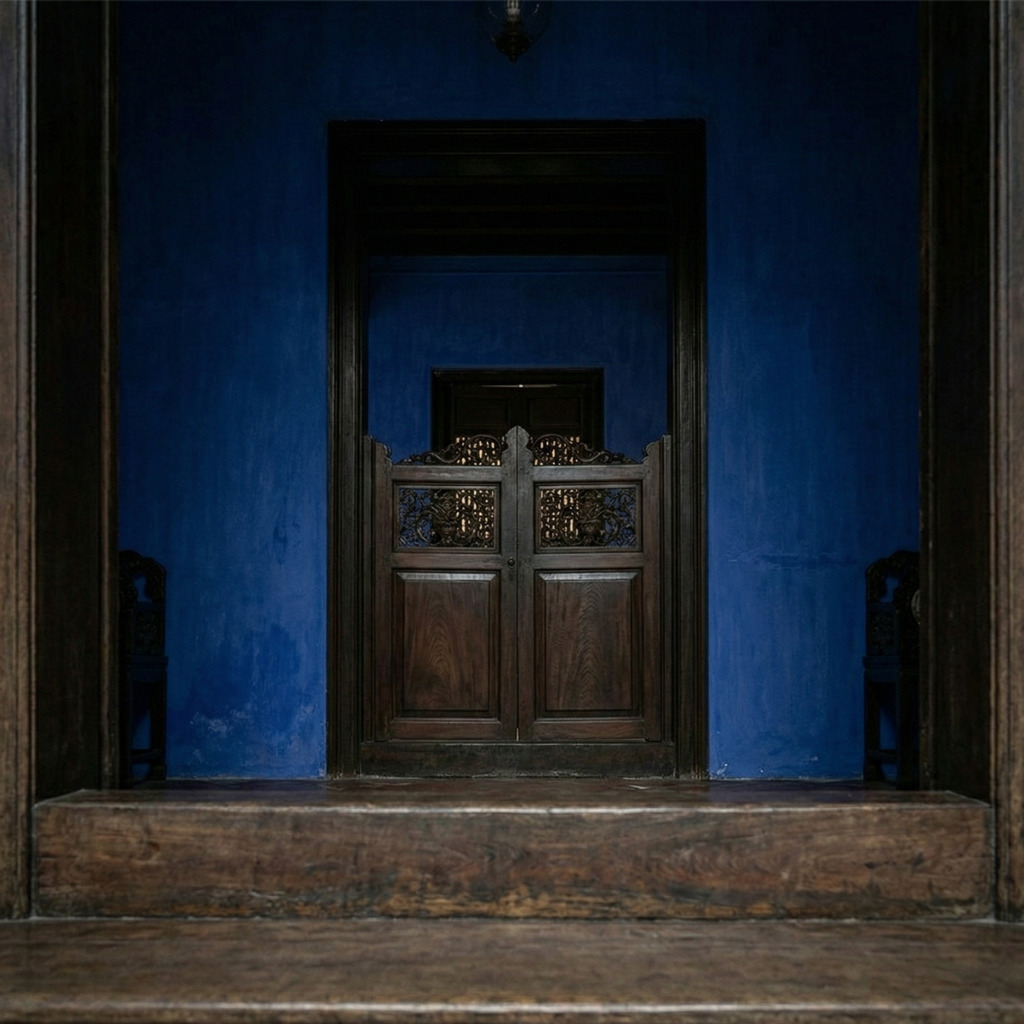
Step across the threshold of a Penang mansion, and you’ll notice a high wooden sill. This is the Pintu Pagar. Most visitors stumble over it. That is exactly the point.
Traditional lore suggests that malevolent spirits, or Gui, travel only in straight lines. They cannot hop or pivot easily. The high sill acts as a spiritual hurdle. It forces the human guest to pause and step mindfully. It supposedly blocks the “straight-line” energy of bad luck.
Once inside the courtyard, the protection continues. Look up at the eaves. You’ll see carved bats peering down from the gilded brackets. In the Hokkien dialect, the word for “bat” sounds identical to the word for “fortune.” Five bats carved together represent the “Five Blessings.” These are longevity, wealth, health, love of virtue, and a peaceful death.
The Blue Mansion: A Study in Indigo
In Penang, the Cheong Fatt Tze Mansion stands as a monument to indigo. The lime-wash walls reflect a deep, regal cobalt. This colour was a massive flex of 19th-century wealth.
Indigo was an expensive import. Using it on such a scale signalled immense power. But the choice was also practical. The lime-wash allowed the masonry to “perspire.” This prevented the damp rot that plagues tropical buildings.
The blue walls also softened the glare of the tropical sun. Within the courtyard, the light becomes ethereal. It feels underwater. This cooling psychological effect was intentional. It lowered the blood pressure of everyone inside.
Phuket: The Red Haired Houses
Four hundred kilometres north in Phuket, the Ang Mor Lao tell a different story. These mansions were built by tin barons who looked toward Europe. “Ang Mor” translates literally to “Red Hair,” referring to the British and Portuguese influence.
Their courtyards feature Romanesque arches. They have colourful floor tiles from Italy and Greece. Yet, despite the Victorian flourishes, the heart remains Chinese. The Phuket courtyard is often more intimate.
It serves as a private family theatre. Here, the matriarchs would sit in the shade. They would peel pomelos and watch the sky. The fusion of styles created a unique identity. It was neither fully East nor fully West. It was uniquely “Straits.”
The Ancestral Core
Beyond the courtyard lies the Inner Hall. This is the most sacred space in the mansion. It’s where the ancestral tablets reside. The courtyard acts as a buffer for this room.
It filters the noise of the street. It softens the glare of the sun. By the time you reach the altar, the air is still. The light is diffused. This transition is intentional. It moves the resident from the chaos of the marketplace to the peace of the family’s past.
One descendant of a Phuket tin merchant recalls childhood summers spent in the “Middle Hall.” “The courtyard was our clock,” he says. “We knew it was midday by the square of light on the tiles.” The house taught them the rhythm of the seasons.
The Material Language of Feng Shui
The materials used in these courtyards were never accidental. Granite was chosen for the flooring because it represented the Earth element. It provided stability.
Intricate wood carvings represented the Wood element. This signified growth and life. Gilded accents brought in the Metal element. The central open space invited the Air. The rainwater provided the Water.
When all five elements are balanced in the courtyard, the house is “harmonious.” A balanced house led to a balanced family. It was a physical manifestation of a moral philosophy.
The Social Life of the Courtyard
The courtyard was not just for spirits and aesthetics. It was a functional workplace. In the mornings, the space hummed with activity.
Servants would scrub the granite. Kitchen staff might prep vegetables in the shade. Children played near the water basins. It was the only part of the house where everyone crossed paths.
It provided a “view” for those confined to the home. In the 19th century, women of high-standing families rarely left the mansion. The courtyard was their window to the world. They watched the clouds pass. They listened to the birds. It was their private piece of the sky.
The “Green” Wisdom of the Past
Modern architects are now looking back at these old mansions. The “Sky Well” is a masterclass in passive cooling. It requires no electricity. It creates no carbon footprint.
In the 1800s, builders did not have the luxury of air conditioning. They had to outsmart the sun by using thick walls and high ceilings. They used the “stack effect” of the courtyard to move air.
Today, we call this “sustainable design.” To the builders of Penang and Phuket, it was simply common sense. They lived in harmony with the climate rather than fighting it.
The Hidden Gutter Systems
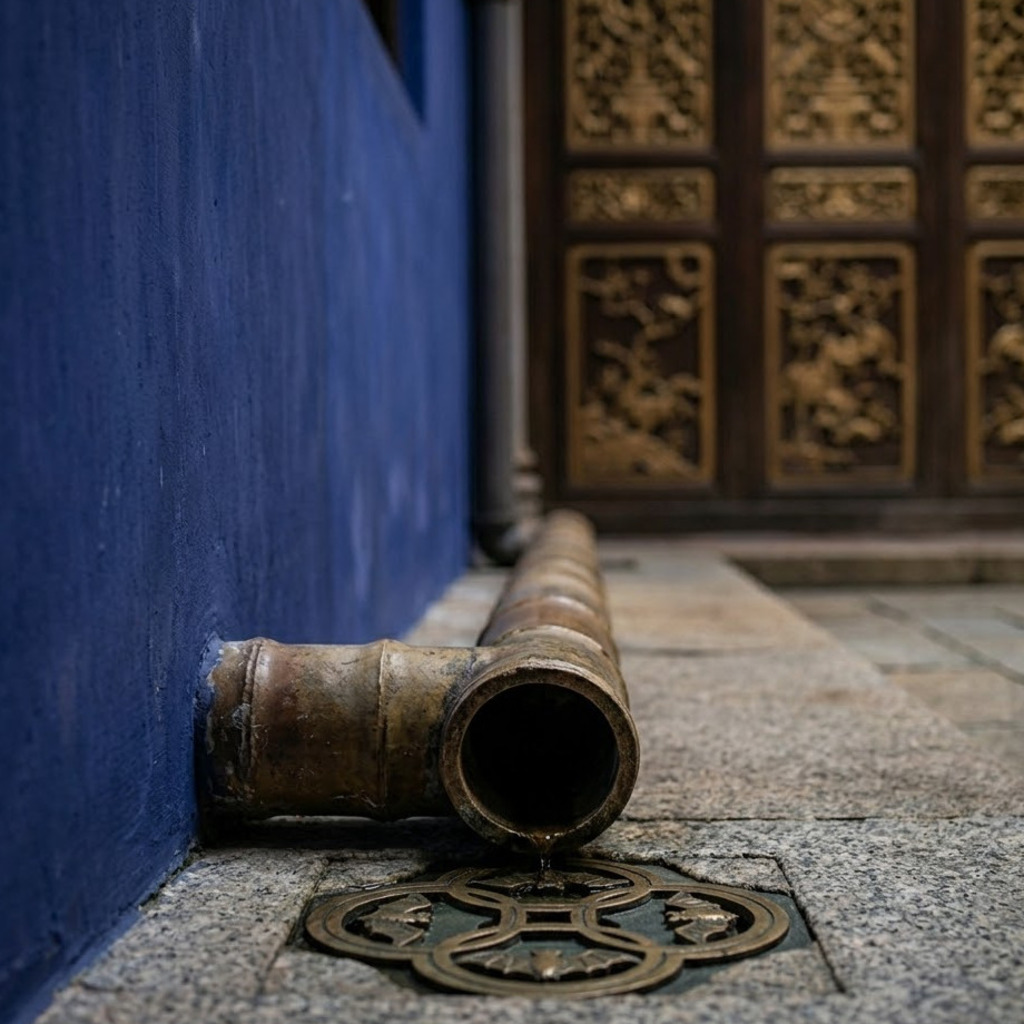
In George Town, the “Five Foot Way” is famous. But inside the mansion, the guttering is the secret hero. These were not plastic pipes. They were ceramic, often shaped like bamboo.
The placement of these gutters followed strict Feng Shui geometry. They ensured that water never splashed the central wooden pillars. If the pillars rotted, the family’s support system was seen as crumbling.
Maintenance was a ritual. Every year before the monsoon, the patriarch would inspect the Sky Well. To ignore the drains was to invite financial ruin. It was a physical manifestation of fiscal responsibility.
The Acoustic Soul
A courtyard house has a specific sound. It is different from a modern apartment. In the morning, the sound of a broom on granite echoes. It wakes the house gently.
During the rainy season, the courtyard becomes a percussion instrument. The different heights of the roofs create different notes. It is a natural symphony.
This acoustic openness kept the family connected. You could hear a laugh from the kitchen. You could hear a whisper from the balcony. It discouraged secrets. It encouraged a shared family life.
The Symbolism of the Lotus
Many courtyards feature a central stone basin. This is often filled with lotus flowers. The lotus is more than a decoration.
It represents purity. It grows from the mud but remains unstained. For the merchant class, this was a moral reminder. They lived in the “mud” of the business world. But at home, in the courtyard, they must remain pure.
The water in the basin also acted as a mirror. On clear nights, the moon would reflect in the water. This “brought the moon into the house.” It was a way to ground the celestial within the domestic.
The Craftsmanship of the Frieze
Look at the walls surrounding the courtyard. You will see intricate plasterwork. These friezes often depict scenes from Chinese mythology.
You might see the Eight Immortals. You might see a dragon chasing a pearl. These were not just for show. They were educational tools. Grandparents would sit in the courtyard and tell stories based on the carvings.
The courtyard was the family’s first classroom. It taught history, morality, and culture. Every carving had a lesson. Every symbol had a story.
The Geometric Balance
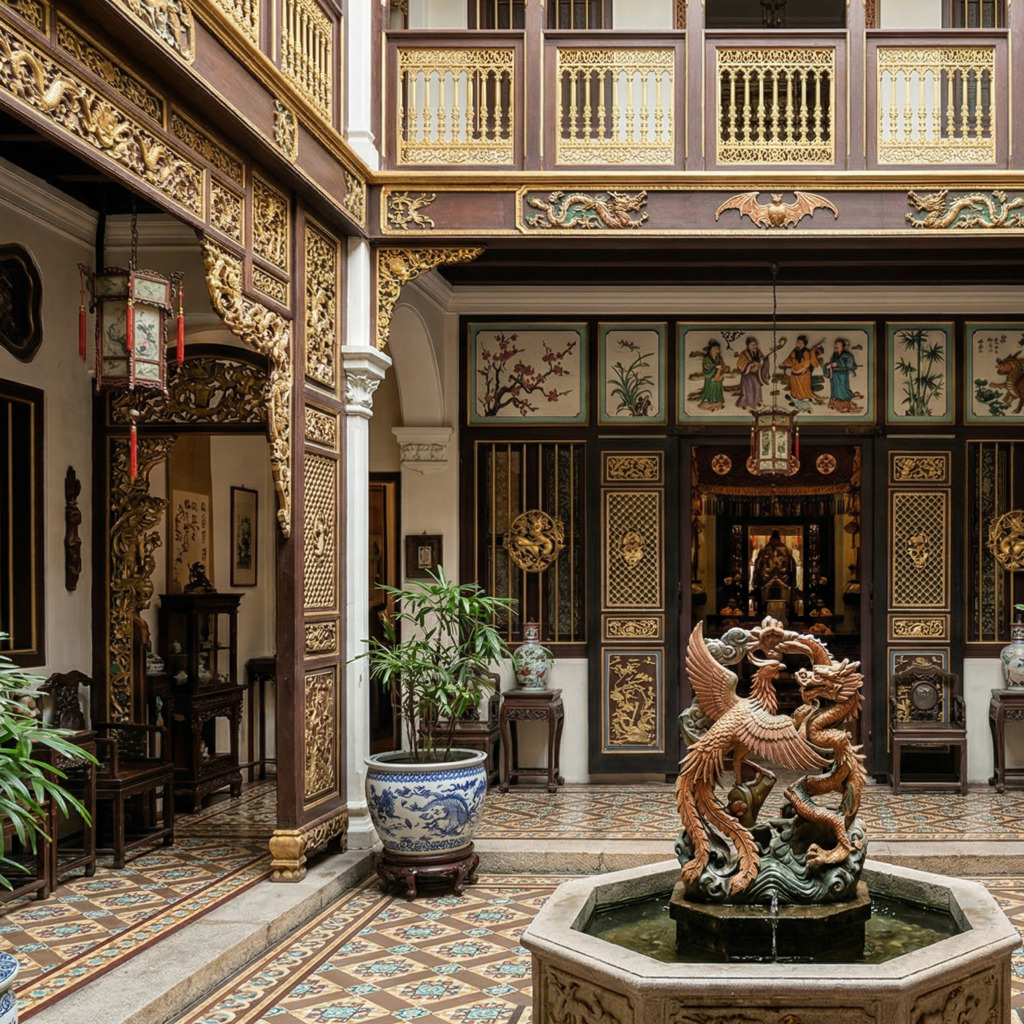
The courtyard is usually a perfect square or rectangle. In Chinese cosmology, the square represents the Earth. The circle represents Heaven.
When you stand in a square courtyard and look at the circular moon, you are at the meeting point. You are the link between the terrestrial and the divine. This geometric balance was thought to stabilise the mind. It provided a sense of order in a chaotic world.
Builders used the “Golden Ratio” long before it was a trend. They balanced the height of the walls with the width of the opening. This ensured the light was never too harsh.
The Modern Survival
Many of these mansions face a new threat: modernisation. Owners often want to seal the Sky Wells with glass. They want to install modern climate control. This kills the “breath” of the house.
However, a new wave of boutique hoteliers is fighting back. They’re restoring the open courtyards. They are clearing the blocked drains. They are proving that 19th-century wisdom still holds up in the 21st century.
Staying in one of these restored mansions is a sensory experience. You hear the city outside, but it feels distant. You feel the humidity, but the breeze keeps it manageable, making you part of a tradition that spans centuries.
The Legacy of the Straits
The hidden meanings of these mansions are not just about ghosts or gold. They are about harmony. They reflect a time when Southeast Asia was a melting pot of ideas.
The Chinese merchants brought their philosophy. The British brought their law. The local environment dictated the architecture. The result was something entirely new.
The courtyard is the symbol of this fusion. It’s open to the world yet deeply private. It is grounded in the earth but looks to the stars. It remains the most enduring feature of the Straits Chinese heritage.
A Sanctuary for the Soul
In our modern world of glass and steel, we have lost this connection. We live in sealed boxes. We fight the weather with machines.
The courtyards of Penang and Phuket offer a different path. They suggest that we can live with the elements and show us that light and rain are gifts, not problems. They remind us to look up.
When you sit in a courtyard at dusk, you feel a peace that no skyscraper can provide. You feel the history of the families who sat there before you. You feel the pulse of the city and the stillness of the stars.
The next time you walk through George Town or Phuket Old Town, look closer. Notice the blue walls. Observe the high door sills. Listen for the sound of rain hitting granite. You are standing in a machine designed for the soul
Straits Chinese Feng Shui Design FAQs
Why is the central courtyard called a “Sky Well” (Thian Chnee)?
In traditional Chinese architecture, the courtyard is viewed as a vertical axis connecting Heaven and Earth. Its name, Thian Chnee, literally translates to “Sky Well” because it “digs” into the sky to draw down celestial energy (Qi), light, and rainwater, much like a stone well draws water from the ground.
Is the open courtyard purely for religious or Feng Shui purposes?
While the spiritual symbolism is significant, the courtyard is a masterclass in passive cooling. It acts as the “lungs” of the house, utilising the “stack effect.” As hot air rises and escapes through the open roof, it creates a natural vacuum that pulls cool, fresh breezes through the ornate floor-to-ceiling shutters, keeping the mansion comfortable without electricity.
What is the significance of the high wooden sill (Pintu Pagar) at the entrance?
The Pintu Pagar serves a dual purpose. Practically, it keeps out street dust and wandering animals. Spiritually, it acts as a “spiritual hurdle.” Traditional lore suggests that malevolent spirits (Gui) travel only in straight lines and cannot easily hop or pivot; the sill forces guests to step mindfully, theoretically blocking “straight-line” bad luck from entering the sanctuary.
Why is the Cheong Fatt Tze Mansion painted such a vivid blue?
The iconic indigo lime-wash was a 19th-century “power move.” Indigo was an expensive, prestigious import that signalled immense wealth. Beyond the “flex,” the lime-wash was functional: it allowed the masonry to “breathe” or perspire, which prevented the damp rot and mould common in the humid tropical climate of the Malay Peninsula.
What is the difference between the mansions in Penang and the “Ang Mor Lao” of Phuket?
While both follow Chinese courtyard principles, Phuket’s Ang Mor Lao (literally “Red Haired Houses”) reflect a stronger European influence due to the tin barons’ ties to British and Portuguese traders. You will see more Romanesque arches and colourful Italian floor tiles in Phuket, whereas Penang’s mansions often lean more heavily toward traditional Hokkien craftsmanship and deep indigo aesthetics.