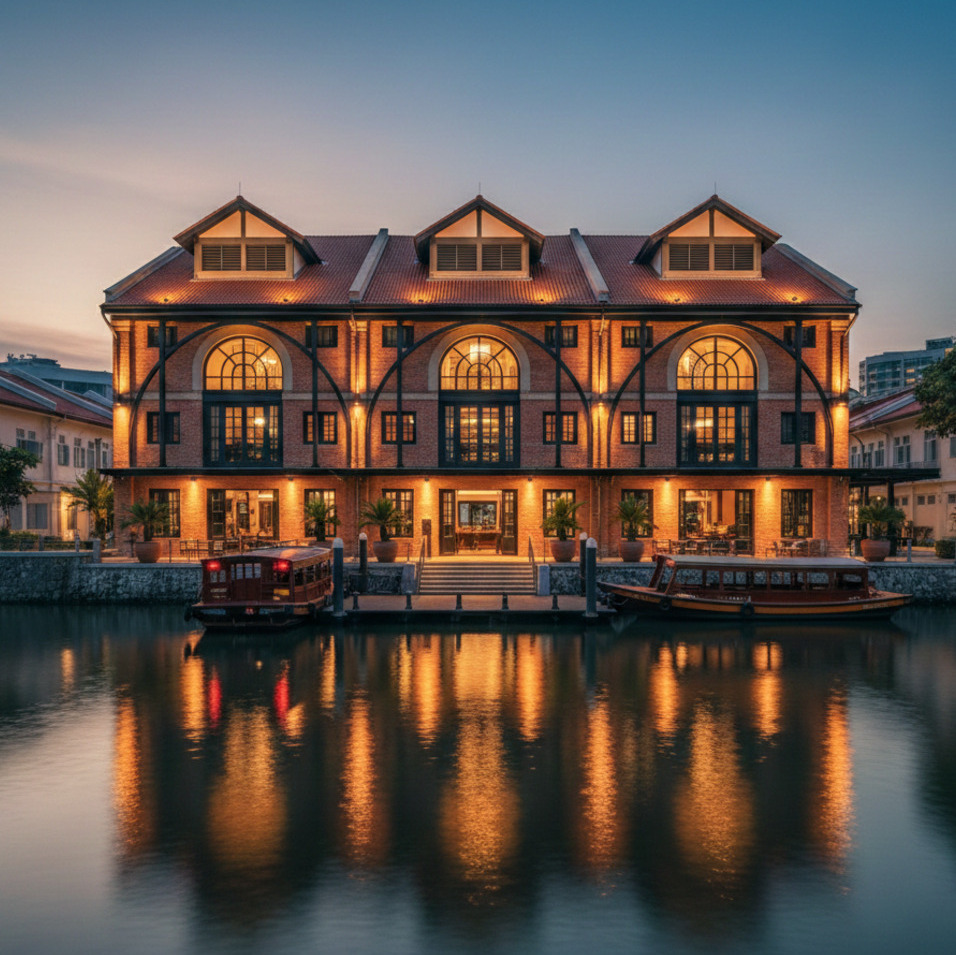

The salt air still bites at the lime-plastered walls of Weld Quay. A century ago, this air carried a different weight, smelling of sun-dried cloves and oily nutmeg—the literal heartbeat of the Straits Settlements. Today, the “machine for moving wealth” has been recalibrated through the art of adaptive reuse. The grand warehouses (godowns) of the past are being reborn as luxury stays, though the method of their rebirth varies from direct preservation to modern reinterpretation.
The Human Engine of the Quay
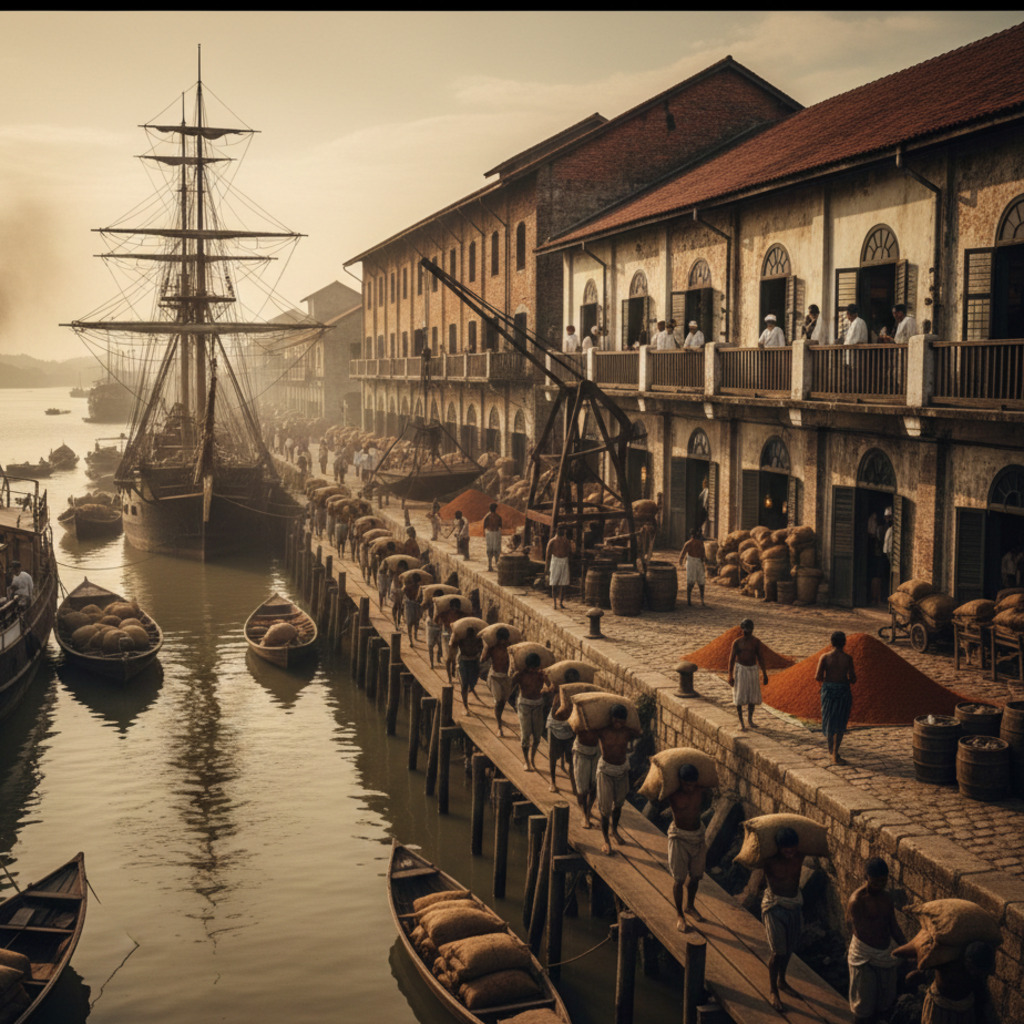
In the late 19th century, the quay was a pressure cooker of human ambition. Most labourers arrived from Fujian with nothing but a cloth bundle, finding work through clan associations. These men, known as coolies, carried sacks weighing over 60 kilograms on their bare backs, traversing narrow wooden gangplanks where a slip could mean losing cargo to the muddy tide.
While the labourers moved like clockwork, merchants watched from upper balconies in thin silk jackets, tracking every bag with a wooden abacus. The clacking of those beads was the rhythm of a rising empire. To ward off fever in the noon heat, men drank herbal tea from ceramic bowls and spoke a linguistic tapestry of Hokkien, Malay, and broken English. This was a high-stakes arena where global commodities were bartered in the shadow of the steamship. The quay wasn’t just a place of work; it was a theatre of survival where fortunes were weighed in peppercorns.
The Physics of the Godown: A Breathing Organism
A Penang godown is more than just a box of bricks; it is a breathing organism designed for the tropics. The walls are remarkably thick, utilising a mortar of lime, sand, and egg whites. This “eggshell” finish allowed moisture to migrate through the stone, keeping the interior cool even during monsoon heat. Unlike modern concrete, which traps heat, these ancient materials acted as a natural thermal regulator.
Structural integrity relied on dense Cengal and Merbau hardwoods. These woods sink in water and resist termite damage. Early carpenters used no nails, preferring mortise and tenon joints instead. This craftsmanship allowed buildings to sway safely during coastal storms. Above, V-shaped terracotta tiles overlap like fish scales. These gaps allow hot air to escape, providing passive cooling without electricity.
The Merchant Dynasties: Architects of Empire
Behind every stack of spices stood a powerful family whose wealth flowed from these dark warehouses into the city’s social fabric.
These families were civic leaders who built schools and hospitals, and today, their names remain carved in stone across the UNESCO zone. Their godowns were their fortresses, and the height of their walls often signalled the depth of their credit.
The Spice Trail: From Balik Pulau to the Rafters
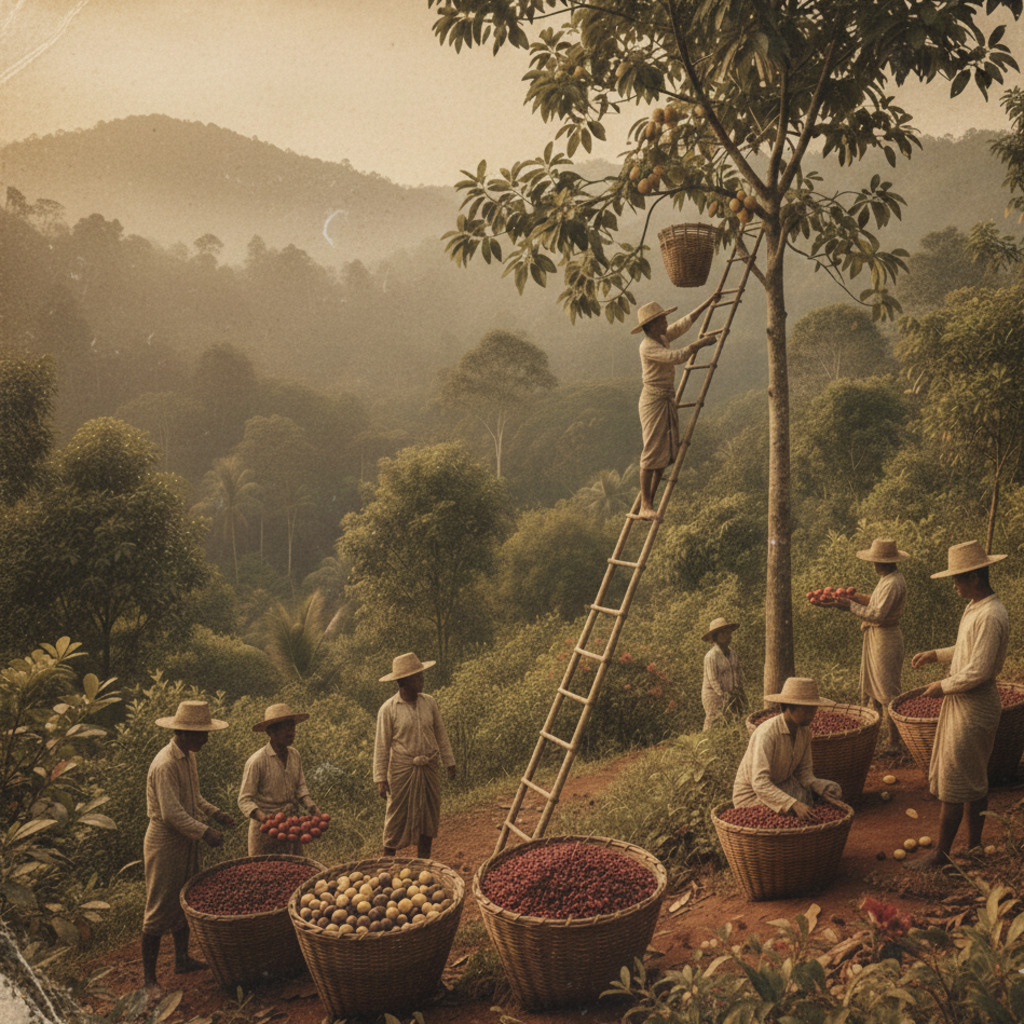
Spices were once more valuable than gold; a single sack of nutmeg could fund a small estate in Kent. The journey began in the hills of Balik Pulau or the Moluccas, where farmers harvested fruit with long bamboo poles. Inside the warehouse, the nuts arrived damp and raw. Labourers spread them across upper floors built from wide tropical planks with intentional gaps. These gaps allowed air to circulate from the ground floor up to the rafters.
Thick clove dust often caused labourers to suffer from “spiced fever.” They countered this lightheadedness by chewing betel nut. Red stains from this habit remain in warehouse corners today. These marks serve as permanent shadows of the men who worked there.
The Dark Years: Silence on the Waterfront
The 1970s brought a cold silence to the waterfront. Global shipping changed forever with the arrival of the container, and these massive steel boxes didn’t need old masonry godowns. Huge ports moved away from the city centre to deep-water terminals like North Butterworth, and the grand warehouses of George Town became redundant overnight.
Pigeons became the new tenants, their acidic droppings eating away at the lime plaster while tropical vines climbed the facades, their roots prying apart the historic brickwork. Some buildings became makeshift garages; others stored cheap plastic goods or recycled tyres. During this era, the quay was a place of ghosts. Property values plummeted, and many owners, seeing only old stone and rot, advocated for total demolition to make way for high-rise steel. They did not yet see the cultural capital hidden in the peeling walls.
The Restoration Chronicles: A Slow Surgery
Restoration is a slow form of surgery, requiring a level of patience that modern construction often lacks. It begins with stripping away decades of “modern” mistakes. One of the most common errors was the application of grey cement or plastic-based paints over the original lime plaster. Because cement is non-porous, it traps moisture inside the bricks, causing them to turn into dust—a phenomenon conservationists call “brick cancer.”
Workers must meticulously scrape away the cement by hand and reapply a mix of river sand and slaked lime. This mortar can take weeks to cure properly, breathing in rhythm with the humid air. During these projects, architects often find “foundation deposits”—porcelain tea sets or silver coins hidden under floorboards a century ago to bring luck to the merchant. One foreman in George Town recalls shifting a construction schedule to accommodate a colony of bats in the rafters, as bats symbolise “Fu” (good fortune) in Chinese culture. To disturb them would be to disturb the building’s spirit.
Case Studies in Adaptive Reuse: Regional Perspectives
The Prestige: The Architectural Dialogue
On Church Street Ghaut, The Prestige stands on the site of a former godown, but it’s a new-build project. It represents a “dialogue” rather than a restoration. While it doesn’t inhabit the old building, it pays homage to it by transposing a Victorian “glass and iron” industrial aesthetic into its structure. The former loading bay area is now a grand lobby, and the lighting is intentionally dim to mimic the natural, windowless shadows of the dark godowns designed to protect sensitive spices from the sun.
The Southern Boutique Hotel: Inland Merchantry
In contrast to the coastal giants of Weld Quay, the Southern Boutique Hotel represents the transition from a grand merchant residence to a functional inland godown. Not all warehouses were massive coastal structures; many were integrated into the deep “long-houses” of the merchant class on streets like Muntri or Chulia Street.
The Southern preserves the intimate, darker textures of these stores. Here, the story is not one of vast ocean-going ships, but of the “middleman” trade. Small cartloads of goods were moved from the quay to these protected inland shells for local distribution. The restoration highlights original timber floorboards and exposed brick, bridging the gap between domestic life and the relentless hum of 19th-century commerce.
The Warehouse Hotel (Singapore): Industrial Rebirth
In Singapore, the Warehouse Hotel (built 1895) on the Singapore River represents the most direct inhabitation of a warehouse shell. Once a centre for secret societies and illegal distilleries, the hotel retains its original triple-peaked roof and black industrial trusses. Like Penang’s structures, it required specialised lime putty because modern cement would have caused the heritage bricks to “explode.” It is a literal inhabitation of the industrial era, where the cavernous volume once used for stacking crates now provides a sense of airy luxury.
The Royale Chulan Penang: The Boustead Legacy
The Royale Chulan Penang offers a masterclass in “facadism” and large-scale reconstruction. Part of the hotel incorporates the original 1892 building belonging to Boustead & Co, one of the oldest and most influential trading houses in the East. While the majority of the hotel is a sensitive new construction, it meticulously preserved the historic facade of the warehouse that once served as the first point of contact for steamships arriving from London.
Heritage buffs often note the building’s role as a literal gatekeeper; its clock and sturdy architecture signalled a port of British administrative precision. Today, guests dine in halls where colonial administrators once argued over shipping tariffs. The transition from a place of cold bureaucracy to a place of hospitality is a testament to the building’s enduring utility.
Hotel Name
Year/Origin
Location
The Experience
The Prestige
Victorian Godown site
Church Street, Penang
The Southern Boutique
Inland Merchants
Muntri St, Penang
The Warehouse Hotel
1895 Warehouse
Singapore River
Royale Chulan Penang
1892 Boustead Godown
Weld Quay, Penang
The Science of the Senses: Designing Heritage
A heritage hotel is a sensory stage. To anchor guests in history, designers curate every detail:
Tips for the Heritage-Loving Traveller
If you are visiting Penang to walk the “Spice Trail,” here is how to truly experience the godown legacy:
The Ethical Ledger
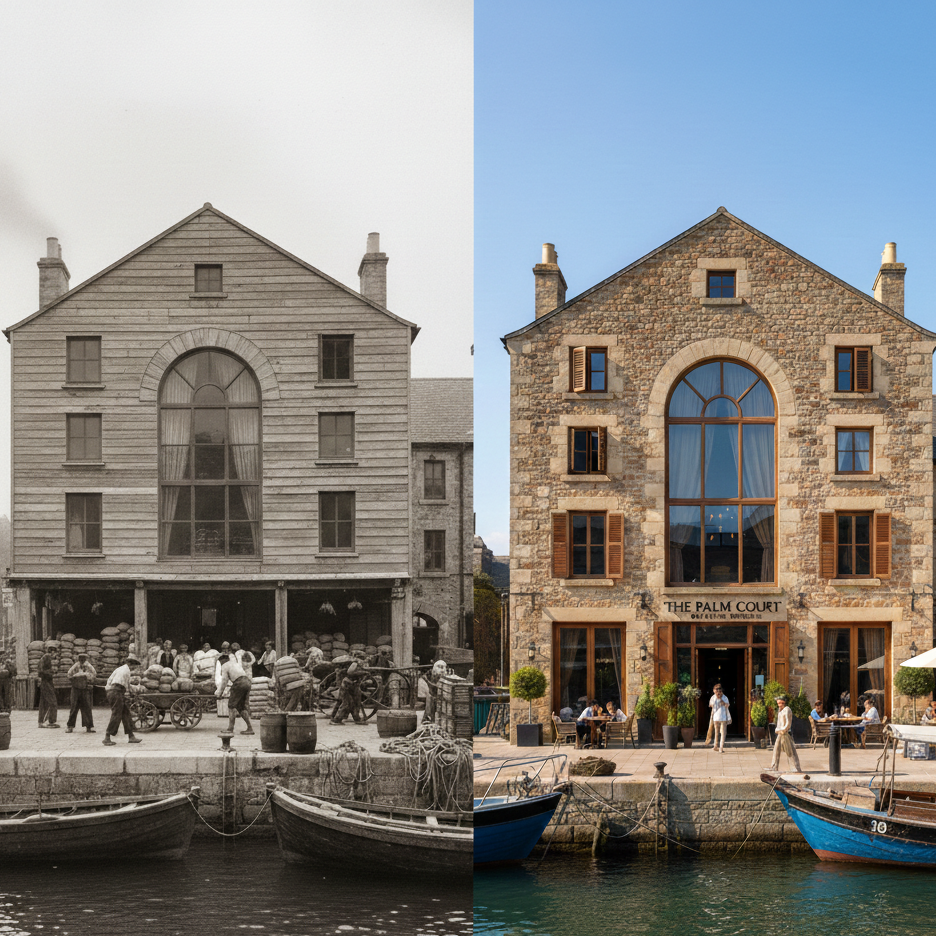
Is this transformation entirely positive? We must look at the social cost. As warehouses become hotels, the working waterfront—the fishermen and small-scale traders—often disappears. This is the “gentrification of history.”
However, the alternative is often total loss. Without hotel revenue, these massive structures would simply crumble. The boutique hotel acts as a patron, funding specialised craftsmen who keep the old techniques of lime-washing and timber-joinery alive. We lose the grit of the industrial port, but we gain a preserved skyline. The coolie of 1880 would not recognise the interior of his workplace today, but he would recognise the exterior. The silhouette of the quay remains intact.
Conclusion: The Eternal Commodity
George Town has always been a city of reinvention. It moved from a jungle outpost to a spice hub, then to a colonial port, and finally to a cultural capital. The warehouse is the constant variable in this equation. Its thick walls have seen fortunes made and lost.
Today, the “spice” being traded is information and experience. We no longer export bags of pepper; we export digital photos of gold-leaf carvings and the feeling of a tropical evening in a historic courtyard. The walls of the godown remain silent—they do not care if they hold nutmeg or a king-sized bed. They were built to endure. As the sun sets over the Malacca Strait, the lights of the hotels flicker on. The old trade is dead, but the new trade is just beginning.
Colonial Godown Hotels of the Straits Settlements FAQs
What exactly is the “gentrification of history”?
In the context of the working waterfront, it refers to the process where a site’s historical aesthetic is preserved—the “shell”—while its original social functions and community are displaced. The physical building remains, but the people who gave it its original meaning (fishermen, labourers, and traders) can no longer afford to exist within its vicinity.
Is Southeast Asian maritime heritage more at risk than European equivalents?
Yes, often due to tropical humidity and the materials used. In places like Penang, Malacca, or Jakarta, timber-joinery and lime-wash deteriorate rapidly. Without the massive capital injection that luxury hospitality provides, many of these “godowns” (warehouses) would collapse within a decade, leading to a “total loss” of the historical record.
Does the preservation of the “silhouette” justify the loss of the “soul”?
This is the central debate. Proponents argue that a preserved exterior allows future generations to understand the scale and shape of 19th-century trade. Critics argue that a “soul-less” building is merely a stage set for tourists, losing the “grit” that defined the region’s identity as a crossroads of labour.
How do boutique hotels contribute to local craftsmanship?
Traditional techniques like lime-washing (which allows old bricks to “breathe”) and intricate timber-joinery are dying arts. Because heritage status often requires authentic restoration, hotel developers become “modern patrons,” hiring the few remaining master craftsmen and ensuring these skills are passed down to a new generation.