
Key Insights
The Penang Ferry Museum, berthed on the retired Pulau Pinang, is a living record of the cross-strait connection that defined the region long before the bridges existed. From the immersive 180-degree cinema to the grease-scented depths of the engine room, this floating archive preserves the industrial soul of the fleet and the personal histories of the millions who crossed the salt-washed straits.
Entrepôt: A port or city where goods are imported, stored, and transshipped without duties. In its maritime heyday, colonial Penang operated as a thriving international crossroads, drawing ships and merchants across the straits from all corners of the globe.
Anorak: A British slang term for someone with an obsessive, deeply detailed interest in niche subjects, particularly industrial history or maritime transport. The descent into the heavy, oil-scented iron machinery of the Pulau Pinang’s engine room is a primary pilgrimage site for these dedicated enthusiasts.
Crucible: A severe test or a situation in which different elements interact to produce something completely new. Stepping onto the island as a seventeen-year-old traveller in 1988 meant entering a unique crucible of local grief that permanently shaped a personal connection to the region.
Diorama: A three-dimensional miniature replica representing a historical scene, landscape, or moment in time. The upper deck of the museum features a meticulous, evolving waterfront model capturing George Town’s old steam tramways and shipping lanes as they once existed.
Lineage: Direct descent from an ancestor, representing one’s ancestry, pedigree, or historical roots. Woven deeply into the heavy sea spray and structural steel of the cross-strait fleet is a sense of private lineage, where family mythology and maritime history seamlessly blur.
Visceral: An intuitive, deep-seated feeling or bodily response that proceeds from the gut rather than the intellect. For anyone carrying the salt of Penang in their blood, the rhythmic chugging and deep industrial hum of the old double-ended workhorses evoke an immediate, emotional connection to the past.
For anyone who calls Penang home – or carries its salt in their blood—the connection to the cross-strait ferries is visceral, almost cellular. Long before the concrete infrastructure of the Penang Bridges physically tethered the island to the mainland, transit relied entirely on the shifting water of the straits, the low groan of diesel engines, and the sharp tang of the sea.
The rhythmic chugging of those double-ended maritime workhorses did not merely define the geographical crossing; it established an enduring way of life. Each cross-strait journey operated as a slow, meditative passage between two distinct worlds. Passengers did not merely commute to Penang Island; the crossing initiated them into its heritage, minute by minute, wave by wave.
Today, a modernised, sleek fleet of fast ferries carries the daily rush of commuters across the straits. They travel in air-conditioned isolation. The service is swift, functional, and highly efficient. However, this clinical efficiency has a way of scrubbing the cultural soul out of maritime transit. The true historical memory of the straits has been sidelined, docked, and quieted by rapid modernisation.
It was this explicit search for the stubborn ghosts of the old straits that led me to step aboard the Pulau Pinang ferry vessel. Workers recently saved this specific ship from the scrap heap and meticulously transformed it into a floating heritage museum. It now berths permanently at the Penang Quayside.
Walking that gangplank, however, was never an act of casual tourism. Within the weathered steel of its hull, I was not searching for generic, curated exhibit plaques. Nor did I want neatly labelled maritime artifacts. Instead, I was searching for a visceral piece of my own family origin story. It is a narrative of lineage buried deep beneath decades of industrial paint.
A Personal Crossing: 1988
Stepping into the belly of the museum ship immediately disrupts the present tense. The static displays fade, the ambient chatter of the modern waterfront recedes, and the heavy, iron-bound scent of the ship drags you ruthlessly backward in time.
My very first encounter with the Penang ferry was forged in a crucible of local grief. It was 1988. I was a bewildered seventeen-year-old teenager stepping onto Malaysian soil for the very first time. I was caught in that strange limbo between the familiar world I left behind and the raw, overwhelming sensory assault of Southeast Asia.
The air in Penang that August was heavy, thick with a collective solemnity that transcended the usual tropical humidity. It was palpable on the streets, in the coffee shops, and on the jetties.
The Ghost of the Straits
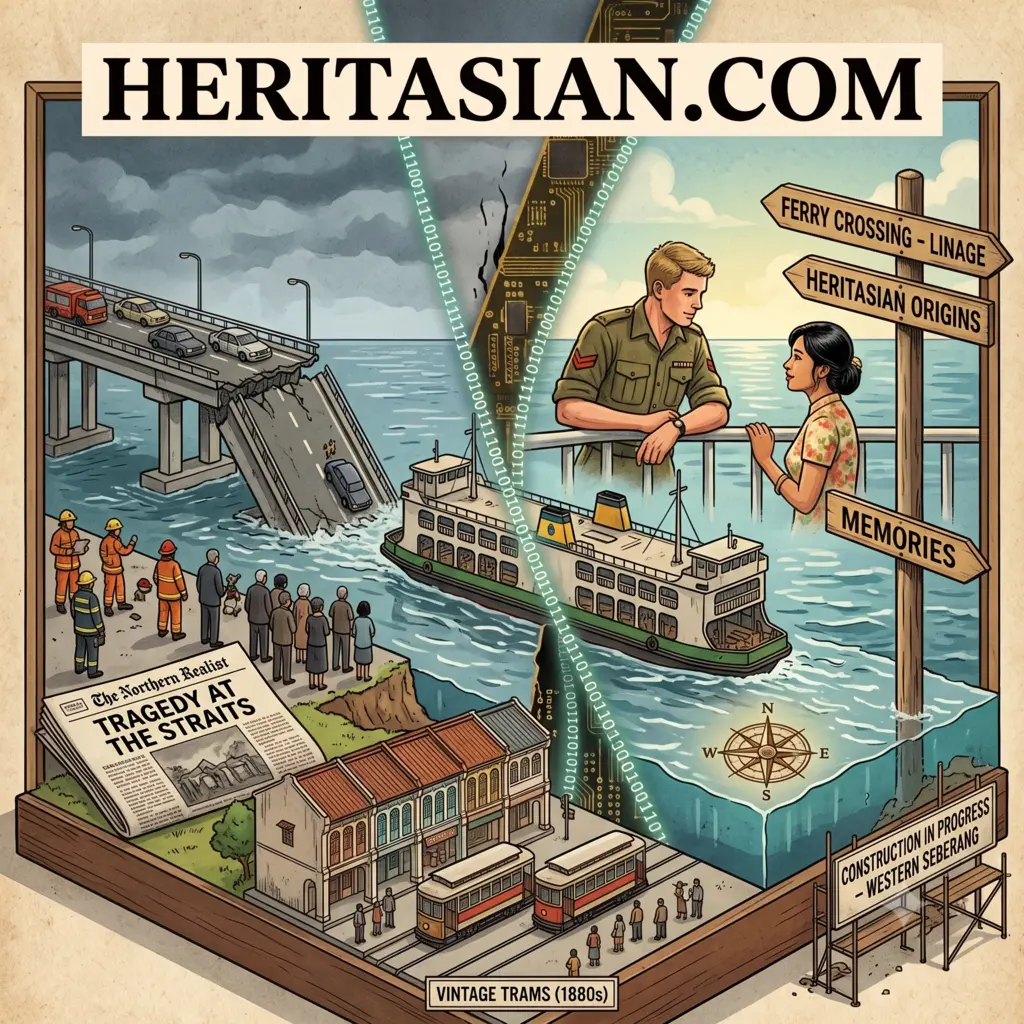
Just days prior, the Sultan Abdul Halim ferry terminal bridge had collapsed. The devastating structural tragedy claimed over 30 lives. It left a permanent, jagged scar on the psyche of the community. I still remember the haunting, monochrome photographs splashed across the local newspapers. They offered a stark, sobering welcome to a new world.
The disaster laid bare the fragile line between the island and the mainland. It proved just how precious – and fraught – the connection across the water truly was.
Yet, life on the water demanded continuity. The straits could not pause for mourning, and so the ships kept churning. I remember wandering the crowded ferry decks back then in a daze. I was enveloped by the thick, choking scent of marine fuel. The deep, bone-rattling vibrations of the ship echoed beneath me.
I watched my father lean against the rusted, salt-crusted rails, capturing this fragile, resilient world through his camera lens.
Even then, amidst the fresh shadow of tragedy and the relentless thrum of the diesel engines, the ferry felt like more than a boat. It felt like a cultural anchor, a floating village carrying a scarred community from shore to shore.
An Origin Myth Written in the Wake
Decades before that 1988 crossing, my father was stationed here with the British Army. He navigated these same currents during a different epoch. The Penang he knew was a bustling, post-war entrepôt. It was still vibrant with the energy of a transitioning colonial port.
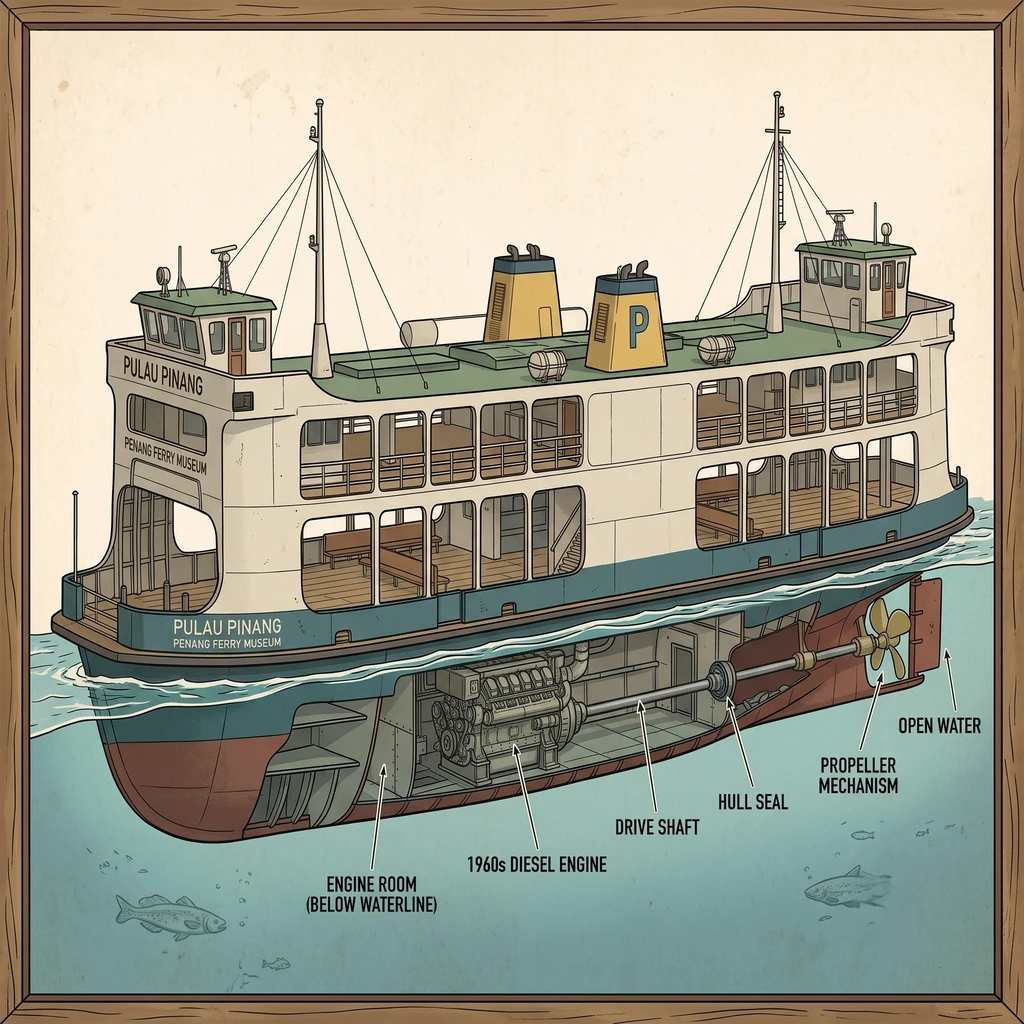
Standing in the silent engine room today, surrounded by colossal machinery, that industrial past feels intensely personal. For me, those old ferries are the reason I am here to write these words. The story that has echoed through my family history goes like this. During his military service, regular ferry crossings to the island led my father to meet my mother.
It is a beautifully cinematic piece of family mythology. It is the kind of romantic origin story that sounds perfectly suited to the salt air, the wooden benches, and the slow, rhythmic churn of the crossing. You never want to question its edges.
In my mind’s eye, I can see them. The young soldier looks out over the water while the local girl commutes across the straits. Their paths collided purely because the ferry forced people to sit knee-to-knee and face the sea together.
Even if the reality of their meeting was likely far more ordinary, the ferry remains the grand stage of the myth. It was far more grounded in the mundane realities of land. Yet, it holds a poetic truth about how Penang connects people.
The exceptionally friendly museum curator possessed an encyclopedic knowledge of the old fleet. They helped me cross-reference my memories to pinpoint the exact vessel from my ’88 crossing. It was the Pulau Langkawi, a sister to the very ship I was standing on.
In that moment, the museum achieved exactly what the best heritage spaces should do. It stopped being a graveyard for dead metal. Instead, it became a sanctuary for our private fictions and collective histories.
Beyond Banalistan: The True Toll of the Bridge
To understand the weight of the Pulau Pinang, one must understand what concrete bridges destroyed when they hooked the island to the mainland. The bridges gave us speed, convenience, and economic velocity.
But they also birthed a sort of tourist “Banalistan.” In this world, travellers skip across the water without ever looking at it. They arrive on the island without experiencing the transition of leaving the mainland.
The ferry, by contrast, demanded a tax on your time. It forced a mandatory pause. You had to switch off your engine, step out of your vehicle, and feel the sea spray hit your face.
You had to watch George Town slowly materialise out of the haze, its low-slung shophouses and church spires rising from the water like a maritime dream. It allowed you to shed the anxieties of the mainland before claiming the island.
Climbing from the ship’s iron belly to the top deck, I stepped into the dual pilot houses. Here, where captains once wrestled with treacherous cross-currents, the panoramic view of the water is overwhelming.
From here, you see the true geography of Penang—not as a dot on a digital map, but as a living creature bound to the sea.
The Preserved Pulse
The Pulau Pinang Ferry Museum shouldn’t be visited to look at the past; it should be visited to feel it. The steel structure around you is a preserved pulse. For those who view heritage as a living entity shaping our DNA and lineages, the old ferry remains indispensable.
It’s a tangible reminder of an era when the journey mattered as much as the destination, and it stands as a floating reminder of the tragedies we survived. It honours the myths we created to understand ourselves. It reflects the waters that continue to define us. Floating defiantly on the straits of where we are, it anchors us to exactly who we came from.