
I personally hand-pick every recommendation on Heritasian. To support my research into Southeast Asian heritage, some links in this review are affiliate links that may earn me a small commission at no extra cost to you.
Most cities bury their history under layers of glass and steel, but in George Town, history is still something you can run your hand across. Turning onto Muntri Street, the modern world begins to peel away, revealing the muted, salt-washed patina of Muntri Mews. What were once the stables for the carriage horses of Penang’s elite now stand as a silent gatekeeper to the elegance of the Straits Settlements.
To step through its doors is to trade the frantic energy of the 21st century for a sanctuary that speaks in whispers. This is a masterful exercise in adaptive reuse, where grooms once tended to merchant carriages, guests now find a cooling respite of polished timber and open-air courtyards. The transition is seamless. By honouring the building’s humble origins while layering it with the sophisticated comforts of a grand Peranakan estate, the Mews offers more than just a room—it offers a rare, lingering connection to the soul of the old port city
The Penang Blue Hour
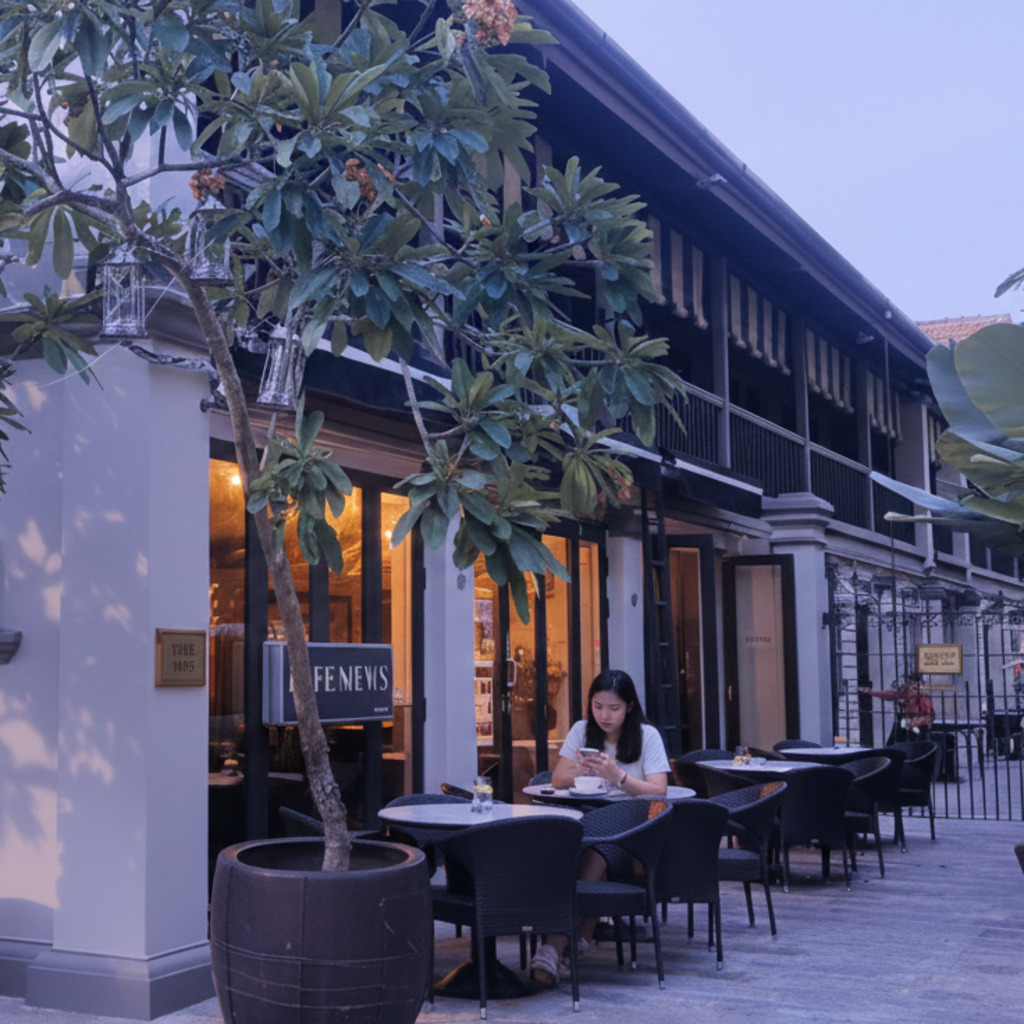
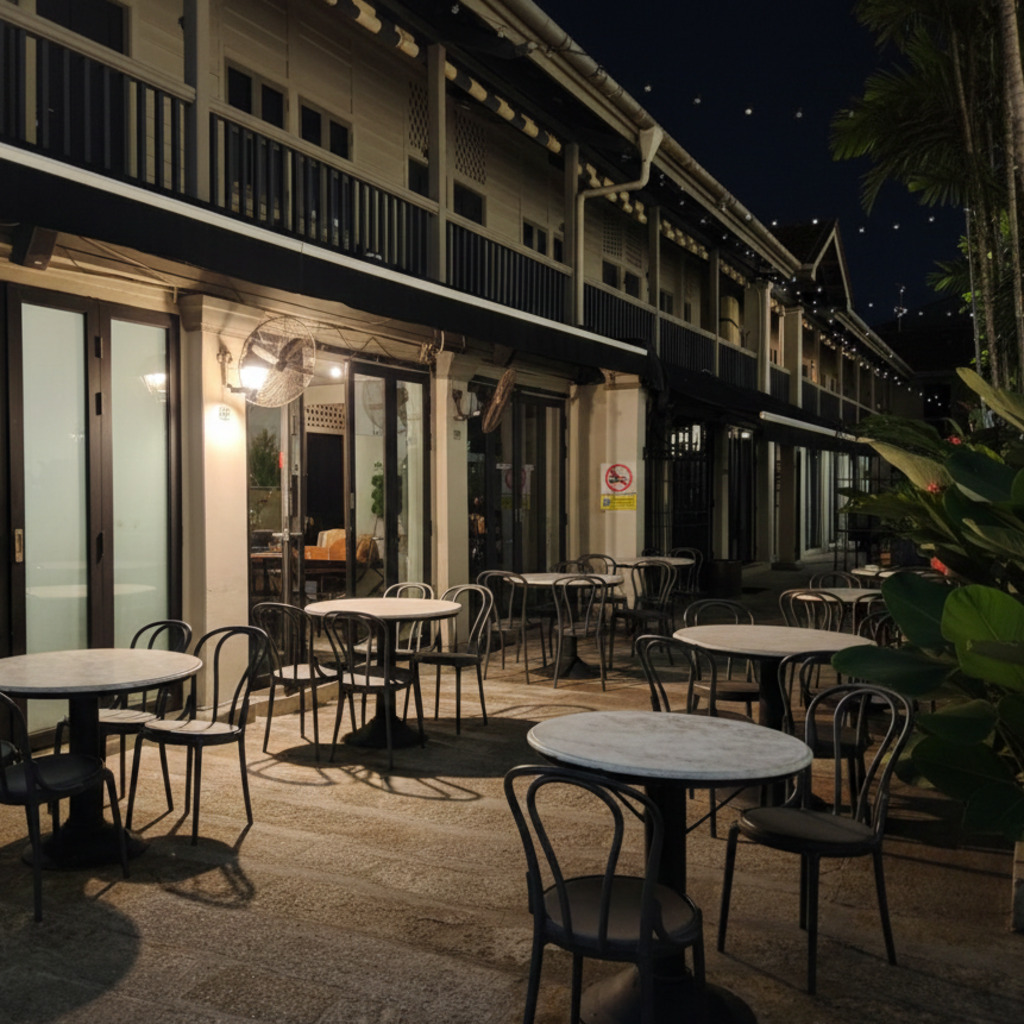
As the sun dips, the “Blue Hour” settles over Muntri Street. This is when the hotel truly comes alive. The shadows of the louvred shutters lengthen across the granite pavers. You can almost hear the ghostly rattle of carriage wheels.
Workers built the property to house the horses and grooms of the grand mansions nearby. Today, it welcomes those seeking a deeper connection to history—a “Time Machine” crafted from brick, timber, and memory.
The Visionary: A Labour of Cultural Reclamation
The story of Muntri Mews is inseparable from its saviour, Christopher Ong. An investment banker turned heritage hotelier, Ong represents a specific type of homecoming. He returned to Penang after decades abroad. He found his ancestral playground crumbling under the weight of neglect.
The Near-Loss of a Landmark
In the early 2000s, these mews were a series of derelict sheds. They were filled with junk and decaying timber. Most developers saw them as “land value” alone. They wanted to raze the site for a glass-and-steel boutique tower. Ong saw something else. He saw the “bones” of a city. He understood that once these structures vanish, the soul of the diaspora leaves with them.
The Philosophy of Decay
Ong’s approach was not to “perfect” the building, but to “heal” it. Chris speaks of the “Philosophy of Decay.” He chose to leave certain scars on the walls while keeping the unevenness of the original floor levels. This honesty reminds the guest that they’re staying in a living piece of history.
One anecdote stands out regarding the restoration struggle. Ong tells of the search for “terrazzo” craftsmen. These are artisans who understand the exact ratio of marble chips to cement. “We had to beg the old masters to come out of retirement,” Ong once remarked. “They are the last keepers of the flame.” This project was an act of Cultural Reclamation. The project proved that heritage can generate profit without becoming “museum-ified.”
Architectural DNA: The Science of the Straits Eclectic
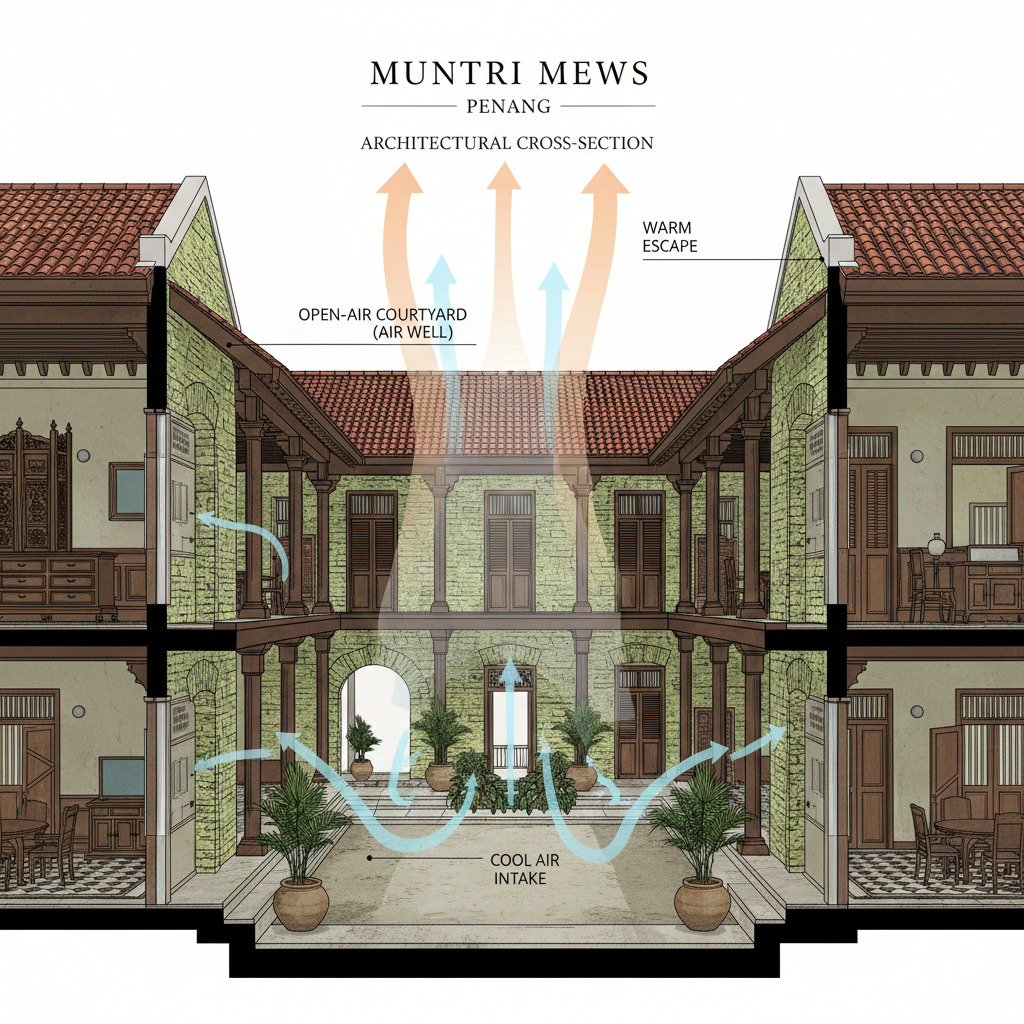
Muntri Mews is a masterclass in the Straits Eclectic style. This architectural language is a beautiful hybrid. It marries Chinese structural logic with European decorative flourishes.
The Thermodynamics of Heritage
Before the advent of air conditioning, Penang’s builders were masters of thermodynamics. The Mews utilises a series of “Air Wells.” These are open-topped courtyards that act as the building’s lungs.
The Ritual of the Lime Wash
The walls are finished with traditional lime wash. Unlike modern acrylic paint, lime wash allows the masonry to “perspire.” This is crucial in the tropics. Modern paint traps moisture inside the bricks. This causes the plaster to “bubble” and fail. The lime wash used here was mixed with a dash of sugar and egg whites. This traditional recipe creates a unique sheen that reflects the morning light. It’s a breathable skin for a breathing building.
The Shutter Language
Notice the wooden louvres on the upper floors. These aren’t merely decorative. They’re the 19th-century version of a thermostat. By adjusting the angle of the slats, residents could control airflow and privacy simultaneously. In the heat of mid-afternoon, the shutters are closed. This creates a shaded, “cool” that keeps the interior rooms comfortable without a fan.
The Anthropological Narrative: The Ghosts of the Mews
To understand Muntri Mews, one must understand its original inhabitants. In 1900, these were not luxury suites. They were the engine rooms of Penang’s elite.
The Syces and the Grooms
The ground floor was for the horses. The upper floor was for the Syces—the grooms and drivers. Many were North Indian or Malay men who lived in communal quarters. There is a fascinating social contrast here. The mews represent a “working-class heritage” that’s often ignored in favour of grand mansions, like the Blue Mansion closeby.
By preserving these spaces, we honour the labour that built George Town. During the 2009 renovation, workers found old iron horseshoes and Victorian coins beneath the floorboards. These artifacts were not discarded. They served as the “talisman” for the interior design. They ground the luxury of today in the grit of yesterday.
Anatomy of the Guest Experience: Private Galleries
Staying at Muntri Mews feels less like a hotel check-in and more like an invitation to a private estate. The rooms are curated experiences of space.
The Luxury of the Duplex
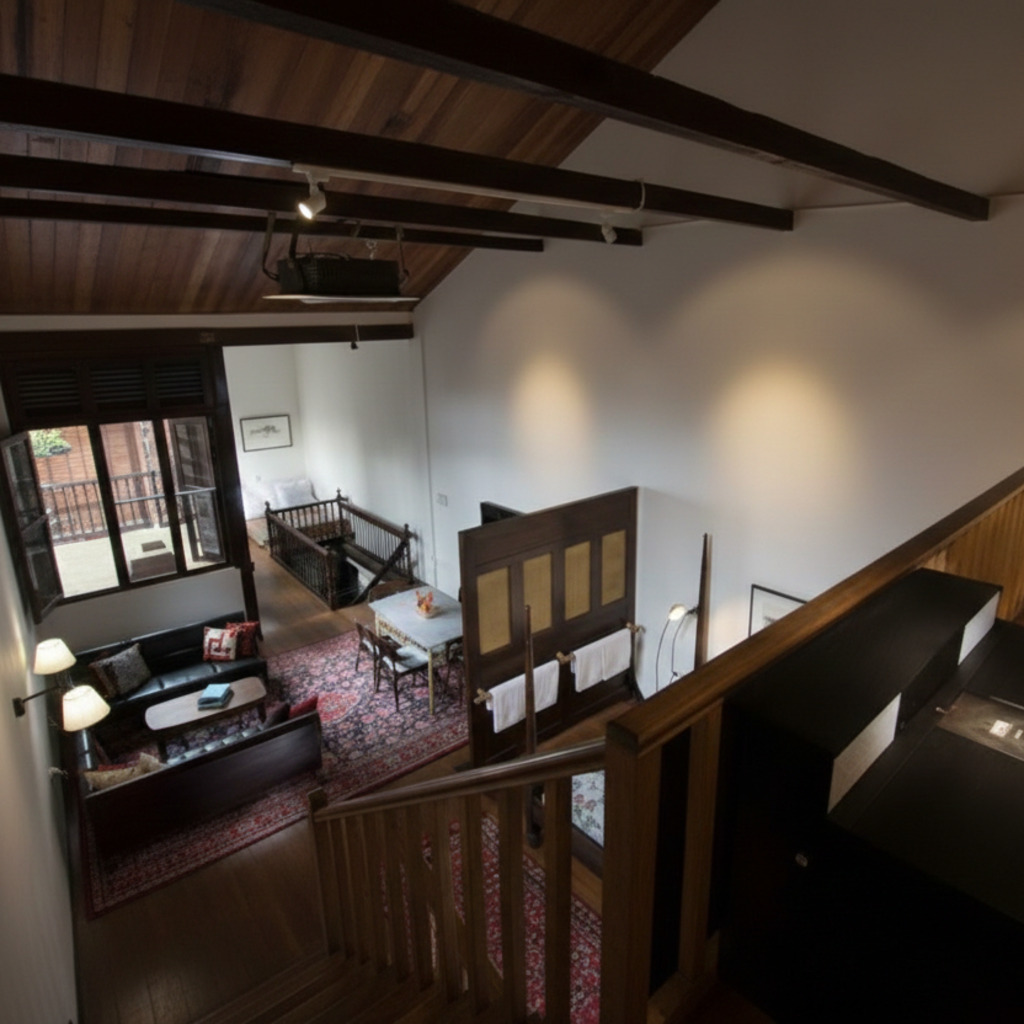
The signature suites are split-level “Private Galleries.” The ground floor serves as a living salon. It is anchored by heavy Blackwood furniture. These pieces often feature intricate Mother-of-Pearl inlays. They depict scenes of cranes and pine trees—symbols of longevity in Chinese culture. These antiques were hand-selected by Ong from across the region.
The Grammar of the Guest Room
Upstairs, the sleeping quarters transition to warm, polished teak. The joinery is remarkable. In the restored timber frames, you’ll notice an absence of modern nails. Traditional “mortise and tenon” joints were used. This allows the wood to expand and contract with the humidity.
While the aesthetic is historical, the comfort is absolute:
The “Secret” Amenities: A Hidden Oasis
In a dense urban heritage site, space is the ultimate luxury. Muntri Mews manages to carve out pockets of serenity that feel entirely private.
The Garden Oasis
The heart of the property is a lush, tropical garden. It separates the main mews from the street. Here, ferns and palms provide a green screen against the city. It acts as a natural sound barrier. You can read a book while the tropical rain drums on the nearby zinc roofs, feeling completely insulated from the world.
Surgical Integration
The challenge was adding a pool and modern common areas. Architects did this “surgically.” They did not break the skyline or the street facade. Instead, they utilised the existing footprints of old outhouses and storage rooms. The result is a seamless blend. You never feel the jarring “newness” of a modern addition. It is a lesson in how to add modern utility to a historical site without damaging its integrity.
Culinary Heritage: Diplomacy on a Plate
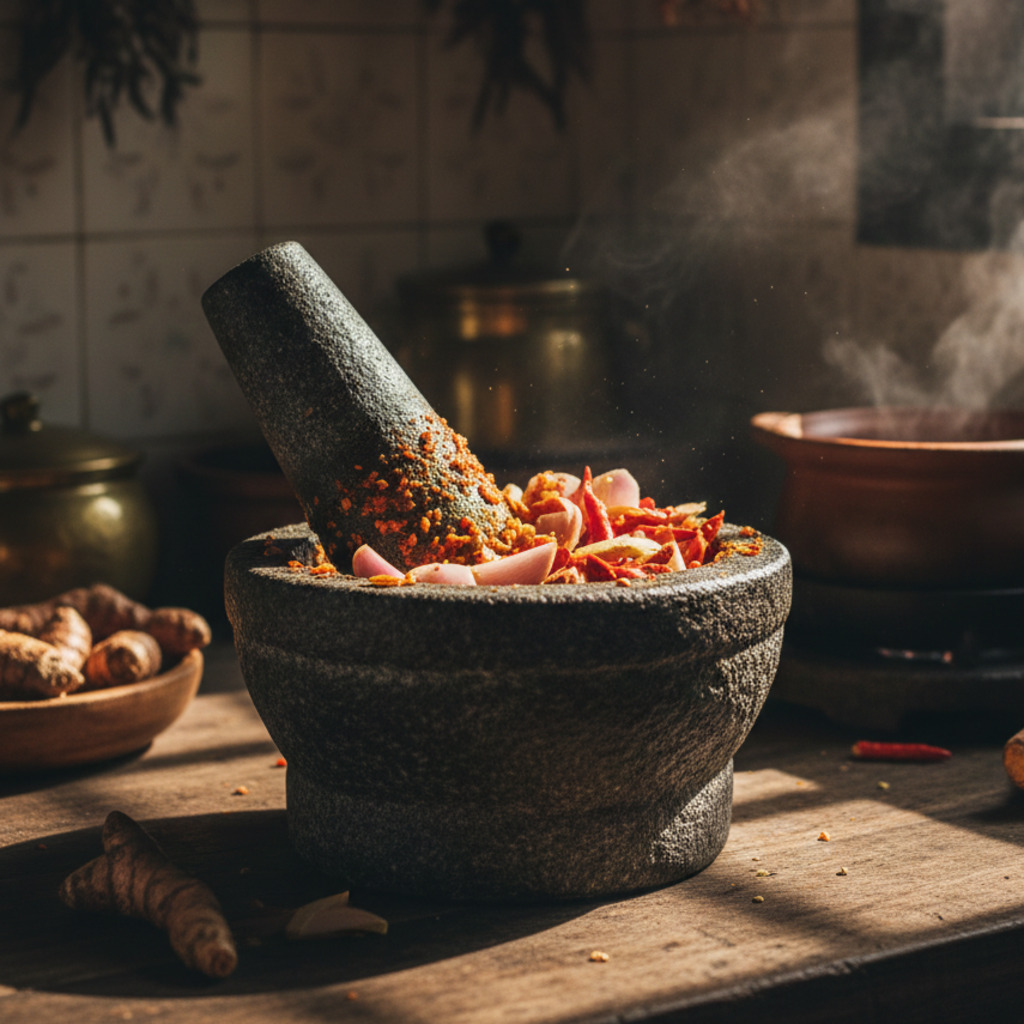
Dining at the Mews Cafe is an education in the Peranakan soul. This is “Culinary Diplomacy” at its finest. The food bridges the gap between the fiery spices of the Malay peninsula and the subtle techniques of Southern China.
The Chemistry of the Rempah
The secret to the food here is the Rempah. This is the spice paste that forms the base of every dish. At the Mews, it is still pounded by hand in a mortar and pestle. This releases the oils in a way that a modern blender cannot.
This is heritage you can taste. The property preserves recipes that the “fast food” era of globalisation is slowly erasing.
The Neighbourhood and the Diaspora Connection
Muntri Mews sits in the “Harmony Zone” of George Town. Within a ten-minute walk, you’ll find a mosque, a Hindu temple, and a Chinese clan house. This is the ultimate expression of the Asian diaspora.
An Act of Preservation
By choosing to stay here, you’re doing more than booking a room. You’re participating in an ecosystem of preservation.
The Human Element
I once spoke to a man named Mr Lee. He has lived on Muntri Street for seventy years. He remembers when these mews were actual stables. “The horses are gone,” he told me with a smile. “But the spirit is still here. These buildings still have their faces.”
When you walk out of the hotel at dusk, the street lamps flicker on. You see the shadows of the past merging with the colourful life of the present. This is the magic of Penang. It is a place where the diaspora has built something permanent.
Conclusion: A Living Legacy
Muntri Mews is more than a boutique hotel. It’s a bridge across time. This place honours the toil of the ancestors—the grooms and the craftsmen—while embracing the sophistication of the modern traveller and proving we don’t have to destroy the past to find comfort.
In a world of “cookie-cutter” luxury, this property offers something rare: an identity. It offers a sense of place that stays with you long after the suitcase is unpacked. It is a reminder that the most luxurious thing we can experience is a connection to the human story.
Experience the Living History
To walk through the louvred shutters of Muntri Mews is to become a part of Penang’s enduring story. If you are ready to trade the modern world for the cooling respite of the Mews, you can find the latest availability and secure your stay via Trip.com.
Montri Mews Penang FAQS
What is the history of the Muntri Mews building?
Workers originally built the property in the late 19th century to serve as communal stables and housing for the syces (grooms) and carriage horses of Penang’s wealthy merchant elite. In 2009, heritage hotelier Christopher Ong rescued the site from a derelict state, transforming it into the boutique sanctuary guests enjoy today.
What does “Adaptive Reuse” mean in the context of this hotel?
Adaptive reuse refers to the process of repurposing an old building for a new function while retaining its historic features. Muntri Mews serves as a premier example, as it converts utilitarian horse stables into luxury suites without erasing the architectural “scars” or original layout that define its character.
What architectural style defines the property?
The Mews showcases the “Straits Eclectic” style, a unique hybrid found in the Straits Settlements. It blends Chinese structural logic—such as timber beam construction and internal courtyards—with European decorative flourishes and neoclassical influences.
How does the hotel support the local George Town community?
The property avoids “gentrification parasitism” by integrating with the neighbourhood. The hotel employs local artisans for specialised maintenance like lime-washing and sources fresh morning pastries from the 80-year-old traditional bakery located just around the corner.
Is the food at the Mews Cafe authentic to the region?
Yes. The Mews Cafe preserves traditional Peranakan and Malay recipes that the “fast food” era is slowly erasing. Chefs hand-pound spice pastes (rempah) using a stone mortar and pestle, ensuring the flavours remain true to the slow-cooked heritage of the Straits Settlements.