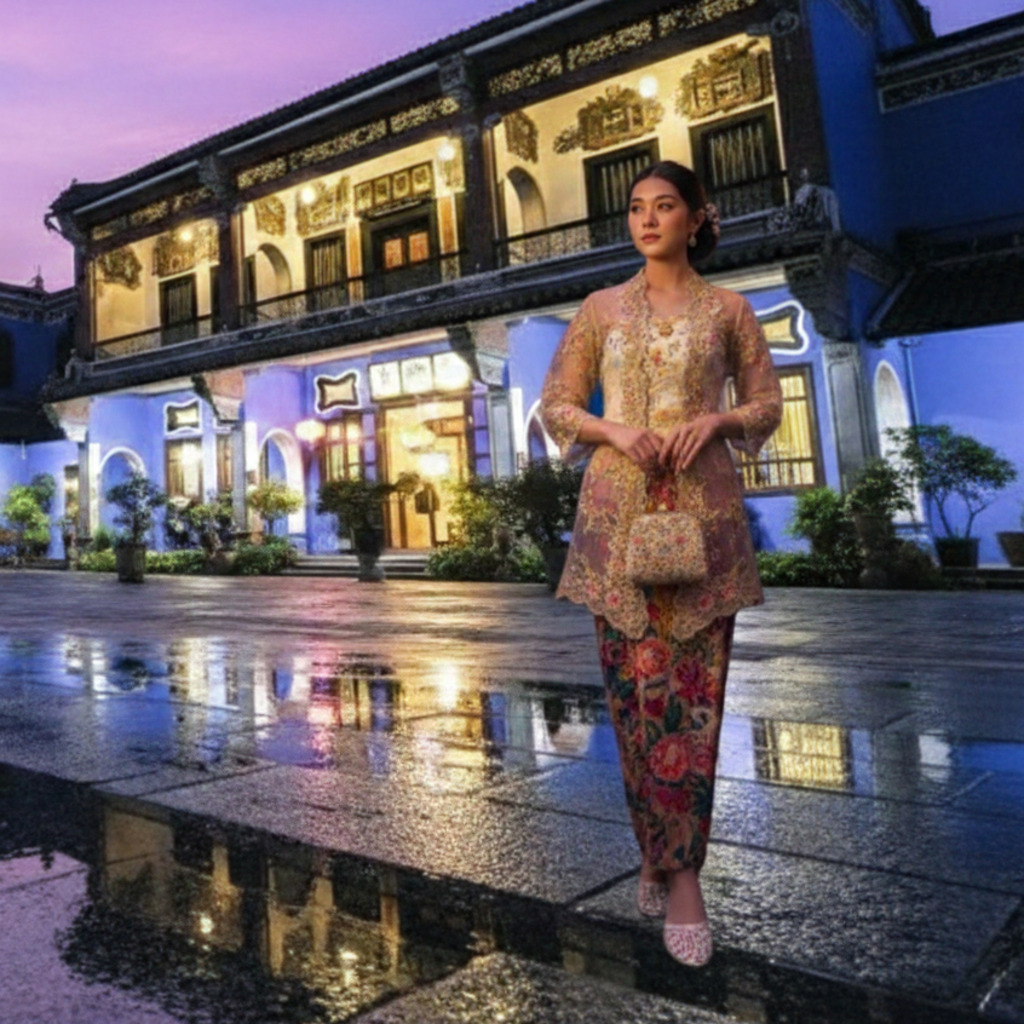

The indigo-washed Blue Mansion in Penang reveals a monument built of immense mercantile ambition and spiritual geometry. For the HeritAsian traveller, staying here is an immersion into 19th-century Chinese success in the Nanyang. Here, the air feels thicker with history, and every gilded carving tells a unique story of migration. Its luxury is measured by the sheer cultural weight of the heritage. Now a world-class boutique hotel, it lets visitors do more than just peer at the past. It invites guests to step inside and sleep within the deeply storied and historic walls.
The Visionary: Cheong Fatt Tze, the “Rockefeller of the East”
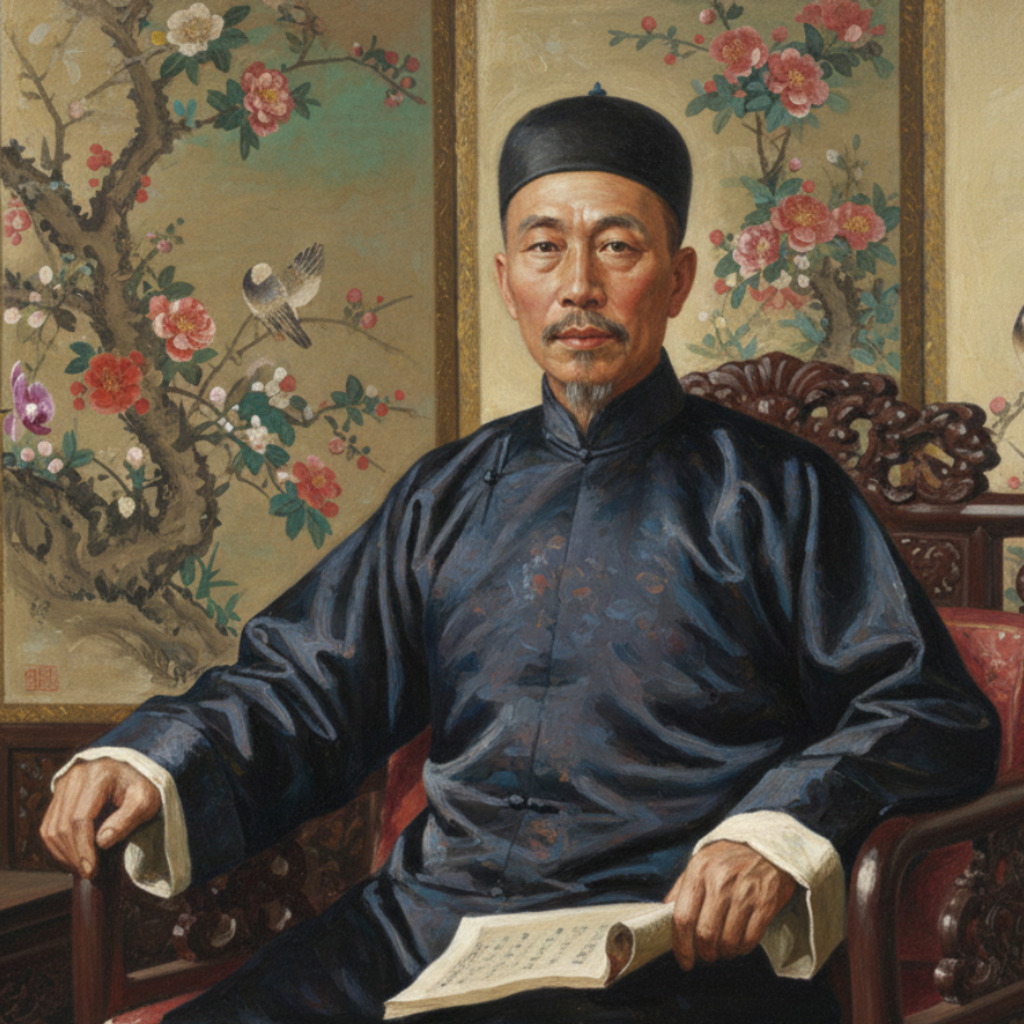
The story of the mansion is inextricably linked to the meteoric, almost cinematic rise of its patriarch, Cheong Fatt Tze. Born into crushing poverty in Guangdong, China, in 1840, Cheong migrated to Southeast Asia as a penniless water carrier. Through a combination of relentless grit and political savvy, he built an empire that spanned banking, rubber, textiles, and shipping, eventually becoming a high-ranking Mandarin for the Qing Dynasty and a consul for the British.
By the late 1800s, Cheong was one of the wealthiest men, dubbed the “Rockefeller of the East.” While others built Western bungalows to mimic colonial masters, Cheong made a defiant cultural statement. His house reflected Chinese roots but integrated the very best of the globalised world he dominated. The design featured everything from imported Scottish cast iron to beautiful Victorian stained glass.
This mansion served as the nerve centre for his global business and a sanctuary for his family. He built it specifically for his seventh and favourite wife, the elegant Tan Tay Po. Cheong’s profound devotion led him to forbid the sale of the property in his will. He decreed that the house remain unsold until the death of his very last son. This legal clause alone saved the mansion from the wrecking balls of the 1980s. The house stood as a lonely indigo sentinel while urban sprawl destroyed the surrounding heritage. A guided tour provides an essential insight into how one man’s will preserved a culture.
The Industrial Legacy: From Penang to the Vineyards of Yantai
While building his Penang sanctuary, he looked toward his homeland with a bold vision of modernisation. In 1892, Cheong founded the Changyu Pioneer Wine Company in the Yantai region of Shandong province. It was the first modern winery in China, representing a massive gamble for the legendary merchant. This ambitious project required importing half a million delicate vine cuttings directly from Europe.
This connection to the global wine trade explains much of the mansion’s unique “East-meets-West” aesthetic. Cheong performed ancestral rites in his central courtyard but toasted his successes with fine claret. The hotel’s dining philosophy captures this duality through Changyu wines, which act as a liquid link to the patriarch’s ambition. When you dine at the mansion, you participate in a century-plus-old tradition of cultural synthesis that Cheong pioneered. Every afternoon, the tour shares this fascinating history with visitors, ensuring the merchant’s global impact remains alive.
Architectural DNA: A Masterpiece of Feng Shui
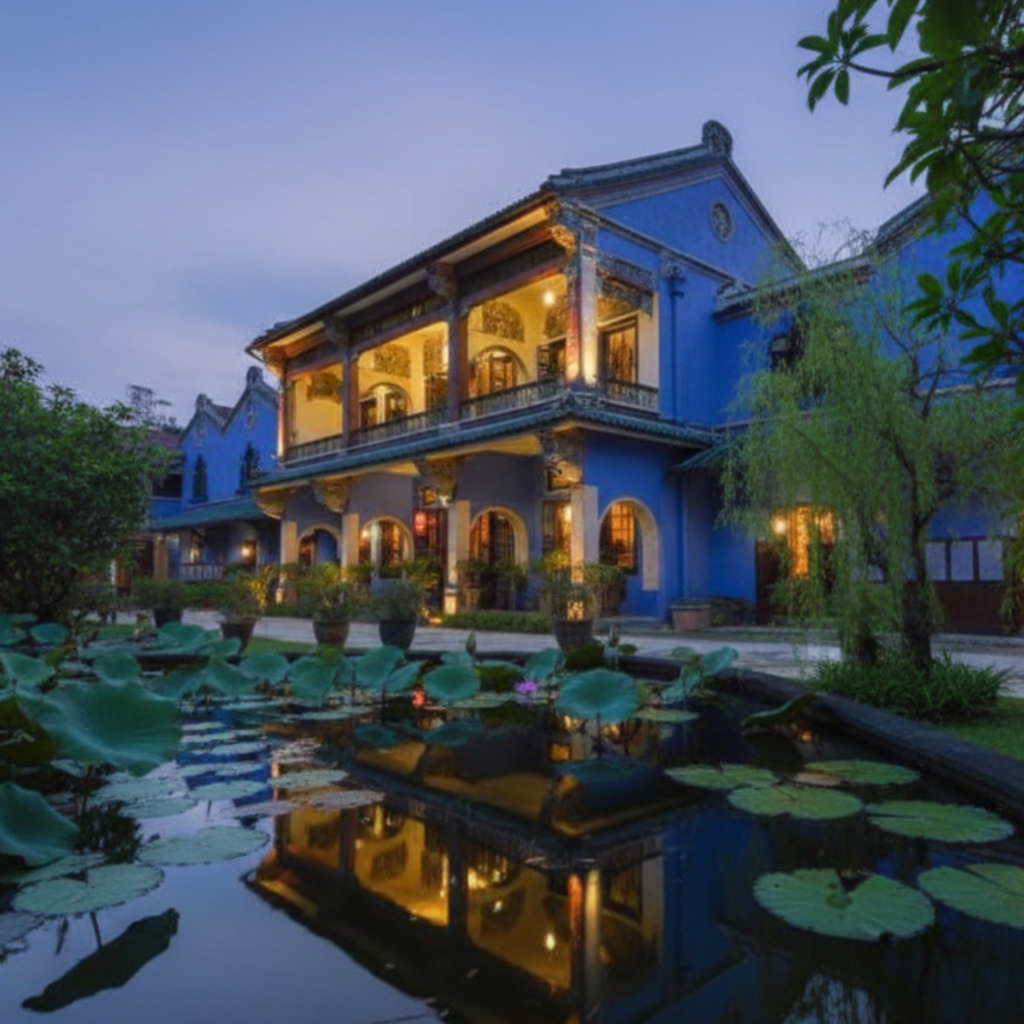
The Blue Mansion is frequently cited as one of the most perfectly “balanced” buildings in Asia. It was constructed according to the strictest principles of Feng Shui, designed as a physical magnet to trap positive energy (and ensure the continued prosperity of the Cheong lineage.
The house features five internal courtyards, but the central Heavenly Well (Tian Jing) serves as the architectural heart. During a tropical downpour, a miracle of 19th-century engineering unfolds before the eyes of the guests. The floor slants slightly toward the centre, where rainwater—representing wealth—collects. A sophisticated internal drainage system then funnels this water throughout the mansion. The design forces the water to “linger” through several turns before it finally exits. This deliberate path ensures the family’s fortune never “leaks” out too quickly.
The iconic blue colour isn’t modern paint; it is a traditional indigo-based lime wash. In the 1800s, indigo was a precious commodity used to signal immense wealth on Leith Street. By washing the 38-room mansion in this hue, Cheong displayed his status to the entire neighbourhood. The lime also protects the building by allowing the old brick to breathe in humid tropical weather. Every tour highlights this structural detail, explaining how the blue hue was originally achieved. The specific shade came from mixing lime with indigo plant dyes imported directly from India.
The Restoration Wars: The Battle for the Blue
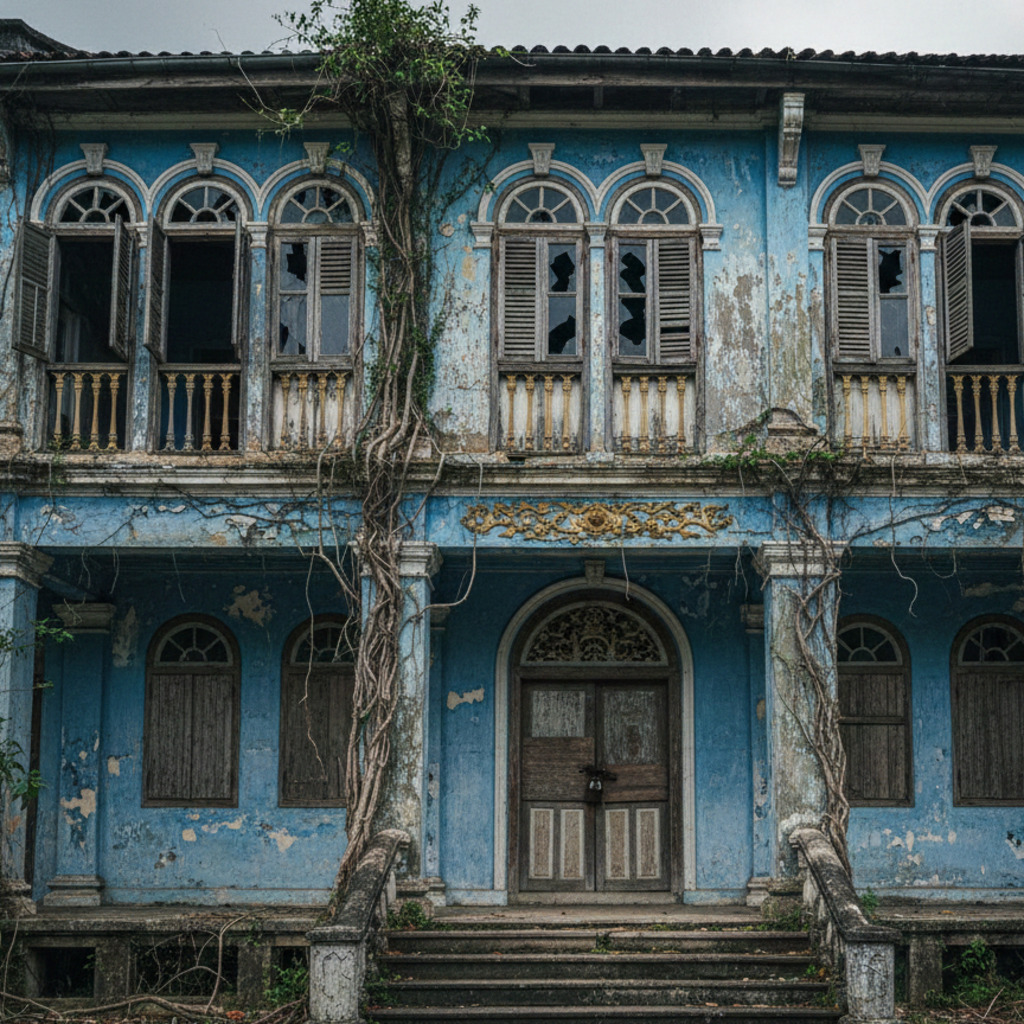
The mansion’s survival was by no means guaranteed, as the property fell into tragic disrepair by the late 1980s. It became a tenement house, subdivided into cramped quarters for over thirty different families. Gilded screens were caked in decades of soot, while magnificent courtyards were filled with discarded debris. When Cheong’s last son passed away in 1989, developers immediately eyed the prime real estate. These builders saw only a valuable plot of land in the historic heart of George Town.
What followed was a dramatic race against time as a small group of local conservationists scrambled to act. Led by architect Laurence Loh, they formed a syndicate to purchase the historic building. They fought the “New Malaysia” vision, which favoured modern skyscrapers over what some called “old ruins.” The group purchased the house just days before it was slated for demolition.
The restoration that followed became a decade-long struggle of intense architectural forensics. They hunted for master craftsmen in Southern China who still understood the intricate Chiau-Chit porcelain technique. Teams sourced over 10,000 Victorian floor tiles to replace those destroyed by years of neglect. This was a high-stakes cultural rescue mission that won the UNESCO Most Distinguished Project award. Today, as a premier heritage hotel, the place serves as a beacon for conservationists worldwide.
Living Like a Mandarin: The Guest Experience and Artifacts
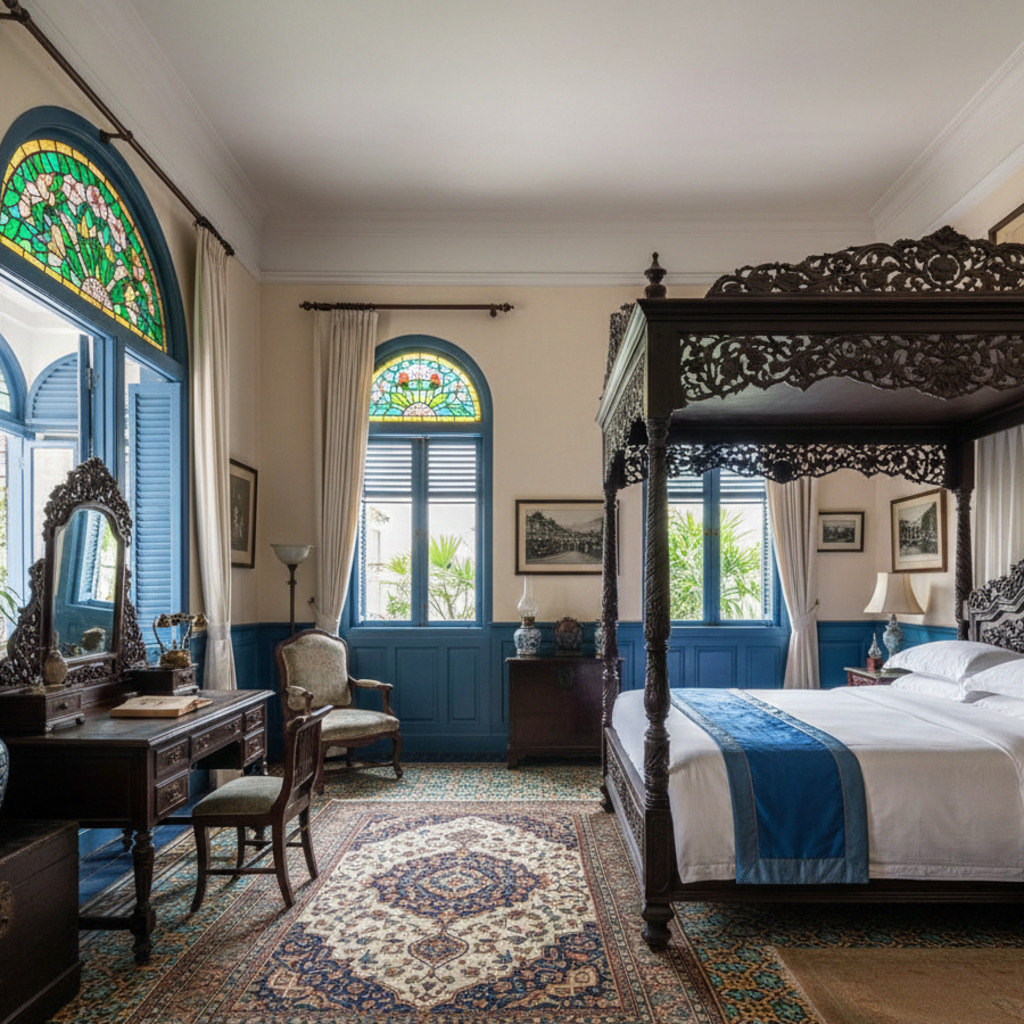
Operating as the Blue Mansion Hotel, the property features 18 boutique guest rooms, each uniquely themed to reflect a different aspect of Cheong’s life. When you stay here, you aren’t just in a room; you are occupying a specific chapter of history. The accommodations are divided into categories like the Liang Collection, the Tang Suites, and the Han Suites.
These rooms aren’t merely furnished with antique furniture—they’re curated galleries of the Peranakan life. In the Han Suites, for instance, you might find an original 19th-century carved bridal bed, a massive structure of gilded wood that functioned as a room-within-a-room for newlyweds. These beds are masterpieces of iconography, featuring carvings of pomegranates for fertility and phoenixes for marital harmony. Elsewhere, you’ll encounter the opium couches of the era—wide, flat daybeds made of heavy Blackwood and inlaid with cool marble, designed for the long, humid afternoons of the Straits Settlements.
Modern guests find their needs met through a clever and seamless design sleight-of-hand. Bathrooms are contemporary marvels featuring rain showers set against beautiful heritage masonry. Mezzanine sanctuaries offer massive beds with premium linens placed under soaring timber rafters. Even in this historic place, modern amenities ensure that history doesn’t come at the cost of comfort. High-speed Wi-Fi and efficient air conditioning provide a perfect balance for every hotel guest. The air conditioning is discreetly integrated into antique furniture, so you hardly notice its presence. This hidden technology ensures the tropical heat vanishes without spoiling the mansion’s authentic atmosphere.
The Neighbourhood: Rivalries on “Millionaire’s Row”
Leith Street, where the mansion stands, was once known as the “Millionaires’ Row” of Penang. In the late 19th century, this street was the stage for an intense social rivalry between the island’s most powerful tycoons. To the left and right of Cheong Fatt Tze’s indigo walls lived other “Captains of Industry,” each attempting to outdo the other with the height of their gates or the intricacy of their ironwork.
Staying at the Blue Mansion Hotel allows you to walk through the “Harmony Zone” of old George Town. This area reveals the fascinating social hierarchy that defined the city during its golden era. To get a full insight, visitors often pair their stay with a tour of the Pinang Peranakan Mansion. Located nearby on Church Street, this secondary site represents the quintessential Baba-Nyonya lifestyle. While one reflects a global tycoon, the other is filled with thousands of pieces of jewellery and glassware. Seeing both attractions provides a complete picture of the diverse wealth that built historic Penang.
Beyond these mansions, the neighbourhood is a palimpsest of identities—Hokkien, British, Malay, and Indian—all competing for space and influence. The Blue Mansion was Cheong Fatt Tze’s way of winning that competition, positioning himself as the dominant force in a city of giants.
The Cinematic Connection and Intellectual Sanctuary
For many modern visitors, the mansion is synonymous with the iconic Mahjong scene from the film Crazy Rich Asians. The producers chose the central courtyard for this climactic battle because of its symbolic power, representing the heart of family and traditional values. Yet, the mansion’s cinematic history runs much deeper, having served as a backdrop for the Oscar-winning French film Indochine and the recent Ghost Bride. These productions have turned the building into a global icon, but the true magic remains in the quiet, unfilmed moments available only to the hotel guest.
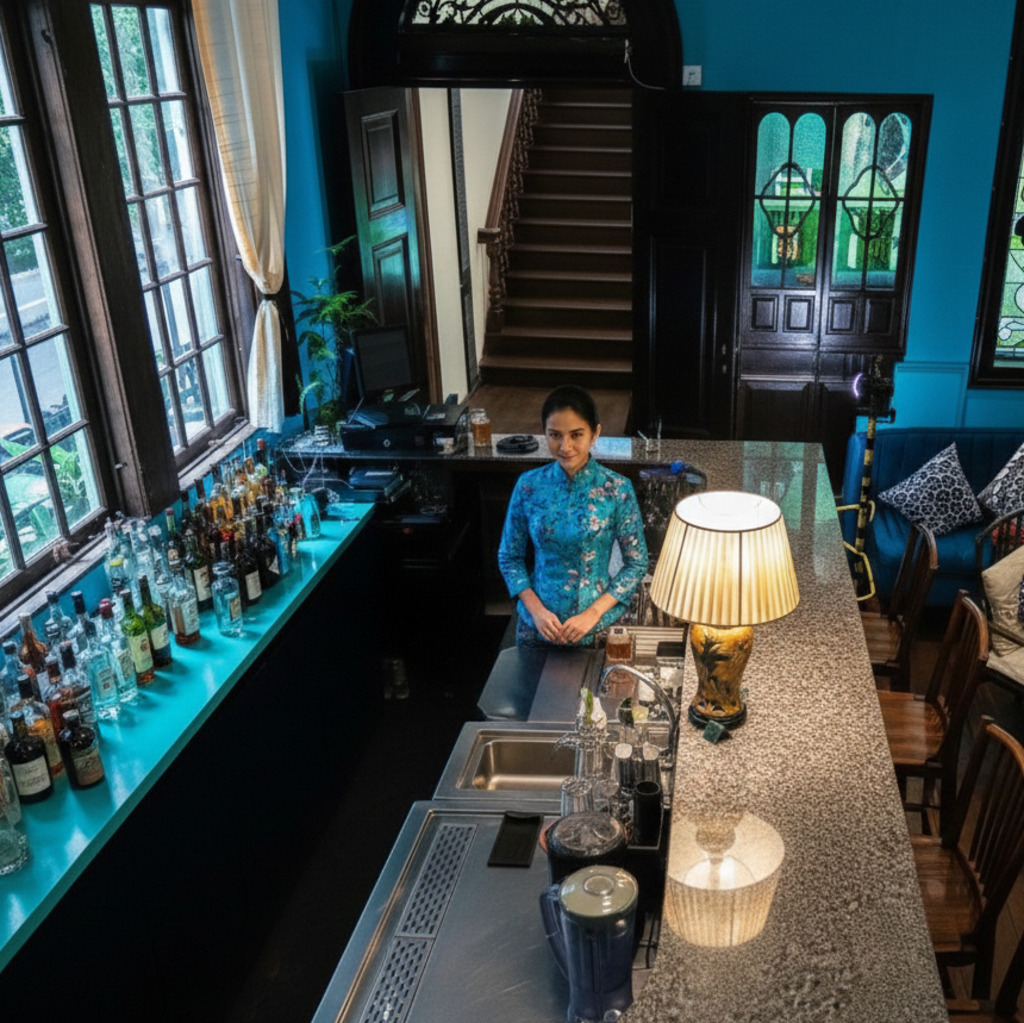
Beyond the screen, the mansion offers hidden amenities like the emerald-green lap pool. It is tucked into a quiet corner of the grounds for a peaceful escape. Swimming here at twilight, with the call to prayer drifting nearby, provides profound privacy. For those seeking intellectual sanctuary, the library is filled with rare volumes on Asian history. Guests can dive into the Nanyang narrative while enjoying a cocktail from the elegant bar.
Culinary Heritage: Indigo at The Blue Mansion
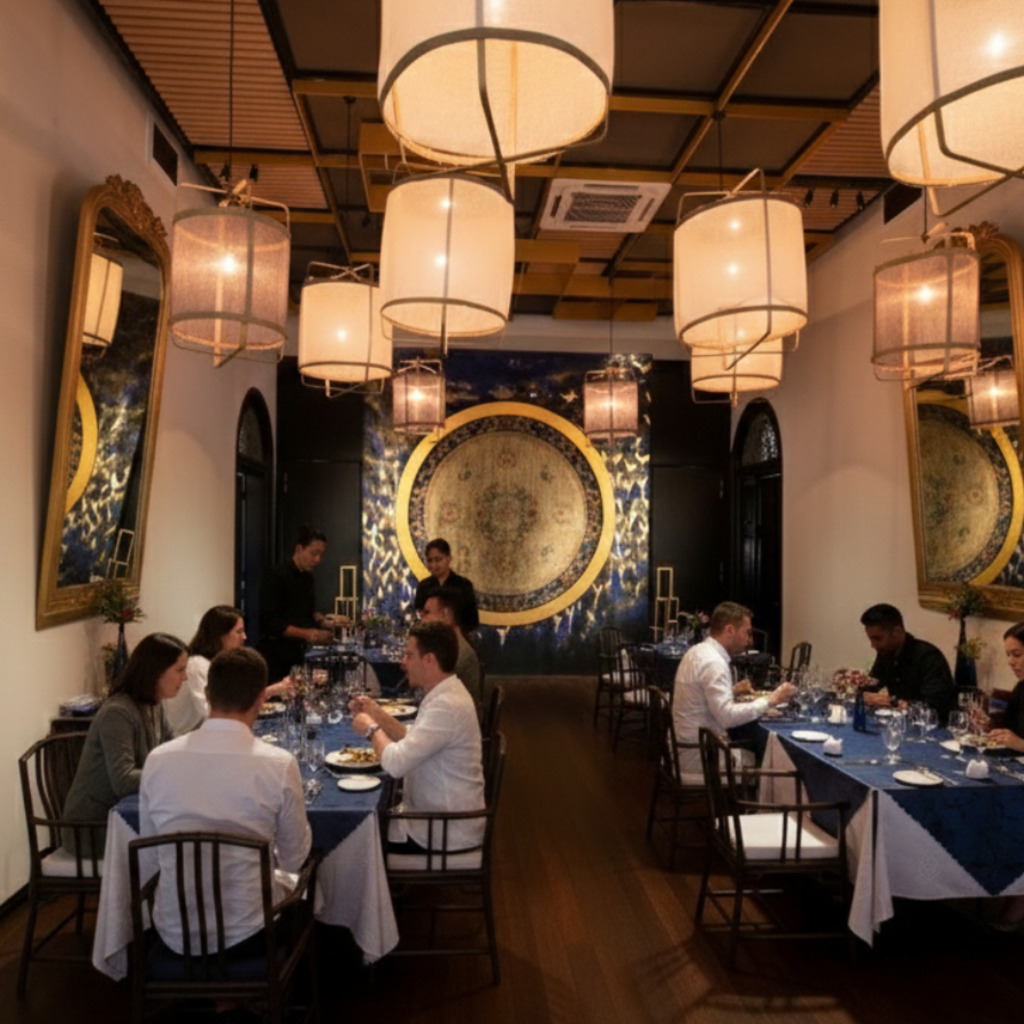
Dining at the mansion is an exercise in “Culinary Diplomacy.” The fine dining restaurant, known as Indigo, is located on the first floor, overlooking the central courtyard. The menu honours Cheong Fatt Tze’s globalised life—he was a man who worshipped his ancestors but also navigated the highest echelons of Western business.
The cuisine at Indigo restaurant is a sophisticated marriage of Eastern flavours and Western techniques. The fine dining restaurant reflects the merchant’s own trajectory; imagine dining on Hokkaido scallops with a ginger-scallion emulsion or a perfectly braised Wagyu beef cheek, paired with a glass of the very Changyu wine that Cheong himself brought into existence. This Indigo restaurant experience is a culinary bridge that connects the merchant’s Guangdong roots with his global ambitions, served with an elegance that feels like a private banquet hall of the 1890s.
Exploring the Island: From Temples to the Peak
While the boutique hotel is a destination in itself, it serves as the perfect base to explore Penang’s broader attractions. A morning tour might lead you to the Khoo Kongsi, perhaps the most ornate clan house in Southeast Asia. The stone carvings and gilded beams of Khoo Kongsi offer a stunning visual comparison to the detail found in the Blue Mansion.
For those seeking spiritual heights, a tour of Kek Lok Si is essential. As the largest Buddhist temple in Malaysia, the “Pagoda of Ten Thousand Buddhas” at Kek Lok Si is a marvel of Chinese, Thai, and Burmese architecture. After visiting the temples, many visitors head to the Penang Hill funicular. A trip up Penang Hill provides a panoramic view of the island, allowing you to see the red-tiled roofs of George Town, where the Blue Mansion sits like a single indigo jewel. After a day of exploring, returning to the cool, high-ceilinged rooms of your heritage hotel is the ultimate relief.
Why It Matters: An Investment in Cultural Continuity
When you book a suite at The Blue Mansion, you’re doing more than securing a luxury bed. You’re directly supporting the preservation of a culture that was almost erased. The mansion is a private entity and receives no government funding; every night spent here helps pay for the specialised artisans who maintain the indigo lime wash and the delicate porcelain Chiau-Chit carvings.
For the HeritAsian reader, this is a way to vote with your feet, ensuring that the story of the “Rockefeller of the East” remains a living, breathing part of Penang. You don’t just stay at the Blue Mansion; you belong there. Whether you are of Peranakan descent or a lover of Asian history, this heritage hotel is a sanctuary where the past isn’t just remembered—it is celebrated in every indigo-shadowed detail. By inhabiting these rooms, we ensure that the ambition of Cheong Fatt Tze and the craftsmanship of the Nanyang artisans continue to resonate for another century, inviting future visitors to embark on their own tour of this fascinating history.
Reside Within the Indigo Walls
The Cheong Fatt Tze Mansion is more than a hotel; it is a monument to a singular man’s ambition. To experience the quiet power of its central courtyards for yourself, reservations can be made via Trip.com.
The Blue Mansion Penang FAQs
Where can I find The Blue Mansion?
You’ll find the mansion at 14 Leith Street in the heart of George Town’s UNESCO World Heritage zone. Its vibrant indigo walls make it one of the most recognisable landmarks in Penang.
Can I visit the mansion without staying as a guest?
Yes, the mansion offers daily guided tours at specific times for the public. These tours allow visitors to explore the courtyards and learn about the history without booking a room.
Why is the building painted such a bright blue??
The colour comes from a traditional indigo-based lime wash popular in the 19th century. This natural dye signalled Cheong Fatt Tze’s immense wealth while allowing the masonry to breathe in the tropical heat.
Is the mansion really featured in “Crazy Rich Asians”?
Yes, the mansion provided the backdrop for the famous mahjong scene in the movie. The production chose the central courtyard for its architectural beauty and cultural symbolism.
How does the Feng Shui of the house work??
The architecture follows strict Feng Shui principles, most notably in the “Heavenly Well” drainage system. The design directs rainwater to flow in specific patterns to retain “wealth” and positive energy within the home.