
For luxury travel designers and private client advisors, “provenance” is often treated as a marketing exercise – a collection of curated lifestyle photographs, a localised welcome amenity, or a static historic plaque in a hotel lobby.
But for ultra-high-net-worth individuals (UHNWIs) moving through Southeast Asia, true luxury is not found in a copy-paste five-star resort brand. It is found in destinations that hold deep cultural continuity.
When travel curators and hospitality consultants look at the borderlands between Southern Thailand and Northern Malaysia today, they tend to see rigid nation-state barriers, separate regulatory frameworks, and distinct geographic destinations. This federal-centric view is a massive strategic blind spot in regional tourism development.
By failing to see the Upper Malay Peninsula as a unified, historic macro-region of prestige, designers miss out on the lucrative cross-border flow of sophisticated travellers – including the modern wealth migration demographic holding the Malaysia My Second Home (MM2H) long-term visa—who naturally seek out these ancient, intertwined pathways.
To design bespoke itineraries and luxury hospitality concepts that command real intellectual authority, we must look back to an era when elite hospitality, international diplomacy, and sovereign risk management were forged in gold—specifically through the lens of regional tributary networks and royal court diplomacy.
The Triennial Caravan (Built on Elephants)
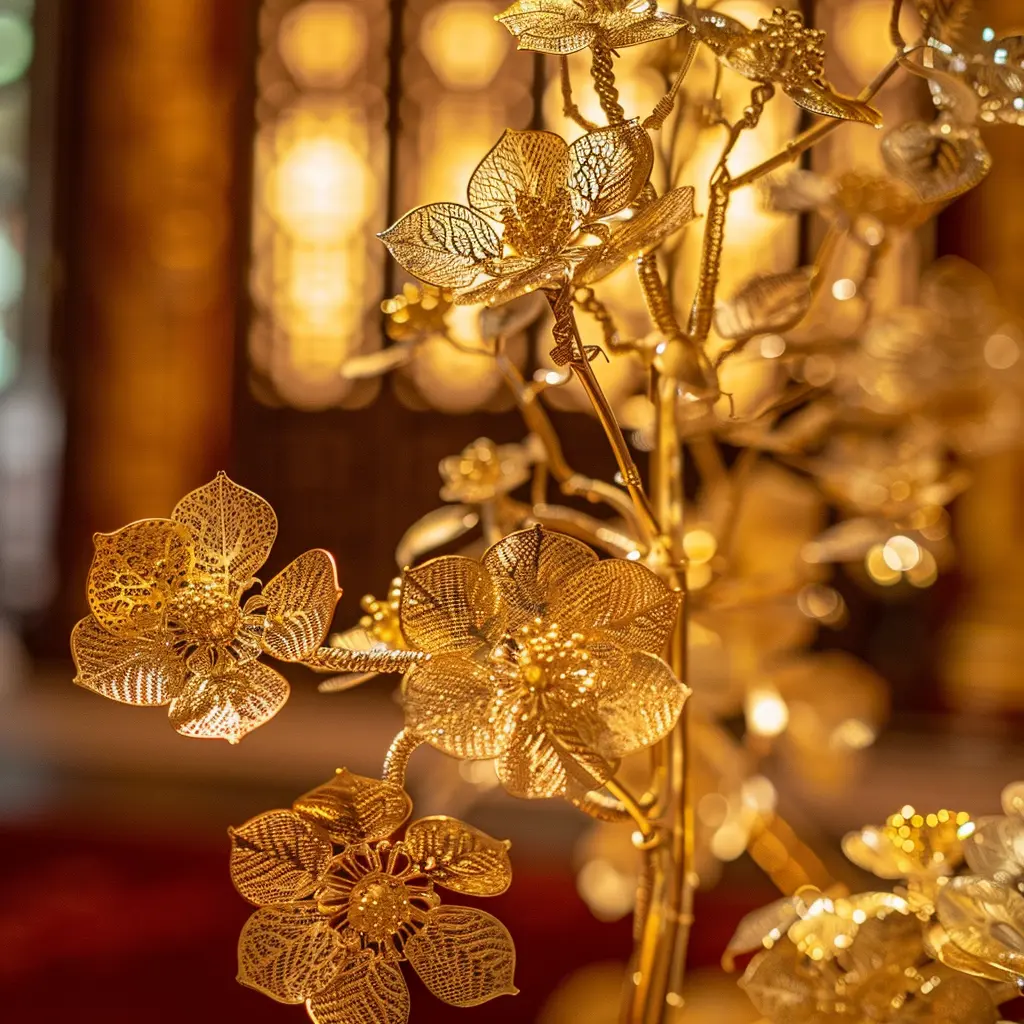
Every three years, a massive state caravan departed the northern tier of the Malay Peninsula. Commanded by royal envoys and accompanied by an escort of up to one hundred elephants, its cargo was the ultimate asset of regional branding: a pair of intricately wrought botanical sculptures known as the Bunga Mas dan Perak – the Golden and Silver Flowers.
Crafted by the finest goldsmiths of states like Patani, Kedah, and Kelantan, these delicate, 1.5-meter-tall trees bore hundreds of leaves inspired by the henna plant and blossoms modelled on coastal shrubs. Their destination was the Grand Palace in Bangkok.
In conventional colonial historiography, this practice is routinely catalogued as a straightforward “tribute”—a submissive tax levied by a dominant empire. But from a market strategy perspective, the Bunga Mas was a highly sophisticated form of corporate-sovereign risk management.
By fulfilling this ritual, the rulers of the Peninsula purchased something invaluable: total domestic autonomy. For the price of a beautifully executed artistic commission, kingdoms like Patani retained their laws, their trade revenues, their religious institutions, and their ruling dynasties.
It was an investment in geopolitical stability that kept the lucrative maritime trade routes open to Chinese junk captains, European merchants, and Arab traders.
The Strategic Ambiguity of Elite Gifting
In both international business and elite travel design, absolute clarity can sometimes flatten an experience; strategic ambiguity, however, preserves prestige. The golden trees were a masterclass in this concept.
To the Siamese court, the arrival of the trees was logged as an acknowledgment of suzerainty. Yet, to the Malay Sultans who commissioned them, the narrative was entirely different. According to regional chronicles like the Hikayat Patani, the tradition originated as a voluntary token of alliance, kinship, and mutual respect (tanda sepakat dan bersahabat).
This dual interpretation allowed both sides to maintain face without going to war. The Malay courts were signalling to Bangkok that they possessed the wealth, the infrastructure, and the artistic sophistication of an advanced civilisation. They were projecting power through patronage.
The Anatomy of a Prestige Packet
The Bunga Mas never travelled alone. It was the centrepiece of a meticulously curated “hospitality kit” designed to showcase the economic terroir of the maritime Peninsula:
The Curated Insight: Designing Beyond the Checkpoint
The practice of sending the Bunga Mas came to an abrupt halt with the signing of the Anglo-Siamese Treaty of 1909. With a few strokes of a pen, British administrators and Siamese diplomats drew a hard, artificial line across the map.
States like Kedah and Kelantan were folded into the British sphere of influence (now Malaysia), while the ancient Kingdom of Patani remained within Thailand’s borders.
The final chapter of this tradition occurred when the Sultan of Kedah had already prepared a final Bunga Mas for Bangkok. Because the treaty shifted control to the British Crown overnight, the golden tree was redirected to London instead, presented to King Edward VII as a marker of a new political era.
Ironically, those final artifacts vanished into the depths of British colonial archives, their physical whereabouts still debated by historians today.
But while the borders became rigid, the cultural terroir did not change. The families who hammered the gold, the culinary traditions that crossed the mountain passes, and the shared aesthetic language of the Peninsula remained intact.
When modern luxury travellers or high-net-worth residents cross the border between Northern Malaysia and Southern Thailand today, they are not entering an entirely alien space. They are moving through an ancient, fluid corridor of prestige and hospitality that was established centuries ago.
For travel designers, hoteliers, and investors looking at the Upper Peninsula today, the lesson is clear: cookie-cutter luxury travel itineraries fail here because they ignore this specific cross-border continuity.
True intellectual luxury lies in honouring the provenance of the corridor—understanding that long before there were passport checkpoints, there was a shared golden thread of diplomacy, craft, and mutual prestige.