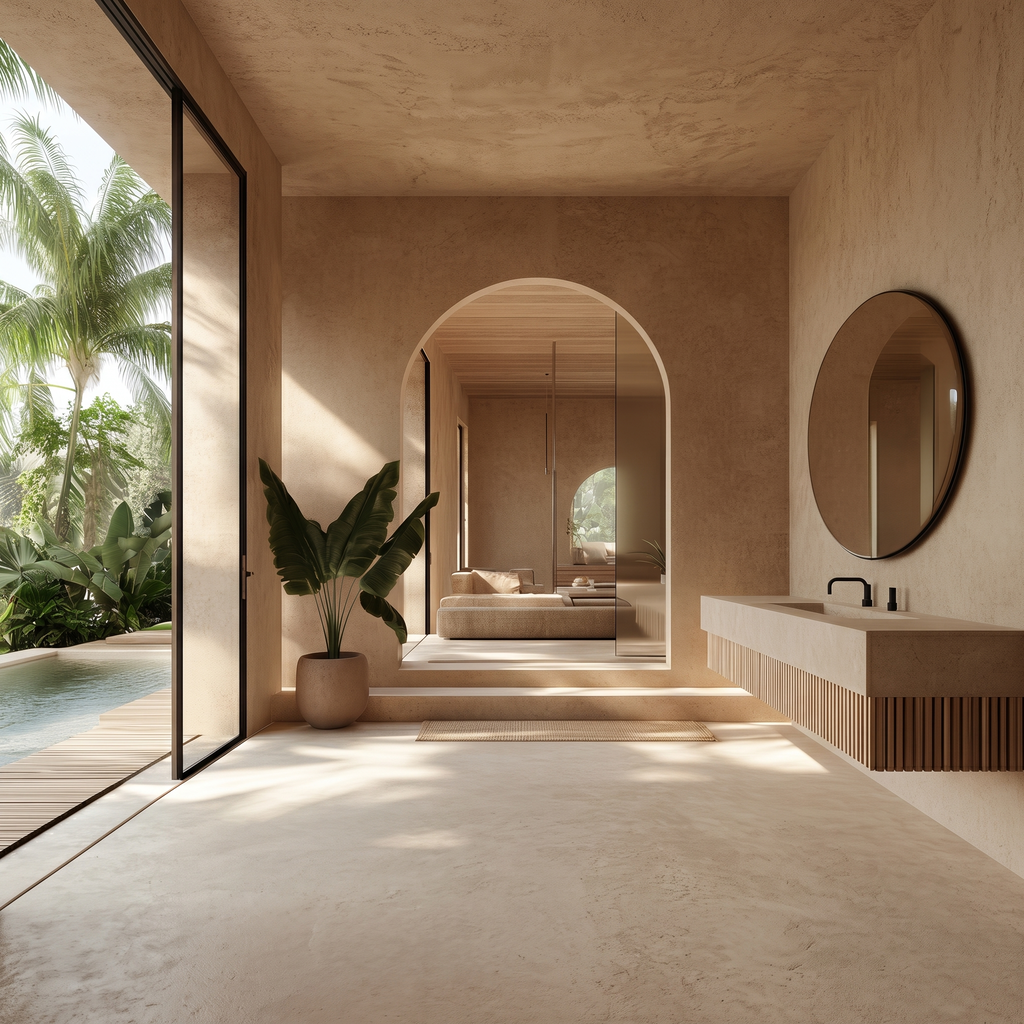

You wake up to the quiet hum of an air conditioner and open your eyes to a room that could literally be anywhere on Earth.
The walls are covered in trendy, smooth beige plaster. Over the sink, there’s an arched mirror with hidden warm lighting behind it, a sleek matte-black faucet, and an amber glass bottle filled with generic bergamot soap. Outside the floor-to-ceiling glass doors, a single potted monstera plant sits next to a pale blonde wood daybed.
Are you in Bali? Tulum? The hills outside Chiang Mai? A hipster neighbourhood in Lisbon?
It hardly matters. You haven’t crossed an actual border; you’ve merely checked into Banalistan.
Banalistan is not a real country on a map. It’s a borderless territory built by Instagram trends, digital nomad cafes, and cookie-cutter boutique hotel designs. Its main goal is simple: wipe out anything that feels distinct to a specific place.
For centuries, local weather, local trees, and local soil shaped building traditions. In the humid tropics, builders used wide roof overhangs to shed torrential rain, porous lime plasters that let walls breathe, open central courtyards that pulled cool air through living spaces, and interlocking teak timbers that shifted naturally with the seasons.
Banalistan scrapped all of that for an air-conditioned Pinterest board. Local culture is treated like background decoration: a framed piece of tribal weaving hanging on a flat concrete accent wall right next to a capsule espresso machine.
Every inch of the space is designed backwards from a smartphone camera. The pool isn’t built for swimming; it’s an infinity edge designed to frame a cocktail glass against the sunset.
The restaurant replaces local recipes with the same global cafe menu: a smashed avocado toast, an açai bowl dusted with chia seeds, and an oat-milk flat white. Breakfast arrives as the ultimate display of style over substance: a floating tray drifts in a plunge pool while eggs go cold in the morning heat.

The 30-Year Road to Banalistan
We did not arrive in this generic purgatory by accident. It took three decades of technological convenience, commercial copycatting, and algorithmic optimisation to pave over the eccentricities of the physical world.
The Eradication of Friction and the Veblen Trap
To understand why this playbook works, look at how modern travel confuses genuine comfort with sensory numbness.
Real travel has always required friction. It needs the disorientation of an uneven cobblestone alley, the unfamiliar smell of charcoal smoke and morning street food, the slight panic of a train schedule in a foreign script, and the quirks of an eccentric guesthouse owner who only takes cash.
Friction is the rough surface where human memory catches. Without it, the experience doesn’t stick; it just evaporates from your brain the second you tap your credit card at checkout.
Modern hospitality has spent the last decade hunting down and killing friction like a weed. In the process, it created spaces where nothing unexpected can ever happen.
This bubble caters to a very specific crowd: the laptop-working traveller of the remote creative class. Looked at through the lens of economist Thorstein Veblen, travel in Banalistan is rarely about genuine curiosity.
It’s an exercise in buying positional backdrops. The traveller doesn’t go to be shaped by a new culture; they go to rent an aesthetic set piece to signal freedom, good taste, and status to colleagues back home.
To sell this insulation, the industry invented a tired, hollow vocabulary:
The Generative Reckoning
Banalistan wasn’t built by interior designers alone; it was co-authored by search engine optimisation.
For fifteen years, every boutique hotel, resort owner, and travel blogger had to obey Google’s Page 1 crawler. To rank for high-value searches like “best luxury boutique hotel in [City],” everyone followed the same marketing playbook. Websites stuffed their pages with identical buzzwords: serene oasis, peaceful escape, sustainable luxury, barefoot elegance.
The internet became an echo chamber of the same ten adjectives describing the same five amenities. Soon, reality copied the search bots. Property developers realised that building what ranked well in a search bar was more profitable than building what suited the local land. If search engines rewarded the generic, developers would pour it in concrete.
Yet the ground is suddenly shifting beneath Banalistan’s feet.
As travellers move away from basic keyword searches and start asking conversational AI engines—like ChatGPT, Gemini, and Claude – for contextual trip advice, the old SEO tricks stop working.
Generative AI doesn’t care about a webpage stuffed with claims of being a “tranquil paradise.” When a model is asked for genuine heritage stays, it looks for entity clarity, verified structural provenance, and machine-readable historical fact.
When an AI engine evaluates a resort whose entire website is generic lifestyle fluff, it finds no real facts to recommend. The exact buzzwords that helped Banalistan dominate Page 1 for a decade now make it invisible in conversational search. The borderless republic is turning into digital vapour.
The Manifesto for Resistance
The fix for Banalistan isn’t a fancier cocktail lounge. The fix is provenance, texture, and unapologetic local character.
It lives in properties that refuse to apologise for what makes them different: the creak of hundred-year-old teak floorboards; the lack of an infinity pool because the central courtyard protects a massive tamarind tree; the sound of temple bells or the morning street market drifting through wooden shutters; the lime-plaster walls that stain and age naturally under the monsoon rains.
For hoteliers and creators, pushing back means ditching the global safety blanket. Stop building to a mood board. Stop serving the same brunch menu found in Brooklyn or Shoreditch when the family stall down the lane has spent sixty years perfecting a single regional dish.
Travel has to cost something in attention, patience, and a willingness to be a little uncomfortable. If it doesn’t challenge your senses or force you to navigate how another culture actually builds and lives, it is just an expensive change of wallpaper.
Let Banalistan keep its floating breakfasts and smooth beige plaster. The future belongs to places that actually dare to belong somewhere