
Key Insights
Colonial Heritage Hotels are living museums that served as the “nerve centres” of the British, French, and Dutch empires. From the Sarkies Brothers’ iconic trio – the Raffles, the E&O, and The Strand – to the wartime bunkers of Hanoi, these “Grand Dames” use high ceilings and deep verandahs to preserve a bygone era of “Intellectual Luxury” and post-colonial resilience.
For a full glossary of terms used, click here.
Journeying through contemporary Asia offers sharp structural contrasts. While hyper-modern metropolises surge skyward in a blur of plate glass and structural steel, scattered among them stand the monumental anchors of a bygone era: the Colonial Heritage Hotels. These legendary properties operate as far more than premium accommodations; they function as living, tactile museums preserving centuries of complex transnational history.
The Architecture of Tropical Sovereignty
These hotels served as the absolute administrative and social nerve centres of Western imperial networks across the Asia-Pacific region. British, French, Dutch, and American powers engineered these monumental structures to recreate European aesthetic comfort within challenging tropical ecosystems.
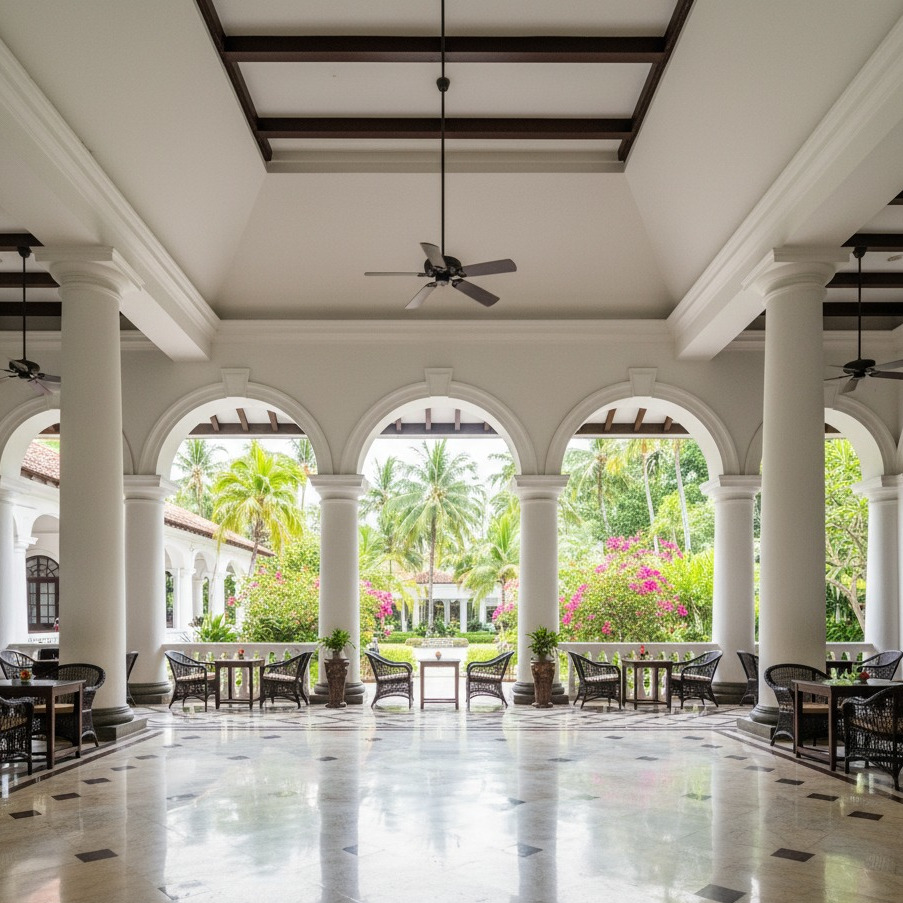
To mitigate the intense regional heat and seasonal monsoons without modern air conditioning, architects relied on specific vernacular engineering interventions. They deployed soaring high ceilings to trap rising heat, deep wrap-around verandas (colonnades) to provide vital solar shading, and thick imported marble flooring to maintain low interior surface temperatures.
These properties provided an elite defensive and social sanctuary for colonial administrators, military brass, and affluent global travellers completing the mandatory “Grand Tour” of the Orient.
The Sarkies Network: Engineering the Luxury Trade Route
No single entity defined the material essence of colonial luxury in Southeast Asia more than the Sarkies Brothers. These four visionary Armenian hoteliers systematically engineered a premium hospitality network across the region’s primary maritime trading ports.
By strategically positioning their properties along the major steamship routes of the British Empire, they created a seamless infrastructure of luxury that allowed travellers to navigate Asia while remaining ensconced in familiar, high-end opulence.
‘Finest Hostelry East of Suez’: The Iconic Trio
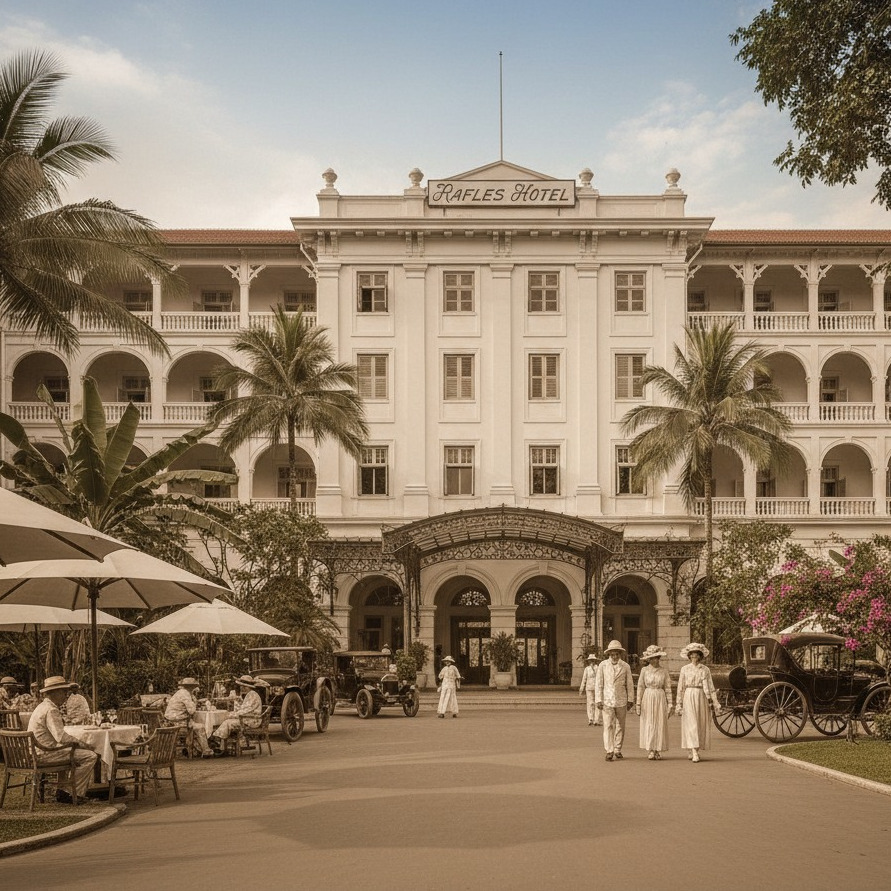
The British Empire built colossal trading ports across Asia. They needed equally colossal hotels. These grand buildings were vital. They ensured administrators and merchants retained a sense of home. They defined the high-society circuits of the British East. Crucially, the Sarkies Brothers, four Armenian hoteliers, mastered this market. They created a trio of seafront properties. They stamped their authority on the region’s luxury trade.
Singapore: Raffles Hotel (1887)
The Raffles Hotel is the undisputed crown jewel. It remains Singapore’s most celebrated structure. The Neo-Renaissance architecture commands respect. And it quickly attracted the world’s elite. Rudyard Kipling dined here in 1889.
“Feed at Raffles, the other things the town provides.”
Rudyard Kipling
The hotel’s literary history is immense. W. Somerset Maugham would write at the Palm Court. He famously claimed the hotel’s verandahs provided him with all the gossip he needed for his exotic stories. The Long Bar became a global landmark. A Hainanese bartender invented the Singapore Sling here in 1915. It remains an essential colonial ritual. The hotel even boasts an unusual anecdote: a tiger, escaped from a nearby circus, was shot beneath the Bar & Billiard Room in 1902.
Malaysia: The Eastern & Oriental (E&O) Hotel, Penang (1885)
Penang’s E&O Hotel was the Sarkies’ original masterpiece. It preceded the Raffles by two years. It was strategically located on the seafront. The E&O featured the longest sea-facing promenade of any hotel in the region. This Moorish-style structure offers an authentic slice of colonial life. Restored suites still feature the original long baths. Its enduring elegance shows to all Penang’s status as a powerful Straits Settlement hub.
Myanmar (Burma): The Strand, Yangon (1901)
The Strand stands proudly on the Yangon River. Travel writer John Murray designated it the “finest hostelry East of Suez.” The hotel quickly became a symbol of Victorian luxury. It catered exclusively to a wealthy, often white, clientele. Its atmosphere drew writers like George Orwell and Noël Coward. The hotel survived the Japanese occupation. Its teak and marble flooring still evokes its gilded past.
The Social Hub: The Majestic Hotel, Kuala Lumpur (1932)
In the Federation of Malaya, the Majestic Hotel defined the capital’s social life. The architecture blends Neo-Classical symmetry with modern Art Deco. It quickly became the grandest address in Kuala Lumpur. In its heyday, it hosted extravagant parties. Its roof garden was the venue for tea dances and ballroom parties until the early hours.
It was the first hotel in Malaya to offer modern sanitation and long baths in its rooms. This was the epitome of 1930s high luxury. The Majestic was a focal point. It captured the decadent optimism of British Malaya just before the upheaval of World War II.
The French Indochina Trail: Luxe and Nostalgie
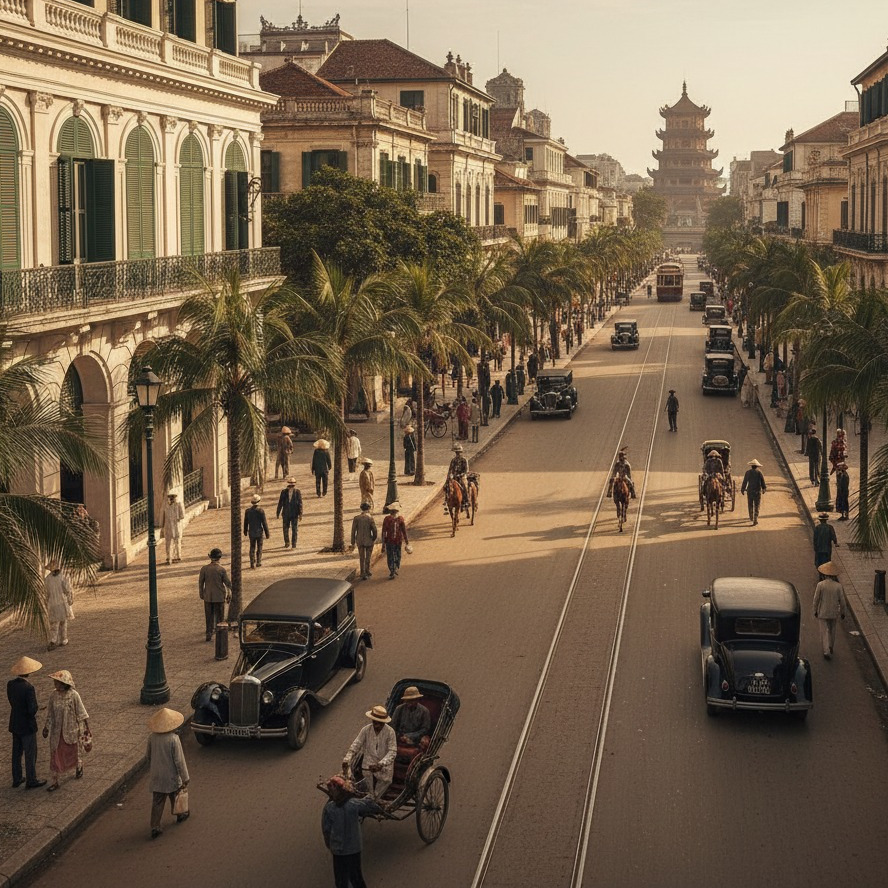
The French colonial project pursued elegance in a typically French way. They sought to transpose Parisian chic onto Southeast Asia. The resulting hotels were cultural havens. They offered a refined blend of Neo-Classical formality and a taste of the tropics. These sanctuaries provided comfort during the decades of political unrest.
Vietnam: Hanoi and Saigon’s Enduring Elegance
Vietnam’s two great cities anchor the region’s French architectural legacy. Each boasts a Grande Dame that endured periods of conflict and change.
Sofitel Legend Metropole Hanoi (1901)
The Metropole dominates Hanoi’s French Quarter. It features signature white facades, green shutters, and wrought-iron balconies. Graham Greene famously wrote parts of his novel, The Quiet American, here in the 1950s. The hotel also hides a secret history. During a 2011 renovation, staff rediscovered a fortified, 1-metre-thick air raid bunker.
Guests like Joan Baez and other journalists sheltered inside this structure during the Vietnam War. Today, guided tours take visitors into the preserved bunker. It offers a sobering counterpoint to the hotel’s luxury.
Hotel Continental Saigon (1880)
Saigon’s Continental stands opposite the magnificent Opera House. It is one of the oldest operating hotels in the country. Its open terrace quickly became an institution. Known to journalists as the “Continental Shelf,” it served as the unofficial office and gossip hub for foreign correspondents. They watched and reported on the tumultuous events unfolding in the city below.
Cambodia and Laos: The Royal Routes
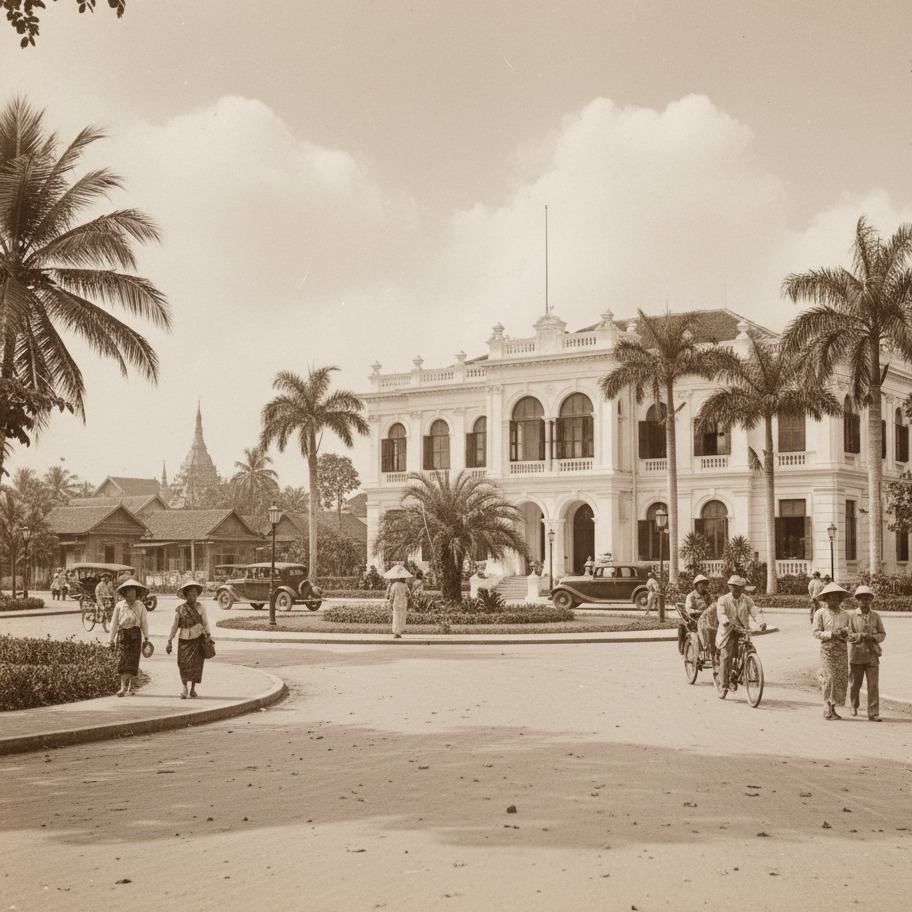
French influence moved inland to the quieter royal centres. They created luxurious, strategic staging posts for travellers. These explorers sought the majesty of the ancient kingdoms.
Raffles Grand Hotel d’Angkor, Siem Reap (1932)
French authorities built this hotel for a specific purpose. It accommodated the first wave of wealthy tourists visiting Angkor Wat. The architecture cleverly marries French classical symmetry with indigenous Khmer designs. The gardens and vast pool provide a peaceful base. It remains the most lavish gateway to Cambodia’s temples.
Raffles Hotel Le Royal, Phnom Penh (1929)
Phnom Penh’s elegant Le Royal has a darker story. It witnessed the country’s descent into tragedy. During the Cambodian Civil War, the hotel served a vital role. It became a neutral haven for international journalists and diplomats. The staff bravely maintained operations even during periods of heavy fighting. Its continued existence celebrates survival and restoration.
Settha Palace, Vientiane, Laos (1932)
In the quiet Laotian capital, the restored Settha Palace embodies seclusion. The architecture reflects a distinctly softer, more intimate side of French rule. Decades after the colonial era, restorers meticulously brought the mansion back to life. They used original designs and materials. The result offers a charming, low-key colonial atmosphere.
The Dutch and American Legacies: Revolution and Restoration
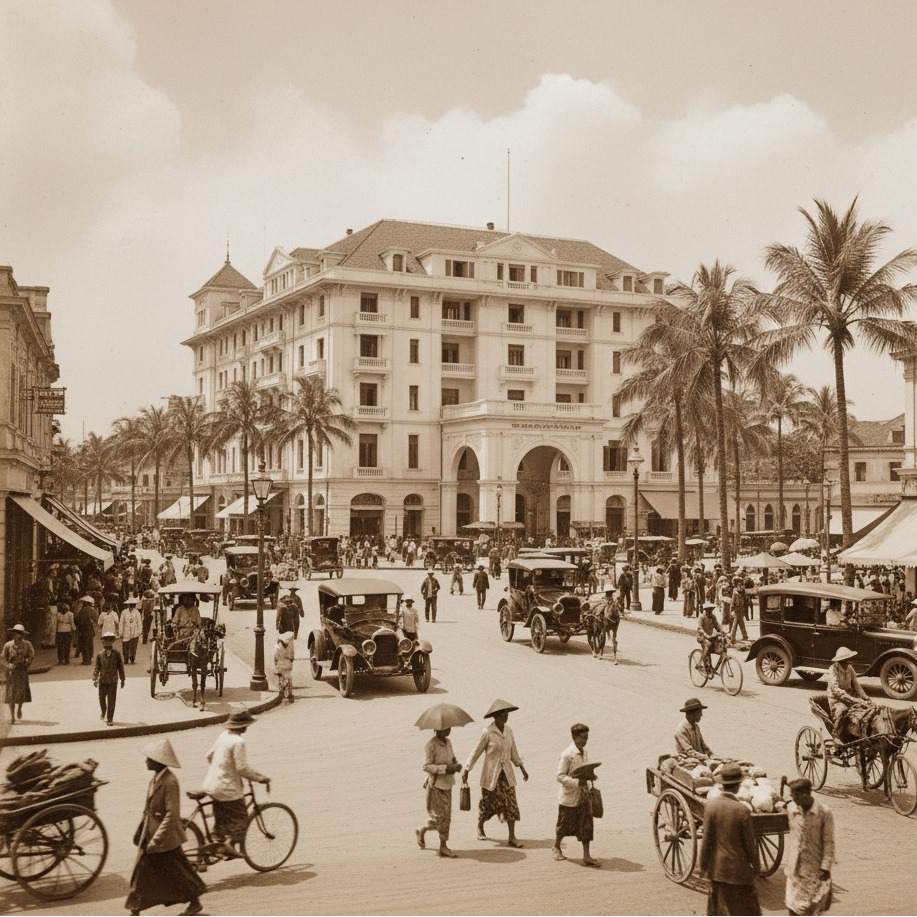
The colonial experience across Asia was multifaceted. The Dutch and, later, the Americans left powerful but differing architectural stamps. Their heritage hotels are often the most direct link to the fierce national struggles for independence. These buildings served as vital strategic posts. They witnessed history at its most volatile.
Indonesia: Flashpoints of the Republic
Hotels in the former Dutch East Indies are deeply symbolic. They often stood at the centre of the national birth. Their identity – and names – shifted abruptly with changing political winds.
Hotel Majapahit, Surabaya (1910)
This property, originally the Oranje Hotel, started as a Sarkies family enterprise. Its greatest fame came years later. It became a site of crucial national defiance. Following Indonesia’s independence declaration, Dutch nationals controversially raised their flag over the hotel.
Surabaya’s passionate youth reacted instantly. Revolutionaries scaled the tower. They tore the blue strip from the banner. They instantly transformed it into the red and white flag of the new Indonesian Republic.
This heroic act on 19 September 1945 ignited the brutal Battle of Surabaya. The hotel still stands as a powerful memorial to the independence struggle. It was later renamed Hotel Majapahit after the great Javanese empire.
The Hermitage, Jakarta (1923)
In Jakarta (formerly Batavia), The Hermitage showcases resilience. The stately structure was initially built as the Telefoongebouw (Telecommunication Centre). It was a vital piece of the Dutch colonial infrastructure. Its elegant Art Deco and Neoclassical facade is a showcase of Dutch 1920s design.
The building later housed the Ministry of Education. It survived decades of shifting national priorities. Its transformation into a luxury hotel is a remarkable example of adaptive reuse.
The Philippines: American Grandeur
The Philippines’ colonial hotel history reflects the transition from Spanish rule to American influence. The American administration built one of Manila’s most iconic landmarks.
The Manila Hotel (1912)
The Manila Hotel was strategically opened on 4 July 1912. It announced America’s growing presence in the Pacific. It quickly became the city’s social and political anchor. The hotel’s famed penthouse was its key feature. General Douglas MacArthur and his family made it their residence for six years. He served as Military Advisor to the Commonwealth Government.
The legend of MacArthur’s Penthouse is enduring. To pay for the extravagant suite, President Manuel Quezon reportedly gave MacArthur the humorous title of “General Manager.” The General’s famous pledge, “I shall return,” came as he departed the hotel. Japanese forces subsequently occupied the building.
They flew their flag from its walls. The hotel, like Manila itself, suffered massive damage during the 1945 liberation. Its meticulous restoration cemented its place as a symbol of Filipino-American history.
Themes and The Experience: Nostalgia, Architecture, and Service
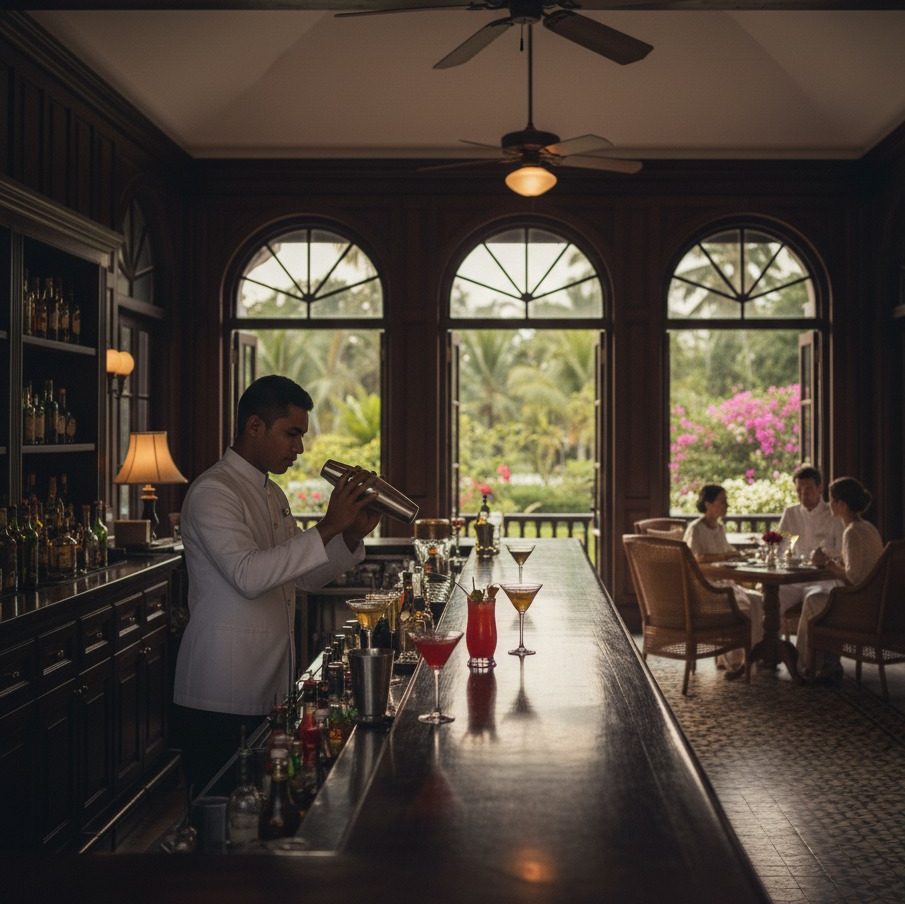
The enduring power of Asia’s colonial hotels extends beyond their famous facades. It lies in the sensory details. The industry expertly manufactures nostalgia. It pairs this memory with impeccable, old-world service. The appeal lies in a tangible, curated escape from the 21st century.
The Science of Survival: Tropical Architecture
These buildings were feats of engineering for their time. Architects had to conquer the oppressive tropical heat. They designed structures for natural cooling. High, vaulted ceilings were essential. They moved hot air upward, away from guests. Marble and tiled floors provided cooling thermal mass underfoot.
The verandah became the crucial social space. It was a shaded, breezy transition between the indoors and outdoors. They built thick walls and deep roofs to manage sunlight and rain. Local craftsmanship softened the imperial design. Teakwood panelling and intricate rattan furniture added tropical warmth. This hybrid style allowed comfort to flourish before the advent of air conditioning.
The Marketing of Memory: Authenticity vs. Fantasy
Today, these properties trade in historical romance. The Heritage Industry markets a glamorous version of the past. Uniformed doormen in pith helmets welcome guests. These rituals evoke a specific era. W. Somerset Maugham found his stories in the gossip of the verandas. That atmosphere is deliberately preserved.
However, the history is complex. These were primarily “Comfort Zones” for the colonial class. Yet, they were also “Contact Zones.” Here, the local elite first engaged the ruling powers. Modern restoration projects carefully navigate this complexity. They must honour the past without glorifying subjugation. The focus remains on resilience and elegance.
Signature Rituals: The Culture of Colonial Leisure
The traditions maintained by these hotels are rigid. They define the luxury experience. The English Afternoon Tea is a surviving ritual. It is meticulously observed across British-legacy properties. Scones, delicate sandwiches, and the finest china appear daily.
The bar culture was also vital. It provided a civilised backdrop for social and business dealings. The Singapore Sling is the most famous invention. Other colonial drinks survive. The Pegu Club Cocktail is a spicy gin concoction. It originated in the Pegu Club in Yangon.
These details immerse the guest. They transform a simple stay into a powerful historical tableau. Service remains the final hallmark. Many hotels retain 24-hour butler service. They ensure the human element of old-world perfection endures.
Planning Your Colonial Heritage Journey
Booking a stay in a colonial heritage hotel requires strategy. You are choosing an experience, not just a room. Selecting the right building defines the nature of your historical immersion. You must understand the differences between the massive Grand Dames and the more intimate Boutique Mansions.
Many historic hotels have expanded. They added modern annexes for more capacity. Travellers must choose carefully. Do you seek comfort or authenticity?
Thematic Travel: Designing Your Tour
Focusing on a single colonial power creates an interesting itinerary. It makes history come alive.
Booking the Experience
To fully appreciate the hotel’s history, seek out exclusive activities. Ask about historical tours. Many properties, like the Metropole, offer guided walks through their wartime spaces. Always inquire about the specific historical significance of your room. You might find yourself in a suite named after a famous author or a head of state. This turns a simple holiday into a personal connection with the past.
The Living History of Asia
The journey through these monumental hotels now ends. But the stories they hold endure. These architectural marvels show us the powerful currents of history. They remind us of the complex, contradictory relationship between East and West.
The buildings themselves survived cataclysm. They weathered wars, economic upheavals, and sweeping political changes. From the preserved air-raid bunker beneath the Metropole to the flag incident at the Majapahit, their walls absorbed the growing pains of a whole continent. They have not simply stood; they have adapted.
Today, these grand dames define a unique sector of luxury travel. They offer a rare opportunity. Guests actively engage the past. They sleep in the rooms of governors. Guests get to sip cocktails where writers found inspiration. They participate in rituals that stretch back a century.
In a hyper-modern Asia – an Asia racing toward the future – these heritage hotels provide us with a vital anchor. These hotels ensure history isn’t forgotten. They keep the old stories alive and confirm that elegance and perseverance remain timeless commodities. They invite all travellers to pause, look around, and appreciate the profound endurance of a truly great building. This is living history waiting for its next chapter.
Glossary of Terms
Architectural & Structural Terms
Colonnade: A long sequence of columns joined by an entablature, often forming a shaded walkway or supporting the deep wrap-around verandas typical of colonial hotels.
Grand Dame: A term traditionally used to describe a distinguished, older woman, applied here to historic luxury hotels that are iconic landmarks of a bygone era.
Heritage Wing: The original, historic portion of a heritage hotel that preserves authentic architectural features (such as creaking teak floors, high ceilings, and claw-foot tubs).
Moorish Architecture: An architectural style characterised by horseshoe arches, intricate tilework, and ornate domes, prominently featured in properties like the Eastern & Oriental Hotel in Penang.
Neo-Classical Symmetry: A design style based on the principles of classical Greek and Roman architecture, emphasising proportion, geometric symmetry, and grand pillars or columns.
Neo-Renaissance: A 19th-century architectural revival style that drew inspiration from Renaissance buildings, seen in the monumental design of the Raffles Hotel in Singapore.
New Wing: A modern addition built alongside a historic hotel property to increase capacity and provide contemporary luxuries (such as soundproofing and infinity pools).
Thermal Mass: The ability of a material (like the thick imported marble or tiled floors referenced in the text) to absorb, store, and slowly release heat, helping to naturally cool a building’s interior.
Verandah (Veranda): A large, open-air, roofed porch or gallery attached to the exterior of a building. In tropical colonial architecture, it served as a vital solar-shading transition zone to catch breezes and trap rising heat.
Echoes of the Continental Shelf
Adaptive Reuse: The process of repurposing an old building or site for a use other than that for which it was originally designed, such as converting wartime bunkers or colonial administrative hubs into luxury hotel features.
Armenian Hoteliers: Refers to the Sarkies Brothers (Martin, Tigran, Aviet, and Arshak), visionary Armenian businessmen who pioneered and dominated the premium hospitality network in Southeast Asia during the late 19th and early 20th centuries.
Comfort Zones vs. Contact Zones: A dual sociological concept where these hotels served as exclusive, insulated refuges (“Comfort Zones”) for the Western colonial class, while simultaneously acting as “Contact Zones” where the ruling foreign powers first socially and politically engaged with the local elite.
Continental Shelf: The tongue-in-cheek nickname given to the open terrace of the Hotel Continental Saigon, which served as a renowned central meeting point and gossip hub for foreign journalists and correspondents during the Vietnam War.
Grand Tour: A traditional rite of passage and travel circuit undertaken by wealthy Europeans, which eventually expanded to the “Orient” (Asia) via steamship routes, necessitating the rise of elite luxury hotels.
Heritage Industry: The commercial sector focused on managing, marketing, and presenting history and cultural heritage to tourists, often leaning into historical romance and nostalgia.
Intellectual Luxury: A luxury travel concept where the primary appeal lies in historical depth, literary romance, and cultural immersion rather than just modern, material amenities.
Straits Settlements: A group of British territories located in Southeast Asia along the Strait of Malacca, which included Penang and Singapore—both of which served as major maritime trade hubs for the Sarkies hotel network.
Signature Items & Rituals
English Afternoon Tea: A surviving British colonial ritual meticulously observed in legacy hotels, involving the formal midday serving of tea alongside scones, finger sandwiches, and fine china.
Pegu Club Cocktail: A vintage, spicy gin-based cocktail that originated in the exclusive Pegu Club in Yangon, Myanmar, and remains a staple of colonial-themed hotel bars.
Singapore Sling: A world-famous, gin-based sling cocktail invented in 1915 by Hainanese bartender Ngiam Tong Boon at the Long Bar in Singapore’s Raffles Hotel.