
For the modern luxury travel advisor, curating an itinerary for an ultra-high-net-worth individual (HNWI) has evolved far beyond securing a five-star rating or an upgraded room category. Today’s intellectual traveller – the conscious connoisseur – demands a rare luxury commodity that cannot be corporate-manufactured: provenance.
When an elite client invests in a heritage journey through regions like the Straits of Malacca or the ancient kingdoms of Northern Thailand, they are not merely paying for premium linen and a dedicated butler. They are paying to sleep inside an active historical narrative.
However, the rapid rise of heritage tourism has birthed a challenging market phenomenon: heritage-washing. Across Southeast Asia, historic properties are frequently retrofitted with superficial design cues – velvet drapes, faux-distressed wood, and mass-produced retro tiles – to mask a complete lack of structural and narrative authenticity.
To preserve your standing as an elite advisor, you must possess the critical vocabulary to audit a property’s true architectural integrity. This master matrix serves as your diagnostic framework to separate true preservation from surface-level curation, allowing you to confidently justify premium nightly rates to your most discerning clients.
🔍 THE QUICK-SCAN HERITAGE AUDIT
How do you spot true architectural preservation versus superficial, mass-market “heritage-washing”? Look for these 5 structural markers before you book:
🏛️ 1. THE SPATIAL LAYOUT
- Authentic: The original historic sequence of open-air courtyards, airwells, and transitional reception halls is completely intact.
- Faux: Central airwells are sealed off with concrete or glass for modern HVAC efficiency, and the layout is entirely gutted to create generic, open-plan western suites.
🧪 2. THE MATERIAL INTEGRITY
- Authentic: Structural restoration relies on traditional slaked lime plaster, natural mineral pigments (like indigo washes), and reclaimed regional timber.
- Faux: Historic brick is covered in modern acrylic paints and concrete patches, mixed with mass-produced, chemically distressed faux wood.
🎨 3. THE NARRATIVE CURATION
- Authentic: Every antique, artwork, and textile corresponds directly to the specific era, family lineage, or trade network that built the estate.
- Faux: “Cultural scrambling”—such as dropping 1920s colonial European artifacts into a 19th-century Chinese courtyard house with zero contextual logic.
💨 4. THE CLIMATE ENGINEERING
- Authentic: The property honours the past by utilising passive tropical ventilation, soaring ceiling heights, and structural eaves for natural shading.
- Faux: The property is turned into an enclosed glass box entirely reliant on constant, heavy artificial cooling to stay habitable.
🌱 5. THE ENCLAVE CONTINUITY
- Authentic: The property operates as a living archive, actively documenting its history and deeply integrating with the surrounding local historic community.
- Faux: A completely isolated luxury bubble that treats the local neighbourhood as a mere aesthetic backdrop rather than an ecosystem.
1. Spatial Authenticity and Layout Integrity
True architectural heritage is rooted in spatial intent. Historic buildings were constructed to reflect the social hierarchies, climatic demands, and spiritual geometries of their respective eras. When a property undergoes adaptive reuse into a luxury boutique hotel, the primary marker of integrity is how much of this original spatial flow has been preserved.
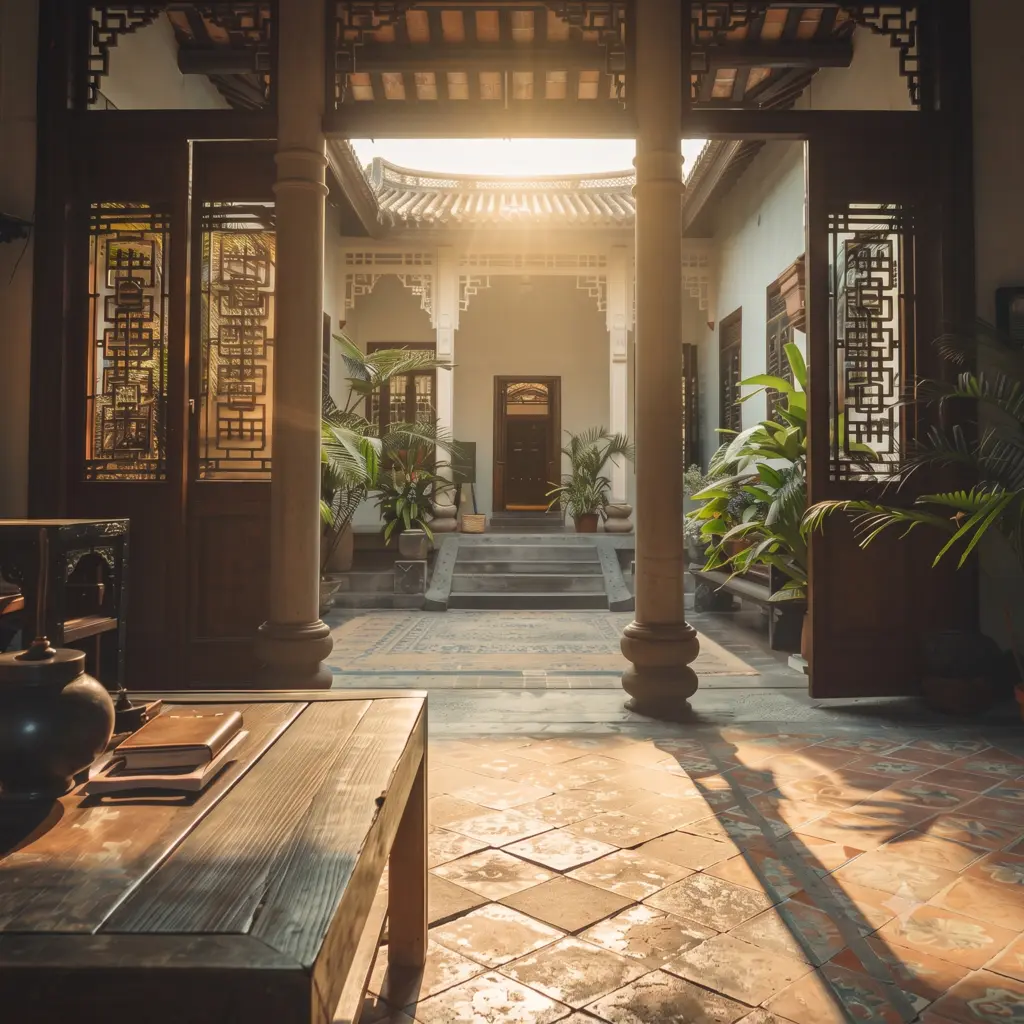
In the historic trading ports of the Straits Settlements, wealth and status were written directly into the depths of the architecture. An authentic conservation property will preserve the traditional sequence of reception halls, transitional thresholds, and open-air courtyards.
The Litmus Test: If a heritage hotel has walled off its central airwells to maximize air-conditioning efficiency, or demolished its structural layout to create generic, open-plan western suites, it has sacrificed its spatial authenticity.
An advisor should look for properties that embrace the architectural quirks of the past. For example, a genuinely preserved Peranakan residence will retain the interplay of light and shadow dictated by its original open courtyards, using structural design rather than modern partitions to define its spaces.
2. The Materiality of Conservation
Fresh paint can hide a multitude of structural sins. A museum-grade heritage asset treats the material composition of a building with absolute reverence, utilising traditional restoration chemistry rather than modern shortcuts.
In tropical Southeast Asia, historic masonry was engineered to breathe. Traditional buildings utilised a delicate combination of slaked lime plaster, organic binders, and natural mineral pigments. This allowed moisture to pass through centuries-old brickwork seamlessly, preventing decay.
Modern, superficial renovations frequently coat these historic walls in standard acrylic paints, trapping moisture within the masonry and permanently damaging the structural core.
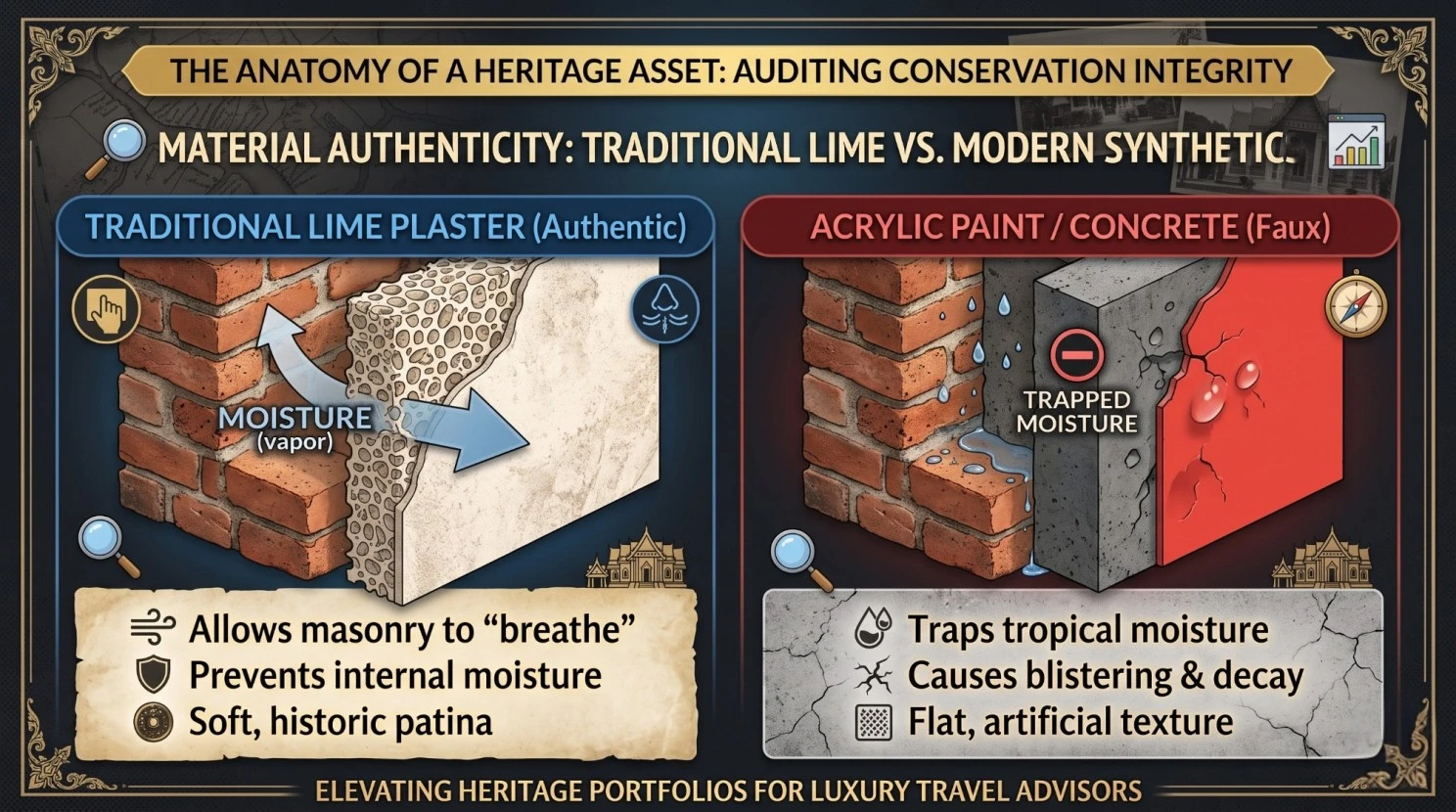
When auditing a property for your client, look closely at the finishes. True luxury preservation reveals itself in the soft, slightly irregular patina of hand-sponged indigo washes, the imperfections of reclaimed timber, and the presence of original encaustic or terracotta floor tiles that bear the wear of generations.
3. Narrative Continuity and Curation
A genuine heritage asset does not treat history as a decorative theme; it treats it as an unbroken lineage. Heritage-washed properties often mix distinct regional dynamics without context.
True editorial authority requires narrative continuity. The antiques, artwork, and textiles within a property should correspond directly to the specific era, family lineage, or trade network that birthed the structure. If a property in Chiang Mai claims Lanna heritage but fills its spaces with generic, imported colonial reproductions from across the continent, the narrative breaks.
The elite heritage hotels in your portfolio should function as living archives. The curation must feel deliberate, preserving the stories of the merchants, tycoons, or royal lineages who originally walked those corridors, allowing your clients to engage with authentic regional legacies.
The Diagnostic “Red Flags”: Spotting the Faux Heritage Hotel
When reviewing a new property or evaluating a sales pitch from a resort representative, train your eye to watch for these three common structural red flags:
The Provenance Premium: Justifying the Cost to HNWIs
When a client questions why an authentic, 20-room heritage mansion commands a premium nightly rate over a sprawling, newly built mega-resort down the coast, the LTA’s role transitions from a booking agent into an advisor of value.
Authentic assets purposefully limit their room inventory to preserve the historic property’s original structural load and spatial flow. The nightly rate does not merely cover lodging; it funds the intensive amortisation of museum-grade preservation, master craftsmanship, and ongoing archive maintenance.
Instruct your clients to view their stay not as a standard hotel booking, but as a direct investment in the safeguarding of regional history – an exclusive luxury that mass hospitality cannot replicate.