

Key Insights
Phuket’s heritage is a story of maritime crossroads and immense mineral wealth. Beyond the beaches lies a “Sino-Portuguese” world forged by 19th-century tin barons and protected by the heroic Lady Chan and Lady Muk.
From the ornate mansions (Ang Mor Lao) of the Old Town to the industrial echoes of the mining trails, Phuket offers a deep, architectural dive into the resilient Peranakan identity.
Ang Mor Lao: Literally translating to “Red Hair Mansions,” these grand European-style estates were built by wealthy Chinese tin barons.
Cassiterite: The heavy, high-grade tin ore that triggered a chaotic, high-stakes land rush across Phuket’s wild-west frontier.
Five-Foot Way: A sheltered, five-foot-wide covered pedestrian walkway built into the facade of traditional Sino-Portuguese commercial shophouses.
Peranakan: A distinct, elegant culture formed through the intermarriage of immigrant Hokkien Chinese men and local women.
Thalang: The historic name of Phuket Island, central to early maritime trading maps and local resistance history.
Chao Leh: The nomadic sea gypsies who represent Phuket’s earliest indigenous population, subsisting on coastal fishing and diving.
Act I: The Labour Machine
To understand the architecture of Old Phuket Town, one must first understand the mud of Kathu.
In the mid-to-late 19th century, the global industrial revolution hit a fever pitch. Western empires needed tin for canning factories, feeding armies and maritime fleets. Phuket sat on a massive, prehistoric vault of high-grade cassiterite. Consequently, it suddenly became the region’s wild-west frontier.
This was not an orderly, state-directed corporate venture. Instead, it was a chaotic, high-stakes land rush. Thousands of young, impoverished Hokkien Chinese men crossed the Andaman Sea. They landed on an island covered in dense, malaria-ridden jungle. Eventually, they were pushed into the interior to work the open-cast mines of Kathu.
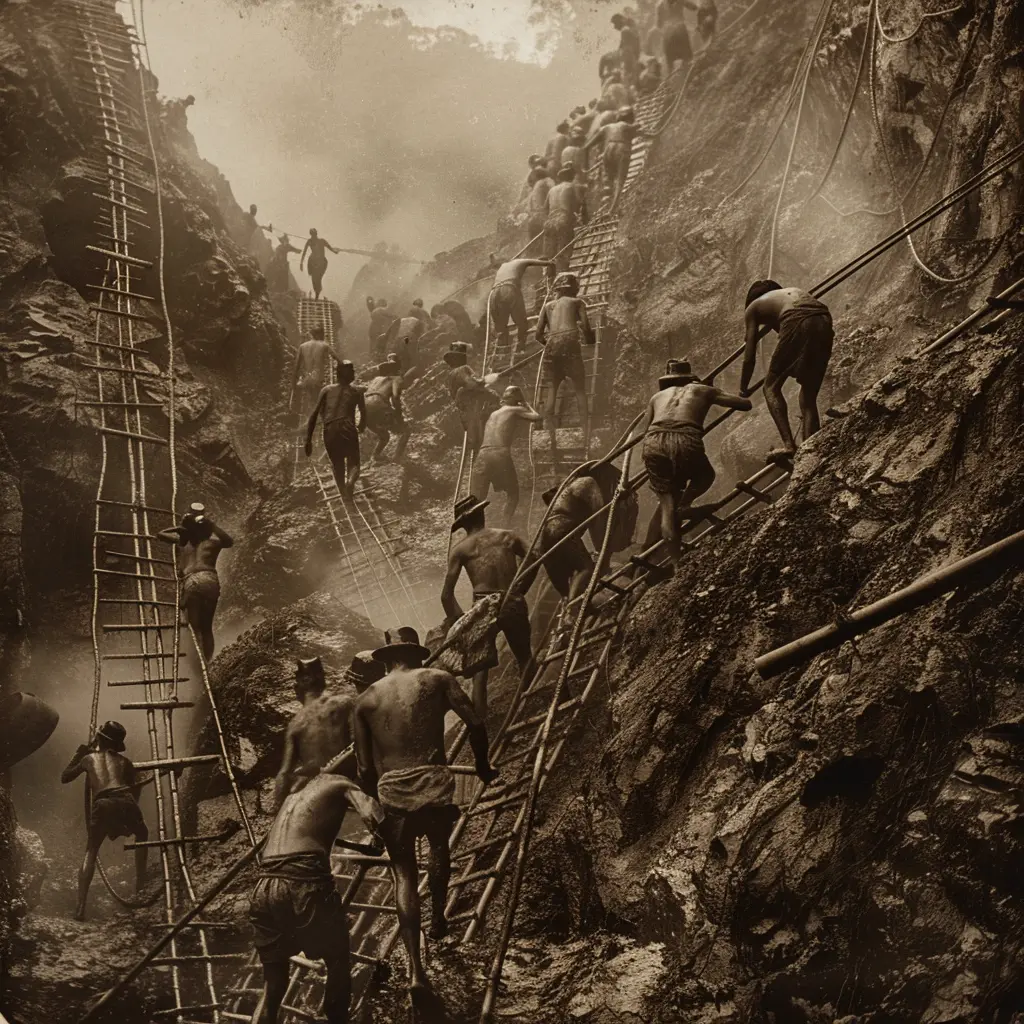
The work was brutal and kinetic. Labourers spent twelve hours a day waist-deep in toxic, shifting clay. They hacked away at pit walls with basic picks and iron shovels. Human chains carried heavy bamboo baskets of raw earth up treacherous, rain-slicked ladders. The mortality rate from tropical fevers, flash floods, and sudden mud wall collapses was staggering.
The Siamese state, operating from distant Bangkok, lacked the administrative machinery to govern this sudden influx of thousands of foreign labourers. Into this governance vacuum stepped the Ang Yee.
The Parallel State
Modern histories often generalise the Ang Yee as mere criminal syndicates or Triads. Literally meaning “Red Banner,” they were actually highly organised corporate and social survival mechanisms. In a frontier lacking courts, police, or hospitals, the secret society provided a migrant’s sole source of identity and protection.
The Ang Yee functioned as a parallel government with absolute authority. They managed the complex logistics of shipping ore, enforced contract law between mine owners and workers, and provided basic welfare for the families of dead labourers.
But their control relied on a closed economic loop fueled by the infrastructure of vice. The secret societies held the monopolies on the three things that kept the exhausted labour force compliant:
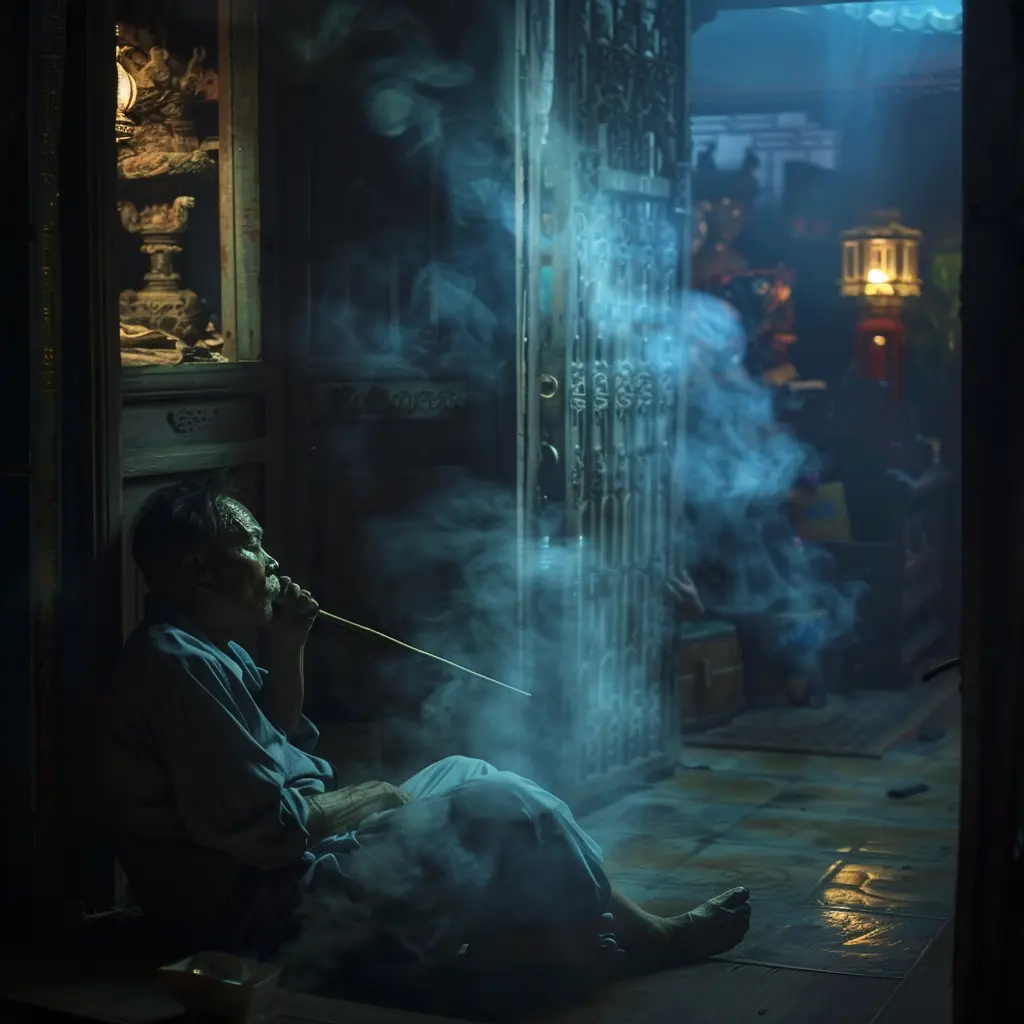
The architecture of Phuket’s earliest urban streets developed specifically to house this volatile ecosystem. The long, narrow shophouses weren’t designed for quaint retail; they were deep, modular compounds. An innocent-looking fabric or spice storefront on Thalang Road frequently hid internal, elevated platforms for opium smoking, reinforced counting rooms for gambling rackets, and hidden rear exits leading to tidal canals for smuggling illicit ore out of sight of royal tax collectors.
This was a highly profitable, deeply tense ecosystem. It was an industry built entirely on cheap labour, fragile environmental conditions, and the absolute authority of the secret society bosses. By the mid-1870s, as the pits grew deeper and the global economy began to shift, this volatile machine was running dangerously hot.
Act II: The 1876 Angyee Rebellion
By the dry season of 1876, the internal pressure inside Phuket’s labour machine reached critical mass. The global tin market, hit by a post-war economic slowdown in the West, experienced a sharp price correction. Suddenly, the thin margins that kept the mine operators profitable and the labourers fed vanished.
Then, the water stopped flowing.
Late 19th-century tin mining required a steady, heavy water supply to run the wooden sluices. These sluices separated heavy cassiterite ore from the surrounding clay. A severe, protracted seasonal drought baked the island.
This hardened the open pits into concrete and brought industrial production to a grinding halt. Thousands of Hokkien labourers sat idle in the squalid camps of Kathu, unpaid, desperate, and facing starvation.
The final spark was structural. Attempting to modernise its revenue streams, the royal court in Bangkok adjusted its tax-farming system (Mhao Muang). The new regulations placed aggressive revenue enforcement directly onto local Siamese authorities. This squeezed the Chinese mine managers. In turn, they passed the financial pain down to the labourers.
The Ang Yee did not negotiate. They mobilized.
The Night the Streets Turned to Fire
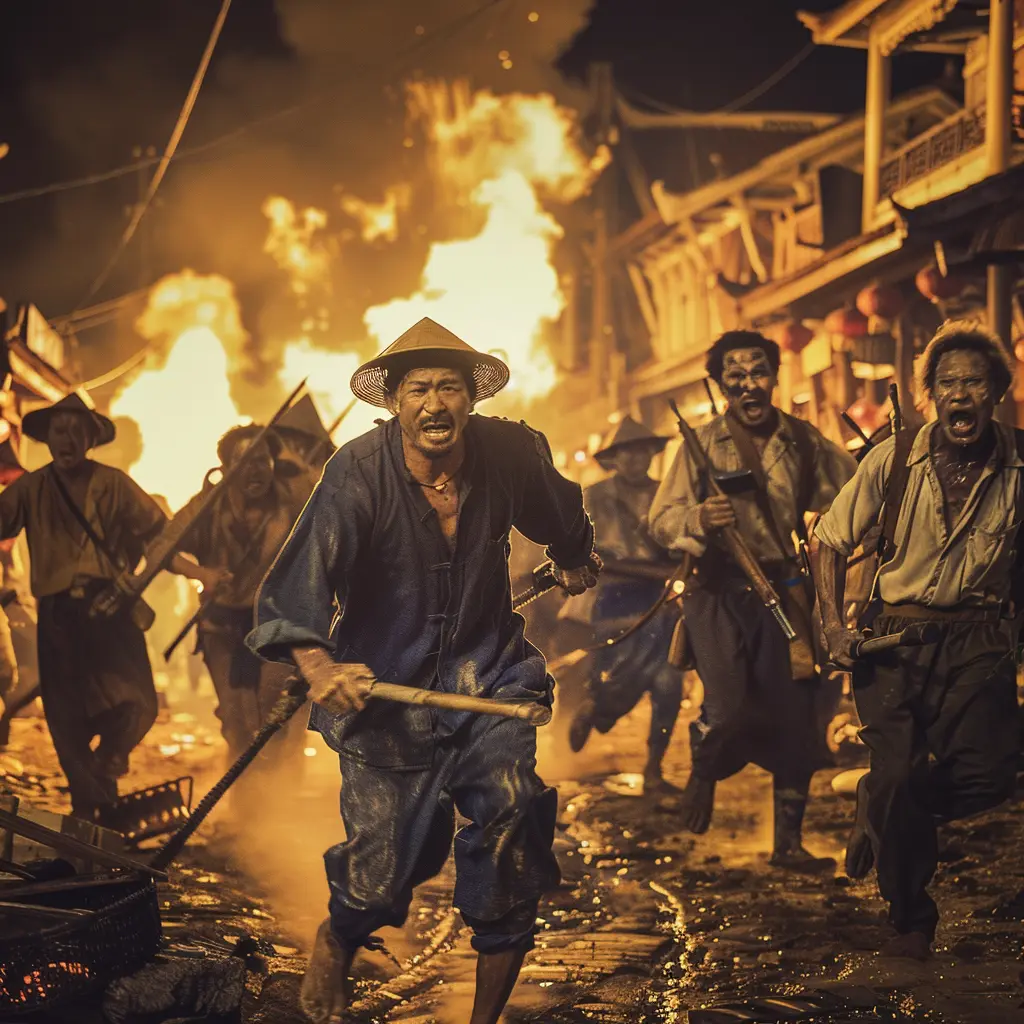
The disparate secret societies—traditionally bitter rivals fighting over territory and opium monopolies – unified under a single, shared grievance. The miners abandoned the inland pits of Kathu, armed themselves with heavy iron mining tools, machetes, and improvised firearms, and marched down the dirt tracks toward the coastal hub of Phuket Town.
It was an explosive, armed insurrection. The sheer demographic imbalance of the island became immediately apparent: the Chinese labour force vastly outnumbered the local Siamese administrative garrison.
The rebels systematically targeted the infrastructure of the state and the elite. They put government offices to the torch, looted commercial godowns along the waterfront, and seized control of the vital shipping lanes. For days, the rule of law on the island ceased to exist. Thai and non-Hokkien residents fled into the dense interior jungles or sought refuge behind whatever high stone walls could be found. Phuket Town became a smoking frontier war zone.
The Sacred Redoubt: The Siege of Wat Chalong
As the rebel factions fanned out across the island, a massive wave of terrified local villagers fled toward the southern valley, seeking sanctuary within the gates of Wat Chalong.
The temple’s abbot was Luang Phor Cham, a monk already deeply revered across the island for his mastery of traditional herbal medicine and his profound spiritual authority. As the armed rebel columns approached the temple perimeter, the secular authorities urged the monk to flee into the hills. He refused.
Bound by his monastic vows, Luang Phor Cham could not pick up a weapon or direct a military strike. Instead, he engaged in spiritual logistics. He cut strips of plain white cloth, inscribed them with ancient, protective yantra scripts, and blessed them. He distributed these sashes (Pha Prachiat) and headbands to the terrified civilian men huddled in the courtyard.
The psychological impact was transformative. Convinced they were spiritually invulnerable, this untrained, desperate home guard organised a fierce, highly coordinated perimeter defence. Armed with only farm implements and sharpened bamboo spears, the villagers repeatedly repulsed waves of armed Ang Yee assaults.
The defence of Wat Chalong held the line for weeks, preventing a total massacre of the southern settlements. The stalemate lasted until royal Siamese gunboats arrived from the mainland. Armed with heavy artillery, they systematically crushed the rebellion. This restored a tense, heavily militarised order to the island.
The 1876 rebellion proved to Bangkok that Phuket could no longer be governed by simple decree or brute military suppression. The Chinese diaspora was too large, too economically vital, and far too dangerous. To prevent the island from burning again, the Siamese state would have to do the unthinkable: make a deal with the very men who had orchestrated the chaos.
Act III: The Architecture of Fear
The smoke of 1876 forced a radical geopolitical calculation in Bangkok. King Rama V realised that executing the triad bosses would destroy the tin economy, while ignoring them would invite another civil war. The Crown chose a third path: co-optation.
The Siamese state systematically transformed Ang Yee leaders from underground outlaws into titled nobility. Powerful Hokkien patriarchs received royal titles, tax-farming monopolies, and provincial governorships. Khaw Soo Cheang and his brilliant lineage are the most notable examples.
This compromised peace birthed the era of the Tin Barons. These newly minted aristocrats found themselves holding staggering wealth, royal legitimacy, and a profound sense of lingering paranoia. They knew exactly how fragile the peace was, and they built their city to survive the next explosion.
The Sino-Portuguese Fortress
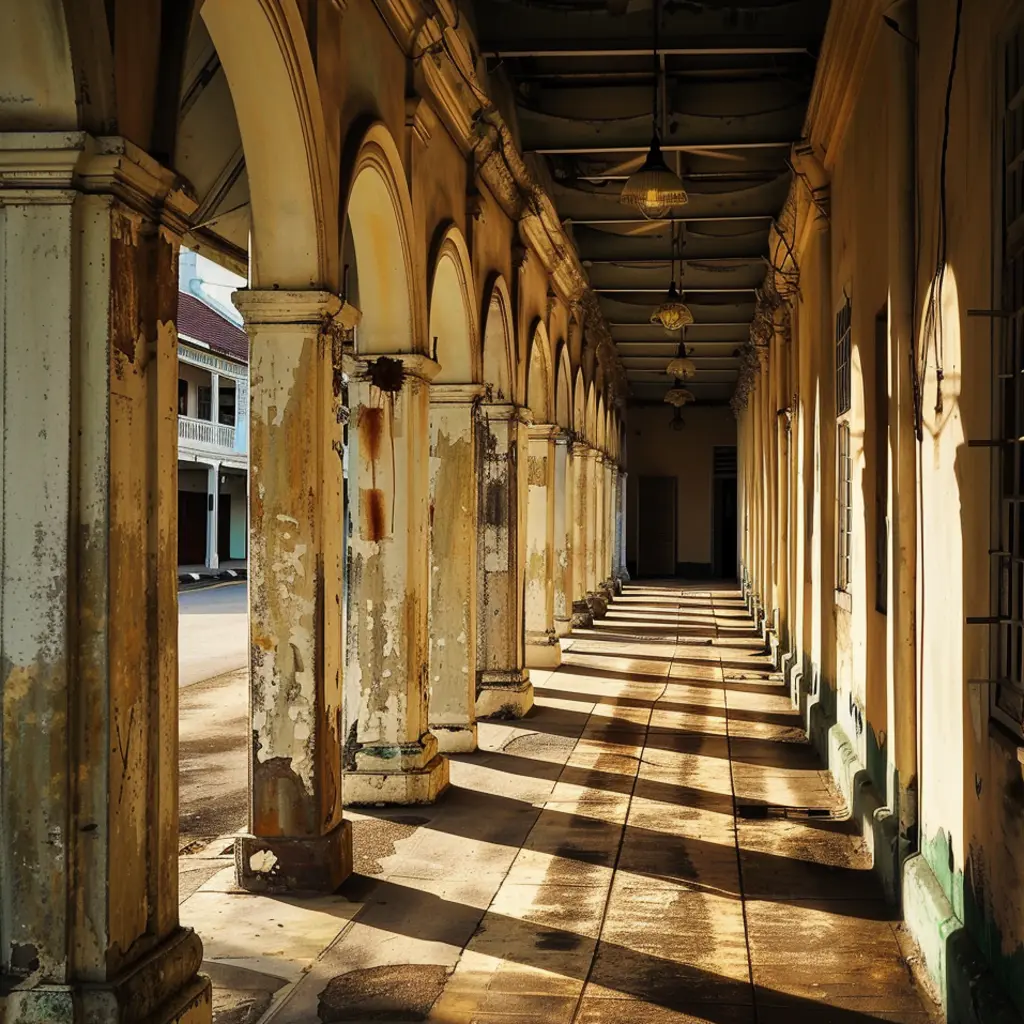
The historic centre of Phuket Town – the rows of “Sino-Portuguese” shophouses along Thalang, Dibuk, and Pang Nga roads – is not a whimsical artistic neighbourhood. It is defensive, compartmentalised urban infrastructure.
Every element of the classic Peranakan shophouse served a dual purpose of commerce and security:
Ang Mor Lao: The Residential Redoubts
Tin Barons fled crowded commercial rows to build sprawling suburban estates. They constructed Ang Mor Lao, or “Red Hair Mansions,” blending European architecture with local flair. These structures mark the pinnacle where global trade wealth met frontier defence.
Take Chinpracha House (1903), built by the Khaw dynasty. The exterior mimics the grand, symmetrical Italianate villas favoured by British elites in Penang and Singapore – Tuscan pillars, sweeping arched loggias, and intricate floral plasterwork. But the bone structure is entirely Chinese, and entirely tactical.
The heart of the mansion is the Chim Chae, a central, open-air courtyard that catches rainwater. While it serves a crucial role in feng shui by symbolising inward-flowing wealth, the internal cistern also provides thermodynamic cooling. Furthermore, it offers a completely independent water supply. If an angry mob surrounded the estate and cut off external pipes, the household could survive indefinitely.
The materials themselves were paid for by the dark, heavy ore pulled out of Phuket’s mud, shipped across global trade networks, and reassembled into a fortress:
Conclusion: Past the Pastel Paint
Today, the casual traveller walks down Thalang Road or Soi Rommanee and sees a whimsical, candy-colored heritage enclave. They see curated boutiques, walls painted in soft pinks and mint greens, and cafés serving coconut-infused iced lattes under the glow of warm fairy lights. It is a highly successful exercise in modern urban preservation.
But to leave your perspective there is to stay trapped in Banalistan.
The real historical Phuket is not found in the fresh coats of pastel paint. It lives in the structural scars that the paint tries to cover. It lives in the weight of the massive iron bars still anchored deep into the brickwork of the window frames, in the heavy teak Pintu Pagar doors that still show the scuffs of decades of friction, and in the sheer, defensive thickness of the walls of Chinpracha House.