

When an affluent client pushes back on your four-figure design fee or questions why they shouldn’t just book a five-star suite via an American Express Centurion portal, you aren’t dealing with a pricing dispute. You’re dealing with a structural misunderstanding of the ultra-high-net-worth (UHNW) mindset.
Too many LTAs mistakenly believe they operate in the service industry. They assume their value lies in booking logistics, securing room upgrades, and smoothing transfers.
But at the highest tiers of wealth, basic five-star inventory is no longer a luxury; it’s an expected, commoditised baseline. If an advisor relies on supplier-provided PR collateral and soft descriptors like “timeless elegance” or “refined heritage,” they invite direct price auditing against public wholesale rates.
An automated booking algorithm can cross-reference room dimensions, aggregate guest reviews, and confirm reservations instantly.
To protect your margins and command non-negotiable planning fees, you must understand the sociology of wealth. You’re not selling hospitality logistics; you are engineering a Veblen good.
The Luxury Travel Advisors Blind Spot: The Veblen Mechanics of Advisory
In classical economics, demand decreases as price rises. A Veblen good operates on the exact opposite principle: its desirability increases in direct proportion to its price and perceived exclusivity, serving primarily as a marker of taste, discernment, and social status.
For a founder, private equity partner, or family office principal, booking an expensive suite at an Aman, Rosewood, or Mandarin Oriental is not an achievement.
Their peers, their corporate competitors, and anyone with a platinum credit card can book that same room with three taps on a smartphone screen. Material comfort has become universally accessible to the wealthy. What remains genuinely scarce is cultural capital and conversational equity.
When wealthy individuals interact socially, exchanging stories about high thread counts or Michelin-starred hotel dining conveys no distinction. It sounds passive, consumerist, and uninspired. What confers real status is proof of intellectual curiosity and insider access; the ability to decipher a complex system that remains opaque to the average tourist.
If an advisor treats a historic regional journey as a casual vacation, the client views the planning fee as an unnecessary middleman tax. But when the advisor reframes the journey as an analytical expedition into the mechanics of historic wealth creation, the deliverable transforms. It ceases to be an expensive holiday and becomes a high-status intellectual asset.
Step 1: Auditing the Extractive Balance Sheet
Every significant heritage property in Southeast Asia traces its physical existence back to an extractive monopoly. Your clients understand capital allocation, regulatory capture, debt leverage, and yield extraction. They don’t want romanticised tourism narratives or decorative folklore; they want to understand the balance sheets that built the empires of the past.
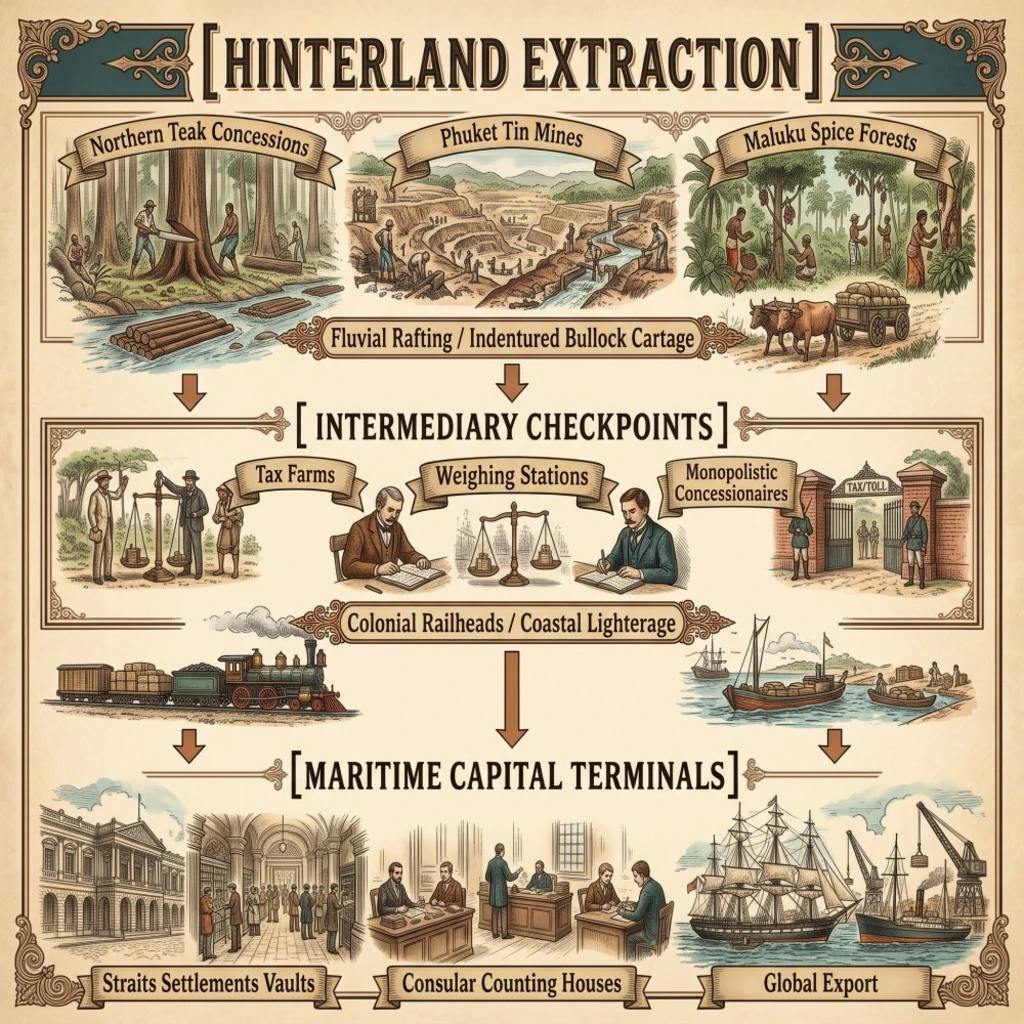
The physical wealth displayed in regional historic estates in SE Asia, for example, reflects three dominant trade regimes:
When briefing a client, bypass standard hospitality descriptions. Identify which chartered corporation or royal syndicate extracted the original liquidity, which local concessionaires brokered the access, and how the physical estate operated as the administrative balance sheet for that trade flow.
Step 2: Deciphering the Built Environment as an Audited Ledger
Equip your clients with an analytical lens to read an estate’s architecture as an audited ledger of historical trade dominance. A 19th-century merchant didn’t install European finishes out of aesthetic appreciation; they used them as visible proofs of liquidity, customs clearance, and commercial rank.
Scottish Cast-Iron Columns
Shipped directly from Glasgow foundries like Macfarlane & Co. along British maritime networks. These served as critical fireproof, load-bearing supports, replacing combustible timber inside heavy storage godowns and customs warehouses.
Belgian Stained Glass
Imported via Mediterranean and Suez shipping routes directly to regional ports. Beyond visual status, this glass provided verifiable proof of direct European shipping access while withstanding severe chemical corrosion from tropical salt air.
Carrara Marble Slabs
Transported across continents as stabilising ship ballast on outbound European merchant vessels. The dense stone offered natural thermodynamic floor cooling in equatorial heat while distributing weight cleanly over shifting coastal mud and alluvial soil.
Interlocking Teak Framing
Extracted from inland forest concessions and assembled by master craftsmen using indigenous mortise-and-tenon joints. This nail-free engineering allowed timber frames to flex naturally, absorbing severe monsoon saturation and riverbank soil subsidence without cracking.
Fortified Counting Houses
Built with massive lime-plaster brick walls and secured behind reinforced wrought-iron gates. These ground-floor bunkers functioned as private vaults, safeguarding daily bullion, transaction ledgers, and physical tax contracts during local uprisings and sudden price runs.
High Clerestory Louvres
Hand-shaped from dense local hardwoods by immigrant shipwrights. These vents created passive thermodynamic airflow by drawing rising hot air out of high ceilings, while keeping high-stakes ledger entries shielded from outside eyes.
Step 3: Re-routing Client Itineraries Along Obsolete Trade Corridors

Standard luxury travel relies on point-to-point transfers: a commercial flight to a regional hub, an insulated highway vehicle to a branded resort, and occasional outbound day trips. This approach disconnects individual properties from the commercial systems that created them, turning the trip into a generic sequence of hotel rooms.
To justify high planning fees, restructure the journey entirely around the historical transit paths of raw commodities.
Instead of flying a client directly between Bangkok and Chiang Mai, build a multi-stage route tracing the log flow down the Ping, Yom, and Nan river basins. The route follows the exact logistical progression of 19th-century timber transport:
Connecting these trade routes turns disconnected highway transfers into a clear, cohesive narrative. Clients track the exact mechanics through which raw resources were harvested in the deep interior, registered at river customs stations, and cashed out at coastal banking hubs.
Step 4: The Commercial Moat: Converting Provenance into High-Fee Advisor Leverage
When you position an estate through its financial and geopolitical origins, you alter how the client views your fee. You are no longer functioning as an administrative booking service; you are operating as an intellectual curator who understands the structural mechanics of wealth.
Generative AI searches pull from public web listings, aggregate marketing copy, and repackage promotional descriptions. It cannot evaluate a property’s architectural history, cross-reference local archival records, or explain why an estate’s ground-floor floor plan features armed defensive vaulting.
Use precise, operational language in your written proposals to establish this authority:
“We do not book heritage hotels as decorative backdrops. We trace how institutional capital, resource monopolies, and colonial concessions shaped the built environment of Southeast Asia. Your itinerary follows the physical movement of trade capital; from interior extraction zones to coastal counting houses—giving you access to private archives, trade infrastructure, and structural histories that remain inaccessible to standard luxury booking channels.”
This positioning completely reframes the advisory dynamic. You are not justifying the retail cost of a suite; you’re charging for un-scrapeable contextual design that cannot be replicated by an algorithmic search, a credit-card concierge, or an in-house booking engine.
When clients realise that every architectural feature, river crossing, and hidden safe tells the story of early venture risk, regulatory capture, and global liquidity, your fee ceases to be an expense; it becomes an essential analytical investment. True luxury advisory isn’t built on glossy marketing promises. It is built on a direct, forensic command of historical reality.