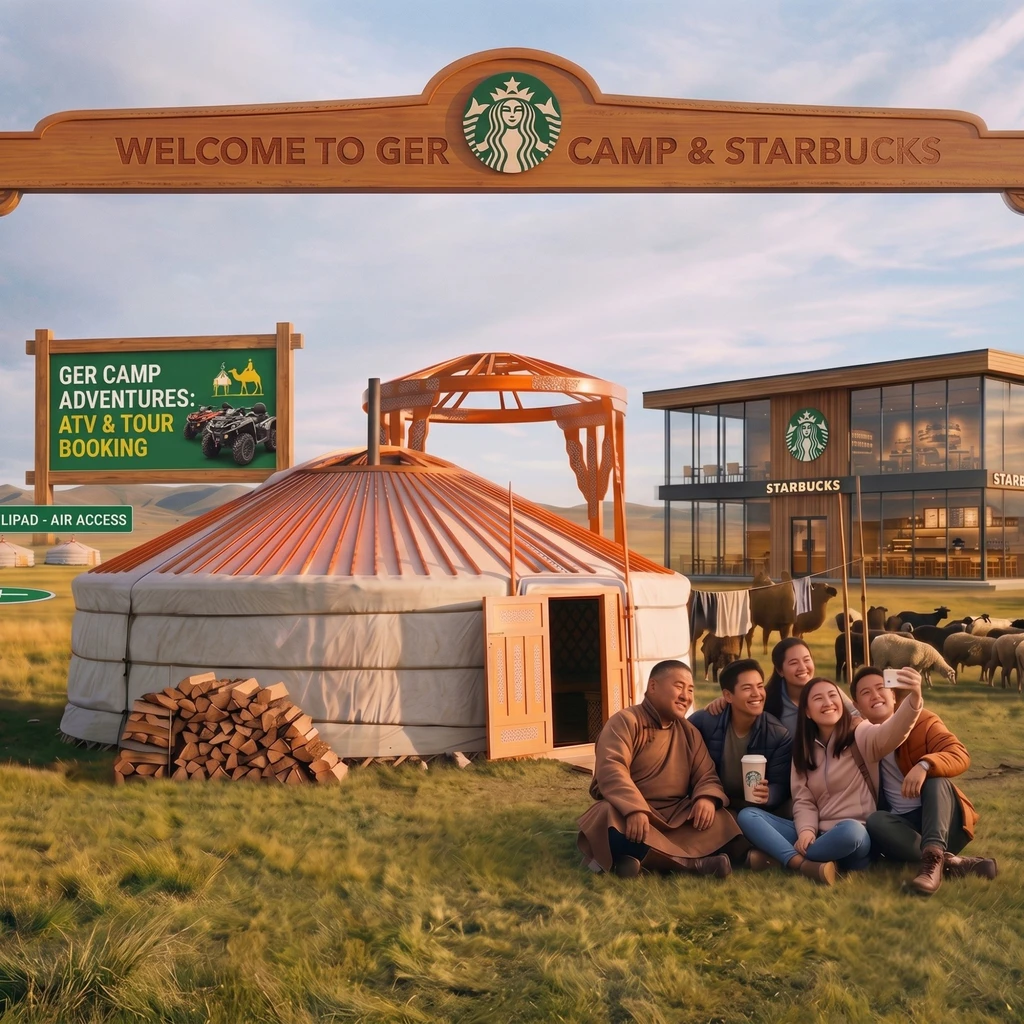

Author’s Note: This article is an expanded response to a brilliant breakdown and dilemma originally posted by Evgenii Kravchenko regarding the lifecycle of remote destinations. Because the LinkedIn comments section simply wasn’t large enough to map out the systemic, structural forces at play, this piece serves as a deep dive into Evgenii’s original post, overlaying it with market mechanics and offering a blueprint for a path forward.
The story perfectly captures the modern existential crisis of travel: A man returns to a remote Mongolian village and builds a 12-room boutique lodge. It isn’t a play to scale a massive corporate empire; it’s a deeply personal space built to host friends and connect travellers with locals around a campfire.
But to pay the bills, he lists the rooms on Booking and Airbnb.
Immediately, the domino effect begins. Travellers arrive demanding the comforts of home – spas, Western restaurants, curated excursions. Outside capital rushes in to fill the gap, building hostels and standardised tourist traps. Then, life gets in the way. The owner’s child falls critically ill. To afford life-saving surgery, he sells an 80% stake to a corporate investor.
Today, those 12 rooms are 50. The genuine connection to the community is dead, replaced by a plastic tourist strip.
The most haunting part of Evgenii’s breakdown is that you cannot find a single villain. The father was saving his child. The tourists just wanted a decent shower. The investors created jobs and built businesses. Everyone made the perfectly rational decision for their own survival and comfort, yet the aggregate result was a cultural disaster.
It makes you wonder: Is every untouched corner of the earth just waiting for its turn to become a mass-market theme park? To understand how to stop it, we have to look past emotional hand-wringing and analyse travel through the cold mechanics of a financial market bubble.
The Four Phases of Destination Capitalisation
When a destination moves from total obscurity to a hyper-inflated tourist trap, it follows the same trajectory as a hot stock moving through a speculative market cycle.
The Capitalist Extraction Engine: Why Good Intentions Fail
It is tempting to blame individual greed or foreign influence, but the real culprit is simpler and colder: unbridled market optimisation.
Tourism, in its current mass-market form, functions as an extraction business. Left unregulated, standard capital markets treat cultural identity exactly like an oil field: they strip-mine it for quick initial returns, optimise it for mass volume, and move on once the asset is depleted.
The system is designed to reward efficiency. The moment a property surrenders its distribution to global algorithms, its unique soul is flattened into a standardised column of price and amenity filters. Capital naturally flows to where friction is lowest. If algorithms reward a corporate spa over raw local connection, investors will build it to minimise risk.
The local operator who sells out isn’t failing morally; they are just surviving. If we want to save the next 12-room lodge, we can’t just wish for a “kinder” version of capitalism or ask locals to stay poor for our viewing pleasure. We have to design a structural shield that changes how money behaves.
The Solution Matrix: Building a Multi-Layered Shield
Growth itself is not the enemy; the problem begins when the mechanics of scale replace the original emotion and vision that made a place special. To disrupt a hyper-optimised market cycle, you must protect a destination across four defensive layers:
1. The Aesthetic Shield: Vernacular Architecture as an Economic Moat
When a destination scales using cheap, standardised concrete, glass, and steel, it chooses rapid depreciation and succumbs to the algorithm. Conversely, doubling down on vernacular architecture—using local materials, traditional construction, and regional design logic—creates a cultural boundary that corporate capital cannot easily replicate.
In the case of Mongolia, for example, an authentic expansion would completely reject a generic concrete hotel block and instead draw from the country’s profound timber traditions:
Traditional craftsmanship, ancestral assembly knowledge, and slow-growth timber cannot be mass-produced overnight by an indifferent investment fund. The architecture itself acts as a natural brake on hyper-scale, retaining premium value and keeping the destination out of the algorithmic race to the bottom.
2. The Legal Shield: Stewardship Ownership and Community Trusts
The Mongolian lodge owner was forced to sell his vision because of a personal emergency. To protect a destination from the vulnerabilities of individual ownership, we must shift the legal framework of hospitality assets.
3. The Digital Shield: Algorithmic Decoupling & High-Trust Networks
The point of no return often occurs the moment a property surrenders its booking process to global aggregators.
4. The Macro Shield: Dynamic Carrying Capacity & Structural Caps
From a governance perspective, treating tourism as a quick, desperate fix for GDP is a failure of imagination. Governments must move from extraction to stewardship.
Conclusion
We cannot stop the tides of global capital. But we can refuse the lazy orthodoxy of mass optimisation.
When a community sees their ancestral building techniques treated as the highest-value asset in the room, local pride is restored. They are no longer performing a cartoonish, plastic version of their culture for foreigners; they are the proud guardians of a living heritage.
By combining vernacular design, steward-ownership, and algorithmic independence, we can build a community shield strong enough to withstand the bubble – ensuring that the next 12-room lodge built from the heart doesn’t just become fuel for a corporate fire.