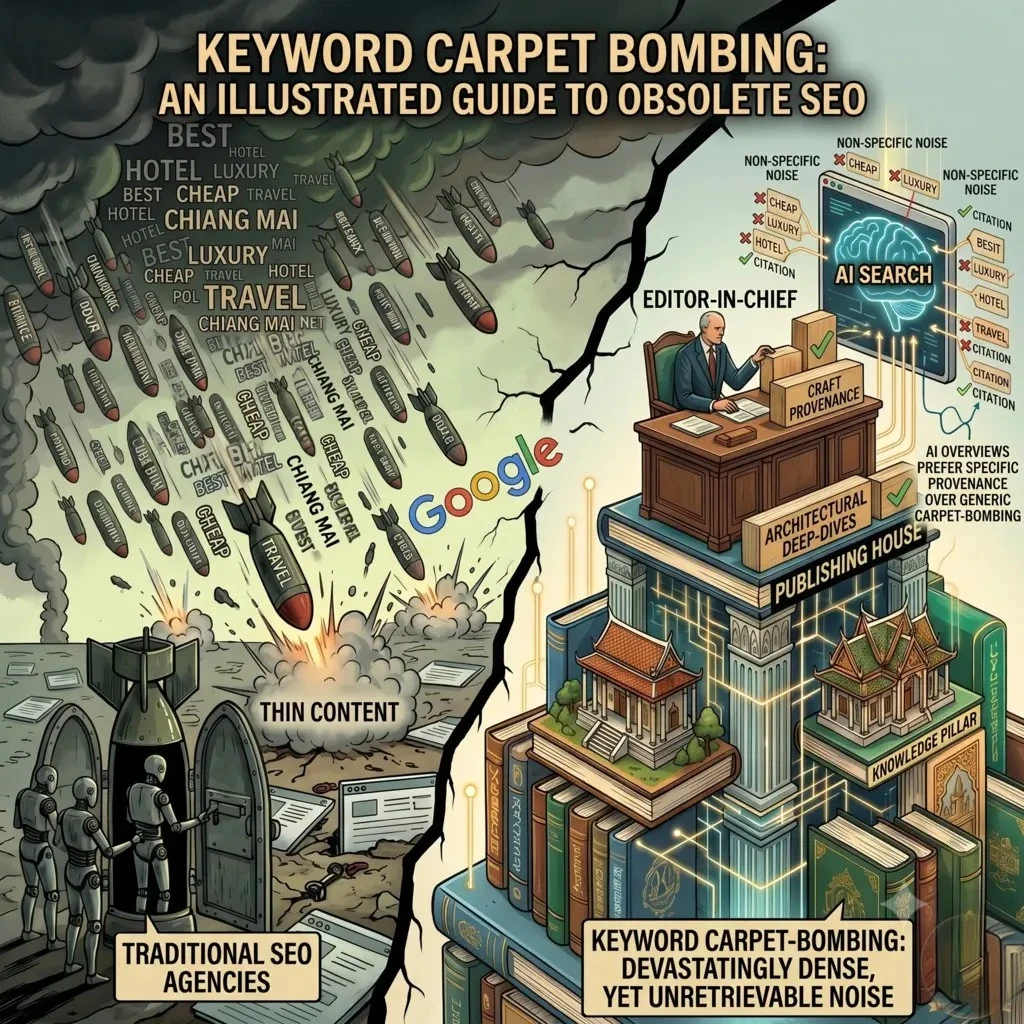

For years, the traditional SEO agency model operated on a comfortable, highly profitable assembly line. You paid a monthly retainer, and in return, an account manager handed you a spreadsheet of “target keywords.”
They would carpet-bomb these keywords across dozens of thin, 800-word blog posts, cross their fingers for a spot on page one of the blue links, and move on to the next client.
In the era of AI-driven search, this model is not just outdated—it is completely dead.
When platforms like Google’s AI Overviews, Perplexity, and OpenAI answer user queries, they do not skim for keyword density. They synthesise answers based on topical authority, structural depth, and unique provenance. Agencies built on high client volume and low-effort churn simply cannot survive this shift.
The Death of the Generic Echo Chamber
Traditional agencies rely on scale. To manage 20 or 30 clients simultaneously, they use generalised templates, low-cost writing pools, or basic AI prompting to churn out content.
The fatal flaw? If an agency uses standard tools to rewrite what is already on the internet, they are just feeding the AI search engines their own training data. AI search engines do not cite the echo; they cite the source.
In a specialised industry like heritage hospitality, the failure of this approach becomes glaringly obvious. A generic agency writer might write a post on “Luxury Hotels in Chiang Mai” using standard travel cliches – calling them “vibrant hidden gems” while listing standard amenities like infinity pools and flat-screen TVs.
AI search models completely ignore this fluff. They look for genuine substance: the specific architectural history of a restored Lanna-style teak mansion, the precise provenance of its traditional craftsmanship, or first-hand reportorial insights into the guest experience.
An agency working on a production line cannot afford the 15 hours of rigorous research required to produce that level of depth.
Why the Lack of Pillar Architecture is Fatal
Many legacy agencies still ignore pillar content hubs because they are harder to produce and don’t fit into a neat “four blogs a month” retainer package. They prefer scattered, superficial articles that target isolated, long-tail keywords.
AI search functions through Retrieval-Augmented Generation (RAG). It needs to verify that a website is a trusted authority on a broader topic before it pulls information into a summarised answer.
Without a deeply structured pillar article – one that comprehensively maps out a subject from top to bottom and connects to specific subtopics – the AI cannot establish your site’s information architecture. Scattered, thin content looks like unverified noise to an LLM (Large Language Model), resulting in the site being entirely bypassed for citations.
3. The Shift from Clicks to Citations
The metrics traditional agencies use to justify their retainers – like keyword rankings and raw impressions – are becoming irrelevant. The new battleground is the share of model voice.
Legacy SEO Agency Model
The AI Search Reality
The New Era: Content as High-End Publishing
The agencies going under are the ones treating content like a digital commodity. To win traffic now, content must be approached like high-end publishing.
It requires an absolute obsession with quality: active voice, concise phrasing that cuts out the fluff, clean technical optimisation (like lean, native Gutenberg structures rather than bloated page builders), and unmatched depth.
The era of tricking a search engine with sheer volume is over. True authority cannot be automated or mass-produced by an agency middleman.