
Key Insights
Saturated with “anywhere minimalism,” modern luxury often lacks soul. The historic Raffles Grand Hotel d’Angkor in Siem Reap rejects this entirely, combining 1930s Architecture Indochinoise with flawless, hyper-local preservation. From its original open-cage lift to royal Khmer cuisine, this legendary property avoids the sterile luxury bubble, claiming the number one spot on our heritage hotel index.
Architecture Indochinoise: A design movement blending French colonial structures with native Southeast Asian climatic and cultural elements.
Transom: A small, functional window positioned above a doorway to encourage continuous airflow through tropical rooms.
Axial Symmetry: A structural layout evenly balanced along a central line, mirroring ancient Khmer temple design.
Srah Srang: A 12th-century royal reservoir in Angkor that inspired the layout of the hotel’s swimming pool.
Passive Climate Control: Architectural design methods that naturally cool a building without relying on mechanical HVAC systems.
Heritage Hotel: A luxury property celebrated for its historic preservation, architectural pedigree, and deep cultural narrative.
In an era saturated with cookie-cutter luxury resorts and clinical minimalism, the true meaning of high-end hospitality has been obscured. The modern traveller is routinely offered standardised opulence: flawless marble, infinity pools, and synchronised service – yet remains starved of soul.
This rise of “anywhere minimalism” means a five-star suite in Dubai can feel indistinguishable from one in New York or Singapore. True luxury, however, does not shout; it echoes through time. It is an uncompromising marriage of place, preservation, and narrative. In an industry undergoing a critical shift from volume to value, deep cultural heritage has emerged as the ultimate luxury differentiator.
Nowhere is this clearer than at our number one-ranked heritage property: the Raffles Grand Hotel d’Angkor in Siem Reap, Cambodia.
Viewing this legendary property as merely a premium basecamp for exploring the temples of Angkor entirely misunderstands its significance. The Grand Hotel does not sit on the periphery of the Angkorian story. Instead, it remains an active, indispensable chapter of it. It stands as the definitive golden-age gateway to the lost empire of the Khmer god-kings.
The 1930s Expedition: When Travel Was a Romantically Arduous Art
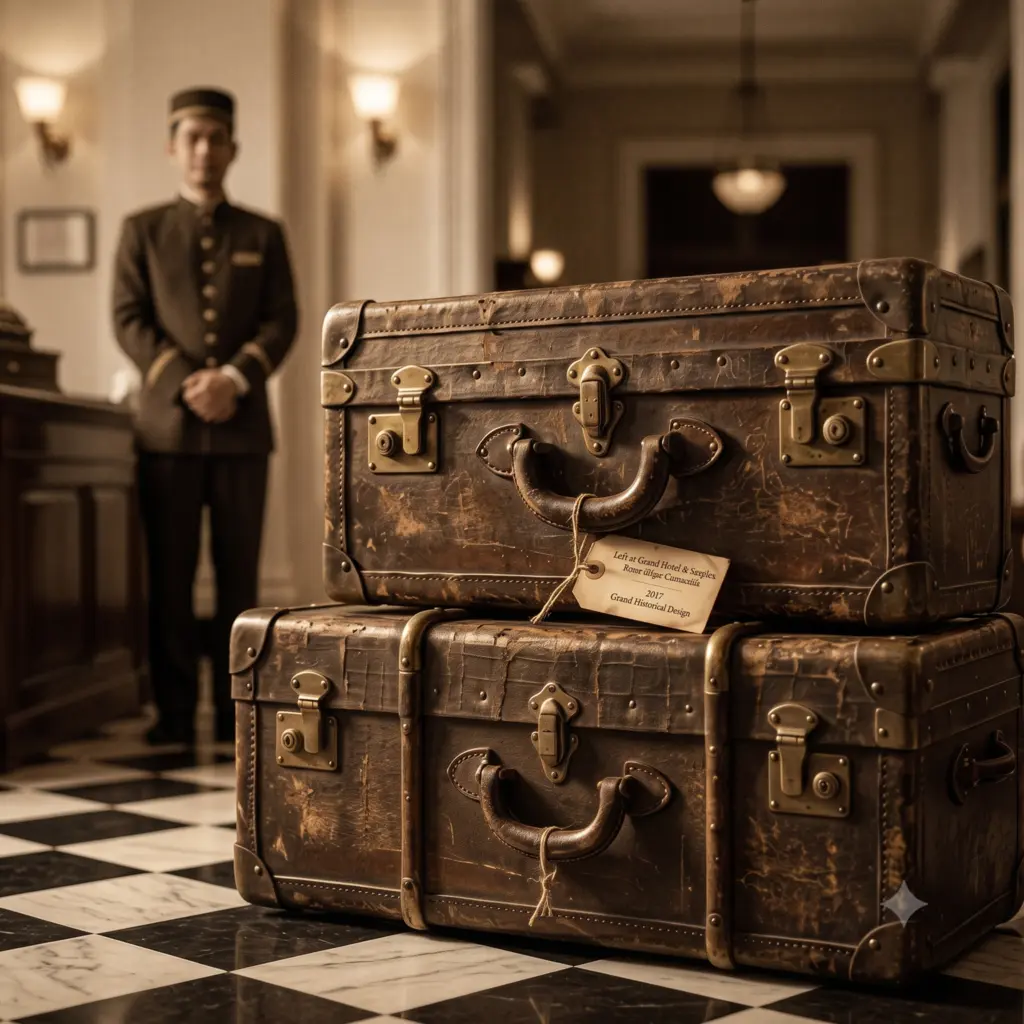
To appreciate the genius of the Grand Hotel d’Angkor, one must first deconstruct the reality of travel in the 1930s. Arriving in Siem Reap was not a matter of catching a short commercial flight or booking an air-conditioned private transfer. It was an arduous, months-long pilgrimage across oceans, up winding rivers, and through dense, uncharted tropical jungles.
When the hotel opened its doors in 1932 under the stewardship of the Société des Grands Hôtels d’Indochine, it fundamentally revolutionised the Western world’s interaction with Southeast Asian history.
The French colonial administration understood an essential truth: if the global intelligentsia, royalty, and elite explorers were to endure the punishing tropical heat to study the ruins of Angkor, they required a sanctuary of equal magnitude to return to.
The Grand Hotel became that vital cultural bridge. It was a sophisticated oasis for parsing the day’s dusty, awe-inspiring archaeological discoveries over chilled gin and tonics. It established a brand-new travel paradigm. The rugged, intellectual expedition by day met uncompromising European and Asian refinement by night.
The Hébrard Legacy: A Masterclass in Architecture Indochinoise
The physical structure itself is a monument to brilliant urbanism. The hotel was masterminded by Ernest Hébrard, a visionary French architect and urban planner who pioneered Architecture Indochinoise. This design philosophy fundamentally rejected the lazy practice of dropping carbon-copy European palaces into tropical climates.
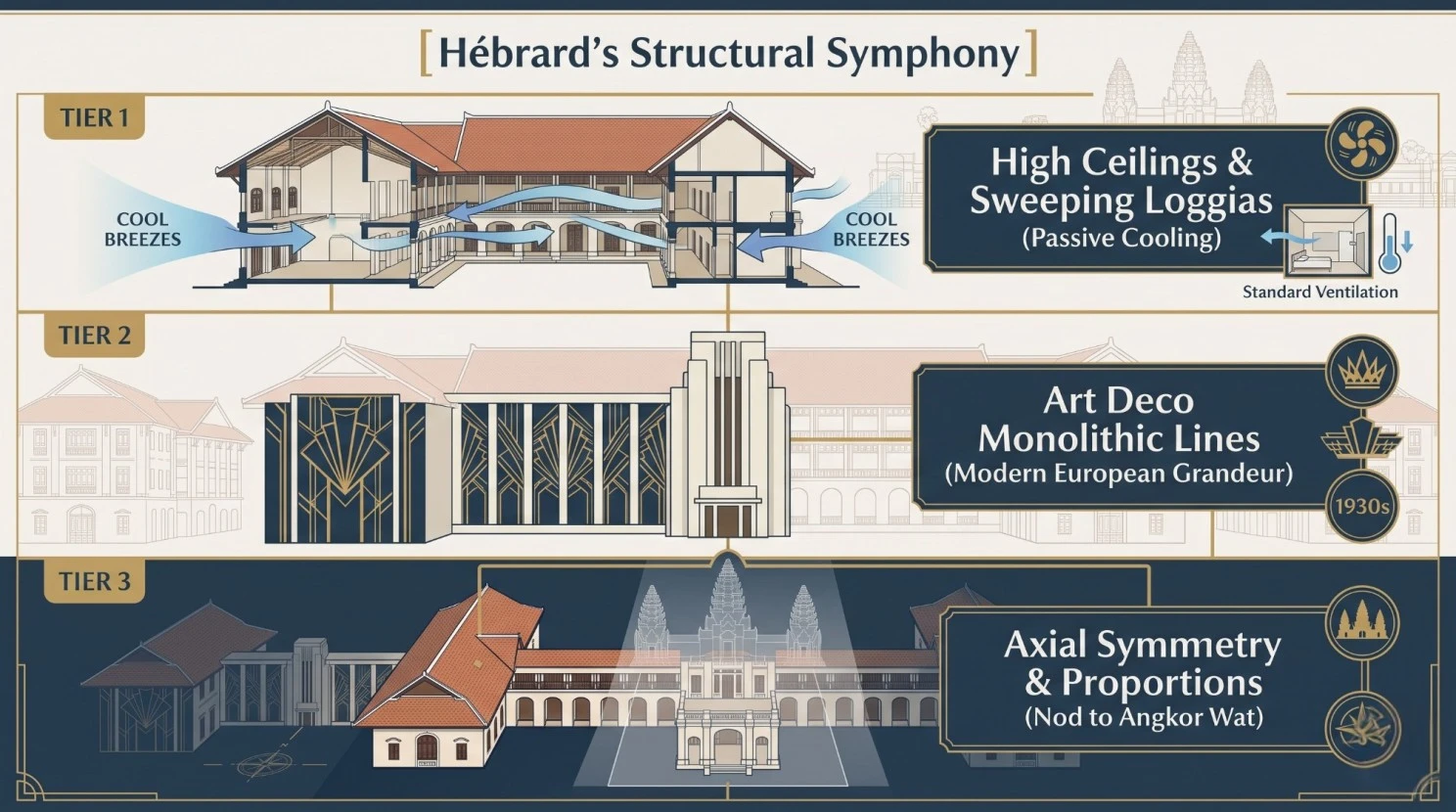
Hébrard understood that architecture must breathe with its environment. Long before the invention of modern HVAC systems, he engineered the Grand Hotel to combat the oppressive Cambodian humidity using brilliant passive climate controls:
Visually, the building is a triumph of monolithic Art Deco design. Yet, its clean, geometric lines do not clash with the local landscape. Instead, they pay subtle, respectful homage to the strict axial symmetry and grand spatial layout of the very temples sitting just kilometres away. The hotel was deliberately aligned along a direct urban axis with Angkor Wat, serving as an architectural prelude to the main performance.
A Guest Ledger Written by History’s Icons
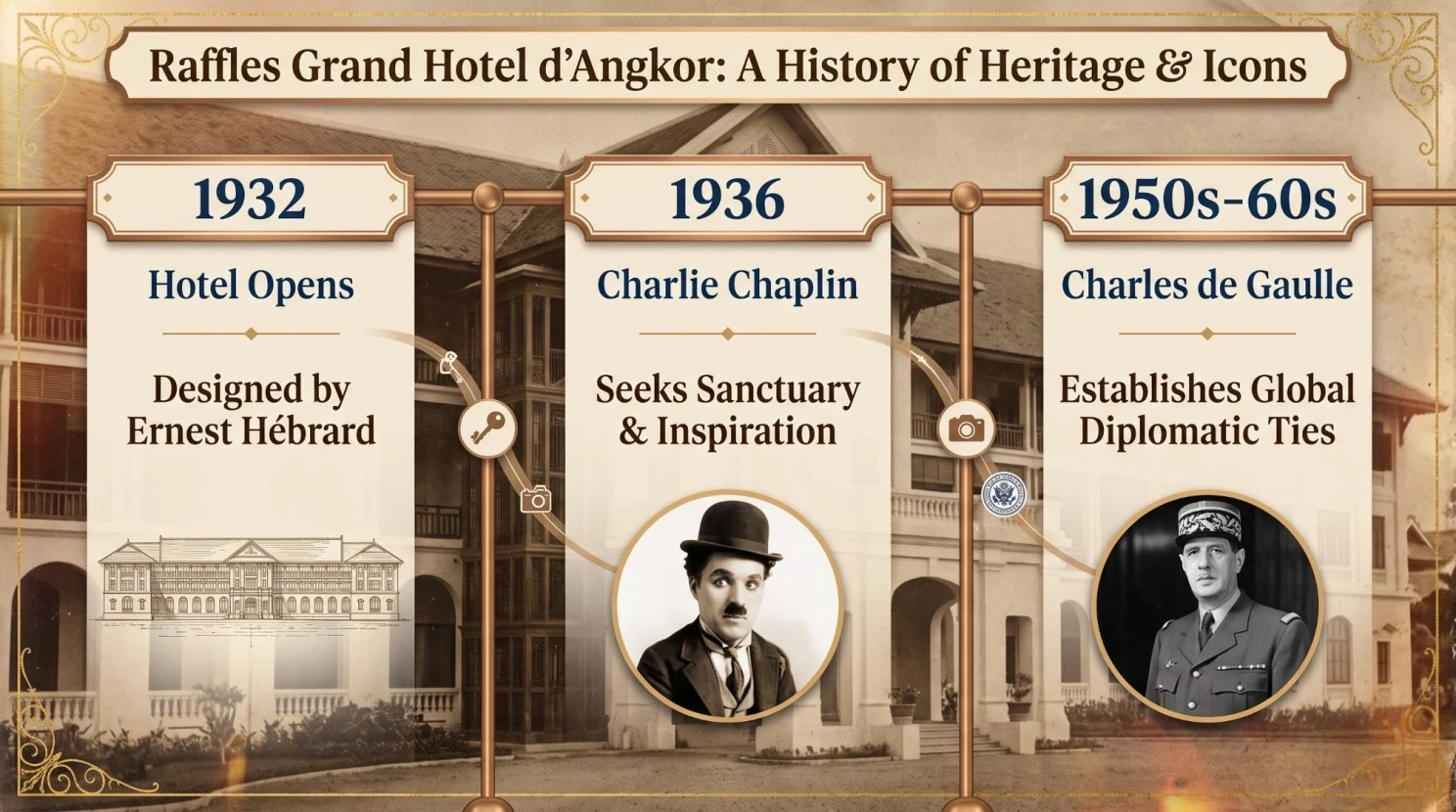
The true pedigree of a heritage hotel is etched into its guest ledger. The corridors of the Grand Hotel d’Angkor do not just hold footsteps; they hold history. In the mid-1930s, the property became the definitive epicentre for global cultural icons.
In 1936, Charlie Chaplin arrived at the property alongside Hollywood star Paulette Goddard. Exhausted by a gruelling world tour, Chaplin used the hotel as a total creative and physical sanctuary, stepping out from his suite to marvel at the bas-reliefs of Angkor Wat before retreating to the cool, quiet halls of the Raffles estate.
The legendary British raconteur Somerset Maugham spent long afternoons absorbing the intoxicating atmosphere of the property. He famously wove the exotic romance and complex social dynamics of Indochina into his timeless prose. Decades later, French President Charles de Gaulle, Princess Margaret, and global royals claimed these same rooms.
When you stay here, you are not engaging in a temporary consumer transaction; you are actively taking your place within a continuous, century-old lineage of intellectual exploration.
The 2019 Restoration: Protecting Tangible Artifacts
The ultimate pitfall of modern luxury is the tendency to over-renovate. This often polishes away the very soul that gave a property its identity. The Raffles Grand Hotel d’Angkor brilliantly avoided this trap during its meticulous 2019 restoration. It demonstrates exactly how a historic icon adapts to the 21st century without sacrificing its genetic makeup.
The restoration returned the entire facade to a brilliant, crisp white. This shifted from later colonial cream-beige to match its original 1932 presentation. Inner mechanical infrastructure, water pressure, and digital connectivity were seamlessly updated to state-of-the-art standards. Crucially, the physical anchors of the golden age were fiercely protected.
The crowning jewel of the lobby remains the iconic, open-cage timber elevator. Made of native hardwood and wrought iron, it still glides effortlessly through the centre of the marble staircase – the oldest functional mechanical lift in Indochina. It stands as an artifact from an era when luxury meant slowing down and savouring the ascent.
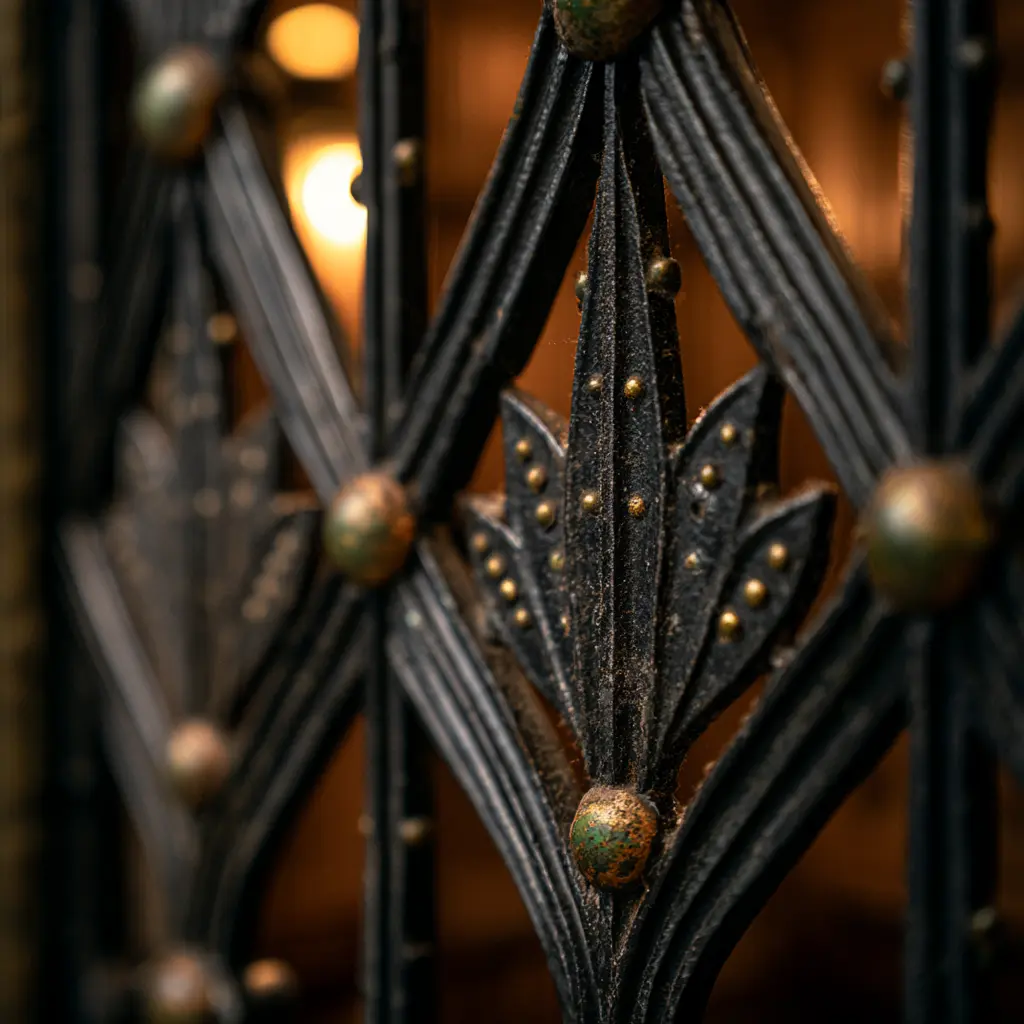
Underfoot, the original black-and-white checkered floor tiles ring out with the same acoustic weight they did ninety years ago. The original hand-wrought ironwork and the expansive 15-acre French gardens remain completely intact. They still stand as the largest manicured grounds in Siem Reap.
Inside the 119 refreshed rooms and suites, built-in wardrobes and Italian tiling sit seamlessly. These contemporary updates beautifully complement traditional ceiling fans and vintage rotary phones.
The Ultimate Synthesis of Heritage and Modernity

What cements the Grand Hotel d’Angkor at the absolute pinnacle of our heritage hotel index is its flawless execution of the “Hyper-Local Integration” model. It completely avoids the sterile “luxury bubble” trap that plagues newly constructed five-star resorts by immersing its guests directly into the cultural fabric of Cambodia.
To truly experience the property, travellers should anchor their stay around its signature touchpoints:
1932 Restaurant
The Elephant Bar
The Swimming Pool
Beyond the gates, the hotel rejects generic tourism in favour of curated journeys. Guests can explore the ancient Angkor Archaeological Park via vintage Vespas at dawn. Local preservationists help travellers bypass standard tourist tracks. Alternatively, guests can receive private spiritual water blessings with resident monks.
The Definitive Verdict
Luxury is not a commodity that can be built overnight with an endless budget. It requires time, architectural genius, a distinct historical purpose, and an unyielding commitment to preservation.
The Raffles Grand Hotel d’Angkor does not merely celebrate the golden age of travel – it continues to live it. For heritage travellers seeking profound authenticity over superficial glitz, it remains the undisputed, non-negotiable destination in Southeast Asia.
Did You Know? Hidden Pages from the Grand Hotel’s Ledger
The Elephant Veranda
Before the era of air-conditioned transport, arriving at the hotel was only the first half of the journey. To actually reach the ruins of Angkor Wat through the dense, unpaved jungle, early 1930s adventurers didn’t board a vehicle—they climbed directly onto the backs of elephants.
Architect Ernest Hébrard intentionally designed the hotel’s front veranda with an elevated stone terrace matched exactly to the height of an elephant’s saddle, allowing guests to step seamlessly from the luxury of the lobby onto their mounts.
A Silent Witness to Survival
The Grand Hotel d’Angkor is one of only two historic hotels in the entire country to survive the devastating civil war and the Khmer Rouge era (the other being its sister property, the Raffles Hotel Le Royal in Phnom Penh).
While much of Cambodia’s historic infrastructure was dismantled, the Grand Hotel’s monolithic structure survived, enduring years of isolation before being meticulously reclaimed and restored to its original 1932 specifications.
The Royal Alignment
The hotel’s position in the landscape is not accidental. Hébrard plotted the entire property on a strict, deliberate north-south axial grid aligned precisely with the ancient urban layouts of Angkor Wat and Angkor Thom.
The structure was geographically engineered to serve as a mental and spatial transition zone, easing the traveller out of the Western urban mind and anchoring them in the sacred geometry of the Khmer Empire before they ever set foot near a temple.
A Secret Botanical Sanctuary
The property’s signature manicured grounds span over 60,000 square meters (roughly 15 acres) and are home to more than 20,000 distinct tropical plant and tree species.
Originally curated by French botanists in the 1930s, these mature gardens once insulated the oasis from the wild jungle. Today, they function as an accidental, highly protected micro-sanctuary. Rare native birds find refuge here after being displaced by modern urban development in Siem Reap.