
According to Skift’s global travel trends research, 28% of global travellers – over a quarter -now regularly rely on online travel agencies as their primary guidance and research tool during trip planning, frequently bypassing traditional search engines altogether.
At the same time, industry demand metrics from Amadeus Hospitality and Skift highlight a pronounced flight to quality, with high-yield guests systematically skipping standard entry-level rooms in favour of superior and luxury categories.
Demand for high-value lodging exists in abundance, yet independent, boutique, and heritage hoteliers regularly find themselves trapped in an artificial rate cap.
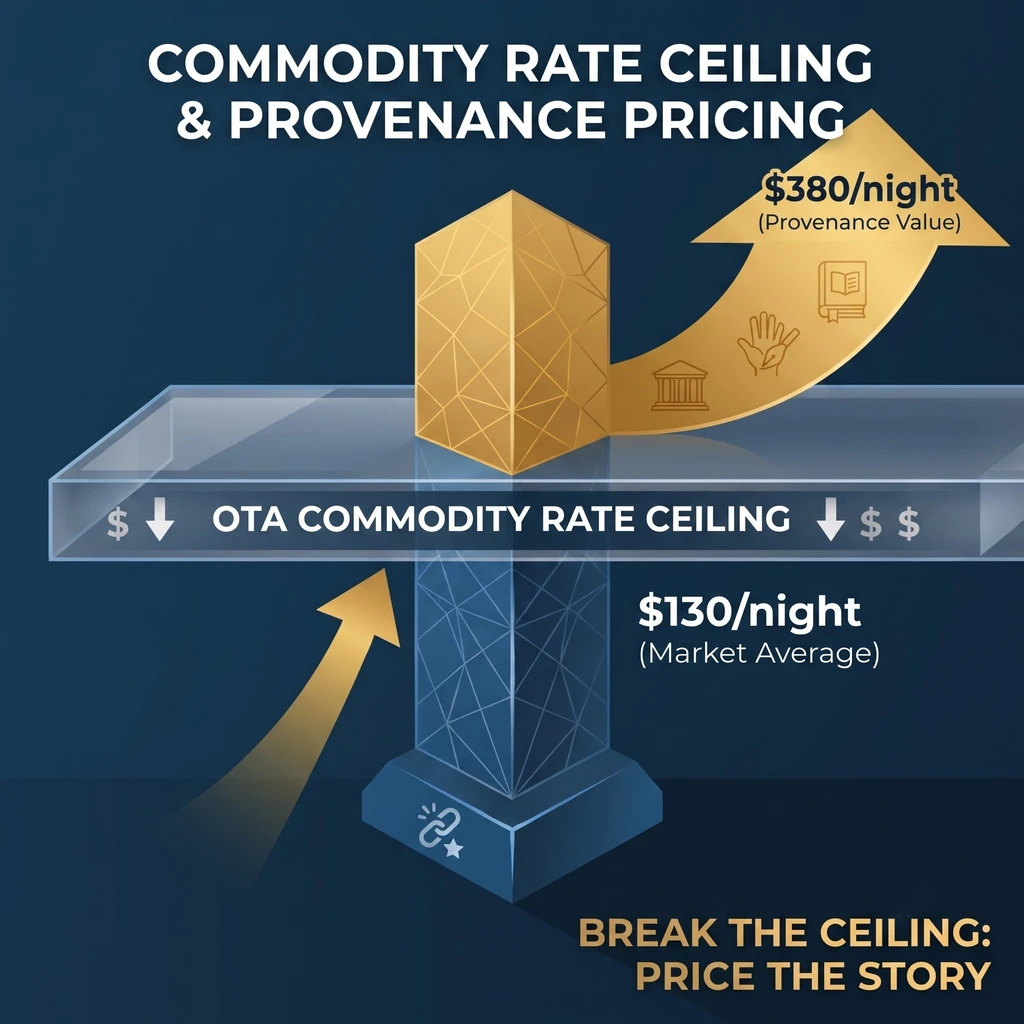
This financial bottleneck is the direct result of the Commodity Rate Ceiling – a structural limitation imposed when unique, story-rich hospitality inventory is filtered through standard, database-driven distribution channels.
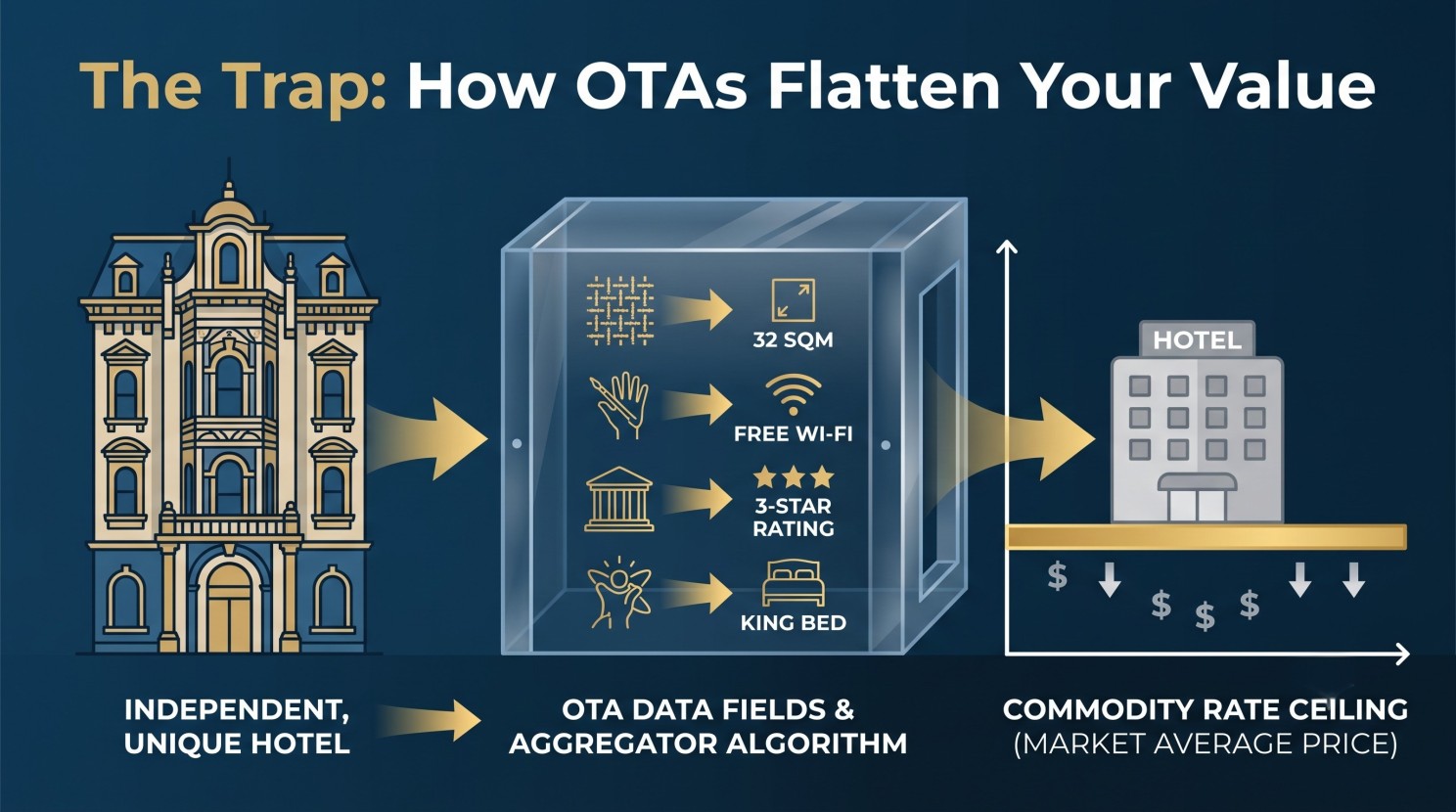
When a restored shophouse or a thoughtfully preserved timber estate relies heavily on third-party channels for dynamic pricing, the algorithms reduce its historical and artistic value to simple database attributes.
To an aggregator’s database, a property is not a living museum or a sanctuary of local craft. It is merely a row in a spreadsheet defined by square footage, bed configuration, and a handful of checked amenity boxes.
By flattening complex physical properties into standardised comparison metrics, aggregators force distinct independent hotels into direct competition with nearby generic chain properties. The algorithm views both as functionally interchangeable, calculating local market supply and demand within a tight geographical radius to dictate optimal rates.
When a mid-tier commercial hotel down the street cuts prices to fill empty rooms, the dynamic pricing engine attempts to drag the independent property’s rates down alongside it. The owner is left watching their Average Daily Rate hit an invisible ceiling, unable to command the premium their physical product deserves.
Trying to outmaneuver third-party distributors using their own volume-based rules inevitably leads to a race to the bottom. The solution lies in a complete shift from feature-based pricing to Provenance Pricing.
Understanding the Economics of Provenance Pricing
Provenance Pricing is a distribution and revenue management strategy that anchors a property’s rates to its cultural, historical, architectural, and experiential scarcity rather than local market baseline averages.
In fine art, wine, and luxury horology, provenance dictates value. A mid-century watch is not priced by adding up the raw cost of its stainless steel casing and leather strap; it is priced based on its origin, its documentation, its surviving rarity, and the story of the hands that crafted it.
Hospitality functions under the same emotional economics when catering to high-yield travellers. High-intent guests are not seeking to rent an optimised block of residential space; they are purchasing access to a non-replicable narrative.
Consider how this distinction plays out in real-time positioning. A traditional commodity pricing model approaches the market horizontally. It evaluates a 35-square-meter room in a historic district and calculates that, based on the neighbouring inventory, the room should sell for $130 per night.
To push that rate higher within an OTA ecosystem, the property is forced to offer discounted extras or bundle generic perks, which further erode margins.
A provenance pricing model approaches the market vertically. It ignores the surrounding geographic average and evaluates the room as a master suite situated inside a meticulously restored nineteenth-century merchant residence.
The value proposition centres on hand-restored ironwood joinery, original floor tiles, and a culinary program sourced exclusively from regional heritage farms. The price point shifts from $130 to $380 per night because the property is no longer competing against the modern concrete hotel next door – it is competing only against the absence of its own unique existence.
Execution: Breaking the Ceiling in Practice
Transitioning a property away from the commodity ceiling requires a deliberate shift across inventory control, positioning, and guest acquisition.
Strategic Inventory Separation
The most common distribution error boutique operators make is granting equal inventory access to every sales channel. Third-party booking platforms are exceptionally efficient discovery engines, acting as a global digital billboard. However, using them for discovery does not mean surrendering your entire room mix.
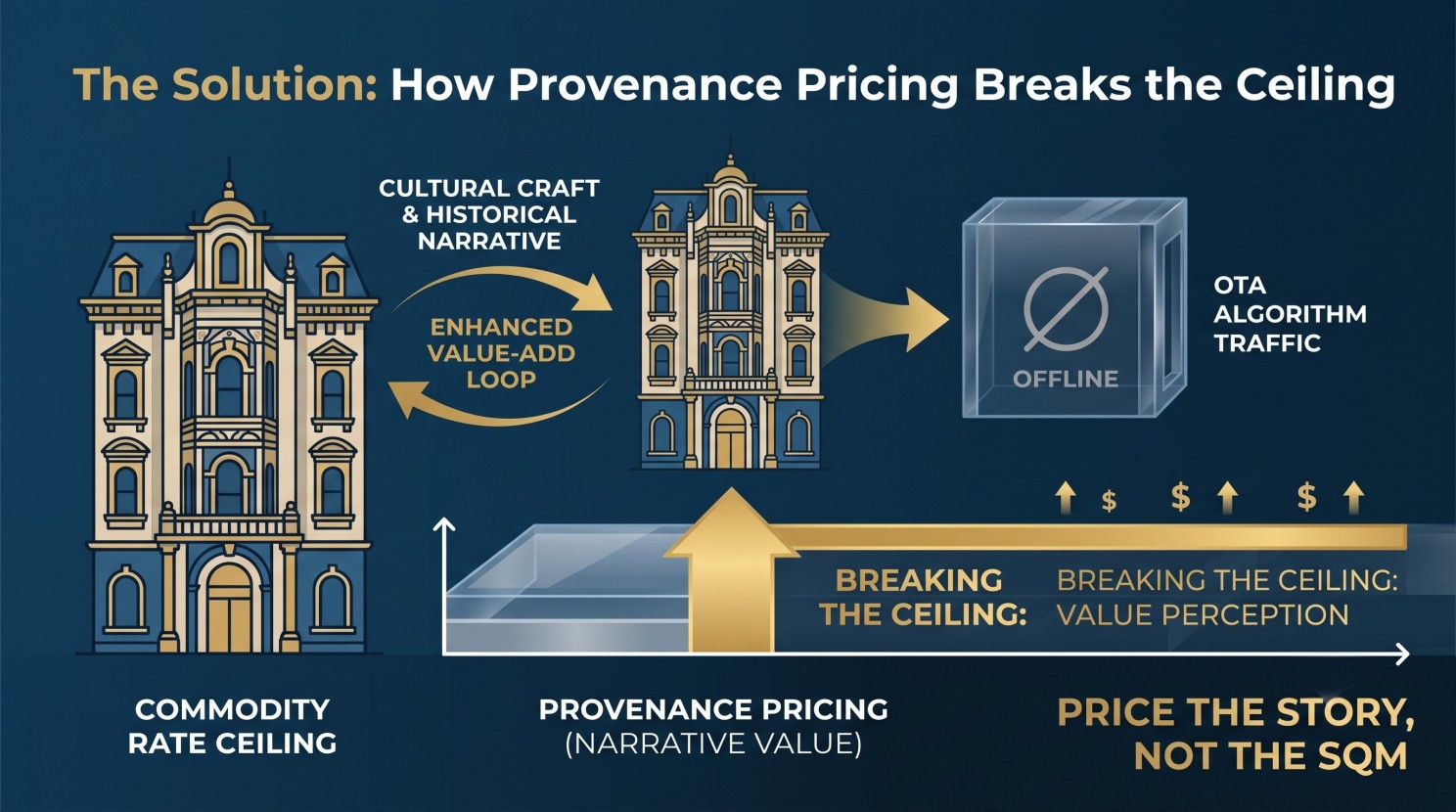
Properties executing a provenance model use third-party platforms strictly for standard room categories to capture baseline volume. Meanwhile, their most story-driven inventory – the historical suites, the top-tier corner residences, and signature experiential packages – is withheld entirely from third-party channels. These units are reserved exclusively for direct booking platforms.
According to landmark research on the “Billboard Effect” conducted by Cornell University’s School of Hotel Administration – and reaffirmed in subsequent cross-channel tracking by Phocuswright and Otamiser – listing a property on an OTA drives an incremental lift of 7.5% to 26% in direct non-OTA reservations, as roughly 15% to 20% of potential guests routinely jump from the aggregator to inspect the hotel’s official website before finalizing a stay.
When these prospective guests arrive on the direct site, they should encounter unique, premium room tiers that simply do not exist anywhere else.
Translating Physical Heritage into Scarcity Signalling
To command a narrative premium, the language of the property’s digital presence must pivot away from clinical hotel terminology. Generic descriptors such as “Deluxe King Room with Heritage Decor” tell the guest that the room is fundamentally standard, with a few aesthetic additions.
Provenance pricing requires descriptive specificity that reinforces rarity. Naming room categories after historical occupants, specific architectural features, or distinct material provenance – such as “The Teak Merchant Suite” or “The Courtyard Terrazzo Room” – creates a clear psychological distinction.
When every touchpoint on a direct website explains precisely why a space cannot be replicated anywhere else in the destination, the guest ceases side-by-side feature comparison.
Value Addition Over Rate Degradation
When market demand softens, commodity-driven properties immediately rely on public rate discounting, triggering price parity friction across channels and degrading the perceived value of their brand.
A provenance-led strategy protects the headline rate at all costs. Instead of cutting rates by twenty per cent to match a drop in regional demand, a property maintains its base pricing and introduces contextual value additions that intermediaries cannot replicate or communicate effectively.
Private architectural walk-throughs conducted by local historians, curated tasting menus featuring regional producers, or bespoke pre-arrival concierge planning add significant perceived value to the guest while preserving public rate integrity and maintaining healthy profit margins.
Reclaiming the Commercial Narrative
Online travel agencies remain an essential part of the modern travel ecosystem, serving as powerful discovery platforms that bring global visibility to independent destinations. However, mistaking a distribution channel for a total revenue strategy is a dangerous misstep.
Third-party aggregators built their businesses on scale, standardisation, and frictionless transaction volume—environments explicitly designed to turn accommodations into commodities.
Boutique and heritage properties are built on the exact opposite principles: specificity, craftsmanship, locality, and story. Attempting to maximise room yield while letting an algorithm treat your property like a standardised room commodity guarantees that your pricing will always remain suppressed.
By taking control of high-value inventory, communicating genuine material and historical rarity, and building direct relationships with guests seeking meaningful travel, hoteliers can break through the commodity rate ceiling. The goal is not to fight the distributor on their terms, but to operate on a model they cannot replicate: pricing the story, not just the square meters.