
For properties born with deep provenance – historic grand dames with 1920s ballrooms and generational traditions – heritage is a beautiful asset. It’s a natural moat that cannot be bought or copied.
But what about the modern luxury properties built last year? When you don’t have a past to trade on, how do you establish elite brand value?
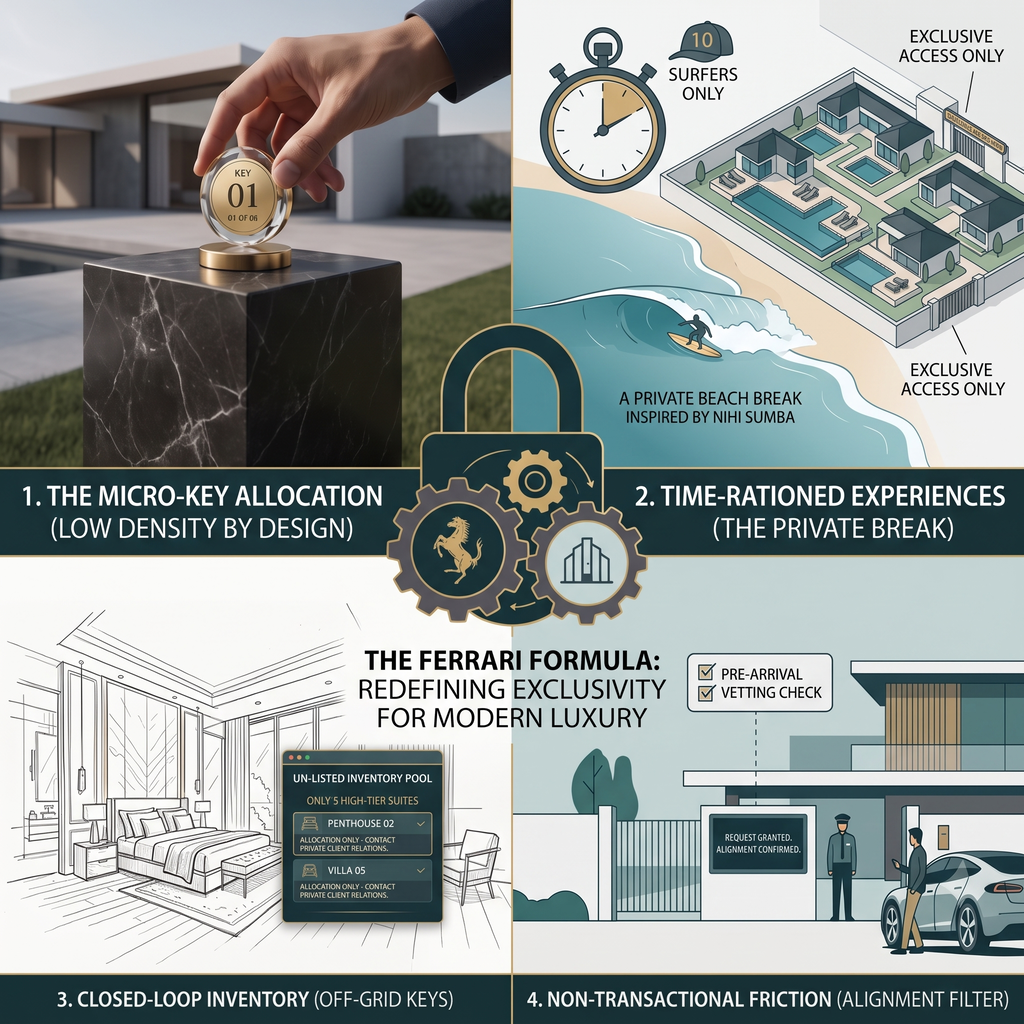
You don’t try to manufacture history. Instead, you look to the automotive or watchmaking sectors and copy the Ferrari or Patek Philippe playbook: operational scarcity.
Ferrari doesn’t just sell exceptional engineering; they sell the privilege of allocation. They intentionally build fewer cars than the market demands, shifting the dynamic from pure affluence to highly curated access.
For contemporary luxury properties, engineering structural bottlenecks is how you build immediate, powerful brand equity and unlock immense Average Daily Rate (ADR) pricing power.
If you are operating a modern asset without a historic narrative, here are six sophisticated operational levers to manufacture genuine scarcity:
1. The Micro-Key Strategy (Low Density by Design)
Without the sprawling physical footprints of historic urban palaces, new luxury properties can intentionally design for low capacity. Look at Bulgari Hotels & Resorts.
They treat their properties as “temples,” purposely capping key counts in major global hubs. Here, lower volume isn’t an operational limitation; it’s a premium brand feature. A smaller footprint guarantees absolute privacy and enables hyper-individualised, 1:1 service precision that large-scale, legacy properties cannot deliver.
2. Time-Rationed Asset Access
Scarcity can be engineered by placing an artificial cap on the hotel’s most desirable experiences, independent of room availability. Consider Nihi Sumba in Indonesia.
They strictly ration access to their world-class private surf wave to just ten surfers per day. Even if a traveller can easily afford the most expensive villa on the property, they cannot access the wave if the daily allocations are gone. By rationing the experience rather than just the room, you turn an activity into a highly coveted asset.
3. The Closed-Loop Inventory Strategy (Hidden Allocation)
Traditional hotels push 100% of their inventory onto public booking engines and OTAs to maximise occupancy. A scarcity model intentionally pulls back. You engineer exclusivity by holding your top 10–15% of inventory – the signature penthouses, private villas, or corner suites – completely off the public grid.
These “unlisted” keys cannot be booked online; they are managed via private client relations and allocated strictly to repeat patrons, direct referrals, or guests vetted through elite travel designers.
4. Non-Transactional Friction (Application-Based Booking)
Classic luxury says, “If you can pay the rack rate, you can stay.” Manufactured scarcity introduces structural friction that screens for alignment over pure affluence.
This means replacing standard instant-confirmation booking engine widgets for top-tier accommodations with a “Request for Allocation” system. By introducing a human-touch pre-arrival intake – asking about preferences, party dynamics, and trip intent – you shift the guest mindset from buying a commodity to being granted entry.
5. Asymmetrical Amenity Access (The Walled Garden)
You can turn the hotel itself into a walled garden by restricting its best secondary venues to overnight guests only.
If local day-visitors or non-residents cannot simply buy their way into your rooftop pool, spa, or signature dining counter, the public desire to breach that wall increases exponentially. The privilege of booking a room suddenly carries a massive functional premium: it becomes the only passport that unlocks the entire estate.
6. Culinary Bottlenecks (Intentionally Scaled-Down Outlets)
Instead of building a 120-seat all-day dining restaurant, design an 8-seat chef’s counter or a 4-treatment-room subterranean spa. By intentionally undersizing F&B and wellness outlets relative to room capacity, demand internal to the hotel constantly exceeds supply. When a guest realises they need to reserve their dinner spot 30 days before arrival even while staying on-property, the perceived value of the culinary program skyrockets.
The Operational Engine: Predictive Service Delivery
Operational scarcity fails immediately if the execution falls short. When guests jump through hurdles or pay steep rate premiums to secure a room, their baseline expectation shifts from “good service” to invisible perfection.
Because low-density properties handle fewer total check-ins per day, front-of-house teams can abandon transactional scripts in favour of predictive stewardship.
The Guardrail: Avoiding the Scarcity Trap
There is a fine line between curated exclusivity and operational arrogance. If a hotel uses scarcity as an excuse for poor communication, rigid cancellation penalties, or dismissive service, high-net-worth travellers will take their capital elsewhere.
The key to executing the Ferrari formula is balancing high friction at booking with zero friction during the stay.
The boundary-setting happens during the allocation phase. Once the guest crosses the threshold, the experience must feel generous, frictionless, and deeply warm. Scarcity should create anticipation and value—never frustration or elitism for its own sake.
ADR Over Occupancy
From an asset management perspective, operational scarcity isn’t just a marketing gimmick – it’s a margin strategy.
The Strategic Takeaway
Heritage is an incredible asset inherited over time. But for the modern hotelier operating a new property, operational scarcity is an active strategy that can be engineered today.
By prioritising low-density footprints, private inventory loops, rationed experiences, and intentional operational friction, modern brands aren’t competing with history – they are creating a completely different, highly potent currency for the modern traveller.
Legacy takes centuries to inherit. Scarcity can be engineered today.