

Search engine indexing turns bespoke travel proposals into price-auditing checklists.
The moment an inbound itinerary lists a boutique property with a direct-booking engine, a dining venue with user-uploaded menus, or a craft studio with a digital pin, the client’s phone becomes a disintermediation engine. The client compares net quotes against retail rates, removes the transfer line items, and books directly. The DMC gets left managing ground logistics on a 10% coordination fee.
The traditional inbound business model relied on information asymmetry. The operator held the local phone numbers, spoke the regional dialect, negotiated paper contracts, and kept net pricing tucked inside an office binder.
Today, camera translation apps, automated mapping platforms, and real-time planning tools have flattened regional obscurity. If a supplier appears on the public web, it is open to disintermediation.
When an operator’s inventory lives entirely on the indexed web, that operator is not selling proprietary access. That operator is charging an administrative markup on public data.
Holding a 30%+ gross margin requires building an unindexed supply chain – a network of physical assets, private residences, and cultural practitioners that deliberately operate outside public search directories.
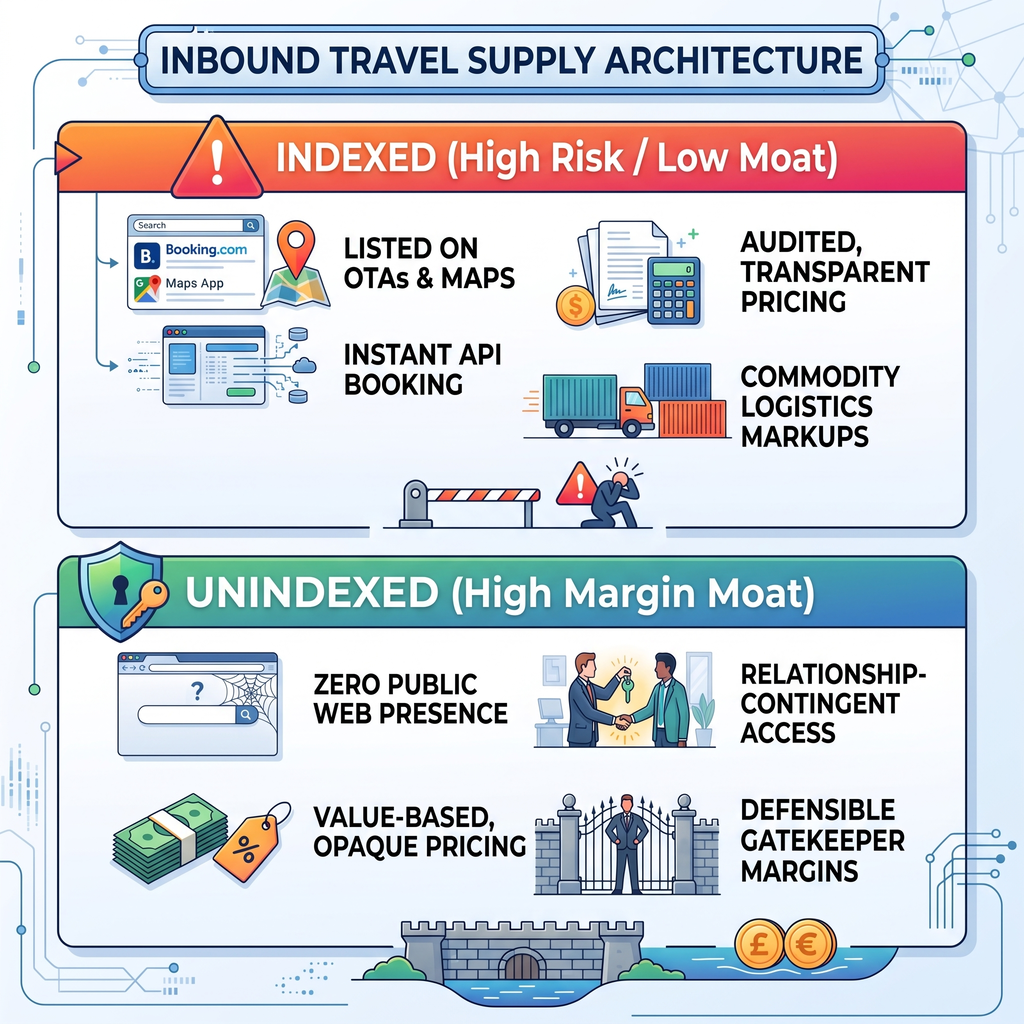
The Anatomy of Indexed Supply Leakage
Standard luxury itineraries across Southeast Asia share the same structural vulnerability. They rely on publicly discoverable vendors that market themselves directly to end consumers:
When a high-net-worth traveller or their outbound advisor receives an itinerary built on these suppliers, the proposal triggers immediate price checking. Every line item gets searched, audited, and compared against published rates.
Public discoverability destroys positional scarcity. When clients see hundreds of public reviews and thousands of user-generated photos for every stop on their schedule, the trip stops feeling exclusive. It feels mass-produced and marked up.
The client begins unbundling the itinerary. They book the hotel through a loyalty program, hire a private driver via a regional app, and make dining reservations independently. The DMC loses control of the product and watches its gross margin compress into a flat vehicle coordination charge.
Procurement in the Unindexed Layer
Protecting high margins requires replacing commercially discoverable vendors with assets that operate without a digital footprint. This means moving procurement away from commercial directories and into three distinct offline categories:
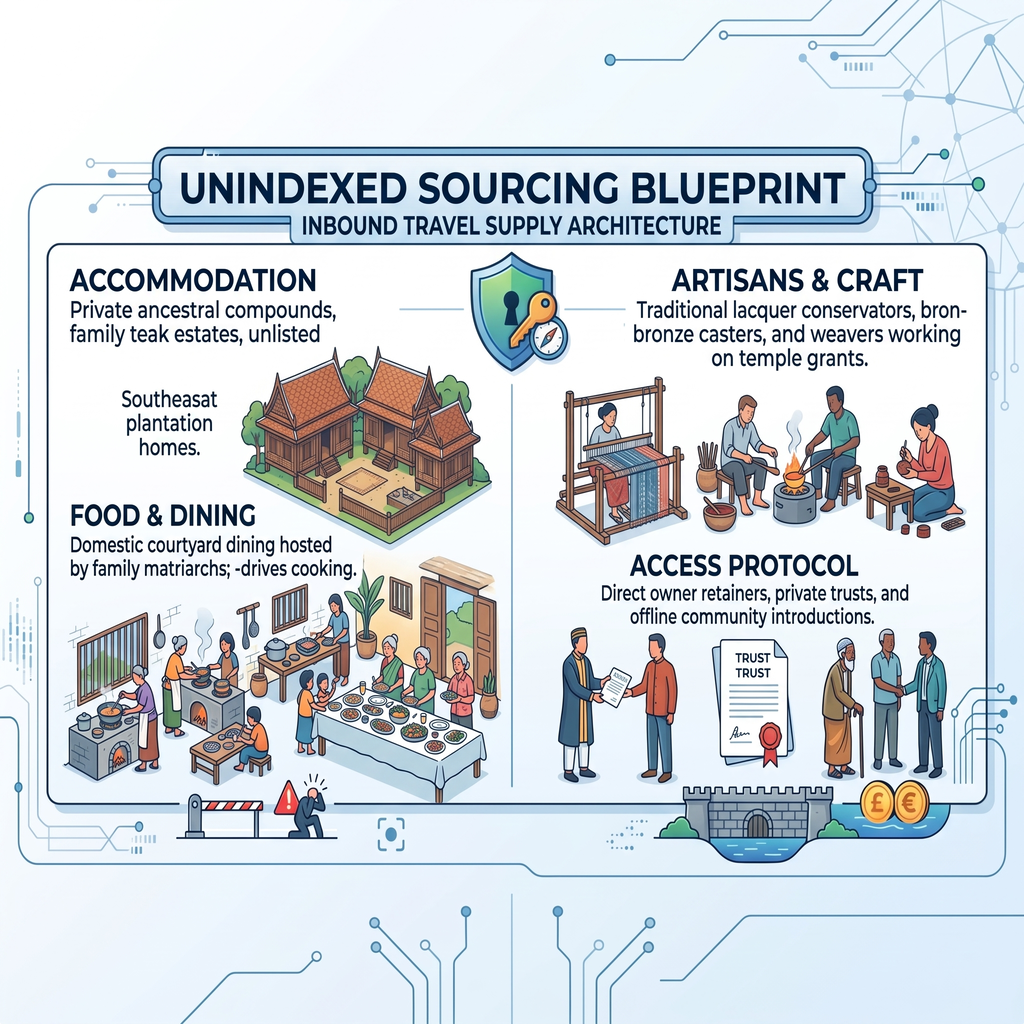
1. Private Residential Estates Over Commercial Hotels
Commercial luxury hotels are public spaces built for high room turnover. The unindexed supply chain relies on private domestic architecture:
2. Unlisted Master Craftsmen
The moment an artisan opens a retail shop for foot traffic, the workshop changes from a working studio into a tourist attraction.
3. Domestic Dining Beyond the Review Economy
The most compelling regional food doesn’t come from commercial dining rooms with public relations budgets. It exists inside private domestic kitchens:
Operational Friction as a Commercial Moat
Online booking platforms, algorithmic search engines, and venture-backed aggregators cannot scale unindexed assets. Scaled tech platforms require structured data: standardised room categories, instant API availability, merchant payment gateways, and automated cancellation rules.
They cannot process a private handshake, an unlisted estate retainer, or an informal family agreement.
That operational friction is the business moat.
When an asset cannot be formatted into a standard database schema, it cannot be indexed by a search engine. When it cannot be indexed, it cannot be algorithmically compared, automated, or disintermediated. The difficulty of contracting the asset is precisely what protects the DMC’s 30%+ gross margin.
Restructuring the Commercial Proposal
To eliminate price auditing, change the way proposals are written for travel advisors and private clients. Remove hyperlinked business names and public vendor tags from all client-facing documentation.
Frame each stop by its barrier to entry:
“This afternoon takes place inside a private 19th-century teak compound along the river. The estate is a private family residence, not a commercial hotel or public museum. Access is arranged through our direct agreement with the family trustees. We ask that location tagging remain disabled on all personal devices.”
This approach changes the commercial dynamics of the sale:
This isn’t a call to make your brand digitally invisible, nor does it require gagging commercial businesses. You should vigorously promote your brand, narrative authority, and curated access across digital channels to capture demand.
The strategy is about procurement: sourcing from private partners—family estates, master restorers, and domestic hosts—who already have zero commercial reason or desire to maintain an online storefront.
When your underlying supply list lives on a public search engine, you are competing against the client’s smartphone. Market your authority on the web, but keep your physical assets unindexed; that is how you control the access gate and defend your margin.