

Across the global inbound sector, destination management companies are committing a systemic commercial error: they are marketing the destination rather than their own operational expertise.
Review the communications output of almost any regional DMC across Southeast Asia, East Africa, or Latin America, and the pattern is identical. Companies invest commercial capital producing saturated drone footage of limestone karsts, golden-hour temple facades, and bustling market stalls.
They craft evocative captions about waking up to ancient rhythms or absorbing the spirit of a heritage city. This is not enterprise business-to-business strategy; it is retail destination marketing masquerading as corporate communications.
Inbound operators are behaving like digital travel agencies and consumer lifestyle brands, turning their corporate channels into distribution feeds for visual travel tropes.
The underlying assumption is fundamentally flawed: they believe that by making a region look alluring, high-billing outbound travel advisors and enterprise product directors will automatically direct multi-generational, high-net-worth clients to their door.
This posture misunderstands the institutional buyer. When an enterprise procurement lead, an outbound tour operator, or a luxury travel advisor evaluates a potential ground partner, they are not seeking holiday inspiration.
They already understand the destination’s appeal; their marketing teams handle consumer allure. What trade buyers are actively looking for is supply chain stability, risk governance, operational competence, and proprietary access.
When an inbound operator relies on postcard visuals, it creates an intellectual vacuum. It signals to trade gatekeepers: We do not possess proprietary access, custom routing, or complex logistical moats, so we have to sell the scenery instead.
The Anatomy of Operational Misalignment
The persistent drift toward consumer styling stems from an unexamined default to retail playbooks. Inbound leadership teams frequently delegate their voice to external agencies or junior staff whose performance benchmarks are shaped entirely by broad public reach, visual appeal, and generic consumer engagement.
However, metrics designed for retail exposure bear zero mathematical correlation to B2B enterprise procurement. When an inbound DMC publishes uncontextualized imagery of a sunrise temple visit or a scenic river bend, it invites three immediate, damaging conclusions from professional trade buyers:
What Institutional Buyers Require: The Operational Blueprint
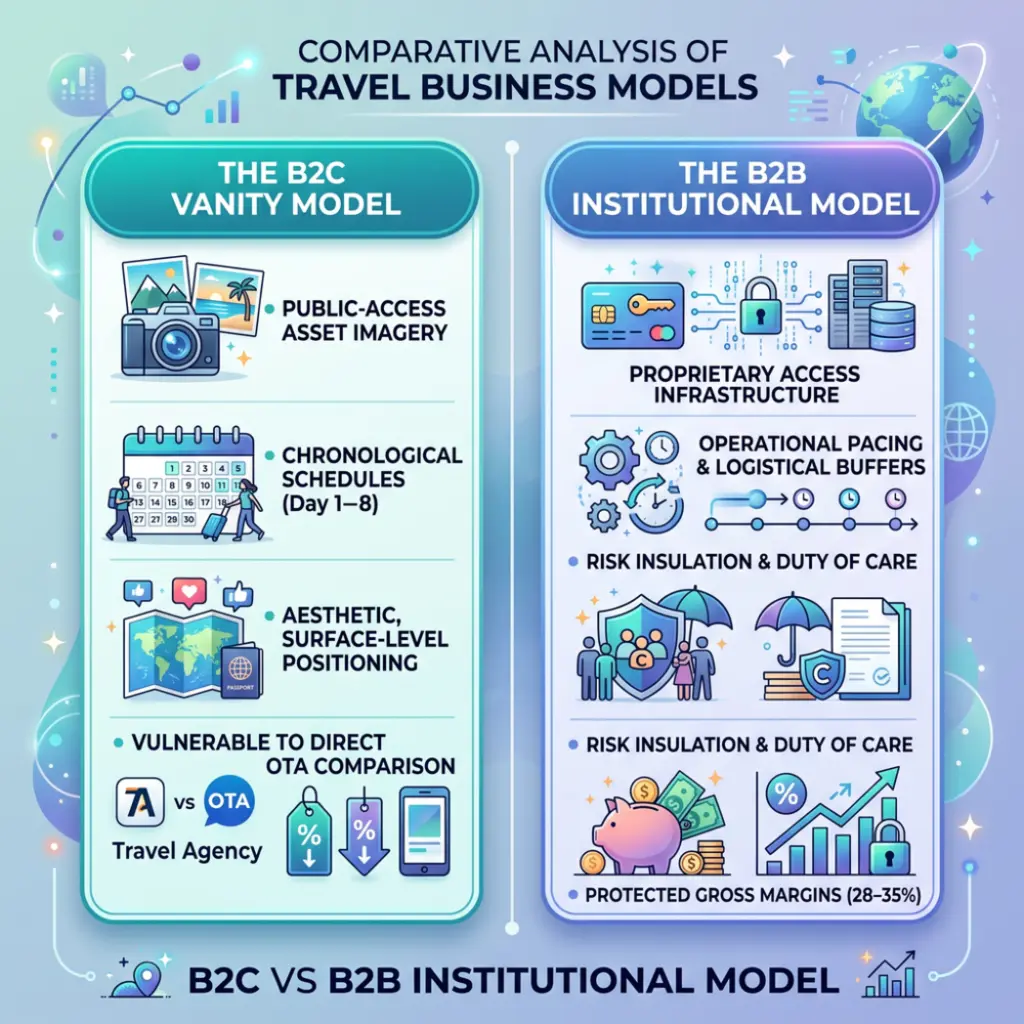
Outbound product directors, high-billing luxury advisors, and consortia procurement heads carry severe legal, commercial, and reputational exposure. If an ultra-high-net-worth traveller gets stranded in an unmanaged crowd bottleneck during peak heat, or suffers an itinerary collapse due to an unhedged seasonal road closure, the outbound advisor absorbs the client backlash.
Glossy visual marketing provides zero reassurance against those liabilities. What trade buyers require is hard evidence of operational resilience. To capture institutional market share and command pricing power, an inbound operator’s corporate communications must transition from scenery to infrastructure, deliberately demonstrating competence across four primary pillars:
1. Operational Pacing and Energy Architecture
Itineraries cannot be treated as flat containers packed with back-to-back attractions. Professional B2B communications must articulate how the DMC engineers pacing to manage physical stamina, thermal stress, and cognitive fatigue.
Detailing why a transfer route is calibrated to micro-climatic windows, or how sensory-dense excursions are systematically counterbalanced with low-friction recovery environments, proves to the advisor that their client will not suffer travel burnout.
2. Logistical Buffers and Contingency Management
Real-world travel execution in secondary and emerging corridors involves friction: road washouts during the late monsoon, rail rescheduling, or regional aviation disruptions.
The hallmark of an institutional DMC is the deliberate engineering of invisible operational slack. Trade buyers want to see that schedules are built with dynamic recovery windows, protecting non-negotiable milestones—such as private charter connections or international departures—without the traveller ever feeling rushed or panicked.
3. Proprietary Access and Intellectual Co-Creation
When itineraries consist solely of standard, public-facing attractions, the client can easily unbundle the trip and cross-reference prices via online booking engines, destroying the advisor’s margin.
B2B communications must highlight proprietary, non-commercial agreements: multi-year relationships with master architectural restorers, private access permissions with regional heritage commissions, or research-led curation with local historians. If an asset has no public ticket window and zero digital indexation, it cannot be commoditised or price-shopped.
4. Verifiable Duty of Care and Risk Governance
Enterprise buyers require documented proof of operational safety.
Inbound communications should transparently demonstrate professional governance: driver shift caps, fleet preventative maintenance regimens, remote satellite communications in secondary regions, extreme heat response procedures, and direct triage protocols with regional medical evacuation providers. Showing how client risk is systematically insulated proves commercial maturity.
The Commercial Shift
Every commercial dollar and operational hour invested in consumer-facing aesthetic campaigns is a resource diverted away from building enterprise B2B authority.
High-net-worth travellers rarely procure complex multi-week journeys through emerging markets through unvetted public feeds; they rely on elite advisors, corporate trade channels, and established luxury networks who audit their ground partners rigorously.
When an inbound operator stops marketing the destination and begins publishing the operational blueprint, the commercial dynamic transforms. The conversation permanently shifts away from transactional day-rate haggling and commodity rate comparisons. Instead, the DMC anchors its positioning on institutional reliability, proprietary access control, and defensible net yields.
The strategic challenge for inbound leadership is direct: Are your public communications actively generating enterprise authority and pricing power, or are you simply producing scenic background noise for an audience that doesn’t hold the contract?