
Thailand Policy Slogan Trap For Inbound Operations

State tourism boards have a habit of broadcasting internal macroeconomic targets directly to international consumers, creating immediate operational friction for luxury inbound firms.

Over recent seasons, Thailand’s public tourism apparatus has leaned into guest-facing policy slogans: quality over quantity (เน้นคุณภาพ ไม่เน้นปริมาณ) high-value tourism (การท่องเที่ยวเชิงมูลค่าสูง) and high-purchasing-power target cohort (นักท่องเที่ยวกลุ่มกำลังซื้อสูง).

When a ministry drafts these phrases for an inter-agency white paper, they define an internal fiscal target. When they leak into outbound marketing campaigns and international press releases, they tell affluent travellers that the destination views them as balance-sheet stabilisation tools rather than guests.

Nobody wires $2,500 a night for a private island villa or books an extended multi-generational charter to be quantified as a fiscal extraction mechanism for a national current-account deficit. Family offices, private wealth clients, and senior advisors sniff out this shift from hospitality to balance-sheet extraction immediately.

For the inbound operator, this policy-speak creates immediate commercial drag. Margins depend on personal trust and discretion, but public messaging frames the entire country as a state-run tollbooth hunting foreign liquidity. The moment an inbound guest feels categorised as a revenue-per-head target, their tolerance for logistical errors hits zero.

The underlying problem is an unresolved identity crisis within the country’s national tourism model. The state attempts to chase 38 million mass arrivals to sustain airport concession fees and airline seat capacity, while simultaneously claiming it runs an elite, low-impact destination.

These two economic models cannot occupy the same physical geography without catastrophic service breakdowns that land directly on the inbound operator’s balance sheet.

Mass tourism relies on high asset turnover, high-density transfers, and wholesale concessions. Elite inbound requires low density, strict acoustic privacy, and controlled access. Because the state refuses to enforce binding spatial limits or caps on municipal throughput, the operational fallout falls entirely on private itineraries:

  • Route Congestion and Transfer Degradation: A client paying $350 for a private airport transfer sits in the same two-hour traffic crawl along Phuket’s Route 402 as forty-seat tour buses. When that transfer fails, the operator comps a $200 spa credit or absorbs client anger while the fleet contractor bills full price.
  • Public Asset Degradation: Marine reserves promoted as pristine environments get swamped by 8,000 day-trippers an hour, dumping fuel wash, microplastics, and reef-toxic sunscreen into shallow bays before 10:00 AM. A $4,000-a-day private yacht charter anchored in the same bay ends up surrounded by idling twin-stroke outboards and plastic waste.
  • Municipal Infrastructure Failures: Ultra-luxury builds commanding nightly rates of 55,000 THB share unzoned property lines with open municipal drainage ditches, unshielded diesel generators, and ad-hoc commercial strip developments.
  • Service Recovery Leakage: When public infrastructure breaks down, hotels don’t discount their non-refundable wholesale rates. The DMC absorbs every dollar of service recovery—private speedboat re-routings, complimentary helicopter transfers, or outright margin refunds—to protect agency relationships.

DMCs cannot fix municipal planning failures, nor can they build bypass roads. Standard wholesale booking models fail because they pull from the same published inventory as mass OTAs and volume packagers. When an agency simply resells five-star chain suites, published golf tee times, and public speedboat transfers, it leaves its clients exposed to municipal bottlenecks.

To defend luxury margins, we need to completely decouple from state-marketed inventory and build defensible, unindexed operational moats.

Inbound firms have to strip policy jargon out of client communications and return to the vernacular host standard: the gracious host (เจ้าบ้านที่ดี). In practice, that means shifting from open-market procurement to locked-access agreements that bypass public infrastructure.
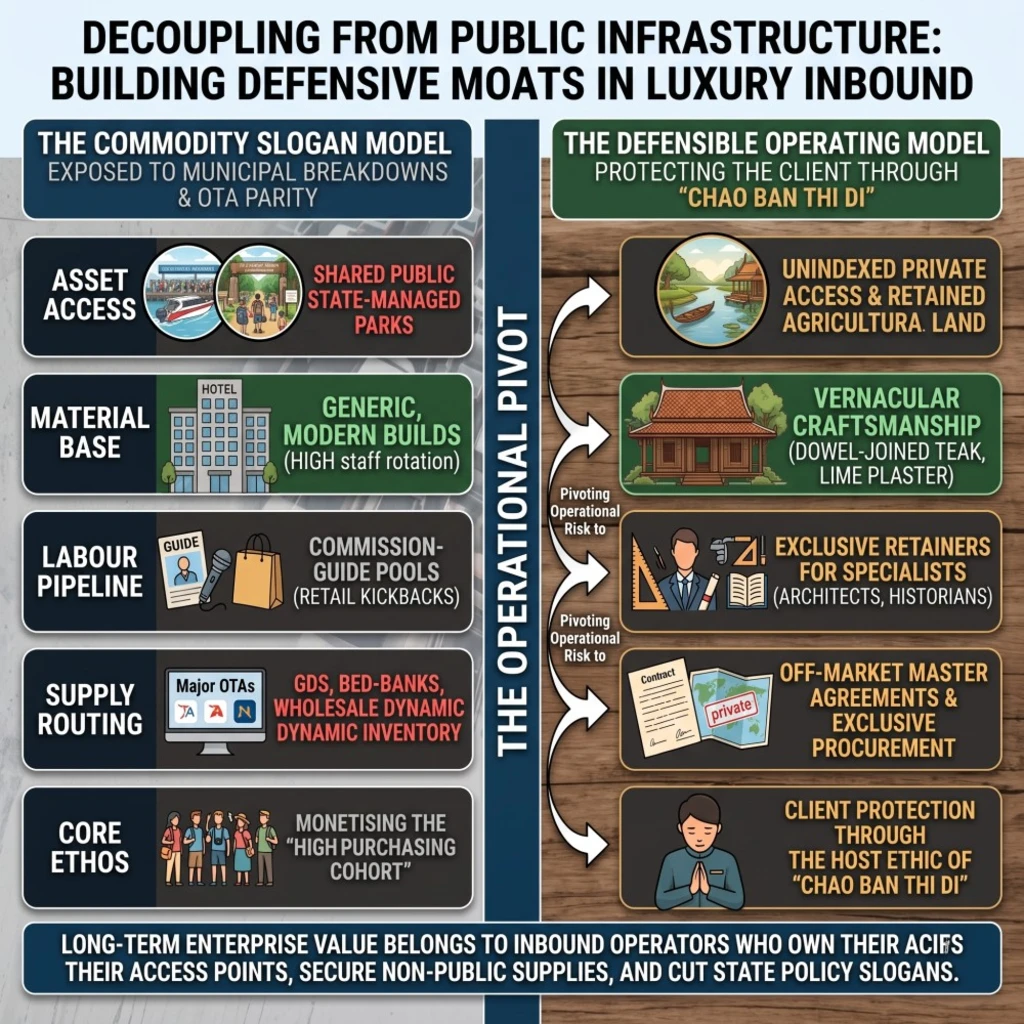
Thailand policy slogan trap: Decoupling from public infrastructure, building defensive moats in luxury inbound.
  • Locking Off-Market Landings: Stop routing marine transfers through public piers like Chalong, Rassada, or Serangan. High-end itineraries must secure exclusive access agreements with private marinas, low-draft river properties, or agricultural landowners who hold riparian rights. If a guest steps onto a dock shared with a bulk package tour running on budget diesel, the illusion of exclusivity breaks, regardless of the vessel’s interior fit-out.
  • Structural Material Defensibility: Steer clients away from generic concrete glass boxes that suffer water intrusion, peeling paint, and mould bloom after three monsoon seasons. Modern builds often rely on thin surface treatments over cheap blockwork that demand constant, noisy remediation. Focus private product development around durable vernacular engineering: raised teak framing that avoids groundwater rot, traditional clay-tile roof pitches that manage heavy tropical rains without ceiling failures, and breathable lime-plaster walls that cut HVAC loads. These properties age well, carry genuine historical provenance, require specific artisan maintenance, and cannot be replicated by international hotel chains operating on 10-year depreciation cycles.
  • Disintermediating the Guide Pool: The wholesale guiding market is broken. Commission-driven kickback networks at commercial gem galleries, latex outlets, and silk warehouses have destroyed client trust and ruined itinerary pacing.
  • Inbound firms must pull specialists out of commercial pools by placing them on exclusive annual retainers. A botanist, an architectural restorer, a textile curator, or an active excavation field technician provides intellectual depth that protects the DMC’s pricing power and keeps the guest away from tourist corridors.
  • Contractual Exclusivity on Ancillary Services: Avoid third-party transport brokers who outsource to gig-economy drivers during peak season surges. Contract directly with small fleet operators under strict service-level agreements: mandatory five-year maximum vehicle age, verified defensive driver training, dedicated fleet maintenance records, and GPS speed tracking. When a driver misses a private flight transfer due to poor maintenance or reckless route planning, the operator carries the reputational loss.

The state’s obsession with promotional slogans like high value tourism (การท่องเที่ยวเชิงมูลค่าสูง) will not build municipal water treatment plants, enforce zoning bylaws, or limit marine park foot traffic.

The public sector’s structural mandate remains aggregate arrival volume to keep national transport metrics viable. Inbound operators waiting for the public sector to fix spatial crowding or clean up marine ecosystems will watch their margins get eaten away by service recovery costs and negative client reviews.

Audit your current product line item by item. If your routing relies on state-promoted attractions, public docks, and resorts that dump unsold room nights onto wholesale channels during shoulder seasons, you’re running a commoditised resale desk with no defensive moat.

Long-term enterprise value belongs to inbound operators who own their access points, secure non-public supply contracts, and cut state policy slogans completely out of client-facing operations.


Cee Jay
Cee Jay

Founder and writer of heritasian.com, a website dedicated to historical travel and heritage. My background includes a diverse range of experiences, from hospitality and sales to writing and editing. Living in Chiang Mai, Thailand for the past 20 years. My mixed British and Straits Chinese heritage, has shaped my understanding of culture and history, which informs my writing.

Articles: 172
DSLR camera for landscape photography with mountain views.