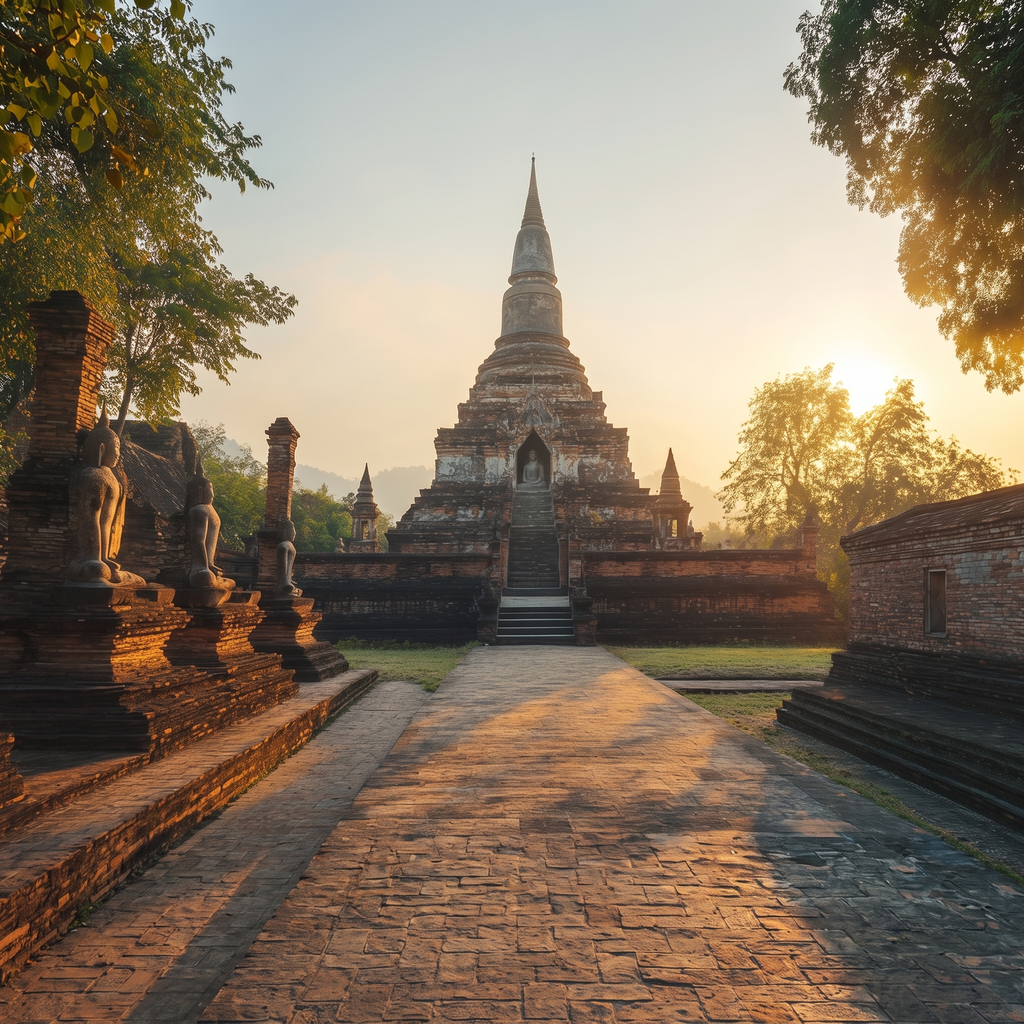

Chiang Mai’s historic core is hitting hard physical and economic limits. Between the Moat and the Ping River, commercial margins for inbound operators are degrading under the weight of commoditisation. Over-trafficked temple circuits, homogeneous retail corridors, and acute vehicular gridlock inside the Old City have diluted the premium guest experience.
Most inbound itineraries still treat northern Thai history as an event that began out of nowhere in 1296 CE with King Mangrai. By cramming high-net-worth travellers into the same four square kilometres as volume-driven bus tours, operators face compressed margins, rising guide turnover, and an inability to justify luxury price points against self-directed digital itineraries.
The structural flaw sits in the itinerary sequence. Luxury travel designers routinely bolt on adjacent provinces as half-day afterthoughts or rushed overland transfers, forfeiting the high-yield intellectual framing that distinguishes an expert inbound operator from an algorithmic booking platform. Secondary destination dispersal isn’t a sustainability talking point.
It’s an operational necessity to protect client yield and relieve carrying-capacity strain on fragile urban centres.
To fix the margin collapse in Chiang Mai, we have to look thirty kilometres south. Lamphun – ancient Hariphunchai – isn’t an auxiliary excursion. It’s the intellectual, architectural, and religious bedrock without which the Lanna Kingdom wouldn’t exist.
Architectural Morphology and the Mon-Dvaravati Baseline
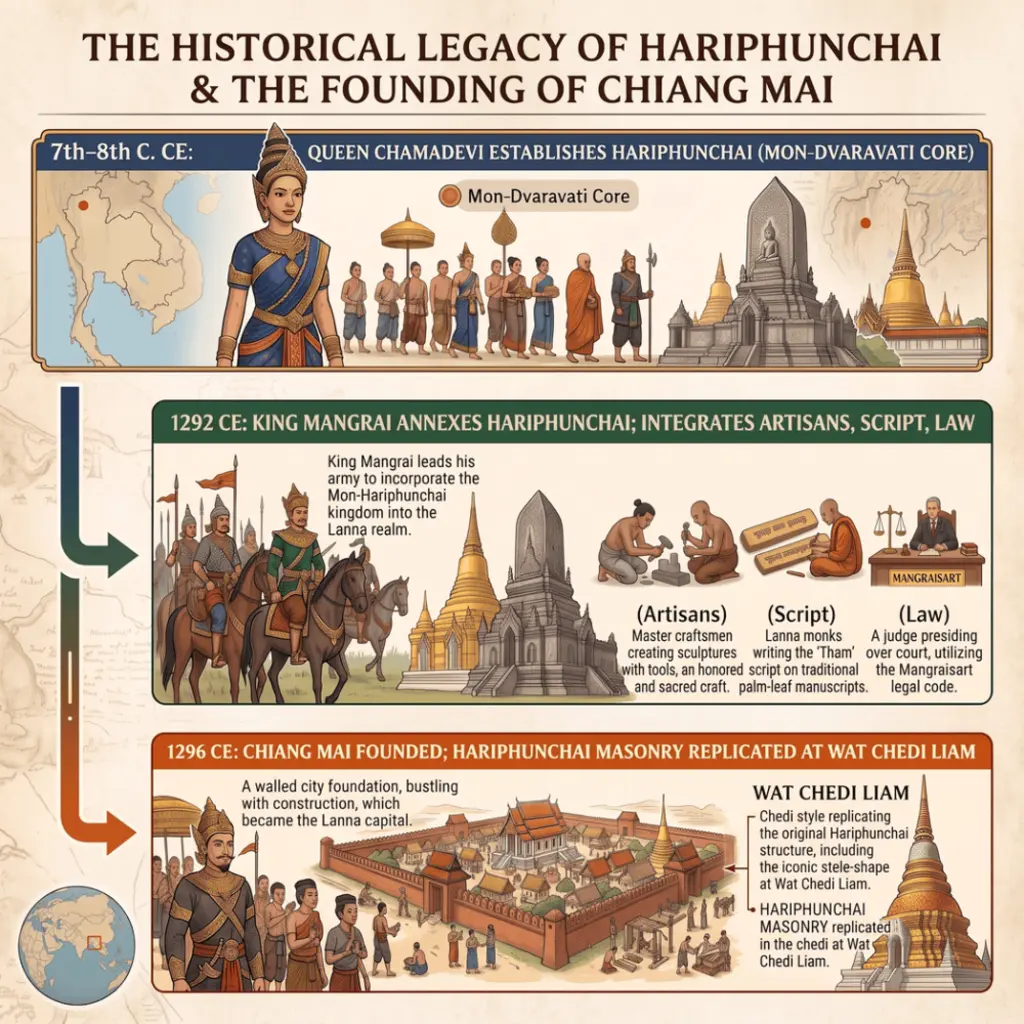
Queen Chamadevi founded Hariphunchai in the seventh or eighth century CE. It represented the northernmost bastion of the Mon-Dvaravati cultural sphere five centuries before King Mangrai cleared the ground for Chiang Mai.
When Mangrai annexed Hariphunchai in 1292 CE, he didn’t raze it. He absorbed its administrative models, its Mon script, its Theravada monastic lineages, and its master masons.
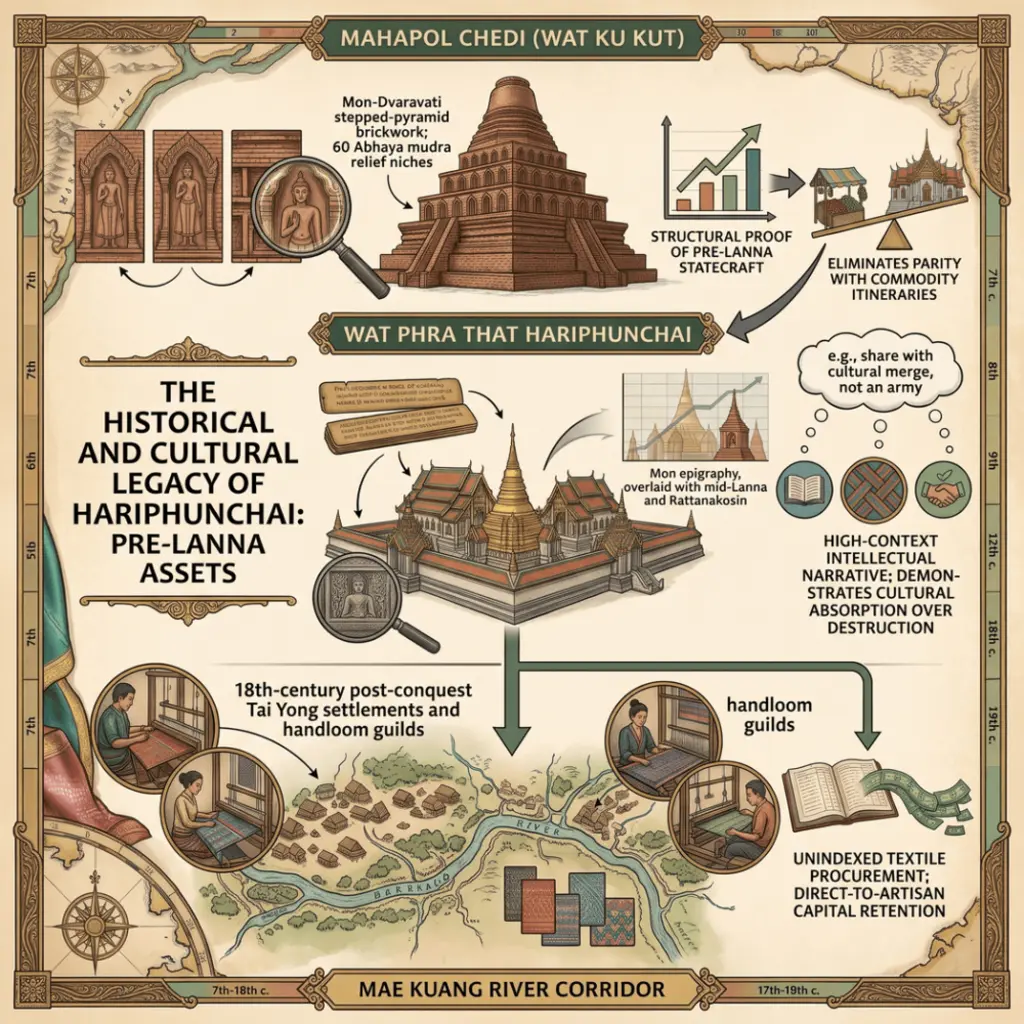
You can read this structural lineage directly off the brickwork at Wat Chammathewi (Wat Ku Kut). Its central Mahapol Chedi remains an exceedingly rare standing survivor of Dvaravati monumentality: a stepped pyramid of fired clay brick and lime-and-sand stucco rising through five diminishing square tiers.
Set within sixty recessed niches, standing Buddha figures cast in high relief display the double Abhaya mudra, exhibiting the broad facial planes and meditative authority unique to Mon sculpture.
This isn’t the sweeping, bell-shaped Sinhalese-Lanna stupa profile that later defined Chiang Mai’s urban skyline. Mangrai admired the Mahapol Chedi’s geometry so much that he attempted to duplicate its five-tiered form at Wat Chedi Liam in Wiang Kum Kam.
Just paces away from the Mahapol Chedi stands the Ratana Chedi, an octagonal brick structure that provides tangible proof of an advanced pre-Tai spatial grammar that most commercial itineraries bypass entirely.
At Wat Phra That Hariphunchai, this architectural dialogue deepens. The complex represents an unbroken spiritual continuum where eighth-century Mon stone inscriptions sit alongside fourteenth-century Lanna gilded stupas and late-nineteenth-century Bangkok monastic halls.
That cultural continuity extends beyond religious compounds. Along the alluvial flats of the Mae Kuang River, settlement enclaves founded by Tai Yong populations – relocated from Shan State during the late-eighteenth-century Kep Phak Sai Sa, Kep Kha Sai Mueang repopulation campaigns – maintain operational handloom workshops.
They weave fine-count cottons and supplementary-weft silks (pha yok dok) on traditional frame looms. This isn’t a costumed cultural performance staged for tour buses. It’s a functional, community-governed craft guild operating on its own economic terms.
Transit Corridors and Value Architecture
Resequencing Lamphun as the structural prologue – rather than the postscript – demands a total overhaul of the transit architecture. Dumping clients into diesel vans on the Superhighway completely ruins the historical narrative before they arrive.
Instead, high-end inbound programs should run on two low-impact transit corridors:
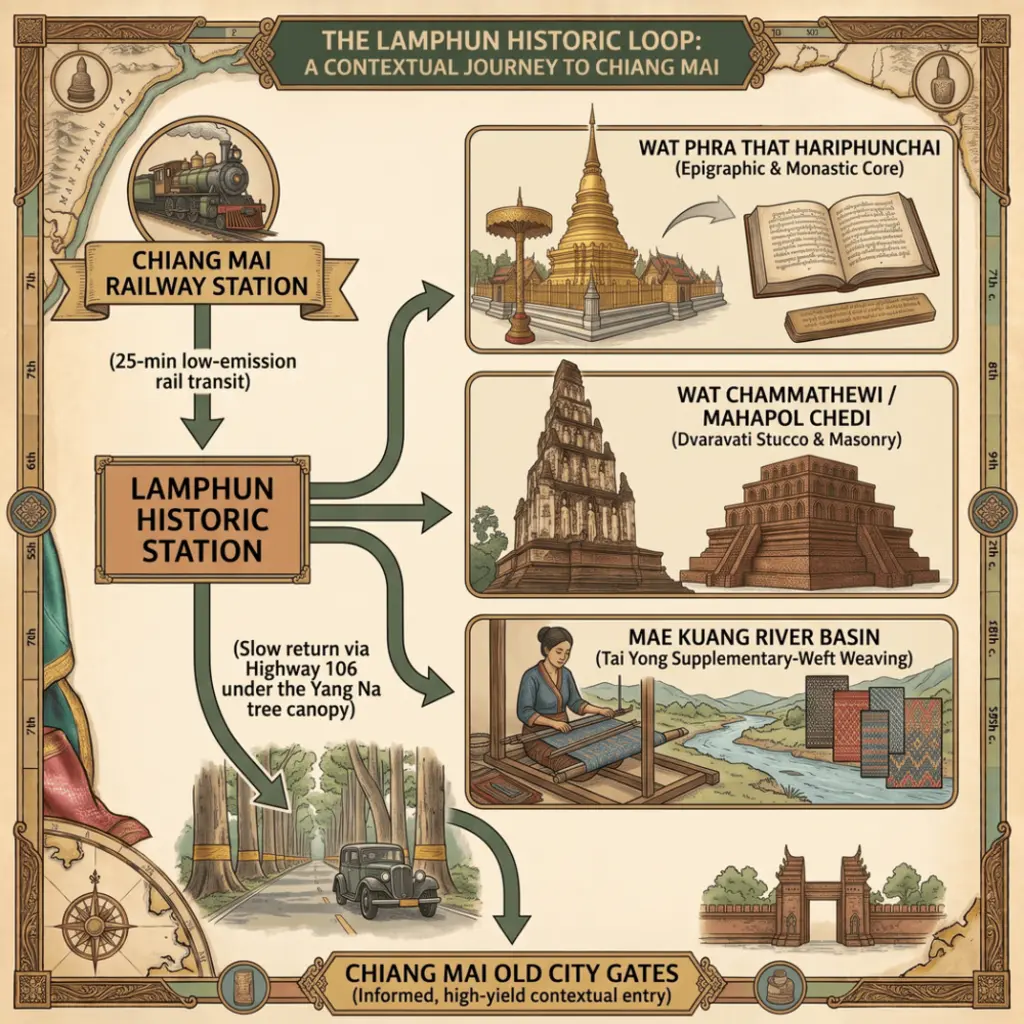
First, the State Railway of Thailand (SRT) Northern Line from Chiang Mai Railway Station to Lamphun. A private booking in a restored heritage diesel railcar or an early-morning commuter run eats up just twenty-five minutes.
It cuts clean through urban perimeter sprawl, dropping guests into Lamphun’s sleepy, low-scale rail terminal without sitting in arterial traffic. It resets the client’s internal pacing, establishing the unhurried physical environment required to digest complex architectural morphology.
Second, Highway 106 – the historic Old Chiang Mai–Lamphun road. This route forms a living arborial corridor sheltered by nearly nine hundred century-old Yang Na trees (Dipterocarpus alatus), soaring forty metres high with trunks wrapped in traditional saffron monastic cloth.
Rather than treating Highway 106 as a generic roadway, operators can position it as a slow-transit heritage asset. Regulated early-morning e-bike departures or low-emission electric transfers allow travellers to understand the physical distance, ecological baseline, and spatial relationship that tied Hariphunchai to its northern annex.
The operational leverage here lies in spend retention and pricing power. When a DMC moves a guest from a high-density hub to Lamphun under a deep-context itinerary, the financial mechanics shift away from commodity aggregators.
Ground arrangements can bypass corporate commission schemes entirely:
The operator captures clean margin through bespoke intellectual property—the curation, the narrative architecture, and the logistical sequencing – while the provincial economy captures clean capital with near-zero leakage.
The Operational Verdict
Destination planners and regional directors have spent years throwing capital at artificial attractions, theme parks, and lifestyle retail developments around Chiang Mai to engineer tourist dwell time. It’s an expensive, capital-intensive mistake.
The most defensible cultural asset in Northern Thailand sits twenty-six kilometres down a rail line. It has stood intact for over twelve hundred years.
If your product team continues to sell Chiang Mai as an isolated, standalone cultural destination, you’re competing on price against online travel agencies and cut-rate local transport apps. By anchoring your northern program in Lamphun’s Mon-Dvaravati lineage, you build an uncopyable product moat, protect your net yields, and shield your clients from the commercial noise of over-trafficked centres. Lamphun isn’t a side trip. It’s chapter one.