
Key Insights
Heritasian.com is the culmination of a lifelong obsession with history, cartography, and the diverse cultures of Southeast Asia. Founded by Cee Jay, a writer of mixed British and Straits Chinese heritage, the platform traces a personal journey from the medieval castles of Wales and England to the “indigo-shadowed” streets of Penang and Chiang Mai.
It is a dedicated space for “Slow Journalism,” where the focus is on the deep, industrial, and social narratives of the region’s heritage.
Northern realism: This is a grounded, no-nonsense approach to storytelling that completely rejects romanticised or airy-fairy fluff. It roots the narrative in blunt, pragmatic truth and real-world honesty.
Peranakan: This term refers to the unique cultural heritage born from the historic intermarriage of Chinese immigrants and local communities in the Straits Settlements. It represents a vibrant blending of customs, language, and stunning architectural design.
Nusantara: This classic Old Javanese term encompasses the vast, sweeping maritime sandbox of the Indonesian archipelago. It carries a deep sense of regional history, romance, and cultural interconnectedness.
Orang Minyak: A supernatural creature from dark Malay folklore known literally as the “grease man.” This spirit is traditionally said to cover itself in oil to slip through the night and evade capture while causing mischief.
Kopitiam: A traditional, bustling local coffee shop that serves as a vital social hub in the Straits region. These establishments are central to everyday community life, blending Chinese culinary roots with local Southeast Asian flavours.
Kaki Lima: This phrase literally translates to “five feet” and defines the historic pedestrian walkways running along the front of heritage shophouses. It is a brilliant architectural feature designed to shelter people from both tropical sun and torrential downpours.
Most travel content today suffers from an acute case of main-character syndrome.
Travellers flood the space with “fuzzy feelings,” curated aesthetics, and personal epiphanies. But if you strip away the influencer selfie, what actually remains of the destination? Usually, not much.
When I founded Heritasian.com, I made a deliberate decision to run completely counter to the industry: The narrative is never about the traveller. It is entirely about the place, its history, and its cultural architecture.
To understand why I built it this way, you have to understand my background. I was a skinny kid from the outskirts of Liverpool. I was dealing with a massive identity crisis. That crisis is exactly how I ended up obsessed with Southeast Asian heritage.
Part 1: Early Subconscious Influences and Northern Realism
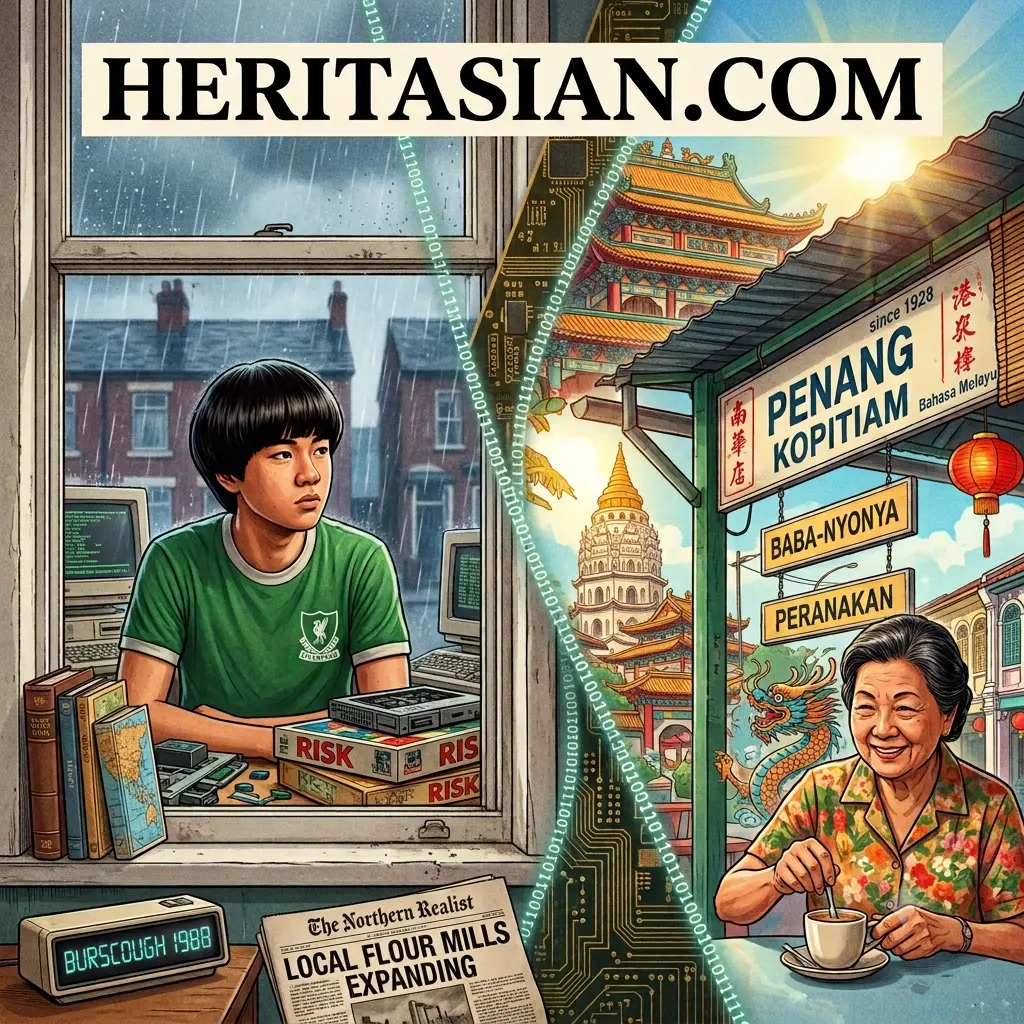
Growing up in Lancashire in the early 1980s, I didn’t want to know about my Asian background. I was desperate to just be British, run around castles, and blend in. Back then, Chinese and Southeast Asian people were rarely portrayed well in Western media. The stereotyping was massive, relentless, and heavy-handed. It drove me to reject that side of myself entirely.
Yet, looking back, the subconscious influences were everywhere – mostly driven by my dad. My love of history came directly from him. Part of me tuned it out, but I grew up listening to his stories. They came from his time based in Butterworth and Singapore.
Long before I ever set foot on a plane, an exotic, parallel vocabulary filled my home. My family casually tossed around terms like Peranakan and Baba-Nyonya culture at the dinner table. My dad would speak of the Nusantara—the vast, sweeping maritime sandbox of the Indonesian archipelago—with a sense of history and romance.
Bedtime horror stories
At night, instead of standard Western fairy tales, I was exposed to the dark, supernatural folklore of the region: whispers of the grease-covered Orang Minyak, the terrifying banana-tree spirit of the Pontianak, and the mischievous Toyol.
My dad seemingly knew a phrase in every language on Earth. He was never afraid to use them, either.
Couple that with my parents schooling me in the art of dining out. We frequented a massive variety of international restaurants. My world was quietly being expanded by these early, deep-seated cues.
When we weren’t eating out, my parents and I were absolutely glued to the TV every week watching Wish You Were Here…?. Judith Chalmers, the original British travel icon, was beaming into our living room from some far-flung paradise.
On rainy days, I channelled that energy into a board game called News Reporter. My job was to jet-set all over the world. I collected stories to fill a newspaper layout. Between that and mastering Risk, I was building an early obsession with geopolitics, journalism, and history.
But I was also raised on a heavy dose of Northern realism. There was no room for airy-fairy dreaming. A high school careers teacher fumbled through her folders and looked right at me. She told me to forget archaeology. Instead, she said to “just go work in the local flour mill.” That pragmatic, blunt reality set me off on a rebellious, wayward tangent.
Then, at seventeen, my world shattered. My parents announced a month-long trip to Malaysia. I was gutted. I begged to stay behind.
Part 2: The Airport Gate That Changed Everything
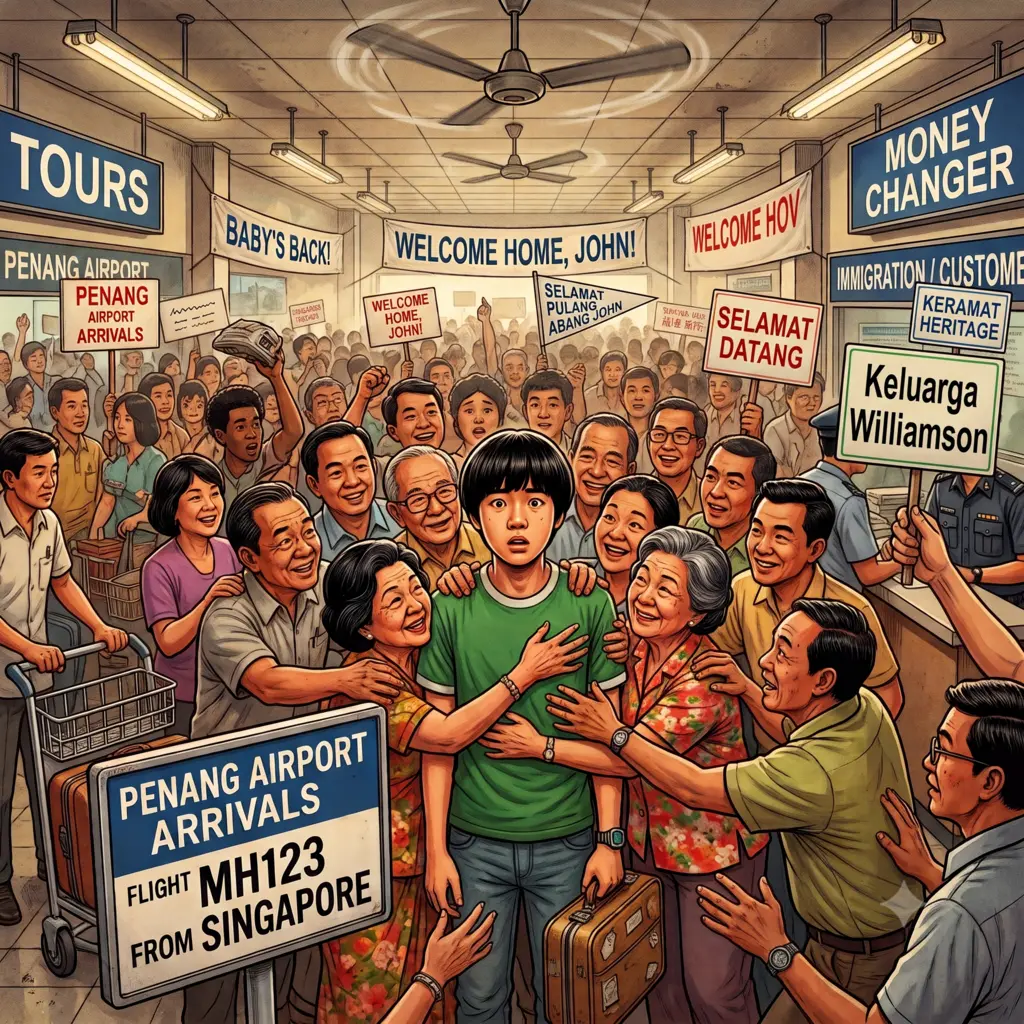
I wasn’t an outgoing kid; I was insular and incredibly shy. So nothing could have prepared me for stepping off the plane at Penang Airport.
It wasn’t just a few relatives waiting. It was every aunt, uncle, cousin, second cousin, and neighbour – over sixty people – treating me like royalty. My grandmother had tears in her eyes.
But the defining moment happened right there on the spot. It had been 17 years since my mum had last visited her homeland, and in that time, she had actually forgotten how to speak her native dialect. Watching that realisation hit her was a profound shock to my system.
In an instant, my teenage defiance vanished. Seeing what time and distance could erode made me want to step up and pick up exactly where she had left off. All those subconscious words from my childhood – the folklore, the history I’d resisted – suddenly became real. I had been awakened.
Within a year, I was back, exploring the very landscapes my dad had described. I traded the rainy streets of Lancashire for the bustling Kopitiams of Penang, walking the covered Kaki Lima (five-foot ways) of George Town, utterly captivated by the stunning Straits Eclectic architecture and the hidden, sacred Keramat shrines tucked away in old neighbourhoods.
Of course, I brought my signature naivety with me too. I managed to rack up a massive two-month overstay in Malaysia. Consequently, I got locked in a border cell. I had to frantically negotiate my way into Hat Yai, Thailand.
I spent that entire Thai trip in a state of absolute panic, blinded by the unfamiliar script.
Years later, the irony isn’t lost on me: Hat Yai is now one of my absolute favourite cities in the world.
Part 3: From Institutional Media to Editorial Discipline
After a detour through the Manchester rave scene, a hospitality degree, and managing a Thai restaurant in London, I eventually uprooted my life and moved to Chiang Mai.
Before smartphones and widespread internet adoption took over the world, I landed a role managing a team of 20 editorial staff running digital news aggregation for institutional financial clients. The childhood game of News Reporter had bizarrely become my real life.
While the digital landscape has changed completely since then, that era drilled a relentless editorial discipline into me. Managing high-stakes financial data for global clients meant developing a brutal eye for detail, filtering out endless background noise, and working to unforgiving, tight deadlines. There was no room for fluff – just tight, professional accuracy.
For years, I walked the beaches of Penang wondering how to fuse my three obsessions: Southeast Asian history, cultural architecture, and digital media.
The result is Heritasian.com.
The Heritasian Framing: Place Over Persona
Travel, in its truest form, is an exercise in humility. It forces you to realise that you are not the protagonist; you are merely a temporary witness to a landscape that was there long before you arrived and will remain long after you leave.
We have come a long way since the crude stereotypes of the 1980s, and we’ve evolved past the glossy postcard travel format of the Judith Chalmers era. Yet, the modern travel media landscape still struggles to give heritage the depth it deserves. It is too busy romanticising the traveller’s personal experience.
That’s where my Northern realism kicks back in.
“We do not travel to find ourselves; we travel to lose our narrow perspectives in the grand architecture of history.”
That is why Heritasian doesn’t feature my personal journal entries, my romanticised opinions, or my “fuzzy feelings.” Instead, we deep-dive into the Teak Trail” of Northern Thailand, the restoration mechanics of Straits Chinese shophouses, and the raw, unvarnished history of Northern Malaysia.
My journey from a Lancashire schoolyard to the heritage lanes of George Town is the reason the site exists – but the site itself belongs entirely to the culture it covers.
If you tire of travel content that reads like a personal diary, see how we frame the narrative differently.