
Key Insights
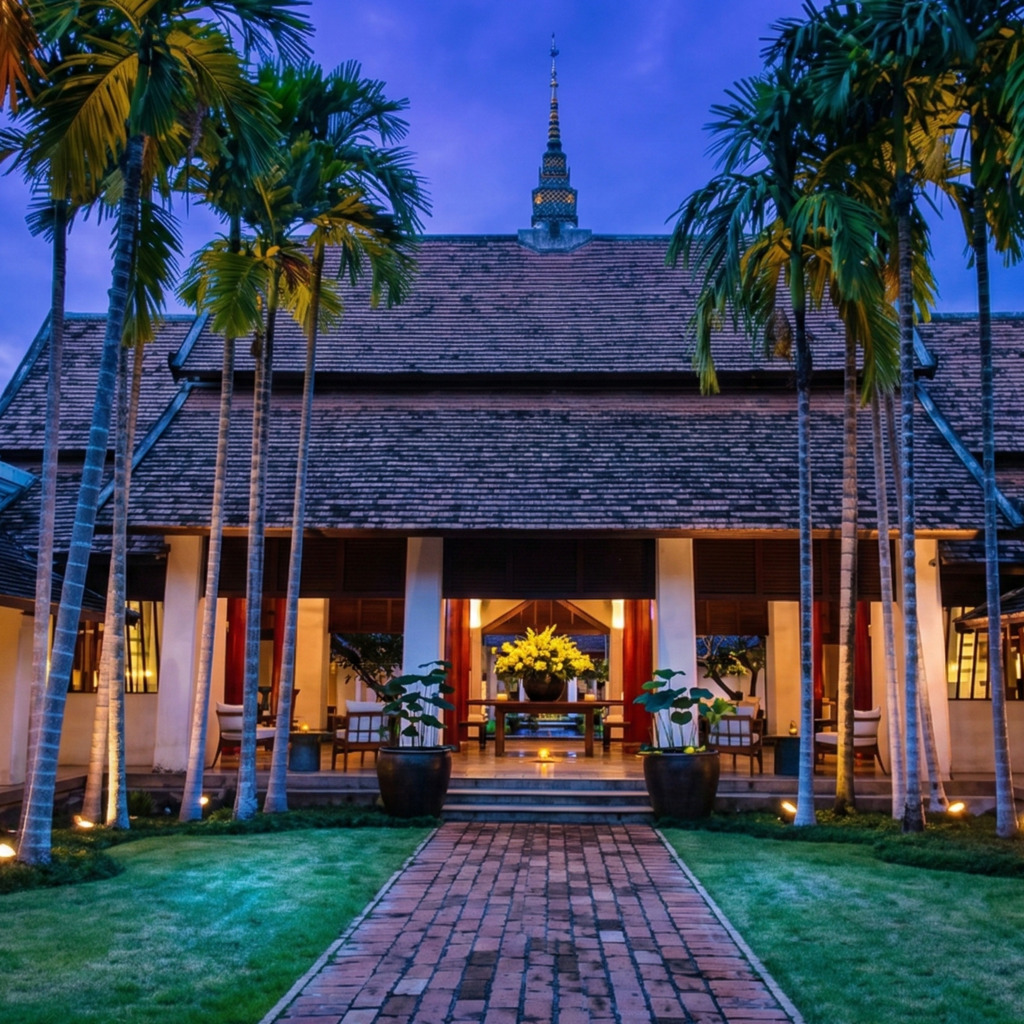
Rachamankha is a 25-room monastic sanctuary designed by architect Ong-ard Satrabhandhu, embodying the “Philosophy of the Void.” It is a masterpiece of New Classicism, blending 15th-century Lanna temple proportions with traditional Chinese courtyard symmetry.
Key heritage markers include the custom Hariphunchai-style bricks, thick lime-plastered walls for passive thermal regulation, and a museum-grade collection of Silk Road antiquities.
Rachamankha: A boutique luxury heritage property located in Chiang Mai’s old city, masterminded by architect Ong-ard Satrabhandhu to function as a quiet, physical counterweight to commercialised hospitality design.
Viharn-Inspired Geometry: Structural layouts that explicitly mirror the proportions, low-slung profiles, and enclosed volumes of traditional Lanna monastic assembly halls (Viharns), fostering an immediate sense of monastic serenity.
Axial Courtyard Typology: An architectural configuration drawing heavily from ancient Chinese domestic planning, where rooms and open-air cloisters are organized symmetrically around a central, walled courtyard axis to control light, privacy, and internal airflow.
Vernacular Purism: A design philosophy that strictly rejects contemporary synthetic surfaces, relying instead on honest, historically accurate materials such as lime-plastered masonry, handmade terracotta roof tiles, and salvaged northern hardwoods.
Chiaroscuro Interplay: The deliberate, dramatic manipulation of light and deep shadow throughout the hotel’s long corridors, high-arched entryways, and shaded verandas, mimicking the atmospheric interior transitions of ancient temples.
Curated Provenance: An interior curation strategy that replaces mass-produced decor with authentic regional antiquities – including Chinese pottery fragments, old Lanna lacquerware, and historic Burmese chests – treating public lounges and guest chambers as private, live-in museum galleries.
I personally hand-pick every recommendation on Heritasian. To support my research into Southeast Asian heritage, some links in this review are affiliate links that may earn me a small commission at no extra cost to you.
Positioned squarely within the historic grid of Chiang Mai’s Old City, Rachamankha operates as a structurally hidden architectural sanctuary. While high-density pedestrian traffic and temple-bound crowds surge along the exterior thoroughfares just feet away, a deliberate, elongated white corridor and blank-walled gateway completely isolate the inner compound from the secular city street.
Crossing this threshold triggers an immediate thermodynamic and acoustic transition: environmental volume drops significantly, and the microclimatic design provides an instant cooling effect. Within the interior, guests encounter an atmosphere analogous to a classical Ming Dynasty scholar’s retreat.
Where contemporary properties like 137 Pillars House commemorate Victorian-era colonial grandiosity, and Raya Heritage explores the raw minimalism of riverine crafts, Rachamankha functions as a highly private, inward-looking intellectual haven.
Designed by master architect Ong-ard Satrabhandhu, the property behaves as an introspective monastic sanctuary, utilising strict bilateral symmetry and ancestral Asian design principles to offer total sanctuary for the mind.
The Vision of Ong-ard Satrabhandhu
Architect Ong-ard Satrabhandhu created this masterpiece. He is Thailand’s most important living traditional architect. He studies the mathematical proportions of ancient temples. Ong-ard practices “New Classicism.” He does not merely copy old buildings. He applies ancient wisdom to modern spaces.
Rachamankha uses “nothingness” as a luxury. It focuses on the space between the walls. This is the “Philosophy of the Void.” Thick lime-plastered walls regulate the heat in Northern Thailand. Heavy clay tiles protect the interiors. This is vernacular intelligence at its peak. The building breathes without modern artifice.
The Anecdote of the “Perfect” Brick
Ong-ard is a perfectionist regarding materials. He spent months searching for the right brick, visiting dozens of traditional kilns across the North. He wanted a specific orange-red hue. This colour matches the 11th-century Hariphunchai era. New bricks often look too bright or too flat.
He worked with a local kiln to create a custom mix. They used ancient firing techniques with wood-fueled heat. These bricks look like they have existed for centuries. Hold one in your hand. You feel the weight of a thousand years. This is the foundation of the vernacular mansion.
The Silk Road in a City Block
The hotel uses a Lanna-Chinese courtyard model. This design provides natural cooling and total privacy. Interconnected courtyards create a sense of absolute order. The library acts as the “Sacred Heart” of the property. It houses rare books on Asian art history. It feels like a private scholar’s sanctuary.
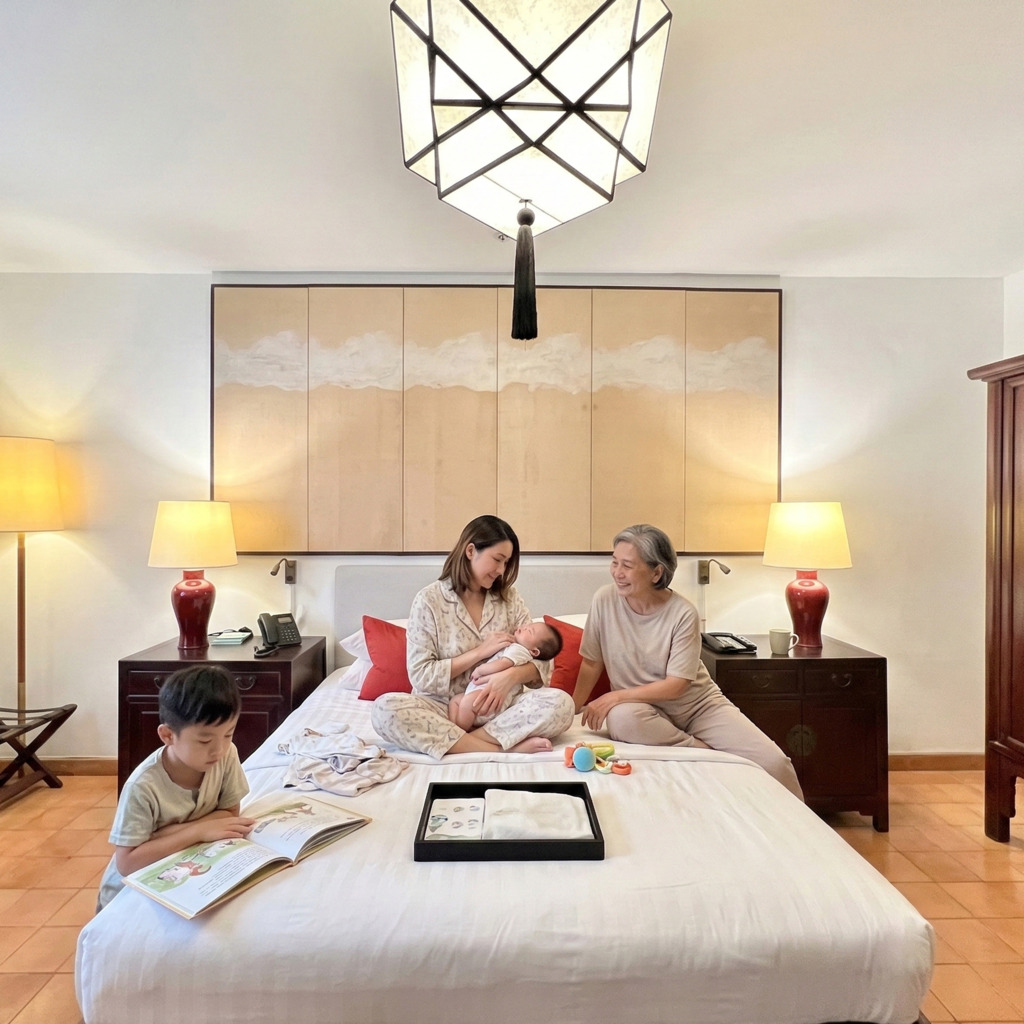
Guest rooms avoid “tech clutter.” You’ll find no televisions in these spaces. 19th-century antiques and hand-woven Shan rugs define the rooms. This is a digital detox for the soul. The luxury lies in the lack of distraction. You focus on the texture of the wood. You notice the light on the white walls.
The Story of the Empty Room
Ong-ard once explained his design philosophy to a curious guest. The guest asked why the lobby felt so empty. The architect smiled. He said the emptiness is the most expensive part. Space allows the guest to think.
He removed unnecessary decorations to highlight the shadows. In Lanna culture, shadows provide comfort. A busy room creates a busy mind. Rachamankha offers the luxury of a clear head.
Living with Antiquity
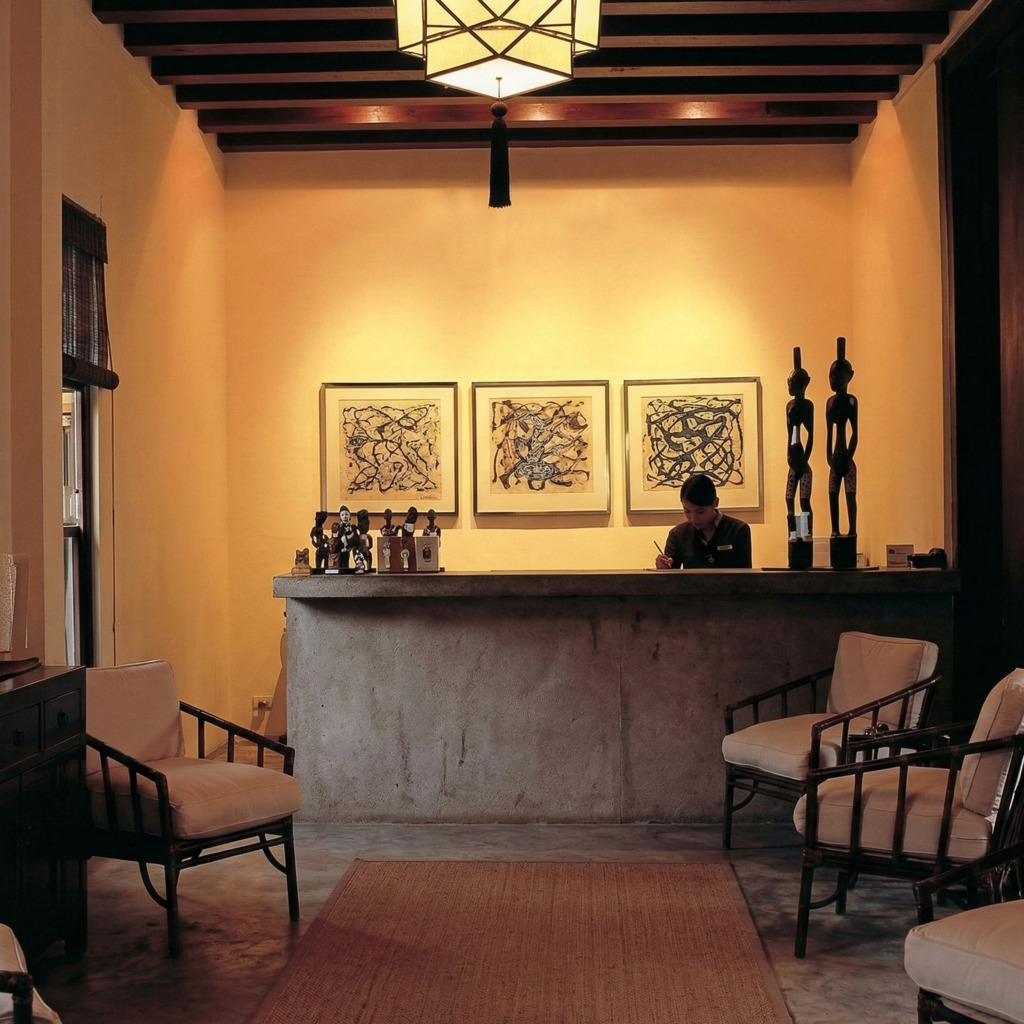
Rachamankha is a living museum. You don’t just look at art here. You live among it. The owner is a legendary collector of Southeast Asian antiquities. He treats the hotel as his personal gallery. You might find a 17th-century Buddha in a hallway. Guests sleep next to museum-grade Burmese statues. They might find Ming porcelain tucked into quiet corners. Heritage isn’t something to view through glass.
The Anecdote of the Shan Rug
One guest noticed a beautiful rug in their suite. It featured intricate patterns from the Shan State. They asked if it was a reproduction. The staff explained its true history. It was a 19th-century original. The owner found it in a remote village market. He restored it by hand. Now, it warms the floor of a guest room. We use heritage to make the present more beautiful.
The Monastic Rhythm: A Day in the Old City
Life here follows a different clock. You wake to the sound of temple bells. Wat Phra Singh sits just across the wall. The monks begin their morning chants at dawn. The sound drifts over the white-washed walls. You don’t need an alarm clock here.
Breakfast is a quiet affair in the courtyard. You hear the water feature dripping slowly. You smell the jasmine blooming in the garden. The staff moves with a graceful, quiet efficiency. They respect the silence of the space. It feels like staying in a friend’s well-managed estate.
The Gallery Dinner
Dining at Rachamankha feels like a private banquet. The restaurant walls are lined with ancient maps. You eat among sketches of 18th-century Chiang Mai The food focuses on refined Lanna flavours. They serve “Khao Soi” with precision. The spices are ground by hand in the kitchen. One guest described it as “eating a painting.” Every plate respects the proportions of the architecture. The culinary heritage matches the structural heritage.
The Architectural Pilgrimage
Many architects visit Rachamankha just to study the walls. They bring sketchbooks and measuring tapes. Intrigued guests study how the columns meet the roof. They look at the drainage systems in the courtyards. This hotel is a textbook for sustainable design.
Ong-ard proved that you do not need glass towers. You don’t need massive air conditioning units. You need thick walls and shaded walkways.
The Anecdote of the Shadow
A famous designer once visited the property. He spent three hours watching a single shadow move. The shadow travelled across the white lime wall. It changed from sharp to soft as the sun moved. He called it the “most beautiful show in Chiang Mai.” This is the level of detail Ong-ard achieved. He designed the building to play with the sun. Every hour offers a different visual experience.
The Library: A Sanctuary for the Scholar
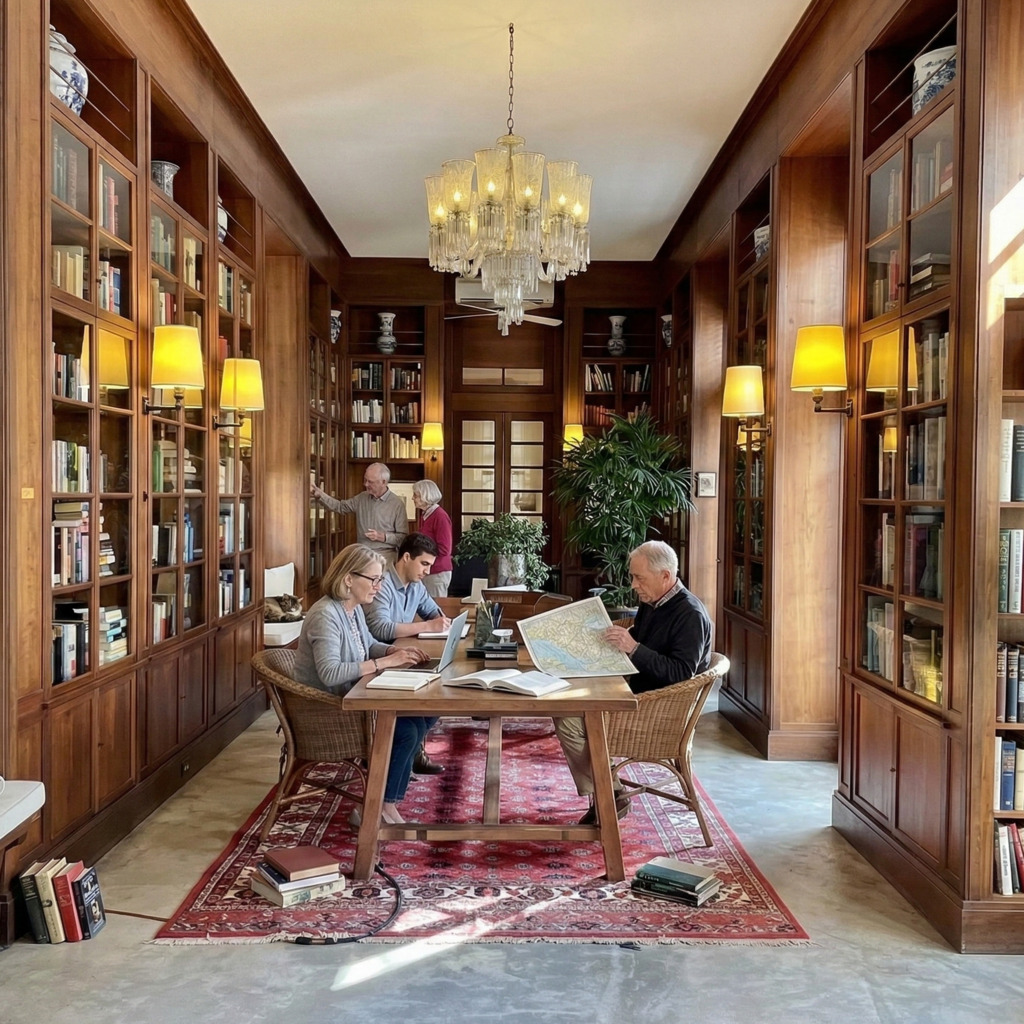
The library at Rachamankha isn’t a mere decoration. It’s the intellectual engine of the entire property. Most luxury hotels stock colour-coded books for aesthetic appeal. Here, the collection reflects the owner’s deep passions.
It houses over one thousand rare volumes. The book focuses on Asian art, architecture, and the history of the Silk Road. Many of these titles are out of print. Scholars often travel here just to sit in this room. The air smells of old paper and beeswax. It is a sensory bridge to another century.
The Story of the Rare Manuscript
One regular guest is a historian from London. He spent three days in the library without leaving. He discovered a 19th-century text on Burmese woodcarving. The book contained sketches of temples that no longer exist. He sat in the high-backed teak chair and took notes. The staff brought him tea and never disturbed his focus.
The library offers a specific kind of freedom. It’s the freedom to get lost in a world of ideas. This is the “mansion” part of the vernacular mansion. It provides a home for the mind as well as the body.
The Garden of Negative Space
Architecture often tries to dominate nature. Rachamankha takes the opposite approach. The gardens are exercises in restraint and “negative space.”
You will not find manicured flower beds or colourful tropical displays. Instead, you see ancient trees and moss-covered stone. The greenery frames the white architecture like a Japanese ink painting.
The Anecdote of the Moss
Ong-ard once stopped a gardener from scrubbing a stone wall. The gardener wanted to remove the moss and lichen. He thought it looked “untidy” for a luxury hotel. The architect explained that the moss was part of the design. He wanted the building to show its age. He wanted the humidity of Chiang Mai to leave its mark.
This “wabi-sabi” approach is rare in Thailand. Most resorts fight the jungle. Rachamankha invites the jungle to soften its edges. The moss is a badge of honour. It shows the building has successfully inhabited the landscape.
The Ritual of the Evening
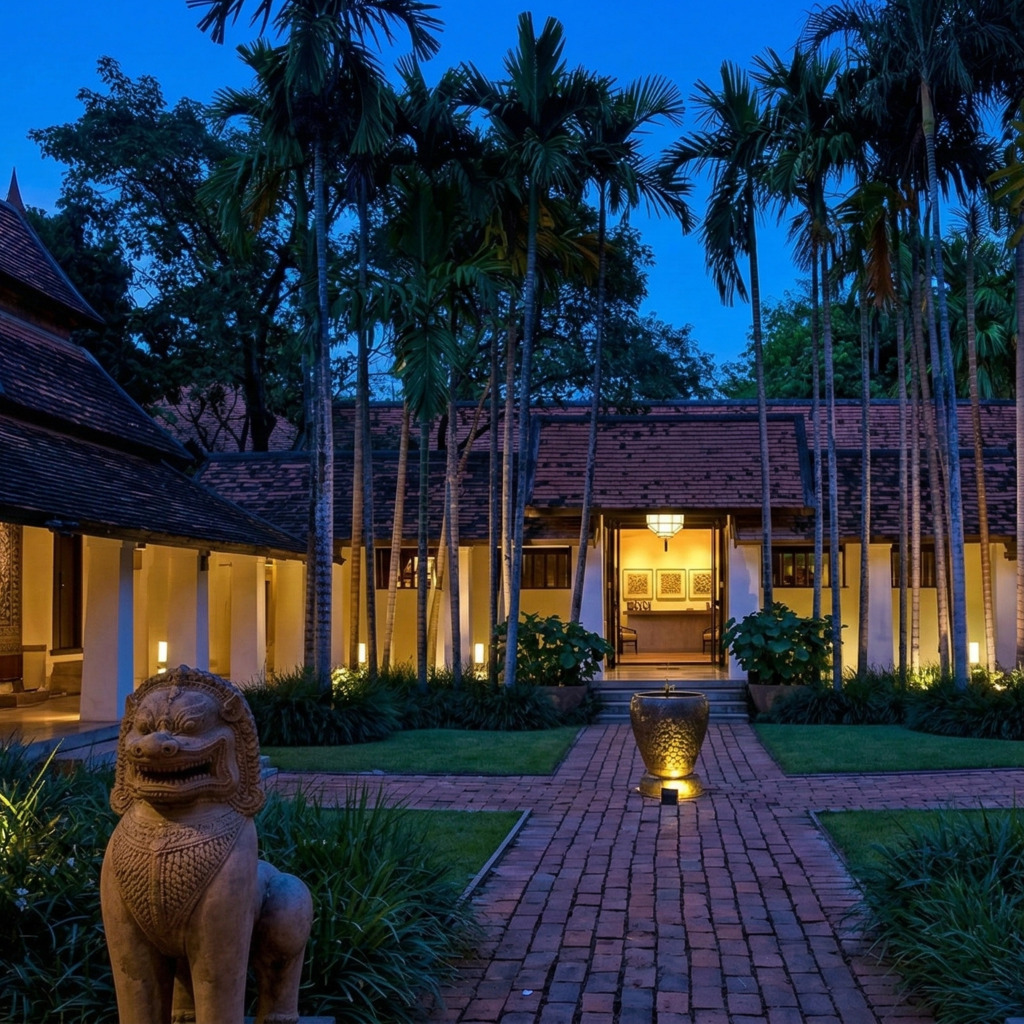
As night falls, the hotel undergoes a dramatic transformation. The bright white walls absorb the blue of the twilight. The warm glow of the lanterns creates deep, dramatic shadows. The transition is nearly liturgical. The staff light candles in the colonnades. The smell of incense drifts from the lobby.
The Sound of the Bells
Sitting in the central courtyard at 6:00 PM is a ritual. The silence of the hotel acts as a resonator for the outside city. You hear the motorbikes on Rachamankha Road. You hear the distant calls of street vendors. Then, the bells of Wat Phra Singh begin to chime.
The sound is deep and metallic. It vibrates through the lime-plastered walls. For a few minutes, the modern world and the 14th century coexist perfectly. You are not just staying in a hotel. You are participating in the long, slow history of Chiang Mai.
The Curation of Antiquity: A Silk Road Diaspora
The antiques at Rachamankha are not mere props for a “heritage” theme. Every object in the property is a survivor of a shifting political landscape. The owner spent decades travelling through the porous borders of the Golden Triangle. He collected pieces from Burma, Laos, and Southern China during periods of great upheaval.
These items did not come from high-end auction houses in London or Paris. They came from dusty village markets and the private collections of elderly Lanna families.
The hotel maintains a dedicated team of restorers who use traditional lacquers and resins to stabilise 300-year-old wood. The pieces are not “over-restored”. They keep the scratches and the fading. These marks tell the story of the object’s journey.
The Anecdote of the Burmese Chest
One guest noticed a heavy, black-lacquered chest in the corner of the library. It featured intricate gold leaf scenes of the Buddha’s life. The guest assumed it was a high-quality replica.
The owner happened to be nearby and shared the true story. He found the chest in a collapsed monastery near the Salween River. It had survived decades of humidity and war.
He transported it back to Chiang Mai by truck and boat. He spent a year slowly cleaning the grime of a century from the gold leaf. Now, it holds the hotel’s collection of rare architectural maps. It’s a place where the broken pieces of the past find a permanent home.
The Mastery of the Lanna-Chinese Fusion
Rachamankha represents a specific historical intersection. For centuries, the Lanna Kingdom was a vital node on the southern Silk Road. Chinese traders, or the “Haw,” brought their architectural sensibilities to the northern valleys.
Ong-ard Satrabhandhu honours this fusion through the structural rhythm of the hotel. He uses the heavy, inward-facing security of a Chinese courtyard. Then, he softens it with Lanna materials like teak and clay.
The shaded walkways are a masterclass in perspective. They draw your eye toward a single stone statue or a splash of greenery.
The hotel follows a strict, mathematical symmetry. This creates a sense of psychological safety. Your mind does not have to work to understand the space. You simply exist within it.
The Story of the Red Pillar
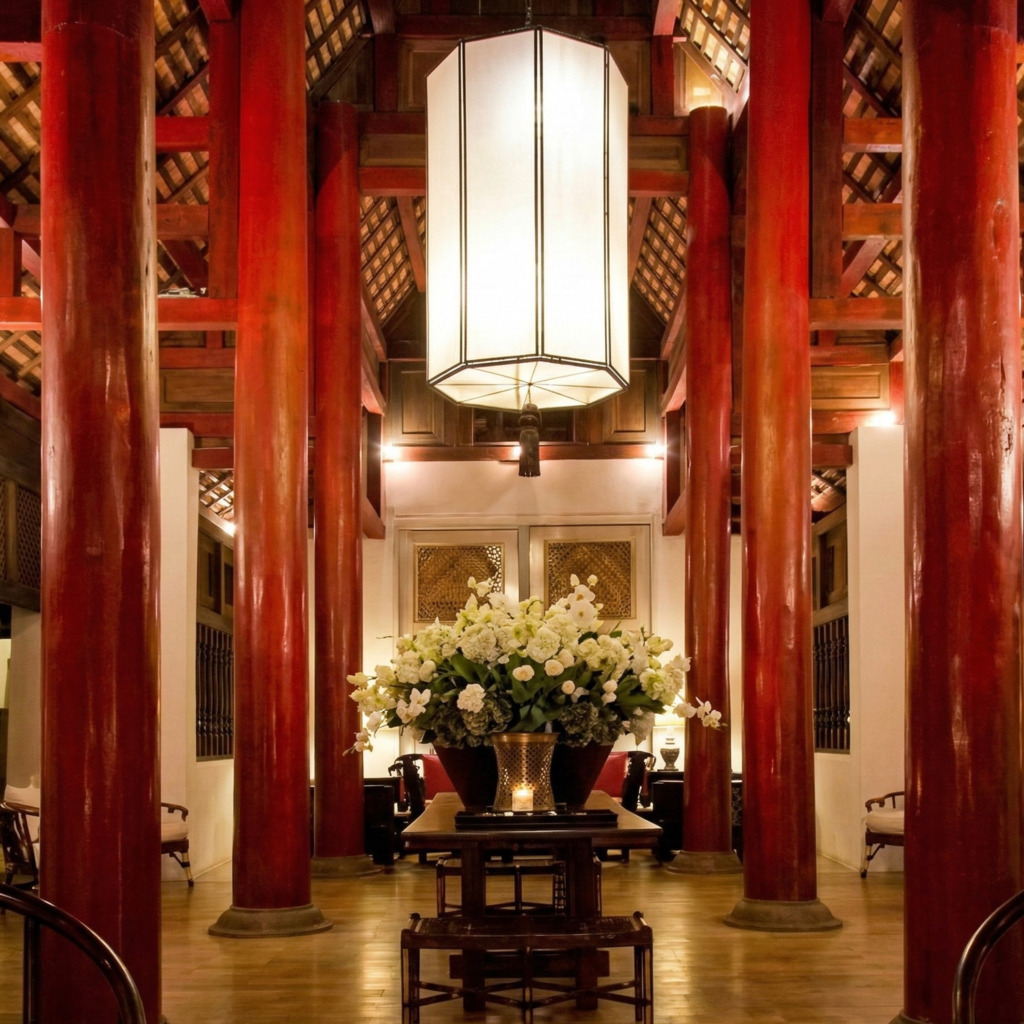
A visitor once asked why certain pillars were painted a deep, oxblood red. In many hotels, this is just a colour choice. At Rachamankha, it is a nod to the trade caravans of the Yunnanese.
Red symbolises prosperity and protection to the Chinese. By placing these red accents against the white Lanna walls, Ong-ard tells a story of migration. It shows how two different cultures merged to create the unique identity of Chiang Mai.
The Final Verdict: A Sanctuary of Intent
Rachamankha is a rare example of a hotel built with total intent. Every brick, every shadow, and every antique has a reason for being there. It does not try to be “all things to all people.”
It is a hotel for the observer, for the person who notices the way a clay tile meets a white wall. And for the guest who values the sound of the wind over the sound of a television.
When you walk out of the long white corridor back onto the street, the city feels different. The noise of the motorbikes feels more distant. The heat feels less oppressive. Rachamankha gives you a new set of eyes. It teaches you that heritage is not a relic of the past. It is a living, breathing blueprint for a more thoughtful future.
This is the true monastic masterpiece. It is a sanctuary that stays with you long after you have left its walls.
Experience the Living History
Experience the ‘Philosophy of the Void’ for yourself. Check thelatest rates for Rachamankha on Trip.com.