
Key Insights
Thai spirit houses, or San Phra Phum, are miniature shrines rooted in ancient animism that predate Buddhism. Functioning as symbolic real estate contracts, they serve as grand peace offerings to the land’s original invisible custodians.
This enduring architectural tradition seamlessly integrates ancient spiritual compromises into contemporary Southeast Asian urban landscapes, preserving cultural continuity amid modernisation across Thailand and its borders.
San Phra Phum: This is the traditional single-pillar spirit house found throughout Thailand, modelled after royal palace architecture. It acts as a miniature sanctuary built to house the displaced guardian spirit of the land.
Phra Phum: This is the invisible guardian deity or “land lord” believed to inhabit and protect a specific plot of earth. Human property owners make daily offerings to this spirit to secure good luck and prevent spiritual mischief.
Prasat: This term refers to the elegant, tiered-roof palace architectural style reserved for royalty and divine beings. It is replicated in miniature form when designing high-end spirit houses to show maximum respect.
Naga: This is a mythical, semi-divine serpent figure deeply rooted in Buddhist and animist cosmology. In Thai architecture, its stylised form is used as a protective roof finial to ward off negative energy.
San Chao Ti: This is a specific type of spirit house built on four pillars rather than one. It is dedicated to the ancestral or household spirits of the locality, ranking just below the guardian land spirit in the spiritual hierarchy.
Malai: These are hand-woven fresh flower garlands, typically crafted from fragrant jasmine and bright marigolds. They are placed on the shrines daily to symbolise purity, beauty, and ongoing respect for the spirits.
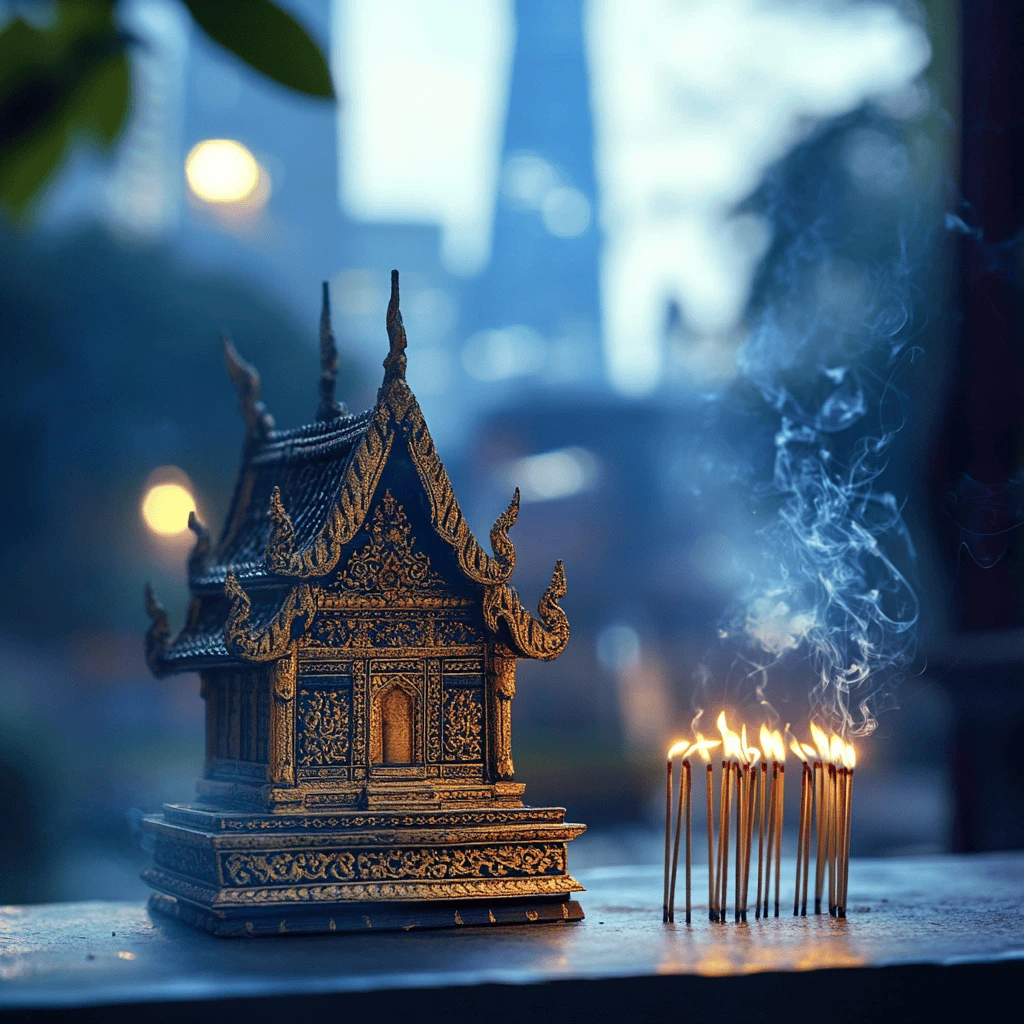
In contemporary urban Thai environments, such as Bangkok and Chiang Mai, daily ritualistic behaviours intersect directly with modern commercial infrastructure. At dawn, local business owners present physical offerings—including fresh jasmine garlands (malai) and specific symbolic liquids like red Fanta—to miniature, gilded architectural structures anchored to public sidewalks.
These structures are San Phra Phum, or Thai spirit houses, which function culturally as symbolic real estate contracts rather than superficial streetscape decorations.
Architecturally, San Phra Phum represent a sophisticated spiritual and legal compromise between human property developers and the invisible, indigenous animist deities (Phra Phum) considered the original custodians of the land.
This practice demonstrates an ideological framework rooted in Pre-Indic animist substrates that predate both Theravada Buddhism and modern concrete urbanisation.
Within Southeast Asian urban geography, the spirit house serves as a primary structural symbol of cultural continuity. It illustrates how an ancient, architectural belief system successfully navigates contemporary daily commerce. It integrates seamlessly into capitalist real estate development.
The Root of the Ritual: Animism in a Buddhist World
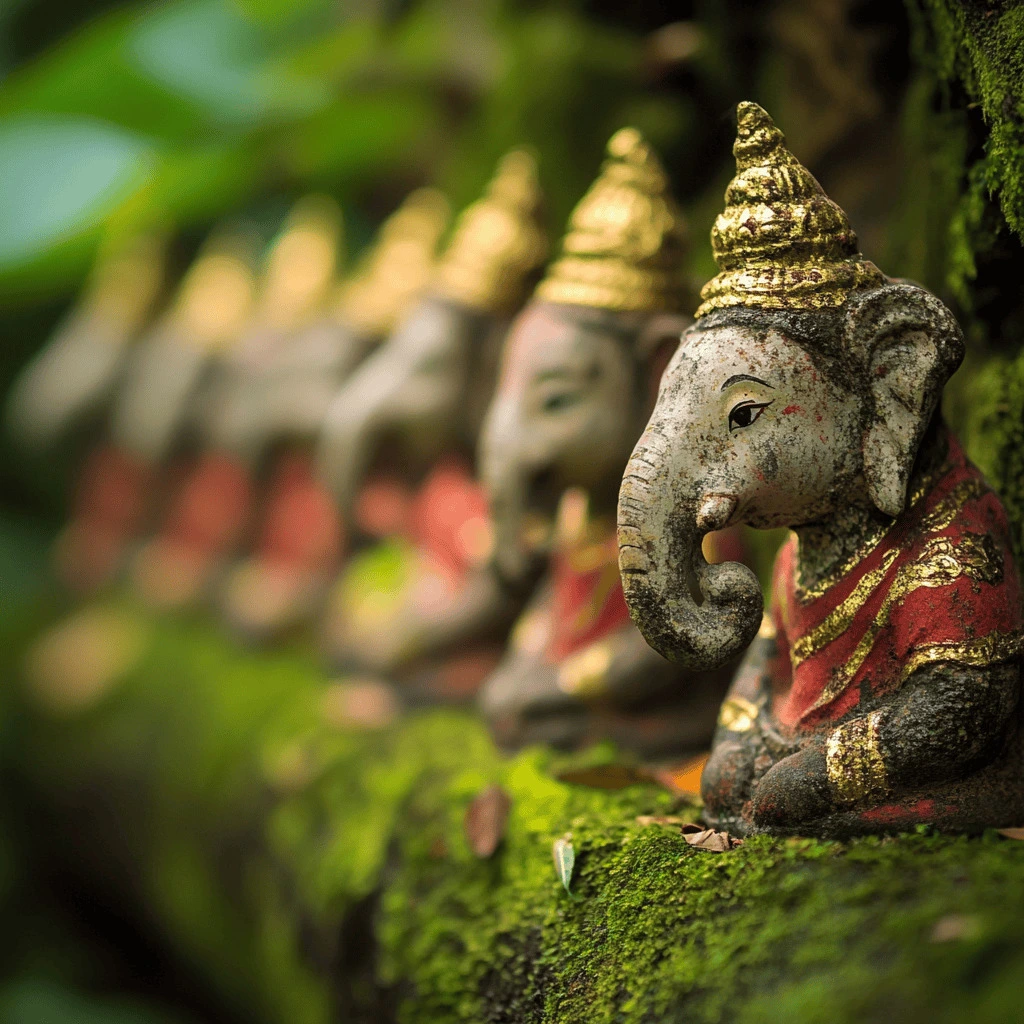
To understand the spirit house, one must look beneath the saffron robes of Thai Theravada Buddhism. Thailand sits upon a “Pre-Indic” substrate. This deep-rooted layer of animism existed long before Hindu priests or Buddhist monks arrived.
This is the world of the Land Lord. In the Thai worldview, the earth is not a commodity to be bought and sold. Instead, it is a domain owned by spirits.
When a human clears a forest or pours a concrete foundation, they commit an offence. By building a hotel, they are technically squatting on someone else’s property. The Phra Phum (Guardian Spirit of the Land) is the displaced land lord.
The spirit house is a peace offering – an architectural apology. By providing a grander home, the owner ensures the spirit stays outside. A happy spirit guards the gate; a neglected spirit moves inside to cause mischief, illness, or ruin.
Thai spirituality is resilient because it doesn’t choose between Buddha and the Spirits. It honours both, recognising that the Buddha manages souls while spirits manage the daily luck of the soil.
Interestingly, this tradition does not stop at the border. In Northern Malaysia, particularly in states like Kedah and Perlis, Thai cultural influence remains a historical bedrock. You will often find these shrines nestled in the gardens of Thai-Malaysian communities. These act as silent architectural markers of the region’s shared, porous heritage.
Architecture in Miniature: Designing for the Divine
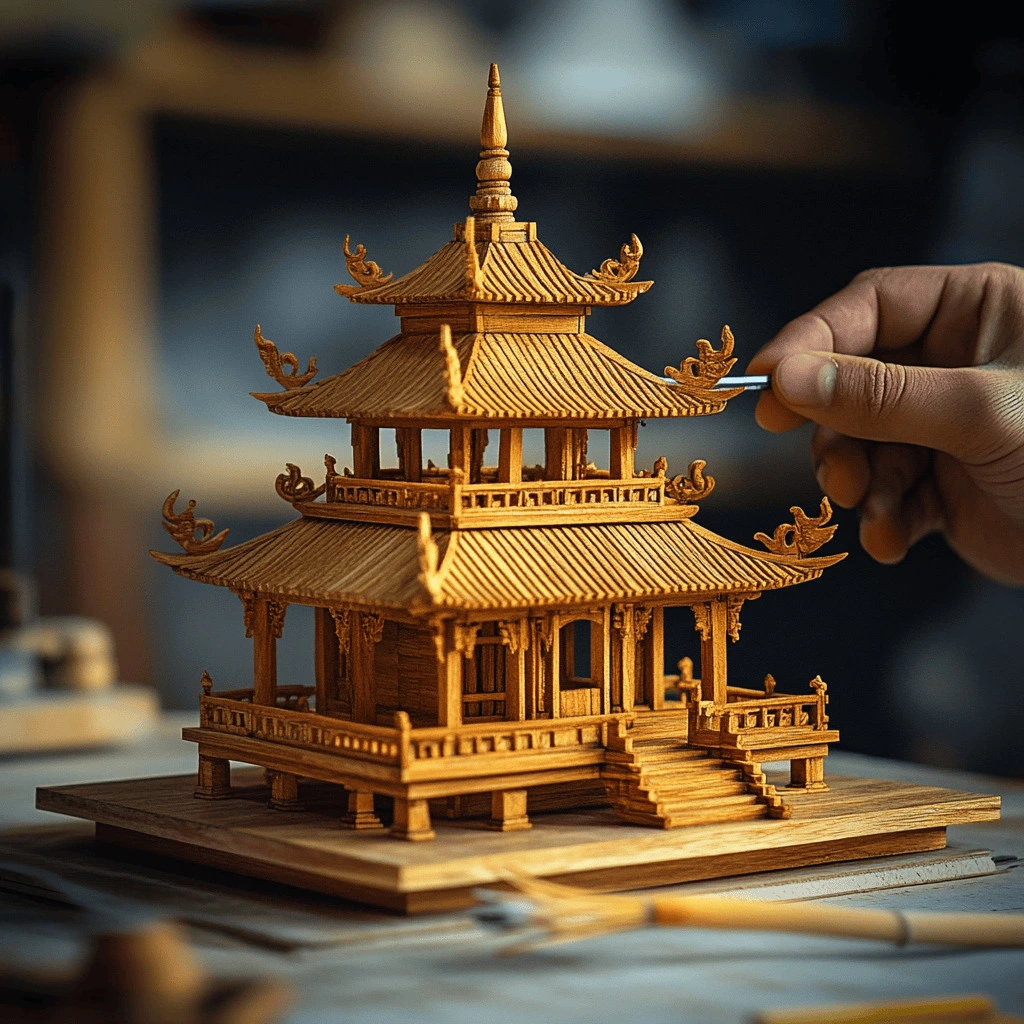
The design of a spirit house is rarely accidental. It is a reflection of the high architectural aspirations of the era. In Thailand, the most common form is the single-pillar sanctuary, modelled after the Prasat (palace) style. These miniature structures often mimic the tiered roofs and stylised naga finials found in Ayutthaya-era royal architecture.
Materiality and Evolution
Historically, craftspeople hand-carved these from teak or wove them from bamboo. In the teak-rich northern regions, artisans created masterpieces of woodcraft. Their intricate fretwork beautifully mirrored the grand Lanna palaces.
Today, while buyers still view wood as a prestigious choice, colourful cast concrete and vibrant glass mosaics dominate the landscape.
The Anatomy of a Shrine
A proper spirit house is an ecosystem. Inside, you will find:
Location and Orientation: The Spiritual Feng Shui
Placing a spirit house is not a DIY weekend project; it requires a specialist, often a Brahman priest or a village elder with “the sight.” The rules are strict and governed by a form of spiritual topography.
The Shadow Rule is vital: the main house’s shadow must never fall upon the spirit house. The shadow of the spirit house must also never touch the main house. Overlapping shadows mix the realms of the living and the dead. People consider this a recipe for disaster.
Ideally, the house should face North or Northeast and must never be near a toilet or trash. Large properties, like heritage hotels, often feature two houses: the San Phra Phum and the San Chao Ti. The San Phra Phum sits on one pillar, while the San Chao Ti sits on four pillars. The hierarchy of the spirit world is as rigid as any Thai royal court.
The Daily Offering: Red Fanta and Fresh Garlands
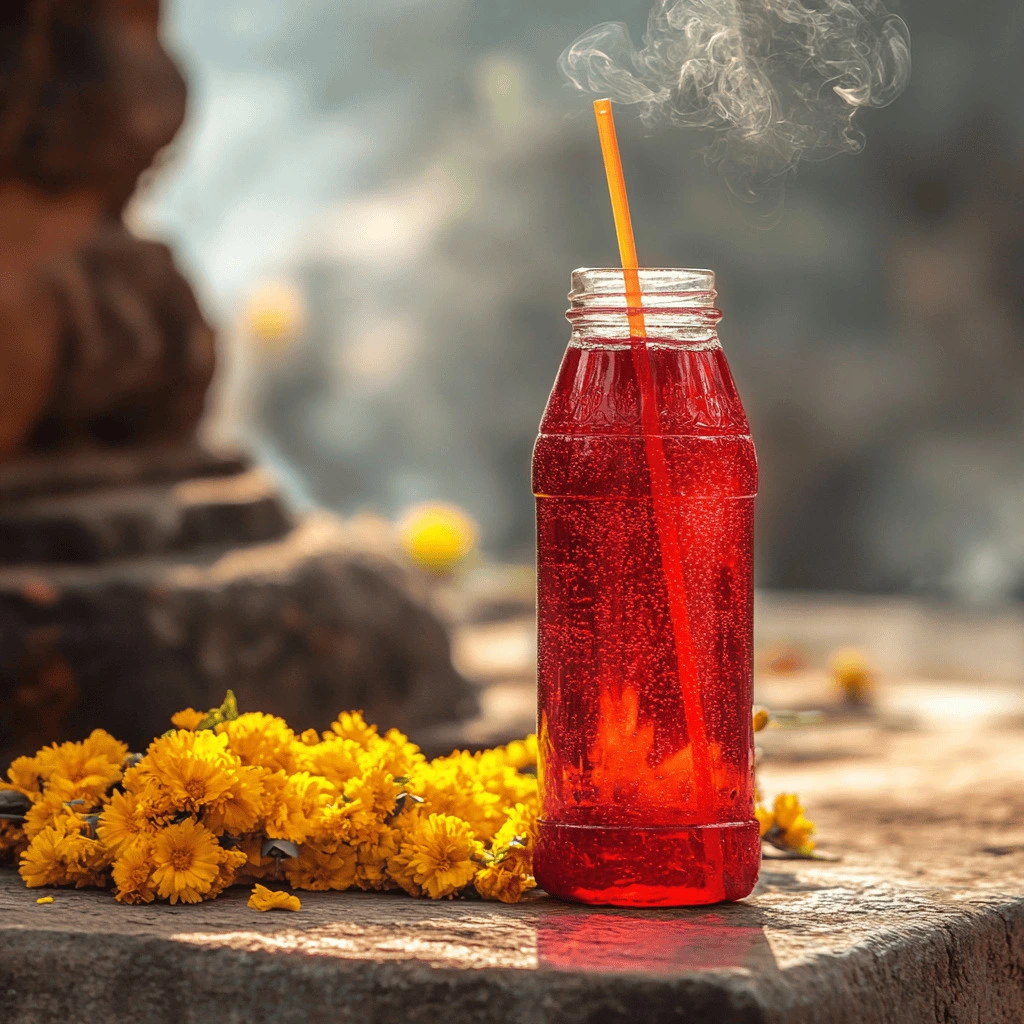
To the uninitiated, the sight of a neon-red bottle of Fanta with a straw poking out, perched precariously on a thousand-year-style altar, seems like a kitschy collision of consumerism and faith. However, in the Heritasian context, this is a fascinating evolution of “Blood and Beauty.”
The Symbology of Colour
The preference for red Fanta is not a modern marketing win; it is a sanitised surrogate for the past. Historically, land-clearing or the “appeasement” of a powerful Phra Phum required a blood sacrifice. As Buddhist influence grew, the literal shedding of blood became taboo. The red liquid serves as a symbolic placeholder, maintaining the spirit’s “cooling” energy without slaughter.
The Sensory Altar
A well-tended spirit house is a masterclass in sensory heritage:
Etiquette for the Traveller: For those visiting heritage sites, the rule is “observe but do not disturb.” A subtle Wai (the traditional Thai gesture of pressed palms) when passing a prominent spirit house is a sign of high cultural literacy. It signals to the locals—and perhaps the Landlord—that you acknowledge you are a guest in a space that was occupied long before you arrived.
The Abandoned and the Broken: Spirit House Graveyards
In a world of constant urban renewal, what happens when someone demolishes a building or breaks a spirit house? You cannot simply toss a consecrated vessel into a rubbish bin; to do so would be to invite the homeless spirit into your own life in a state of fury.
The Sacred Junkyard
This has led to one of the most hauntingly beautiful sights in Thai heritage: the Spirit House Cemetery. Usually located at the base of an ancient Banyan tree or at a sharp, “dangerous” bend in a rural road, these clusters of discarded shrines create a surreal landscape.
The Banyan tree (Ficus religiosa) is seen as a natural skyscraper for spirits. By placing a broken shrine at its roots, the owner “releases” the spirit back into the natural world. Over time, the aerial roots of the tree begin to wrap around the concrete gables and wooden pillars, literally reclaiming the man-made structure back into the earth. It is a slow-motion architectural collapse that highlights the transient nature of human construction.
Continuity in a Concrete Jungle
As we look at the skyline of modern Bangkok, it is easy to assume that these “superstitions” would fade. Yet, the opposite is true. The more complex and “concrete” our world becomes, the more we seem to crave these small anchors of sacred space.
The High-Rise Shrine
In the 21st century, the spirit house has gone vertical. On the 50th-floor balconies of luxury penthouses, you will find sleek, minimalist shrines. These are made of stainless steel or tempered glass. They are designed to match the building’s “Industrial Chic” aesthetic.
The form has changed, but the function remains: a psychological map of our anxieties and our hopes. Even the world’s most modern tech hubs in Thailand still carve out space for the spirits, proving that the digital and the divine are not mutually exclusive.
The Heritasian Perspective
At Heritasian, we believe that heritage is not just about old stones and dead kings; it is about the living threads that connect us to the landscape. The spirit house is a reminder that we are never truly “owners” of the land—we are merely temporary tenants.
These shrines represent a persistent psychological map of the region. They remind us that we still feel the urge to ask the earth for permission to stay.
Whether it is the grand Erawan Shrine in a shopping district or a humble wooden box, these spaces demand a pause. They ask us to remember a deeper, older heartbeat beneath the asphalt and the Wi-Fi signals. This land deserves our respect, a little incense, and perhaps a cold bottle of red Fanta.