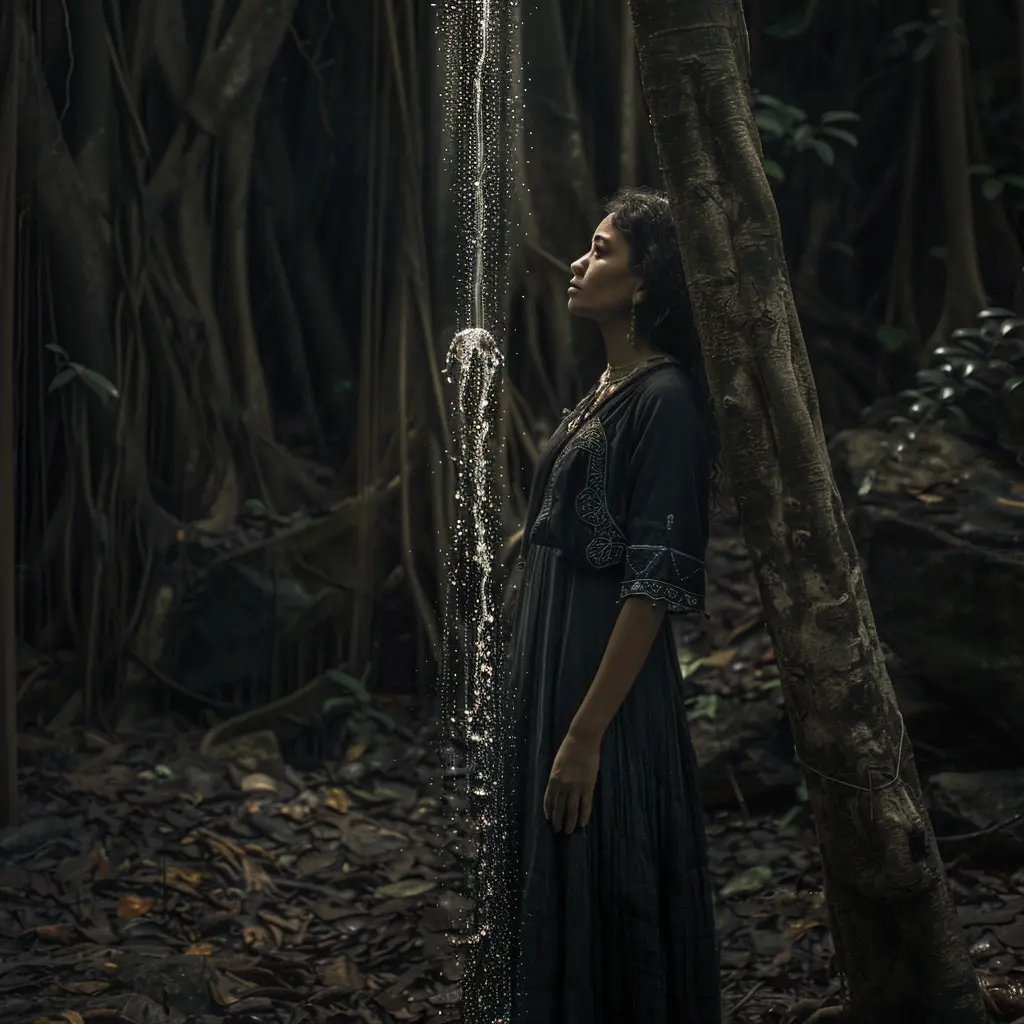

Key Insights
In Southeast Asia, geography is a living archive of moral law and history. Tragic landscapes like Doi Nang Non and Langkawi serve as spiritual landmarks enforcing Adat (customary law). From urban spirit houses to honking at sacred trees, these myths dictate daily etiquette, framing humans not as masters of the earth, but as temporary tenants navigating a sentient landscape.
Nang Non: The mythical sleeping princess transformed into Chiang Rai’s mountain ridges.
Mahsuri: Innocent noblewoman whose white blood cursed Langkawi for seven generations.
San Phra Phum: Elevated miniature “Spirit Houses” built to placate the lord of the soil.
Adat: The unwritten code of customary law and spiritual equilibrium.
Datuk Keramat: Sacred Malay/Indonesian shrines honouring localised nature protectors or ancestors.
Syncretism: The blending of indigenous animism with major world religions like Buddhism and Islam.
The scent of burning camphor and limestone hangs heavy at the mouth of the Tham Luang caverns in Chiang Rai, Thailand. Outside, the monsoon rains thrash the jagged peaks of the Doi Nang Non mountain range – a geographic formation that contours sharply against the sky, mimicking the silhouette of a resting woman.
Long before international dive teams entered these chambers during the 2018 Thai cave rescue, local Chiang Rai elders approached the limestone rocks with traditional offerings: small woven baskets of sticky rice and jasmine garlands.
They were not negotiating with basic geology; they were practising indigenous animism, pleading with Jao Mae Nang Non (the mythical sleeping princess), whose womb-like caves held the trapped Wild Boars youth football team.
In Southeast Asian culture, the natural landscape is never just scenery. It operates as an active ledger of historical trauma, Adat (customary law), and spiritual sovereignty.
For the modern traveller wandering through these ancient territories, understanding regional folklore and animist traditions is vital. It is not an academic exercise.
Instead, it is the definitive key to decoding daily behaviour and religious architecture. It also defines the cultural rhythms of Thailand, Malaysia, and Indonesia.
The Landscape as a Living Canvas

To understand the indigenous mindset of the region, one must abandon the Western view of geography as inanimate matter. Across modern Thailand, Malaysia, and Indonesia, landscapes are understood as physical remnants of historical figures. These people were frozen in moments of profound emotional crisis.
The Just and Tragic Maiden
Further south, off the coast of Kedah, the island of Langkawi holds a similar monument to historic injustice. In the late 18th century, a noblewoman named Mahsuri was falsely accused of adultery while her husband was away fighting Siamese forces.
Condemned to death by village elders blinded by political jealousy, she was tied to a tree. Executioners pierced her with a ceremonial kris. According to local chronicles, her innocence was proven at the moment of her execution. Her blood flowed pure white, staining the soil. With her final breath, she cursed Langkawi with seven generations of barren crops and bad fortune.
The Sleeping Lady of Doi Nang Non
The mountains of Chiang Rai provide a stark visual reminder of how mythology and geography intertwine. The local lore tells of a young princess of the ancient Lanna Kingdom who fled her palace with her lower-born lover, a woodsman.
Her father’s soldiers tracked them to the hills and killed her partner. The devastated princess drove her hairpin into her own chest. Her blood spilled across the valley floor, transforming into the life-giving waters of the Mae Sai River. Meanwhile, her torso and legs grew rigid. They rose to become the limestone ridges of Doi Nang Non.
Heritage Highlight: The Architecture of Veneration

Walk into the courtyard of any modern, concrete building in Bangkok or Chiang Mai, and you will find a miniature temple elevated on a single stone pillar. This is the San Phra Phum (Spirit House). Far from a mere decorative vestige, these structures represent a sophisticated architectural compromise between human occupation and indigenous animism.
Constructed to mirror the traditional tiered roofs of old kingdoms, the house occupies a precise location. An astrologer calculated this placement. Consequently, the shadow of the main house never falls upon the spirit’s domain. Here, the Phra Phum, or guardian lord of the soil, is invited to reside.
The human occupants become tenants, paying daily rent. They offer red Fanta bottles as a modern substitute for sacrificial blood. They also provide fresh orchids and the intoxicating smoke of sandalwood incense.
Cosmic Justice and the Enforcement of Adat
Why do these stories endure with such tenacity across centuries of religious transitions to Buddhism and Islam? The answer lies in their function as oral legal systems.
In traditional Southeast Asian societies, community life is anchored by Adat – the unwritten code of customary law, behaviour, and spiritual equilibrium. When the formal human hierarchy fails or becomes corrupt, the mythology serves as a reminder that cosmic justice is absolute.
Consider the physical aftermath of Mahsuri’s curse. For generations after her execution, Langkawi suffered devastating fires, rice crops that failed instantly upon sprouting, and a catastrophic invasion by the Siamese fleet.
The local population did not view these events as mere political or agricultural bad luck. Instead, they understood them as spiritual blowback. Violating Adat through wrongful judgment and gossip made this damage inevitable.
The white blood of Mahsuri and the stony body of Nang Non are permanent ethical landmarks. They remind the living that the land itself remembers human cruelty, and that the universe eventually balances its own ledger.
Cross-Cultural Echoes
While the linguistic lines and political borders of the region have shifted dramatically since the Suez Canal era, the underlying spiritual infrastructure remains remarkably uniform. These deep cultural connections reveal themselves across shared themes and traditional archetypes:
This synthesis of geography and spiritual architecture reaches its absolute zenith in the high-altitude sanctuaries of Northern Thailand. To see how these cosmic principles physically shaped a mountain kingdom, explore the legendary history and folklore of Wat Doi Suthep. There, the tragic final march of a sacred white elephant transformed a rugged peak into a living monument. The temple stands as a testament to the enduring power of regional animism operating beneath Buddhist devotion.
The Weeping Landscape
This core archetype reflects the foundational belief that nature is sentient. The landscape reacts directly to human emotion, grief, and arrogance. In the Thai and Indochinese landscape, this is manifested in Doi Nang Non. There, a princess’s tragic death physically shaped the Chiang Rai geography.
This concept echoes strongly in the Malay and Indonesian traditions through Gunung Ledang, the mystical mountain home of a magical, reclusive princess who famously defied a Sultan.
Cursed Innocence
Rooted in a profound societal anxiety surrounding the betrayal, mistreatment, or targeting of women within the community, this archetype explores the spiritual consequences of violating moral boundaries.
The Spirit Guardian
This archetype stems from the strict, deeply ingrained cultural requirement to negotiate with and placate the unseen inhabitants of a place before changing or developing the physical landscape.
In Thailand, this practice is seen in the San Phra Phum, which are elaborate miniature palaces built to house the original spirits of the land. This directly mirrors the Malay and Indonesian custom of honouring the Datuk Keramat – sacred shrines built around ancient trees, boulders, or graves to pay respect to localised protectors.
The Modern Experience: Living with the Unseen
Heritage travellers encounter these myths in the subtle etiquette of daily life, not in museums. When traversing Northern Thailand’s mountain passes or Malaysia’s jungle tracks, local drivers tap their horns three times. They do this when passing a sacred banyan tree or an old roadside shrine.
The sharp, sudden sound breaks the forest silence. It is a polite request for safe passage through someone else’s territory.
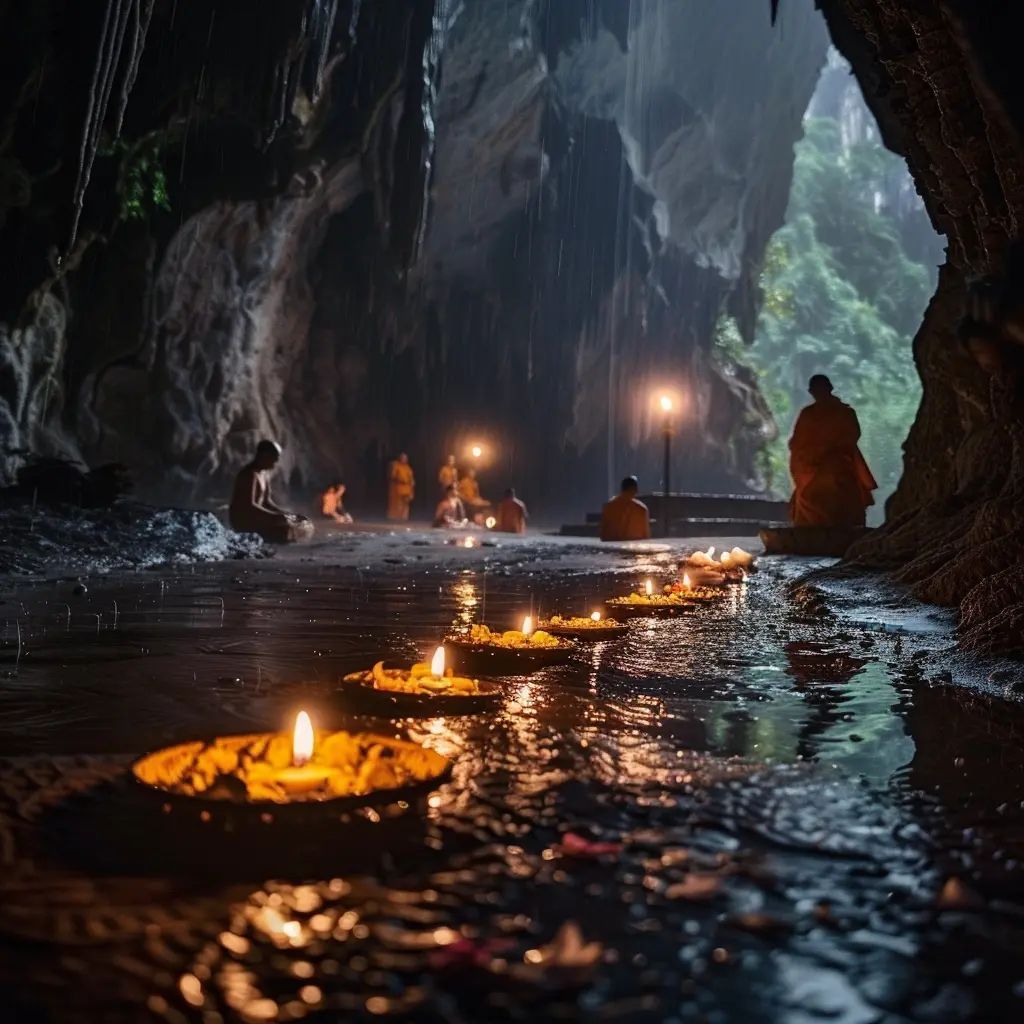
During the 2018 cave rescue, international engineers brought high-capacity water pumps and military technology to bear against the flooding chambers. Yet, alongside the diesel generators, local monks and spirit mediums sat in deep meditation, performing rituals to apologise to the princess’s spirit for disturbing her waters.
When the boys were successfully brought to the surface, the community returned to the mouth of the cave with elaborate offerings of fruit, traditional music, and prayers of gratitude. The crisis was resolved not just by conquering nature, but by restoring harmony with it.
The Heritasian Verdict
Southeast Asia’s folklore is an enduring synthesis of historical reality and spiritual necessity. To look at a mountain range or an island shoreline through the lens of these legends is to see the landscape as the locals do: a living, breathing archive of human experience, law, and memory.
Beyond the dramatic narratives of white blood and weeping princesses lies a profound environmental philosophy that feels increasingly urgent. These ancient stories suggest that humanity does not own the earth; we merely share it with the spirits, the ancestors, and the history embedded within the soil.
If you wish to look deeper into the physical history of these legends, read our archival guide to the Chao Phraya River Monasteries, where the early syncretism of animism and royal Buddhist architecture was first carved into stone.