
Key Insights
The Straits Chinese Eclectic style is a 19th-century architectural hybrid representing the dual identity of the Peranakan “Merchant Princes.” These mansions utilised a global supply chain, combining Southern Chinese craftsmanship with Glasgow cast iron and English Minton tiles.
Key technical features include the Thian Cheng (Air Well) for passive ventilation, the Kaki Lima (Five-Foot Way) for public accessibility, and the use of Chunam masonry for tropical durability.
Explore the complete Evolution of a Shophouse topic.
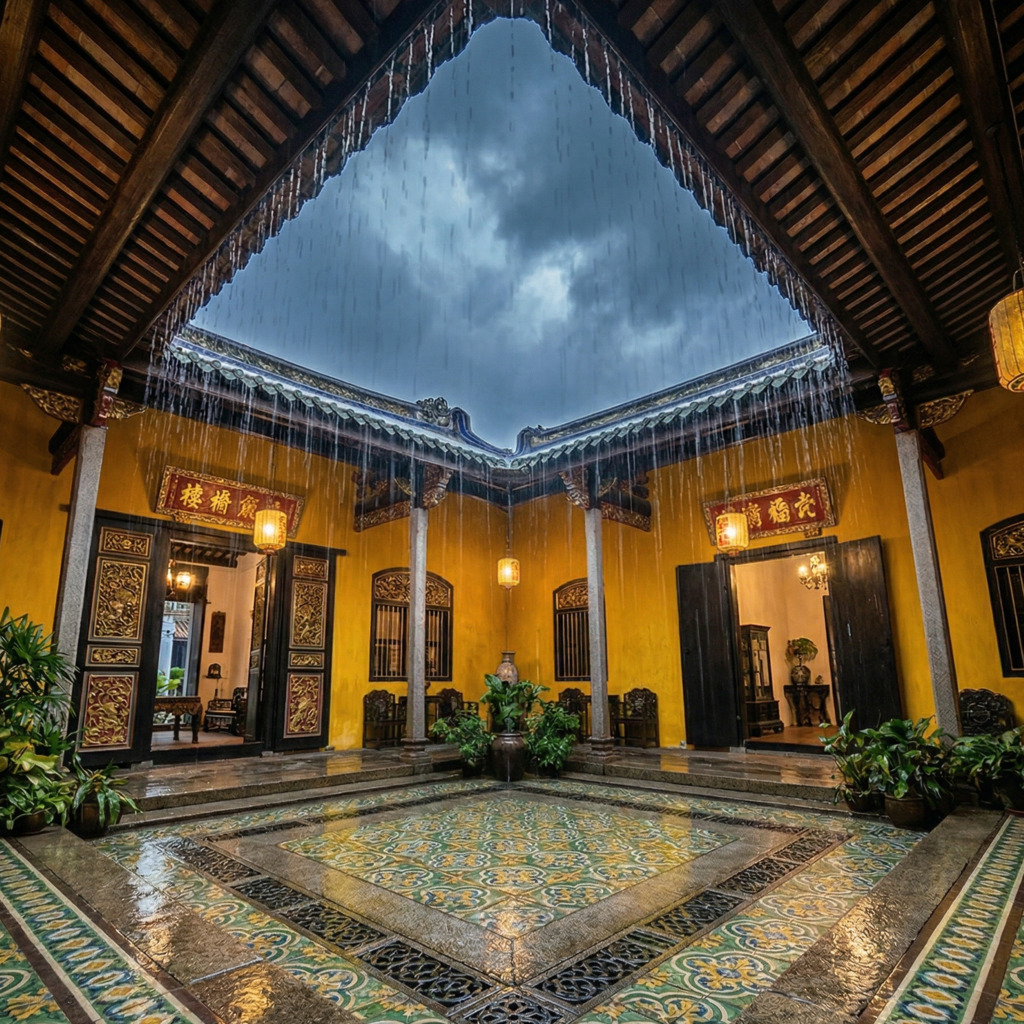
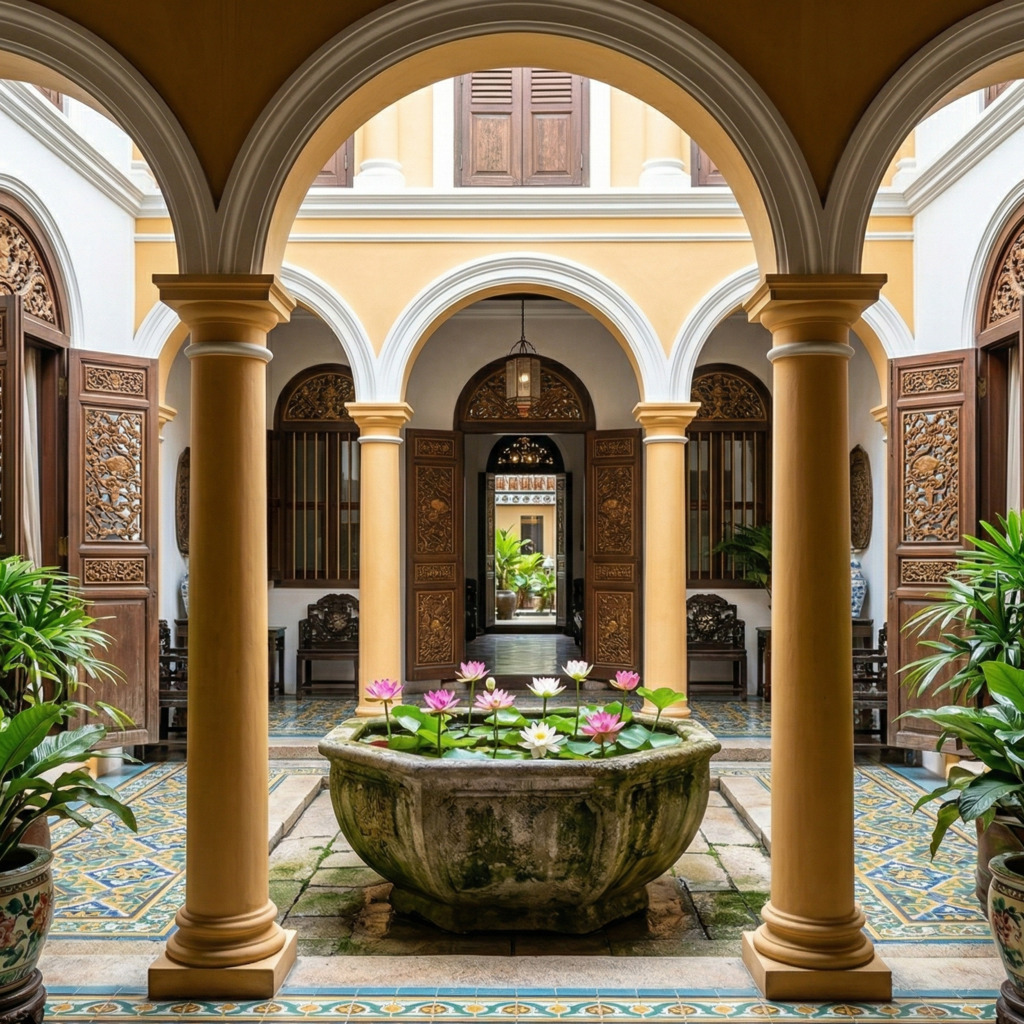
Thian Cheng (Air Well): The central, open-air internal courtyard that serves as the spiritual heart and mechanical “lungs” of the mansion, facilitating passive cooling by drawing hot air up and out.
Kaki Lima (Five-Foot Way): The iconic, continuous covered pedestrian walkway mandated along the building’s street front, protecting passersby from tropical rain and intense sun.
Chunam: A highly durable, traditional masonry plaster made from a mixture of lime, sand, egg whites, and sugar, which allows the mansion walls to “breathe” and withstand high humidity.
Encaustic Tiles: Intricate, colourful ceramic floor tiles (often imported from makers like Minton in England) where the pattern is baked into the clay rather than glazed on top.
Peranakan: The unique, affluent hybrid culture and community of the Straits Settlements, born from the intermarriage of Chinese merchants and local Malay populations.
Sui Khee: The house servants who managed the hidden, bustling domestic engine rooms at the rear of the mansion, from the smoke-filled kitchens to the cooling water jars.
Stepping off the relentless, sun-baked asphalt of Leith Street and crossing the threshold of the Cheong Fatt Tze Mansion (“Blue Mansion”) triggers an immediate microclimatic shift. The ambient temperature drops by a measurable five degrees Celsius.
Visitors immediately register the cool thermal mass of imported encaustic floor tiles beneath their feet, while high above, a sharp shaft of sunlight cuts through a massive granite courtyard. This architectural void is the “Air Well” – functioning literally and mechanically as the lungs of the entire domestic space.
During the late 19th and early 20th centuries, these grand courtyard residences were the definitive architectural symbols of a rising global elite: the “Merchant Princes” of the Straits Settlements.
Accumulating vast industrial fortunes through the extraction of Malayan tin and the cultivation of rubber, these Peranakan tycoons constructed highly complex homes that mirrored their cross-cultural commercial empires.
The resulting architectural taxonomy – formally classified as the Straits Chinese Eclectic style – brilliantly fused southern Chinese structural layout with European material technology to create a unique vernacular.
The Rise of the Merchant Princes
The 1869 opening of the Suez Canal changed Southeast Asia forever. Steamships replaced sail. Goods moved faster. Ideas moved faster, too. In the Straits Settlements, a hybrid culture flourished. This was the “Baba-Nyonya” or Peranakan community.
These families were the bridge between East and West. They spoke Malay and English. They worshipped Chinese ancestors. Their homes reflected this dual identity. They rejected the simple wooden huts of the past. Instead, they built stone monuments to their success.
One famous magnate, Cheong Fatt Tze, built the “Blue Mansion” in Penang. He wanted the best of both worlds and so hired master craftsmen from Southern China. He also ordered decorative cast iron from Glasgow. It was a bold statement of power. It showed he was a man of the world.
The Heritage Highlight: The Internal Courtyard
Every great mansion starts with an open space. The Thian Cheng, or Air Well, is the spiritual heart. It serves a practical purpose. Hot air rises. The open roof pulls a breeze through the ground floor.
But for the tycoon, it was also about Feng Shui. Rainwater represents wealth. In a Straits Chinese mansion, rain falls directly into the house. It is collected in granite-lined channels. This symbolises wealth flowing into the family coffers.
Imagine a monsoon afternoon in 1890. The patriarch sits in the courtyard. He listens to the rhythmic drum of rain on stone. The water swirls around the carved pillars. Outside, the world is chaotic. Inside, the elements are controlled. The house is a machine for prosperity.
The Façade: A Global Billboard
The front of the house is where the owner meets the public. It was a visual CV. Architects combined styles with reckless abandon. You might see Corinthian columns from Greece. Above them, you find Chinese stucco carvings. These depict peonies for beauty and phoenixes for grace.
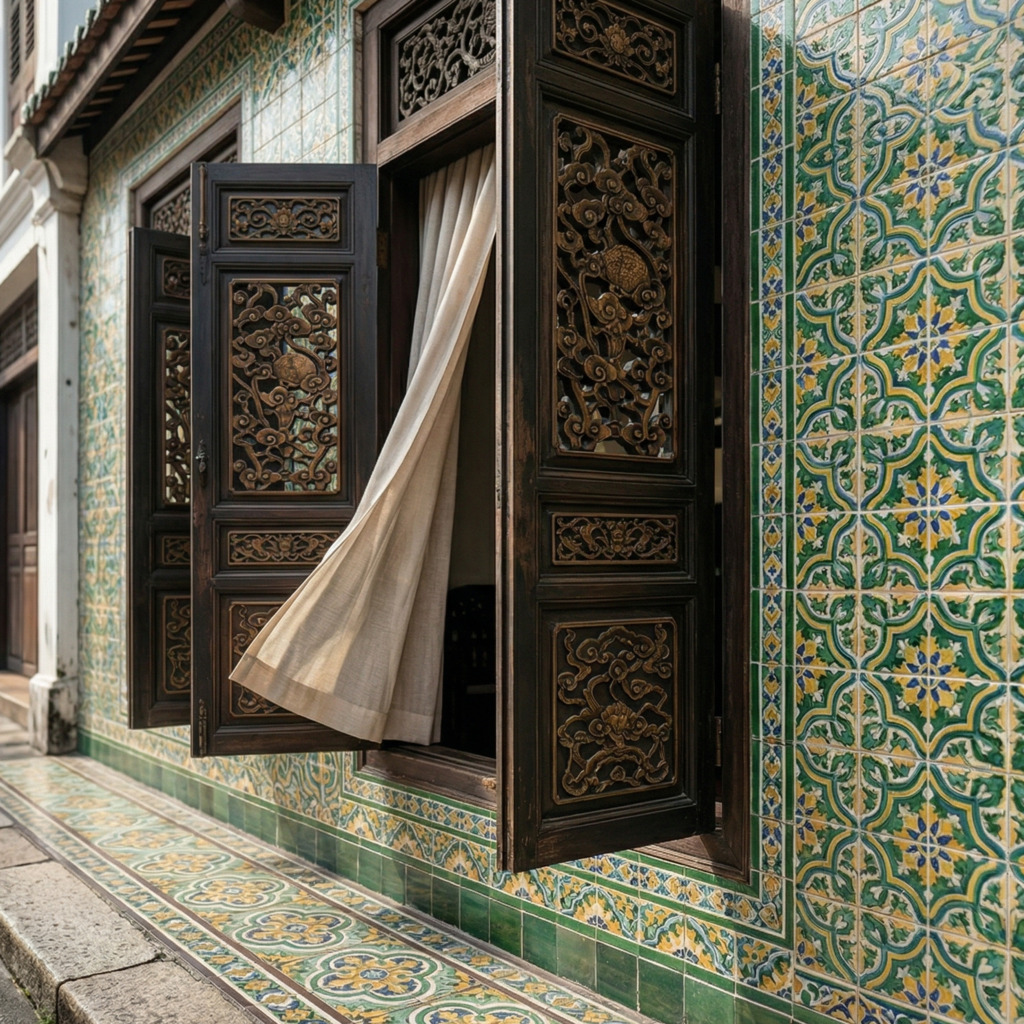
Look closely at the windows. Many feature colourful louvres. These allowed for privacy while letting in the breeze. The walls were finished with lime-wash. This was not just for aesthetics. Lime wash allows the masonry to “breathe” in humidity.
The most social part of the façade is the Kaki Lima. This is the “Five-Foot Way.” Sir Stamford Raffles mandated these covered walkways in 1822. They protected pedestrians from the sun and rain. Today, they remain an iconic feature of Southeast Asian streetscapes. They are where the private home meets the public city.
The Hidden House: The Servant’s World
The front of the house was for show. The back of the house was for survival. This was the domain of the Sui Khee, or house servants. Here, the air was thick with the scent of shrimp paste and charcoal.
The kitchen was the engine room. It was usually located at the very rear. This kept the heat and smoke away from the formal living areas. Servants used heavy stone mortars to grind spices. The rhythmic “clack-clack” of the pestle was the heartbeat of the home.
In these back quarters, the strict social hierarchy was clear. Servants slept in small lofts or near the kitchen. They moved through narrow side passages to ensure the patriarch’s tea was always hot. They kept the brass fixtures polished to a mirror finish.
One elderly resident remembers the “water carriers.” Before indoor plumbing, men carried buckets of fresh water from local wells. They entered through the rear service door. They filled the large ceramic tempayan jars. These jars kept the water cool for the evening bath.
The Tycoon’s Catalogue: The Global Supply Chain
A Straits Chinese mansion, such as the Pinang Peranakan Mansion, is a map of 19th-century trade. The floor tiles often came from Minton in England. They feature intricate geometric patterns. They are incredibly durable. Even after a century, the colours remain vivid.
The walls were built with chunam. This was a mixture of lime, egg whites, and sugar. It created a rock-hard finish. It could withstand the tropical moisture that rots modern concrete.
Then there is the ironwork. In the late Victorian era, Scotland was the iron capital of the world. Tycoons flipped through catalogues from MacFarlane’s Saracen Foundry. They ordered spiral staircases and balcony railings.
These arrived in crates at the Penang docks. They were bolted onto traditional Chinese structures. This was early globalisation. A merchant in Malacca could order the same railing as a banker in London. He just added a few Chinese gold-leaf characters to the gate.
Materiality and Craftsmanship
The wood used was almost always teak or cengal. These timbers are naturally resistant to termites. Craftsmen used “mortise and tenon” joints. They did not use nails. This allowed the wood to expand and contract with the humidity.
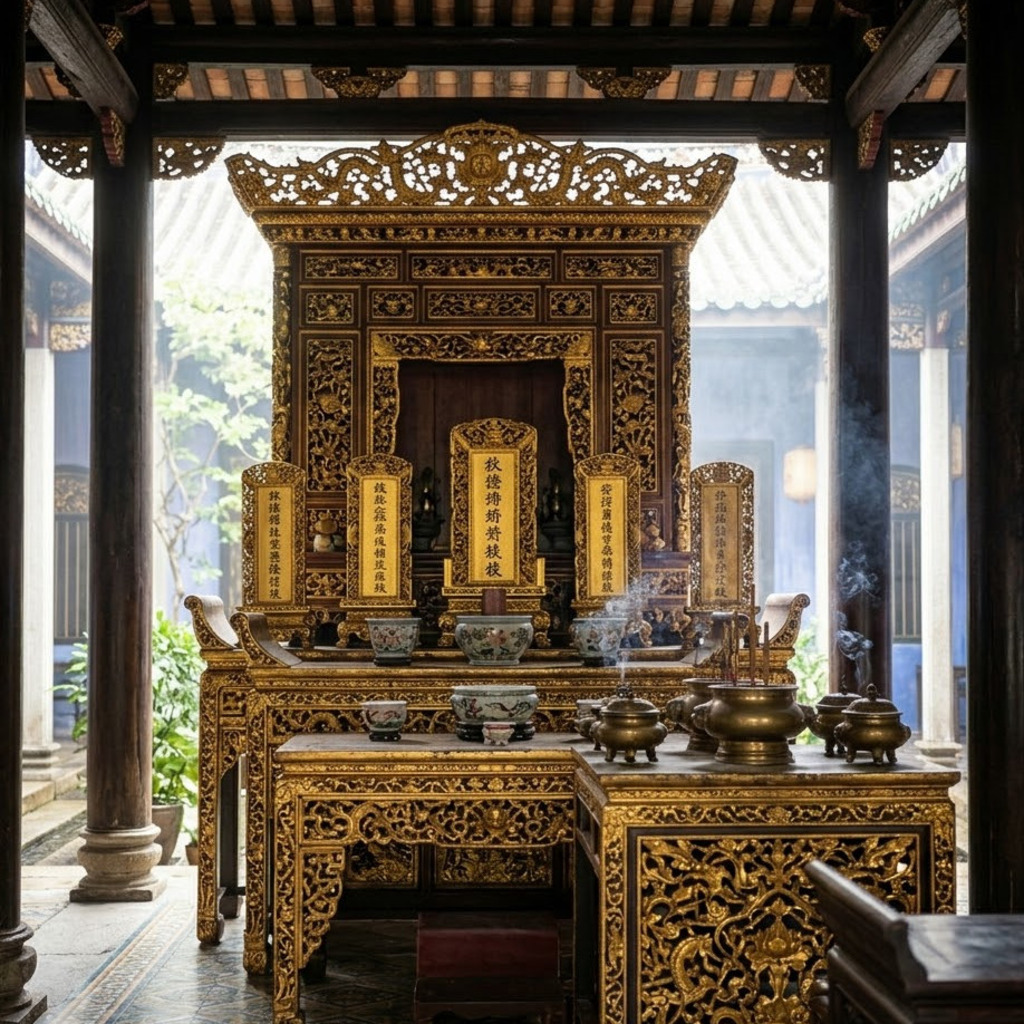
The gold leaf on the ancestral altars was real. It came from thin sheets beaten by hand in China. It caught the flickering light of peanut-oil lamps. This created a sense of divine presence.
One story tells of a tycoon who imported an entire marble floor from Italy. The ship sank in the Malacca Strait. He simply ordered another one. Money was no object. The house had to be perfect. It had to outshine his rivals.
The Reception Hall: Screens and Spirits
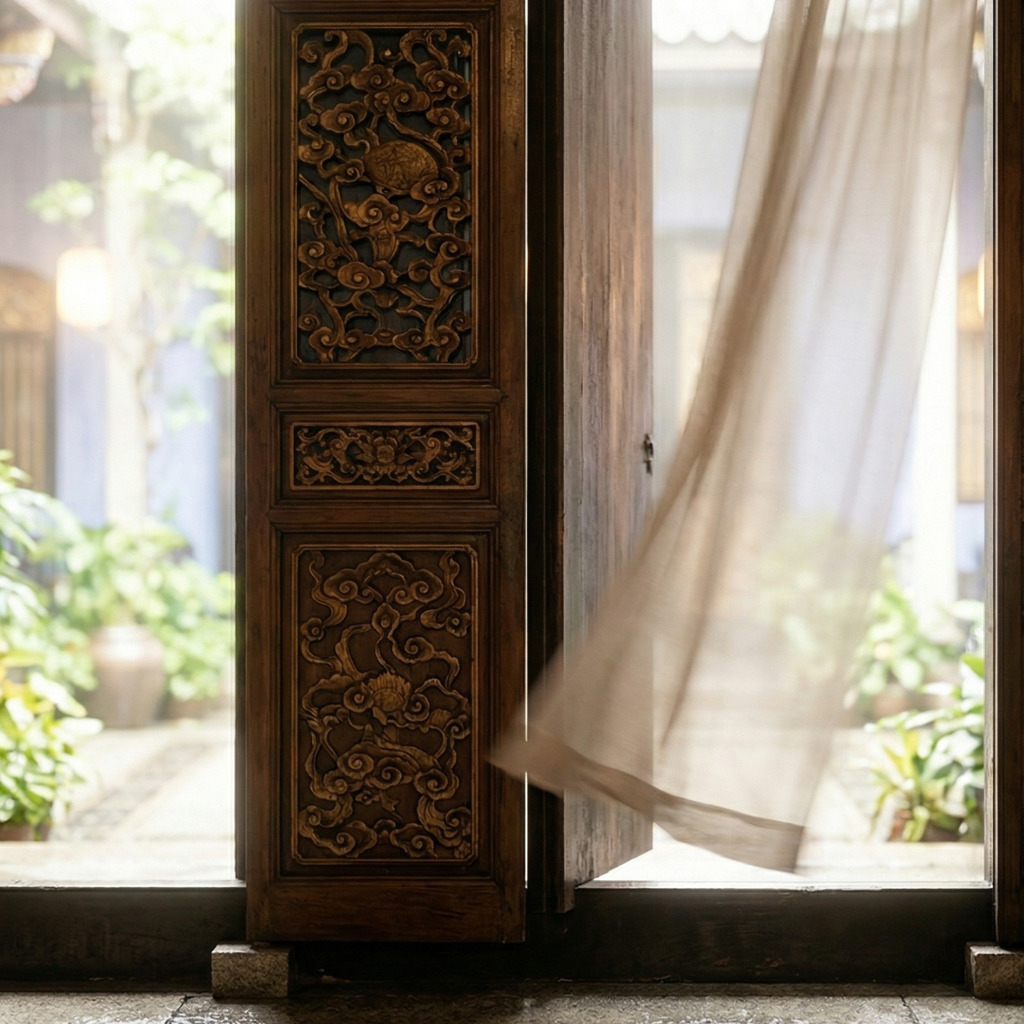
To enter the house, you must pass the Pintu Pagar. These are waist-high swing doors. They allow air to circulate while keeping out stray dogs. Beyond lies the Main Hall.
This room was for formal business. The furniture is heavy. It is usually made of Namwood or Blackwood. Much of it is inlaid with mother-of-pearl. The scent of aged teakwood fills the air.
A carved timber screen usually blocks the view of the rear. This is the Chiah-Tay. It ensured that visitors could not see the private family areas. However, the screen often had “peep holes.” The women of the house could observe guests without being seen. It was a house of secrets.
Ancestral Spaces: The Spiritual Anchor
Deep within the mansion lies the Ancestral Altar. This is the most sacred space. Even the wealthiest tycoon answered to his forefathers. The altar is usually draped in red embroidered cloth.
Here, the family offered food and incense. The smoke would drift up toward the second-floor gallery. In the evenings, the “rhythmic whir” of overhead punkah fans moved the air. These fans were manually operated by servants. They ensured the patriarch remained cool while he paid his respects.
The placement of the altar was never accidental. It followed strict geomantic rules and anchored the house to the past. It reminded everyone that the family’s fortune was built on the foundations of tradition.
Life on the Upper Floor
The ground floor was for business and spirits. The upper floor was for the family. In many mansions, the floorboards are wide planks of tropical hardwood. If you walk softly, you can hear the house “speak.”
The bedrooms were often arranged around the central air well. This ensured every room had a window for ventilation. Before air conditioning, this was a life-saving design.
In some homes, small “spy holes” were cut into the floorboards. This allowed the matriarch to see who was at the front door. She could vet visitors before the servants opened the gate. It was a primitive but effective security system.
Preservation and the Modern Experience
Many of these mansions fell into decay after World War II. Rent control laws made them unprofitable. The lime-wash peeled. The teak rotted. However, the UNESCO listing of George Town and Malacca changed everything.
Today, a new generation of “Heritage Heroes” is restoring these buildings. They are not just museums. They’re boutique hotels and galleries. They offer a “Slow Travel” experience.
For the modern traveller, the best time to visit is the “Golden Hour.” This is just before sunset. The low sun hits the ochre and indigo walls. The shadows in the five-foot ways grow long. The city slows down. It is the best time for photography.
Avoid the main tourist routes. Walk the quiet backstreets. Look for the houses that still have their original patina. These are the ones that tell the truest stories.
The Botany of the Courtyard
The air well was often filled with plants. These were not just for decoration. They helped cool the air through transpiration. Tycoons favoured auspicious plants.
The “Money Plant” was a common choice. It was believed to bring good luck to the business. Jasmine provided a sweet scent in the evenings. Potted pomegranate trees symbolised fertility and a large family.
One mansion in Malacca still has its original bird’s nest ferns. They’ve grown for over fifty years. They cling to the damp granite walls of the courtyard. They are living witnesses to the family’s history.
A Legacy in Lime and Teak
The Straits Eclectic mansion is more than just a building. It is a record of a specific moment. It represents an era when East and West merged.
These homes were built by men comfortable in two worlds. They wore silk tunics and gold pocket watches. And they ate spicy Nyonya curries on English bone china. They built houses as complex as their own identities.
To walk through a mansion today is to step back in time. It is a reminder of when craftsmanship mattered. The materials were honest. The ventilation was natural. The beauty was intentional.
The tycoon is gone. His tin mines are empty. But his stately home remains. It stands as a syncretic blend of Hokkien tradition and British order. It is a monument to the endurance of heritage.
Planning your own heritage journey?
Explore our archives at the Blue Mansion. Discover how the “Golden Age of Travel” lives on in our curated list of boutique heritage hotels. Don’t just stay in a room. Stay in history.