
Key Insights
The Teak Trail represents the “connective tissue” between Chiang Mai’s 700-year-old Lanna heart and the global Victorian-era economy. Essential to the 2026 UNESCO bid under Criteria II and IV, it showcases an interchange of human values through the “Teak-to-Temple” pipeline and the Gingerbread architectural legacy.
Key technical elements include the 137 Pillars structural philosophy and the intangible heritage of mahout culture.
Explore the complete Lanna Teak Trail topic.
Teak Capitalism: The late 19th-century economic system driven by European timber firms—primarily British—that industrialised forest extraction in Northern Thailand through state-sanctioned concessions.
UNESCO Tentative List: The official registry of cultural and natural properties undergoing rigorous evaluation to demonstrate Outstanding Universal Value (OUV) before securing permanent World Heritage status.
Ho Kham: A traditional Lanna royal hall or “gilded pavilion” constructed entirely from premium golden teak, historically serving as the residential or administrative epicentre for northern rulers.
Vernacular Forestry: The localised, pre-industrial knowledge system of selecting, curing, and structural engineering with native hardwoods, practised by Lanna master builders to maximise architectural longevity.
Buffer Zone Management: A critical UNESCO planning requirement establishing strict, legally monitored perimeter rings around heritage assets to insulate traditional timber structures from modern urban encroachment.
Tangible Cultural Assets: Physical, permanent historical remnants—such as surviving monastic compounds, city walls, and aristocratic teak mansions—that serve as empirical evidence of a region’s architectural lineage.
For centuries, Chiang Mai’s identity was defined by the terracotta bricks of its moated walls and the golden spires of Lanna Buddhism. However, as the municipality prepares its final nomination dossier for Chiang Mai UNESCO World Heritage status under the designation “Chiang Mai, the Capital of Lanna,” a different material has taken centre stage: Tectona grandis (Teakwood).
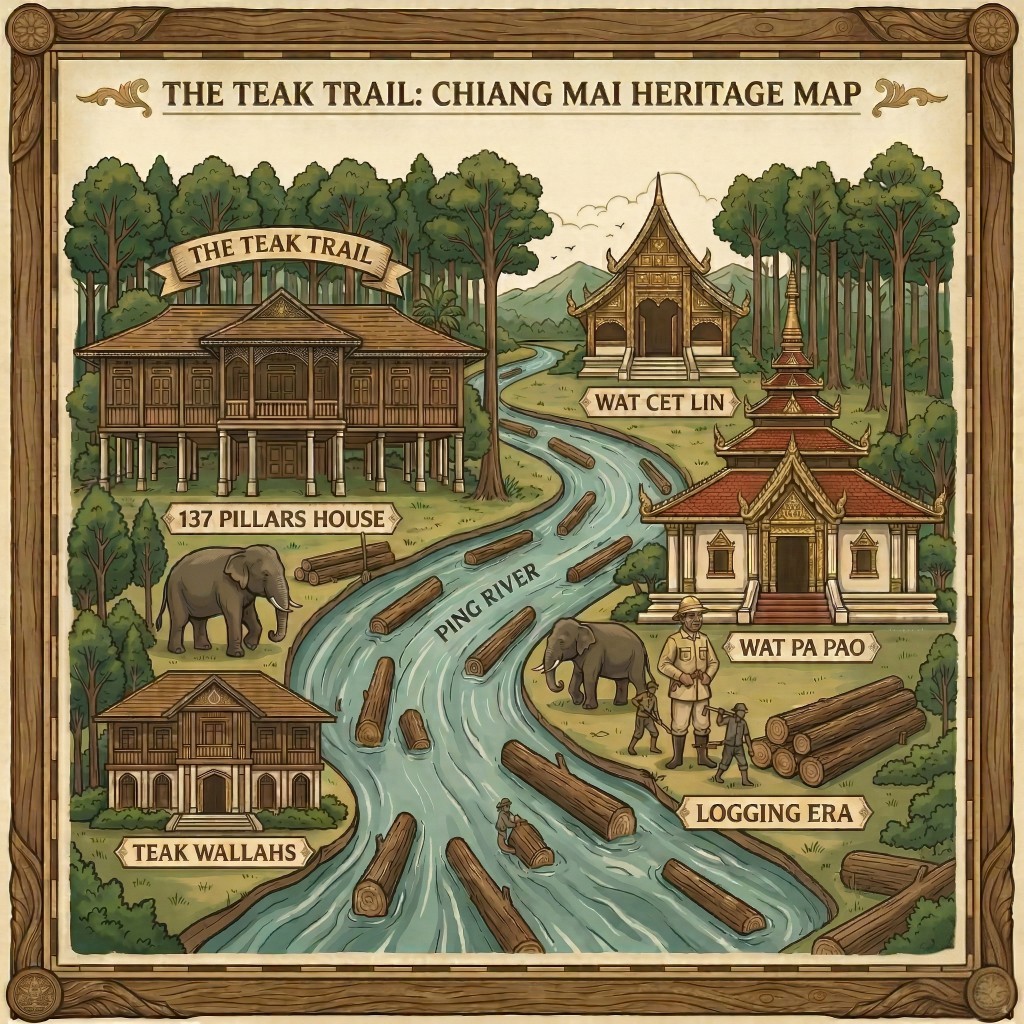
The “Teak Trail” – the historical narrative tracking 19th-century timber concessions, British “Teak Wallahs” (forest managers), and skilled Burmese artisans – has emerged as the critical connective tissue in the city’s bid.
By shifting the historical perspective, this material legacy transforms Chiang Mai from a secluded mountain kingdom into a vital global node of the Victorian-era industrial economy. This specific transnational heritage provides the definitive Outstanding Universal Value (OUV)
The River that Built a Kingdom: A Narrative Hook
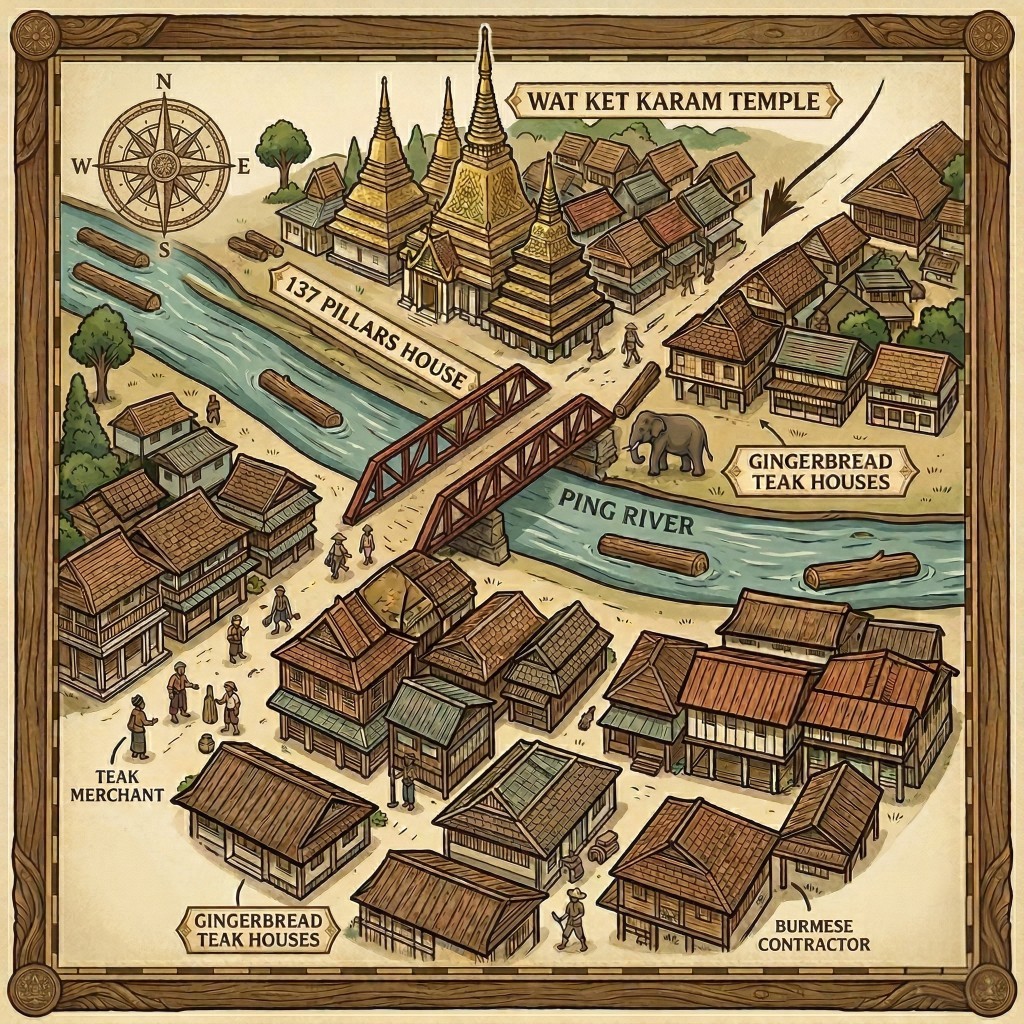
Imagine the Ping River in 1890. It’s not the tranquil waterway lined with cafes that we see today. Instead, it’s a churning industrial highway, choked with thousands of massive teak logs, each branded with the distinctive iron stamps of the British Crown, the Danish East Asiatic Company, or the local Lanna royalty.
The air is thick with the calls of mahouts and the trumpeting of logging elephants. These beasts were the heavy machinery of the era. This was the “Teak Rush.”
The UNESCO bid focuses heavily on the 700-year-old “Lanna Heart” within the city walls. However, these “Teak Arteries” flowing toward the river sustained that heart into the 20th century. Ultimately, the Teak Trail bridges the medieval moat and the modern, creative city.
The Economic Engine of “Outstanding Universal Value”
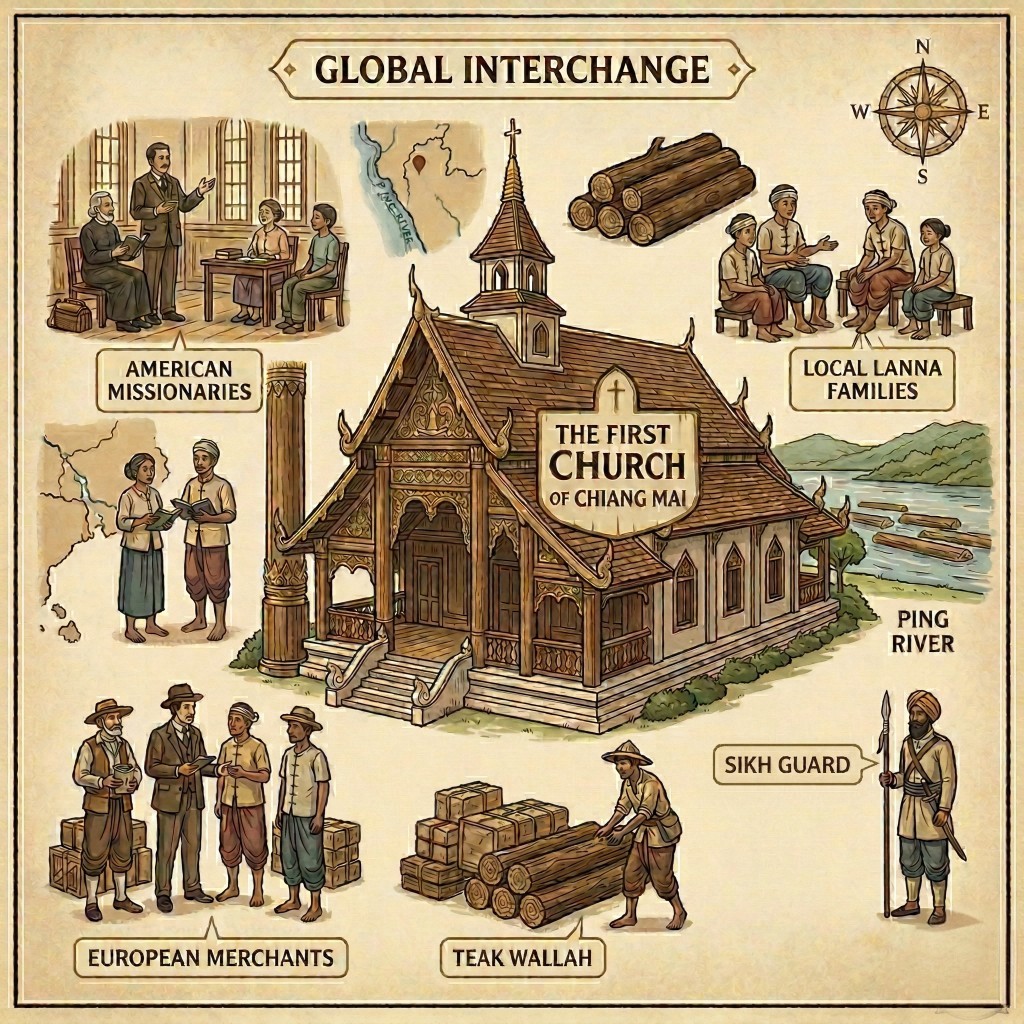
One of the most rigorous requirements for a UNESCO World Heritage listing is Criterion II: exhibiting an “interchange of human values.” A site cannot simply be old; it must show how it was influenced by, and influenced, the wider world.
In Chiang Mai, the teak trade was the primary engine of this interchange. In the late 19th century, Northern Thailand held the world’s last great frontier of high-quality teak. This brought an influx of capital that fundamentally altered the city’s religious landscape.
The “Teak-to-Temple” Pipeline
We often view the exquisite wood carvings of Wat Phra Singh or the gold-leaf stencilling of Wat Chedi Luang as purely ancient relics. However, the “Gilded Era” of the late 1800s saw a massive wave of “merit-making” funded entirely by timber wealth. The local Chao (Lords), who grew immensely rich by leasing forest tracts to European firms, funnelled their “forest gold” into temple restoration.
The Viharn Lai Kham, perhaps the most famous example of Lanna art, reached its peak of complexity during this period. Abundant, high-quality aged teak allowed artisans to push the boundaries of woodcraft. They created the “Lanna flower” motifs now synonymous with Northern Thai identity.
Without the economic surplus from the Teak Trail, these temples might have succumbed to tropical decay a century ago. This financial lifeline ultimately preserved their “Living Heritage.”
Anatomy of the “Teak Wallah”: A New Social Fabric
UNESCO looks for a “Living Cultural Landscape,” and the Teak Trail provides the human element of this landscape. The arrival of the “Teak Wallahs” – the European foresters and agents – shifted the city’s gravity.
Before the 1880s, the “Inner City” was the seat of power. The Teak Trail pulled that power toward the riverbanks, specifically to the Wat Ket and Charoen Rat districts. This area became a true melting pot, fulfilling the UNESCO requirement for a multi-ethnic historical narrative.
Architectural Deep-Dive: The “Gingerbread” Legacy
Perhaps the most visible influence of the Teak Trail is the shift in the city’s “architectural DNA.” UNESCO Criterion IV highlights buildings that represent a significant stage in human history. For Chiang Mai, that stage is the Colonial-Teak Fusion.
The “137 Pillars” and Status Symbols
In traditional Lanna architecture, the number of pillars supporting a house was a direct reflection of the owner’s status. The iconic 137 Pillars House, once the headquarters of the Borneo Company, stands as a masterclass in this philosophy. Elevated on a forest of teak stilts, the building survived the Ping River’s annual floods. This structure represents a crucial architectural transition. It moves from traditional post-and-lintel Lanna construction to a hybridised “Bungalow” style.
The Rise of Gingerbread
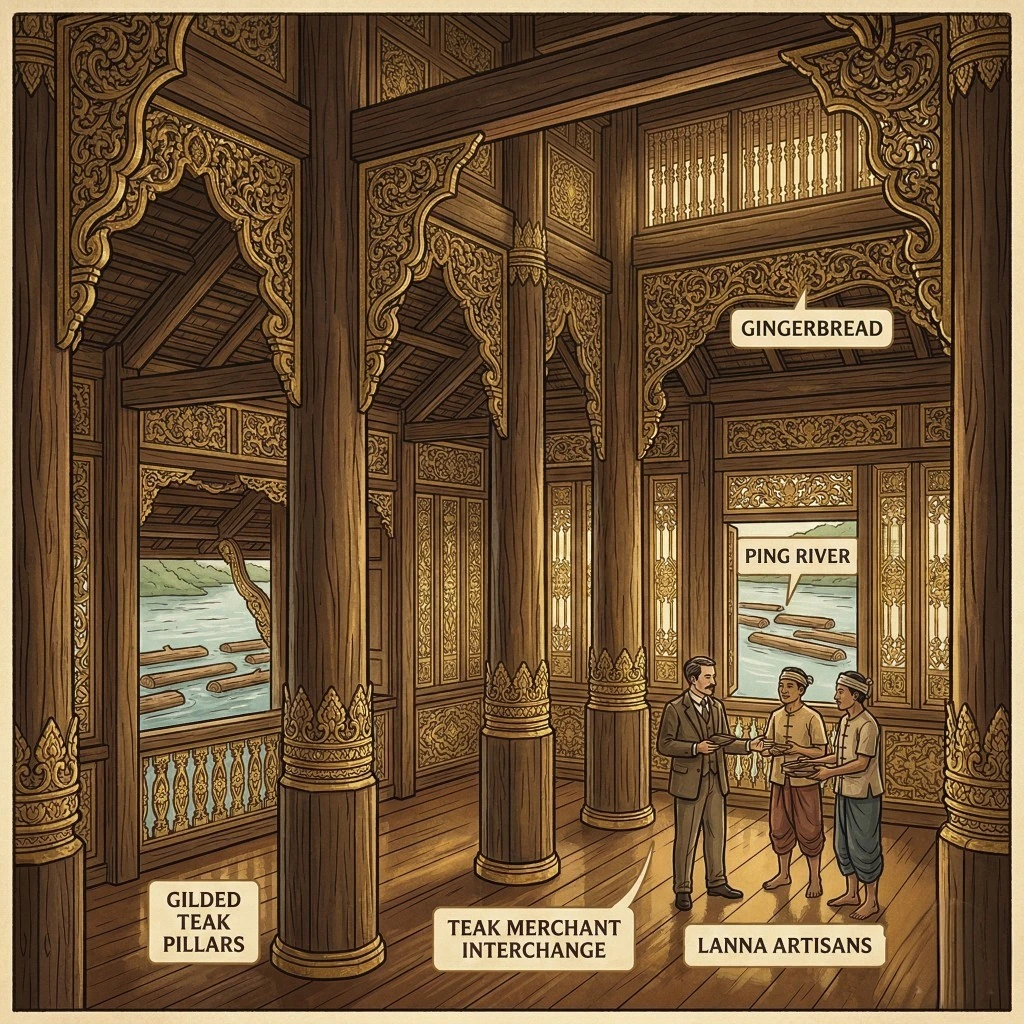
The Teak Trail also introduced the “Gingerbread” style– intricate, fretsaw-cut wood ornamentation. Using the very material they were exporting, merchants adorned their homes with “lace” made of wood. The Lanna Ancient House, the oldest teak structure in the city, showcases this transition. These buildings transcend mere pretty facades. They form the “physical fabric” justifying the riverside districts’ inclusion as a UNESCO “Buffer Zone.”
The Invisible Labour: Mahouts and the Intangible
A UNESCO bid is incomplete without Intangible Cultural Heritage (ICH). An ancient partnership powered the Teak Trail: the Thai Elephant and the mahout.
While the logging industry ended with the 1989 logging ban, the “knowledge systems” it created remain. Teak era techniques refined elephant training for dense terrain, tusk leveraging, and foot-press commands to professional standards.
UNESCO’s dossier links Chiang Mai’s industrial history to its current role as an elephant conservation centre. It argues that Mahout culture is a Teak Trail lineage surviving the shift from extraction to education.
The Modern Conflict: Preservation vs. Profit
As the “Teak Trail” becomes a centrepiece of the UNESCO bid, it faces a modern paradox. The very charm that makes these teak districts “World Heritage worthy” also makes them prime real estate for luxury development.
Gentrification and Authenticity
Many of the original teak warehouses and “Teak Wallah” mansions have been gutted to make way for boutique hotels. While this “adaptive reuse” preserves the building’s shell, UNESCO’s “Nara Document on Authenticity” asks whether the spirit of the place survives.
The Chiang Mai Heritage Conservation Group has been vocal: for the UNESCO bid to succeed, the city must implement stricter zoning. It’s not enough to have a teak facade if the community that lived there – the descendants of the traders and artisans – has been priced out. The bid acts as a legal shield, incentivising owners to restore heritage assets rather than demolish them for high-rise condos.
The Conservation Legacy
Ironically, the Teak Trail also gave birth to Thailand’s modern conservation movement. The rampant deforestation caused by the 19th-century “Timber Rush” led King Rama V to establish the Royal Forest Department in 1896, originally headquartered in Chiang Mai. The UNESCO bid frames this as the beginning of the city’s commitment to “Green Heritage,” linking the management of the city to the preservation of Doi Suthep-Pui National Park.
Conclusion: A History Carved in Wood
The Teak Trail transcends a mere logging path. It is the narrative thread binding Chiang Mai’s ancient Lanna origins to its contemporary global identity. By highlighting the 19th-century timber boom, the UNESCO bid recognises a deeper truth. The city’s value lies not in isolation, but in its ability to adapt and trade. Ultimately, Chiang Mai flourished beautifully at the historic intersection of diverse cultures.
When the UNESCO evaluators walk the banks of the Ping River, they won’t just see old buildings. They will see a history carved in the world’s most resilient hardwood—a history that proves Chiang Mai has been a “World City” long before the first tourist arrived.