
If you scroll through the endless stream of content marketing for Chiang Mai, you will inevitably find yourself in the most exhausting province of Banalistan. In this particular zone, the ancient capital of the Lanna Kingdom is flattened into a sterile, hipster cliché.
It is aggressively packaged as a “digital nomad hotspot,” a “cafe-culture paradise,” or a “serene wellness hub” where remote workers go to consume matcha lattes and seek lifestyle mindfulness.
This commercial flavour of destination marketing treats the geographic city as an empty, low-cost playground, reducing its sacred mountains and Buddhist topography to mere scenic backdrops for social media lifestyle content.
But Chiang Mai was never meant to be a wellness commodity or a generic remote work infrastructure.
Its historic urban foundations were dictated not by modern urban planners, search engine algorithms, or lifestyle influencers, but by sacred geography and royal chronicles. The spatial planning of the 13th-century capital was determined by a wild, dying white elephant carrying a sacred Buddhist relic.
To understand authentic destination storytelling, cultural tourism strategists must look past the co-working spaces and examine the sacred topography of Wat Phra That Doi Suthep. At this mountain peak, a white elephant established the geopolitical and spiritual centre of a kingdom.
The Plot: A Fractured Relic and a Divine Test
The year was 1383. King Nu Naone of the Lanna Kingdom ruled a prosperous, culturally distinct northern empire. But a kingdom without a supreme spiritual anchor was vulnerable – it lacked cosmic legitimacy in the eyes of neighbouring rival empires like Ayutthaya.
Enter a wandering monk named Sumana Thera from the ancient, fading ruins of Sukhothai. He brought with him an object of immense, terrifying power: a sacred bone relic believed to be from the shoulder of Gautama Buddha himself.
This wasn’t just a piece of history; it was a living talisman. According to the Lanna chronicles, the relic possessed a volatile, miraculous energy – it would glow with an ethereal light, vanish at will, and replicate itself.
When King Nu Naone placed the relic on a golden tray to revere it, the object performed its final, definitive miracle: it violently split in two. One piece remained identical in size, while the other was smaller.
The King decided to enshrine the larger piece in a grand stupa, but he faced a fundamental geopolitical and spiritual dilemma: Where do you place the absolute heart of an empire?
In a society deeply rooted in both Theravada Buddhism and ancient animism (the belief that nature is alive with powerful spirits), humans were deemed too flawed, too politically biased, and too spiritually blind to make such a monumental decision. A human would choose a spot based on trade routes, defence, or convenience. But an empire needed to be aligned with the cosmos.
So, they outsourced the grand strategy to a higher power.
The Twist: The White Elephant’s Final March
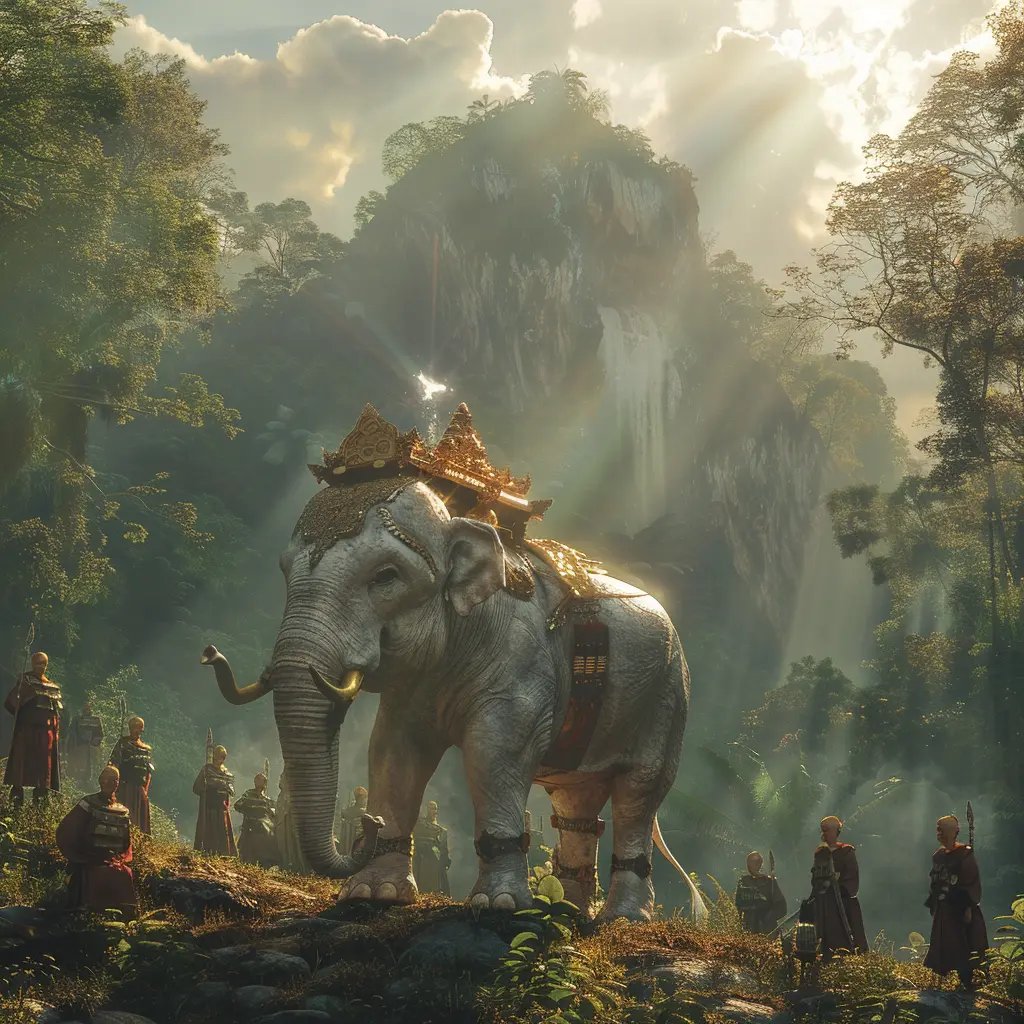
The King took the sacred relic and strapped it securely to the back of a majestic, revered white elephant. In Southeast Asian statecraft, a white elephant was not just a rare animal; it was a Chakkavatti – a living deity, a physical manifestation of royal power, universal justice, and cosmic order.
The elephant was released into the wild. Wherever the elephant walked, the fate of the kingdom would follow.
The animal didn’t choose the flat, comfortable plains where modern air-conditioned cafes now sit. Instead, it turned its eyes toward the imposing, jungle-choked peaks of the west. It began a gruelling, vertical ascent up the rugged slopes of Doi Suthep (then known as Doi Aoy Chang, or Sugar Cane Elephant Mountain).
This wasn’t a peaceful stroll. The royal court, the high monks, and the heavily armoured soldiers had to hack through thick bamboo forests, sweating, gasping for breath, and battling tropical insects as they struggled to keep pace with the steady, deliberate march of the massive beast.
The elephant climbed higher and higher into the clouds, ascending over a thousand meters above the valley floor, moving deep into the territory of the mountain spirits.
Finally, near the very peak of the mountain, the elephant stopped.
It didn’t just sit down to rest. It trumpeted three times into the mountain air, wheeled around in a slow, deliberate circle, dropped to its knees, and immediately died of pure exhaustion.
The message was unmistakable. The elephant had spent the absolute last ounce of its biological life force to reach these exact, high-altitude coordinates.
The King immediately ordered the construction of a magnificent golden chedi on that exact patch of dirt – the foundations of Wat Phra That Doi Suthep. For nearly seven centuries, that mountain peak has looked down upon Chiang Mai, serving as the literal and figurative crown of the Lanna world.
The Destination Marketing Takeaway
Banalistan sells Chiang Mai as a cozy refuge for temporary visitors—a place to consume “culture” like a product. Real storytelling reveals that Chiang Mai is a city anchored to a sacred mountain by a divine death.
When you write your next destination campaign, burn the lifestyle template and apply these three deep narrative laws:
1. Elevate the Gravity (Shift from “Pleasant” to “Sacred”)
When you market Chiang Mai merely as a “chill mountain town,” you reduce it to a temporary, disposable trend. When you market it through the legend of Doi Suthep, you show that the entire city layout exists because an ancient king let a dying deity choose his spiritual capital. It forces the traveller to arrive not with a sense of entitlement, but with a sense of reverence.
2. Contextualise the Geography (Turn Excursions into Pilgrimages)
Tourists often view the climb up Doi Suthep as an optional morning excursion, a checkbox on a list, or an Instagram photo-op. By telling the story of the white elephant’s final, exhausting march, that winding mountain road transforms. Every twist in the asphalt gains historical and physical weight. The traveller realises they are retracing the final heartbeats of a sacred creature.
3. Reject the Lifestyle Sanitisation
True luxury and authentic branding require friction and depth. Chiang Mai isn’t a blank canvas for digital nomads to paint their aesthetic onto; it is a living Lanna civilisation whose spiritual heart sits on a mountain peak because of a 14th-century miracle.
The next time you write a campaign for a destination, stop using terms like “lifestyle destination,” “nomad hub,” or “hotspot.” Look up at the landscape, find out what creature died to claim that ground, and tell a story that commands actual respect.