
Key Insights
Founded in 1350, the Ayutthaya Kingdom became a powerful, cosmopolitan maritime hub in Southeast Asia. Its brilliant island fortress dominated regional trade networks for four centuries. Internal political instability eventually fractured the empire from within.
In 1767, invading Burmese forces destroyed the capital. Today, its UNESCO-listed brick ruins stand as a monumental reminder of that vanished architectural grandeur.
Chao Phraya: This major waterway served as the primary river channel for the kingdom. It acted as the vital lifeblood for Ayutthaya’s vast global trade networks.
Chedi: This monumental, bell-shaped stupa reflects a clean Sri Lankan art influence. Builders erected these structures to hold the ashes of three royal generations.
Devaraja: This political concept established the absolute, semi-divine authority of the monarch. The early Siamese rulers adopted this framework from old Khmer traditions.
Dharmaraja: This ruling philosophy established a moral framework for the king. It rooted the monarch’s righteous authority deeply within Theravada Buddhist principles.
Prang: This soaring, finger-like temple spire features a highly distinct silhouette. Architects derived this specific structural style directly from traditional Khmer designs.
Sapanwood: The crown held a very strict monopoly over this highly valued regional tree. International merchants bought this commodity to produce brilliant, high-quality red dyes.
The rhythmic slap of water against a longtail boat’s wooden sides tracks your approach to Ayutthaya. Closing your eyes, you feel the breeze carry the faint scent of drying fish, river mud, and burning incense.
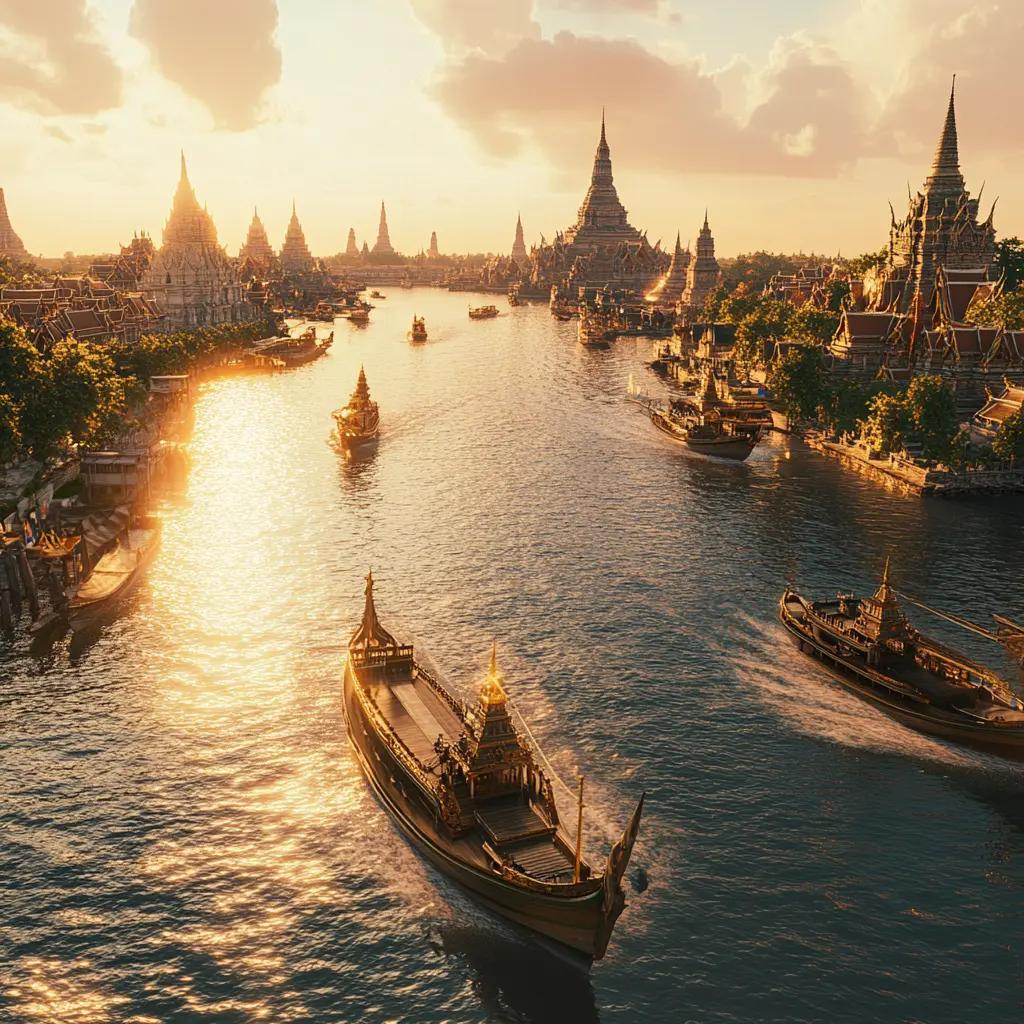
In the mid-17th century, travellers arriving via the Chao Phraya River encountered a different sensory assault. The sharp aroma of cloves and nutmeg drifted from nearby spice warehouses. A cacophony of languages filled the foreign quarters, while gold leaf reflected blinding glare off hundreds of temple spires.
This city once rivalled the grandest capitals of Europe. As a cosmopolitan maritime power, it dominated Southeast Asia for four centuries. Today, the UNESCO-listed brick ruins stand as a monumental reminder of that architectural grandeur.
This exploration traces the spatial and political evolution of the Ayutthaya Kingdom. We examine how a swampy river delta became the centre of a global trading empire before its catastrophic demise.
The Strategic Conception of an Island Fortress
In 1350, fracturing empires defined Southeast Asia. The Khmer capital at Angkor suffered a long, slow decline. Meanwhile, the northern Siamese kingdom of Sukhothai lost control of its peripheral territories. Seizing the moment, Prince U Thong – who would ascend the throne as King Ramathibodi I – engineered a new centre of gravity in the lower central plains.
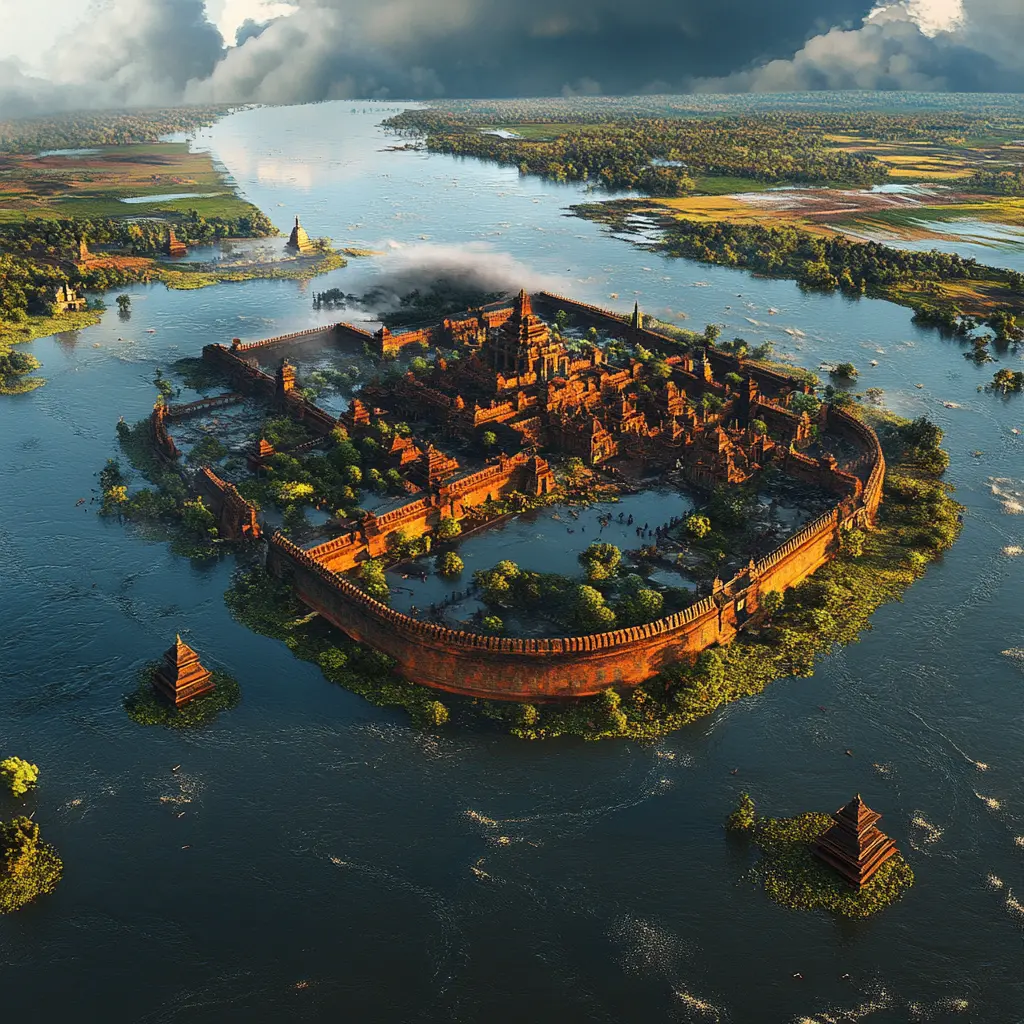
The choice of location was a masterpiece of military defence and agricultural foresight. At the confluence of three major rivers – the Chao Phraya, the Pa Sak, and the Lopburi – the prince ordered the excavation of a massive loop canal. This human intervention turned a low-lying peninsula into a completely isolated island.
During the annual monsoon season, torrential rains caused the rivers to breach their banks, submerging the surrounding plains for miles. For any invading land army, this environment was disastrous.
Enemy troops found their supply lines cut, their camps underwater, and their ranks decimated by malaria. Ayutthaya, meanwhile, sat safely above the waterline inside its island fortress, using the floods to isolate and exhaust its attackers.
To solidify his rule, King Ramathibodi I turned to symbolic branding. He named the city Krung Thep Dvaravati Sri Ayutthaya, directly referencing Ayodhya, the legendary, unassailable home of the god-king Rama from the Hindu epic Ramayana.
By blending the absolute, semi-divine authority (Devaraja) of old Khmer traditions with the moral, righteous ruler framework (Dharmaraja) of Theravada Buddhism, Ayutthaya’s monarchs established an ironclad grip on power.
Rather than relying purely on military force, the early kingdom expanded by absorbing the weakened Sukhothai state through generational marriage alliances and economic integration. By the mid-15th century, Ayutthaya quietly integrated Sukhothai into its own administrative machinery.
The Maritime Super-Hub and Foreign Enclaves
By the 17th century, Ayutthaya had evolved from a regional fortress into a global trade valve. Situated safely inland from naval assaults but accessible via deep river channels, the capital attracted merchants from across the globe.
The crown held a strict monopoly on highly valued regional commodities. These included aromatic eaglewood, sapanwood dyes, and deerskins exported by the hundreds of thousands to Japan. The rulers also controlled vast stores of surplus rice.
Seasonal monsoon winds dictated all maritime travel. Consequently, international merchants had to reside in the kingdom for months waiting for the winds to shift.
The Siamese kings capitalised on this by establishing a sophisticated zoning system outside the city walls. The king granted foreign traders specific plots of land along the riverbanks. There, the merchants established permanent settlements. These enclaves featured their own micro-administrations, religious buildings, and docks.
This multi-ethnic layout turned Ayutthaya into a striking cosmopolitan capital. A walk along the outer river canals offered vibrant sensory contrasts. You would pass the rhythmic chanting of Latin mass in the Portuguese quarter. Nearby lay the clatter of porcelain in Chinese markets and the quiet gardens of Japanese samurai.
By 1700, the city’s population had reached nearly one million, making it one of the largest and most culturally diverse urban centres of the early modern world.
Heritage Highlight: The Syncretic Court of King Narai
The peak of Ayutthaya’s international diplomacy occurred during the reign of King Narai (1656–1688). King Narai grew wary of the commercial monopoly held by the Dutch East India Company. In response, he initiated a high-stakes geopolitical balancing act. He opened direct relations with King Louis XIV of France to counter Dutch influence.
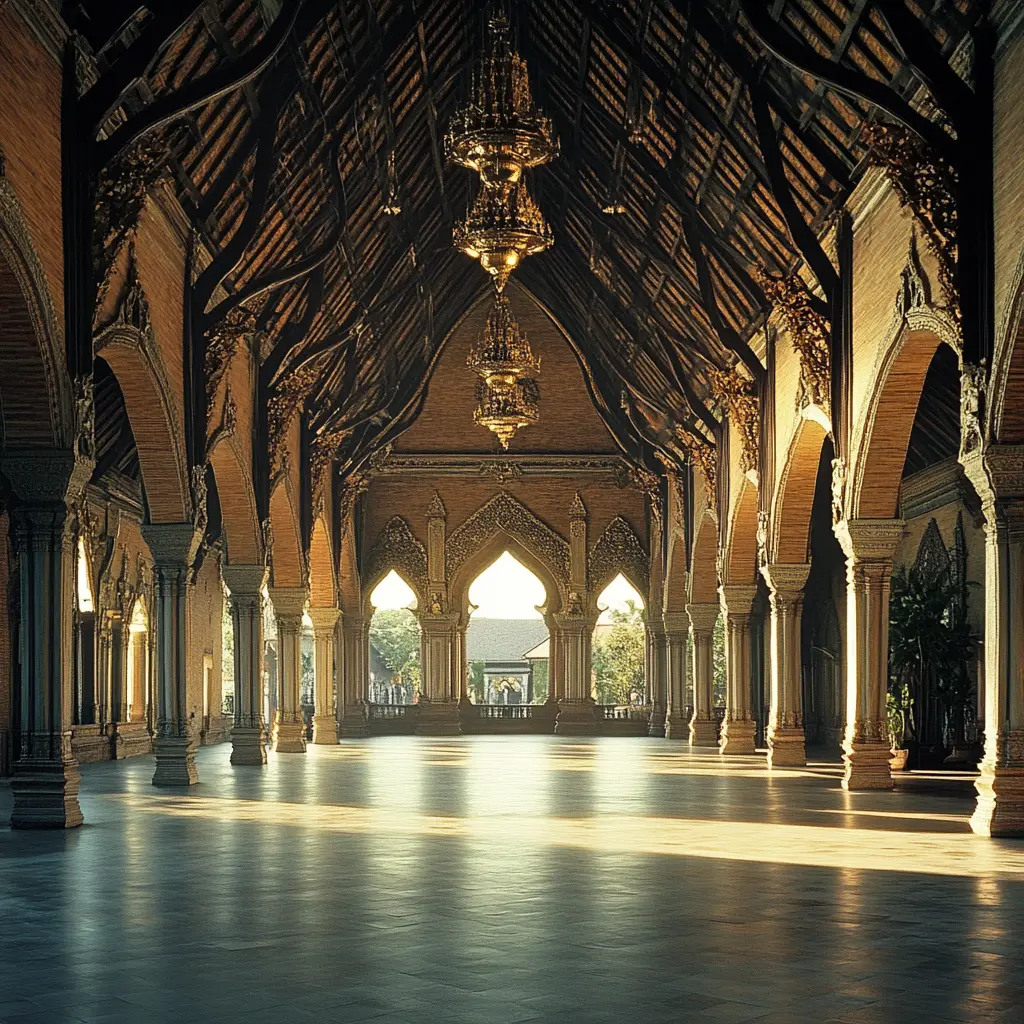
The physical legacy of this era was defined by a fascinating architectural synthesis. In his secondary capital of Lopburi, Narai commissioned European engineers to construct palaces that blended traditional Siamese layouts with Western classical elements.
The ruins of the royal reception halls still show a unique mix: pointed Gothic arches executed in local brick and mortar, topped by multi-tiered Siamese roofs.
At the center of this diplomatic web stood Constantine Phaulkon. This brilliant, opportunistic Greek cabin boy learned the Siamese language and rose through the royal treasury. Eventually, he became the King’s chief minister.
Phaulkon’s residence, Baan Wichayen, stands today as a collection of ruins. Here, European Renaissance window frames sit alongside traditional Buddhist shrines. The site physically manifests an era when old Siam was deeply intertwined with global power politics.
The Crisis and Apocalypse of 1767
The exceptional wealth of Ayutthaya’s golden age eventually fostered institutional complacency. By the middle of the 18th century, the kingdom’s political foundation was rotting from within. The royal court had become trapped in a cycle of violent succession crises.
Whenever a reigning monarch fell ill, rival princes turned the capital into a tactical battleground, executing competing factions, experienced generals, and senior administrators. This internal instability bled the provinces of leadership and left the empire’s standing armies disorganised and poorly led.
To the west, the hyper-militarised Konbaung Dynasty of Burma saw its opening. In 1765, Burmese forces launched a coordinated, two-pronged invasion, sweeping through the peripheral Siamese provinces and systematically dismantling regional resistance. By the dry season of 1766, they had locked Ayutthaya in a tight, suffocating siege.
Ayutthaya’s military commanders fell back on their historical defence strategy, closing the city gates and waiting for the monsoons to flood the plains and force a Burmese retreat.
However, the Burmese army changed the rules of engagement. Instead of retreating, they built fortified high-ground earthen stockades, seized local boats, and maintained their positions throughout the floods.
As the siege dragged past the one-year mark, life inside the city walls deteriorated into a nightmare. Food reserves emptied, outbreaks of beriberi and cholera spread through the crowded quarters, and an accidental fire tore through the centre of the city, destroying thousands of homes.
The end came on the night of April 7, 1767. Burmese engineers targeted a section of the city wall near the river, digging tunnels beneath the foundations and packing them with timber. They set the wood alight, collapsing a massive section of the brick wall, and surged into the exhausted city.
The subsequent destruction was total. The grand wooden palaces were systematically burned to the ground. Soldiers hacked at thousands of stone and bronze Buddha statues, peeling away layers of gold leaf to be melted down into portable bullion.
The royal archives, containing centuries of legal codes, religious commentary, and historical records, were burned to ash. The majority of the surviving population—including artisans, court musicians, astronomers, and the royal family—were marched westward in chains as prisoners of war. A city that had stood for 417 years was reduced to a landscape of smouldering brick ruins.
The Fragmented Ruins: A Discerning Traveller’s Guide
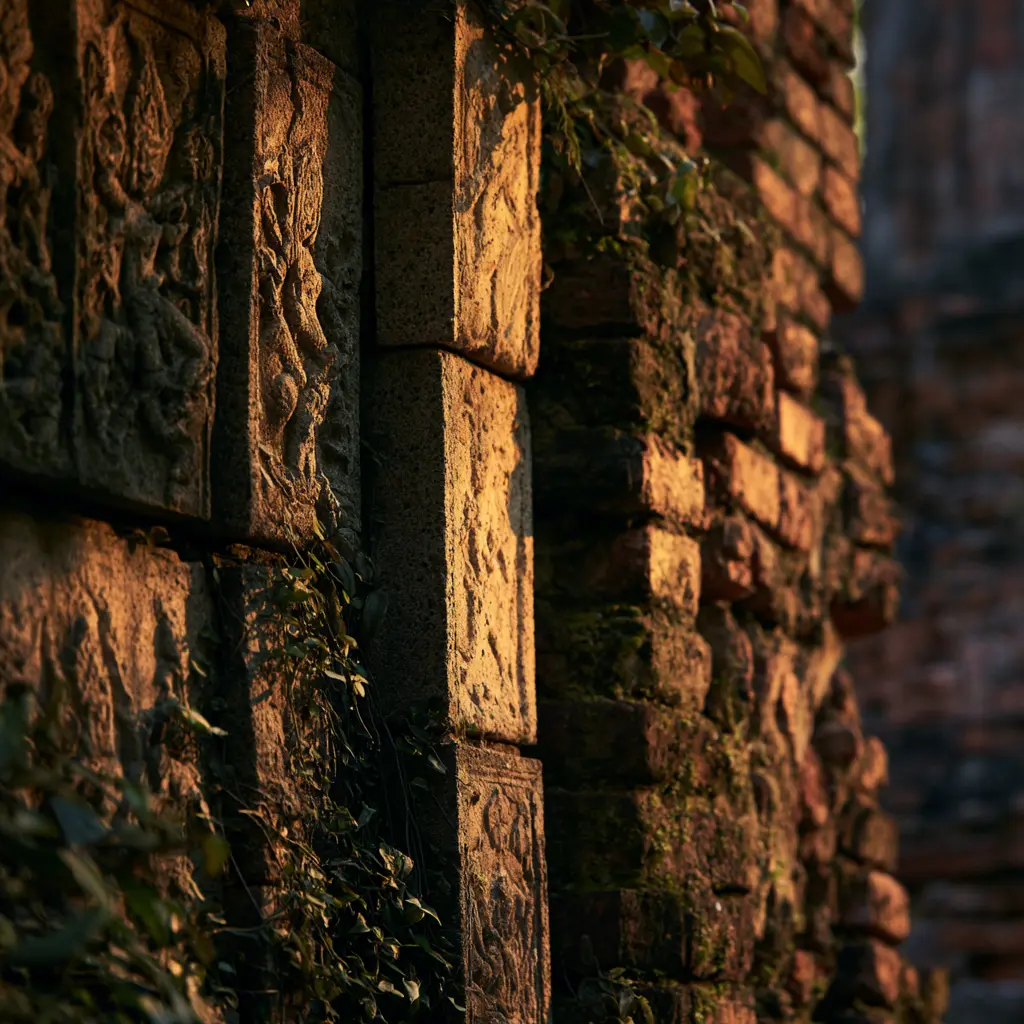
The destruction was so comprehensive that when General Taksin successfully rallied the remaining Siamese forces and drove out the Burmese garrisons, he abandoned the capital entirely. The vast, ruined city was deemed too difficult to defend with a depleted population. He moved the political centre further south down the Chao Phraya River to Thonburi.
His successor, King Rama I, later established Bangkok on the opposite bank. He intentionally constructed the Grand Palace to mirror Ayutthaya’s ruined structures. Workers even used bricks salvaged from the old capital’s walls to lay the new foundations.
For the modern traveller, traversing Ayutthaya requires looking past the modern town to read the stories preserved in the weathered red brickwork.
Wat Phra Si Sanphet
This site was the spiritual heart of the old kingdom, serving as the private royal chapel within the palace grounds. Its three monumental bell-shaped chedis (stupas) stand as iconic symbols of the historical park.
Built in the late 15th century to hold the ashes of three generations of Ayutthayan kings, its architecture reflects a clean, classic Sri Lankan influence that defined middle-period Siamese religious art.
Wat Mahathat
As the former seat of the Supreme Patriarch of Siamese Buddhism, this temple complex once held towering spires. Gilded altars also filled the grounds. Today, it is best known for a quiet, accidental work of art. A sandstone Buddha head was severed from its torso during the 1767 sack.
Over the decades, it dropped into the soil and was slowly lifted by the growing roots of a sacred banyan tree. The face, displaying a calm, meditative expression, remains perfectly framed by the wooden roots.
Wat Ratchaburana
Located directly across from Wat Mahathat, this temple features a soaring, well-preserved prang. This finger-like spire derives from classic Khmer temple designs. King Borommarachathirat II built the temple in 1424. He chose the exact spot where his two older brothers killed each other. They died in an elephant-back duel fought over the vacant throne.
In 1957, looters broke into the sealed vault deep inside the prang. They uncovered an immense collection of solid-gold jewellery, royal regalia, and precious bronzes. These rare artifacts had miraculously survived the devastating Burmese fires. Most of the recovered treasure is now safely displayed at the Chao Sam Phraya National Museum down the road.
The Enduring Legacy of the Water City
Ayutthaya’s true legacy is not found merely in its broken brickwork, but in the cultural DNA of modern Thailand. The artistic styles, religious ceremonies, and court traditions refined during the kingdom’s four-century run continue to shape the aesthetic standards of modern Bangkok.
The city lives on as a romanticised golden age in the local imagination, frequently serving as the backdrop for popular period television dramas that inspire younger generations to explore their historical roots.
Wandering through the quiet ruins as the evening cicadas begin their chorus, one feels the scale of the collapsed vaults and towering spires, revealing the ambition of the old kingdom. Ayutthaya remains a compelling testament to the golden era of Southeast Asian trade, diplomacy, and architectural achievement.