
The global luxury travel market is experiencing a profound structural shift. The modern affluent traveller is no longer satisfied with passive consumption. The era of the generic “foodie tour” – characterised by crowded street-food walks or standard multi-course Michelin-starred dinners with boilerplate explanations of local sourcing—has reached its saturation point.
High-net-worth individuals (HNWIs) and corporate groups are searching for intellectual prestige, exclusivity, and profound narrative depth. They do not just want to taste a dish; they want to understand the geopolitical forces, ecological transformations, and historical migrations that allowed that dish to exist in the first place.
For Destination Management Companies (DMCs) looking to capture high-margin bookings, this shift presents a massive revenue opportunity.
By developing an asset based on Culinary Heritage Mapping – the intentional process of designing itineraries around the historical migration of seeds, pods, and spices – DMCs can provide Luxury Travel Advisors (LTAs), family offices, and corporate planners with an un-Googleable, white-label product that commands massive pricing power.
1. The Market Reality: What Is Being Done vs. What Isn’t
To successfully position a culinary heritage product in the B2B ecosystem, DMCs must understand the current competitive landscape and identify exactly where traditional operators are falling short.
What Is Being Done
“Culinary heritage” and “spice routes” are already major buzzwords in luxury tourism. Premium operators, luxury cruise lines, and standard DMCs routinely offer high-end food experiences.
You can easily book an ultra-luxury houseboat cruise in the backwaters of Kerala, charter a private superyacht through the Spice Islands of Indonesia to see historic Dutch forts, or take a curated walking tour through UNESCO-listed heritage ports like George Town or Malacca.
In these current offerings, guests enjoy exceptional local gastronomy, visit organic farms, and listen to guides share fascinating historical anecdotes over a beautifully plated meal. Luxury properties excel at creating stunning, localised epicurean moments.
What Is Not Being Done (The Gap)
Despite the premium nature of these existing tours, 95% of the market still treats history as a side dish. The industry standard is static and localised; history is used as an entertaining backdrop to a meal, rather than the driving force of the journey.
What is completely missing from the current landscape is a dynamic, multi-destination migratory narrative. Current itineraries rarely connect the biological and geopolitical dots across borders.
For example, an operator might show a guest how nutmeg grows in Banda or how it is used in a modern Indonesian kitchen, but they do not connect that specific seed to its historical layout in a European trading house, its evolutionary journey through the maritime bottlenecks of the Straits of Malacca, or its ultimate culinary synthesis in a foreign cuisine.
The blue ocean strategy for DMCs lies in reversing the traditional framework: treating the biological and geopolitical migration of the ingredient as the actual spine of the itinerary, and using the food to illustrate it.
2. The Core Philosophy: From Where to Why
Traditional culinary tourism answers a basic question: Where should we eat? Culinary Heritage Mapping answers a far more compelling question: Why does this region taste the way it does?
Consider the chilli pepper. Today, it is fundamentally intertwined with the identities of Thai, Indian, and Sichuan cuisines. Yet, before the Columbian Exchange in the late fifteenth and sixteenth centuries, the entire eastern hemisphere had never encountered a single capsaicin-bearing plant.
The spice profiles of these regions relied entirely on ginger, black pepper, and long pepper. The introduction of the chilli pepper via Portuguese trade routes fundamentally rewrote the culinary DNA of Asia within a matter of generations.
When a DMC builds an itinerary around this type of historical migration, they are no longer selling a food tour. They are selling a narrative of global connectivity, adaptation, and human survival. This narrative-driven approach grants DMCs immense pricing power, allowing them to pass on premium, high-margin commission structures to their LTA partners.
3. The Architectural Framework of a Heritage Itinerary
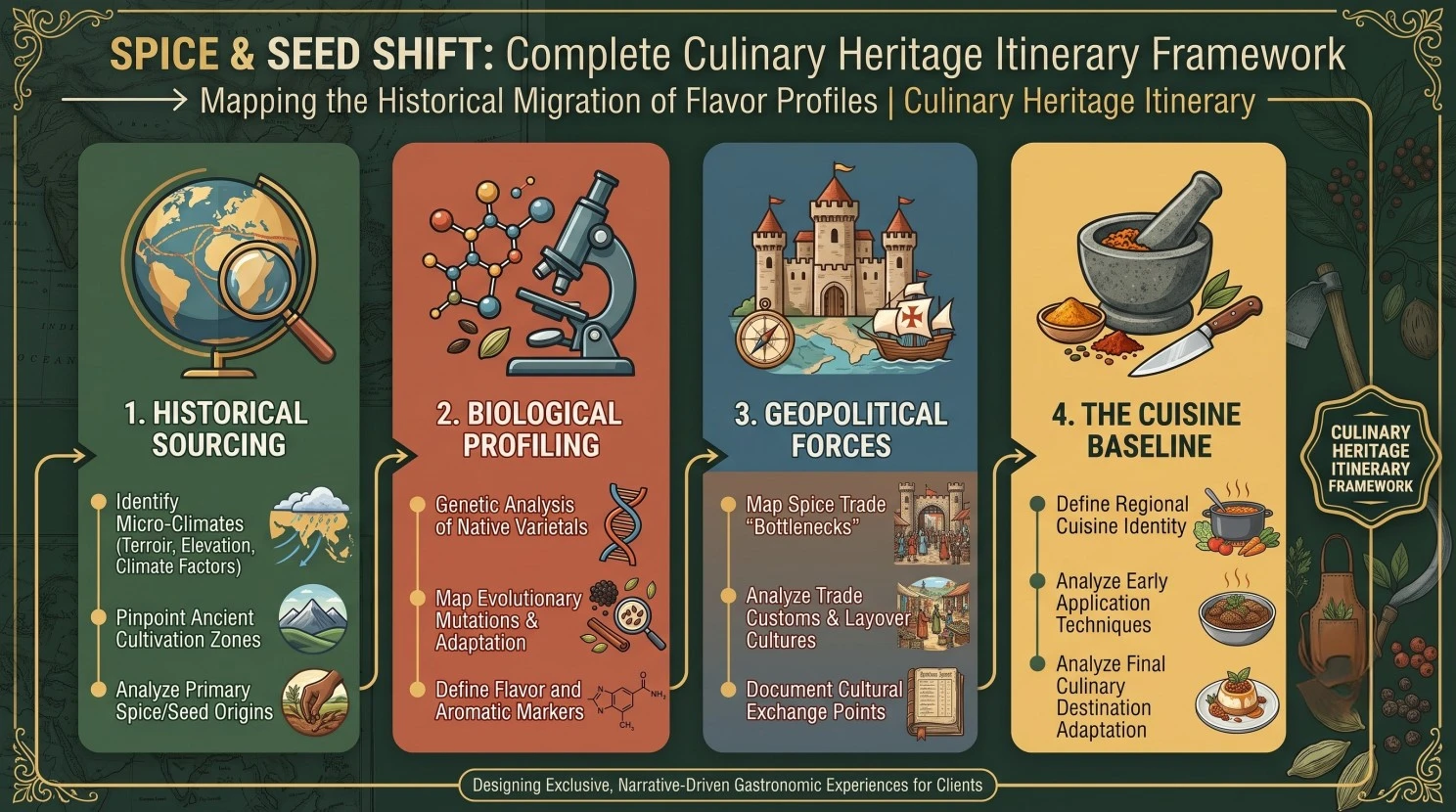
To build a viable, high-ticket product that LTAs can confidently pitch to their top 1% clients, DMCs should structure the journey around a four-layer narrative framework.
Phase 1: Historical Sourcing (The Micro-Climate)
The journey begins by mapping the exact environmental and geographic origins of the flavour profile. DMCs must research the specialised terroir, elevation, and climate factors that allowed a specific spice or seed to thrive initially. The guest experience here focuses on pinpointing ancient, primary cultivation zones through private access to historic plantations or pristine agricultural reserves.
Phase 2: Biological Profiling (The Science of Flavour)
This step brings scientific rigour to the narrative, transitioning from where the spice grew to what it is fundamentally. This phase incorporates genetic analysis of native versus cloned varietals and maps out evolutionary mutations and plant adaptations over centuries. Key experiences involve partnering with heritage geneticists or ethnobotanists to actively define specific flavour and aromatic markers directly from the raw material.
Phase 3: Geopolitical Forces (The Trade Routes)
This phase introduces the human conflict, tracking how the spice moved across oceans and landmasses. The narrative maps the strategic spice trade “bottlenecks,” details ancient monopolies, and highlights the imperial power dynamics that determined supply lines.
Guests explore this by analysing trade customs, studying old port architecture, and reviewing historic shipping manifests inside private archives to document cultural exchange points.
Phase 4: The Cuisine Baseline (The Culinary Synthesis)
The final layer brings the history and science directly onto the plate, analysing how the migrating ingredient permanently reshaped regional culinary identities. This step defines how ancestral application techniques evolved and tracks the final culinary adaptation in the destination cuisine. It allows guests to understand the contrast between predominant flavour profiles before the migration occurred versus the complex contemporary dishes served today.
4. Case Study Blueprint: The Malabar-to-Moluccas Route
When designing a cross-border heritage route, the geographic flow should follow the human and trade migration pattern rather than a strict botanical timeline. By structuring the route from West to East, the itinerary maps exactly how flavour profiles collided, mutated, and were ultimately chased to their source.
Day 1–3: The Origin
- Geographic Focus: Kerala, India (The Malabar Coast)
- Key B2B Experience Assets: Private access to wild black pepper highlands; private seminar with a heritage geneticist tracking native vs. cloned vine profiles.
Day 4–6: The Transit
- Geographic Focus: Malacca, Malaysia (The Bottleneck)
- Key B2B Experience Assets: Private architectural tour of the historic port; a curated tasting of Peranakan (Straits Chinese) cuisine, analysing how Chinese and Malay ingredients fused due to spice trade maritime layovers.
Day 7–9: The Destination
- Geographic Focus: Banda Islands, Indonesia (The Source)
- Key B2B Experience Assets: Private charter to the remote “Nutmeg Islands”; dinner inside a ruined Dutch fort with an interactive menu tracing the global impact of the 1667 Treaty of Breda.
Why this specific sequence? While nutmeg biologically originated in the Banda Islands, the global narrative of flavour migration flows along the trade routes. Starting in India establishes how the Western world became obsessed with Eastern flavours.
Moving to Malacca demonstrates the “diaspora and mutation” phase, showing how forced trade bottlenecks created entirely new fusion cuisines like Peranakan food. Saving the Banda Islands for last acts as the ultimate conceptual climax – revealing the once-secret, highly fought-over epicentre of the global spice trade.
5. The B2B Distribution Model: Pitching to the Gatekeepers
Because this itinerary targets ultra-high-net-worth individuals (UHNWIs) and corporate boards, the distribution strategy must be strictly Business-to-Business. DMCs should package this as a premium, turnkey solution for specific gatekeepers:
Conclusion: The New Currency of Luxury Hospitality
The modern luxury traveller has seen the world; now, they want to understand how the world fits together. While the market is currently flooded with localised spice tours and exceptional standalone meals, it lacks a cohesive, cross-border narrative that treats flavour as a migrating historical artifact.
By filling this gap and mapping the “Spice & Seed Shift,” forward-thinking DMCs can equip their LTA networks with a highly differentiated, high-margin product – transforming global history into an unforgettable, edible reality.