
The modern affluent traveller – having cycled through standard private transfers, enclosed five-star resort bubbles, and staged “cultural encounters” is facing acute narrative fatigue.
In Northern Thailand, this dynamic has produced an insidious monoculture. Premium itineraries have slid into what travel critics call Banalistan – that cliché-ridden landscape where geography is flattened into a repetitive loop of gentle boutique retreats, generic night-market walks, and static, museumified temple visits.
This narrative stagnation is particularly out of touch given Northern Thailand’s evolving heritage status. As Chiang Mai advances its bid for UNESCO World Heritage status as a living cultural landscape, traditional tours remain stuck in the past. Most operators present the UNESCO narrative through a flat, static lens—focusing solely on 13th-century brick moats, ancient Buddhist geomancy, and sacred temple walls.
Intellectually demanding travellers do not want a repetitive museum walk. They want spatial literacy. They seek to understand the geopolitical friction, imperial economies, and global exchanges that allowed the Lanna Kingdom to evolve into a world-class cultural landscape.
Forward-thinking operators should be looking beyond over-touristed core zones. Aligned with the Tourism Authority of Thailand’s (TAT) strategic push into Secondary Cities (Muang Rong), there is an urgent commercial need to disperse high-yield travel capital into secondary provinces.
By expanding the UNESCO narrative footprint into under-the-radar destinations like Phrae and Lampang, DMCs can deliver an un-Googleable, intellectually elite product that commands immense pricing power while distributing economic benefit across regional communities.
2. The Core Thesis: Teak as the Connective Tissue of World Heritage
The central insight behind the Chiang Mai Teak Trail UNESCO Heritage framework is that a city cannot claim global significance through isolated ancient monuments alone. UNESCO values the interchange of human values over time.
While medieval kings laid the spiritual foundations of Lanna, it was the 19th-century teak boom that injected global capital into the region. The extraction of Tectona grandis – the world’s premier timber for Royal Navy dockyards, ocean liners, and colonial infrastructure – transformed Northern Thailand into a dynamic crossroads where British concessionaires, Burmese timber tycoons, Shan artisans, and Siamese royals collided.
In this framework, the physical artifacts of the teak trade – colonial compound manors, gingerbread-style wooden palaces, and multi-tiered Burmese-style monasteries – are not mere architectural eccentricities.
They are the connective tissue of Chiang Mai’s heritage identity. They demonstrate how Lanna’s raw timber wealth was converted into enduring cultural and spiritual architecture, establishing a tangible link between mountain forests and the historic city core.
By framing a tour around this timber highway, DMCs move past superficial sightseeing. They offer guests an insight into how global trade, imperial diplomacy, and local craftsmanship merged to create a landscape worthy of universal value.
3. The Architectural Framework: A 3-Act Spatial Highway
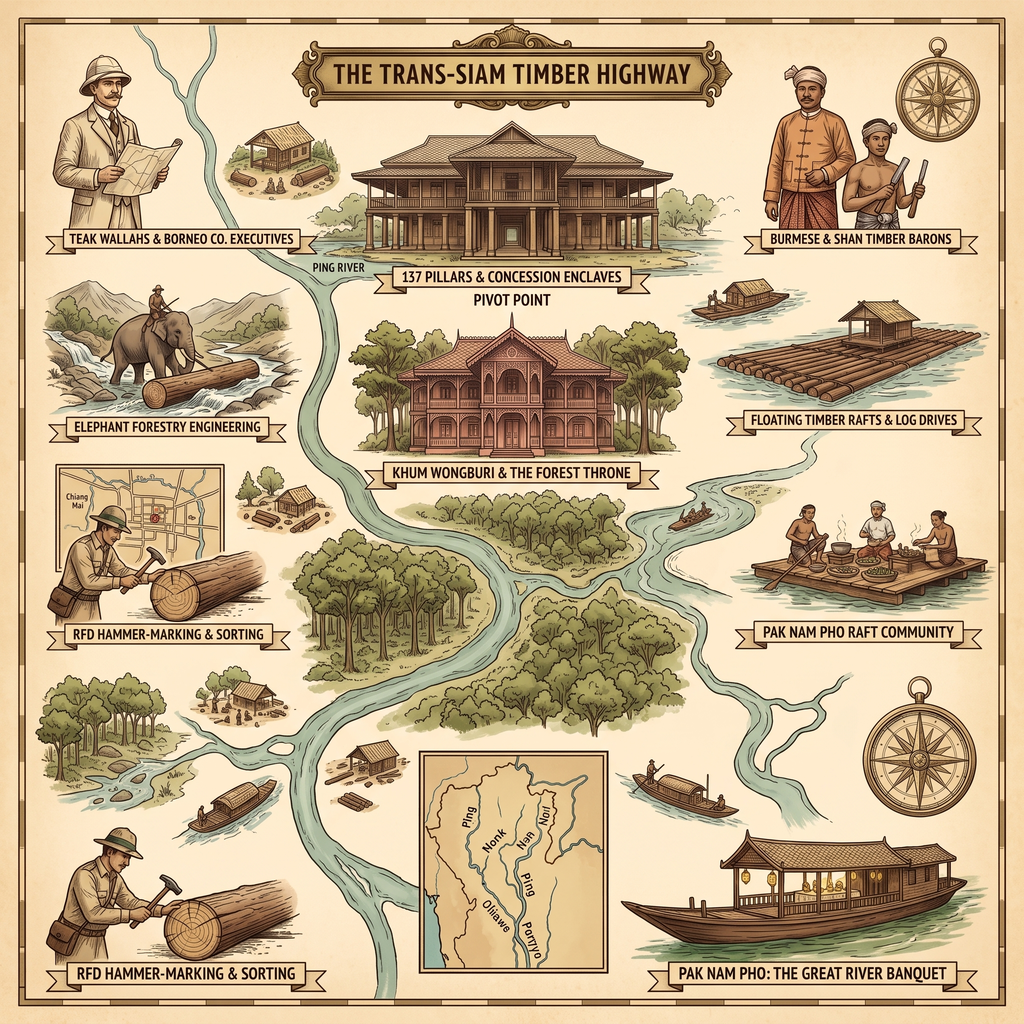
Rather than confining the journey to a single city or resort enclosure, the narrative follows the actual physical supply chain across three distinct geographical acts:
Act 1: Chiang Mai – The UNESCO Core & Imperial River Enclaves
The narrative opens on the east bank of the Ping River in Chiang Mai—the designated 19th-century zone where foreign logging firms operated outside the walled royal city. Guests gain private access to 137 Pillars House, the 1880s headquarters of The Borneo Company, serving as the architectural entry point into the world of the “Teak Wallahs” – British forestry officers who managed mountain concessions.
From here, the journey moves to the Gymkhana Club (est. 1898), where it analyses how European logging executives established social enclaves to maintain imperial networks.
To complete the spatial understanding, guests board a private, catered micro-cruise on a traditional wooden Scorpion-Tail boat from Wat Chai Mongkol upriver, decoding how riverbank geography dictated urban trade posts, timber storage yards, and the spatial expansion of the city beyond its medieval moats.
Act 2: Lampang & Phrae – Secondary City Anchors & The Forest Throne

The itinerary then pivots into the secondary-city heartland: Lampang and Phrae. While Lampang served as the financial and rail transit hub, Phrae was the undisputed capital of primary forest concessions along the Yom River.
In Phrae, guests experience an untouched, authentic secondary-city atmosphere. The journey visits Khum Chao Luang, the grand mansion of Phrae’s last independent ruler, constructed using thousands of solid teak planks, and Khum Wongburi, a magnificent pink gingerbread teak estate built by a prominent timber family.
Here, guests also visit the historic East Asiatic Company headquarters along the Yom River and explore the foundational sites of Thailand’s early forestry conservation movement.
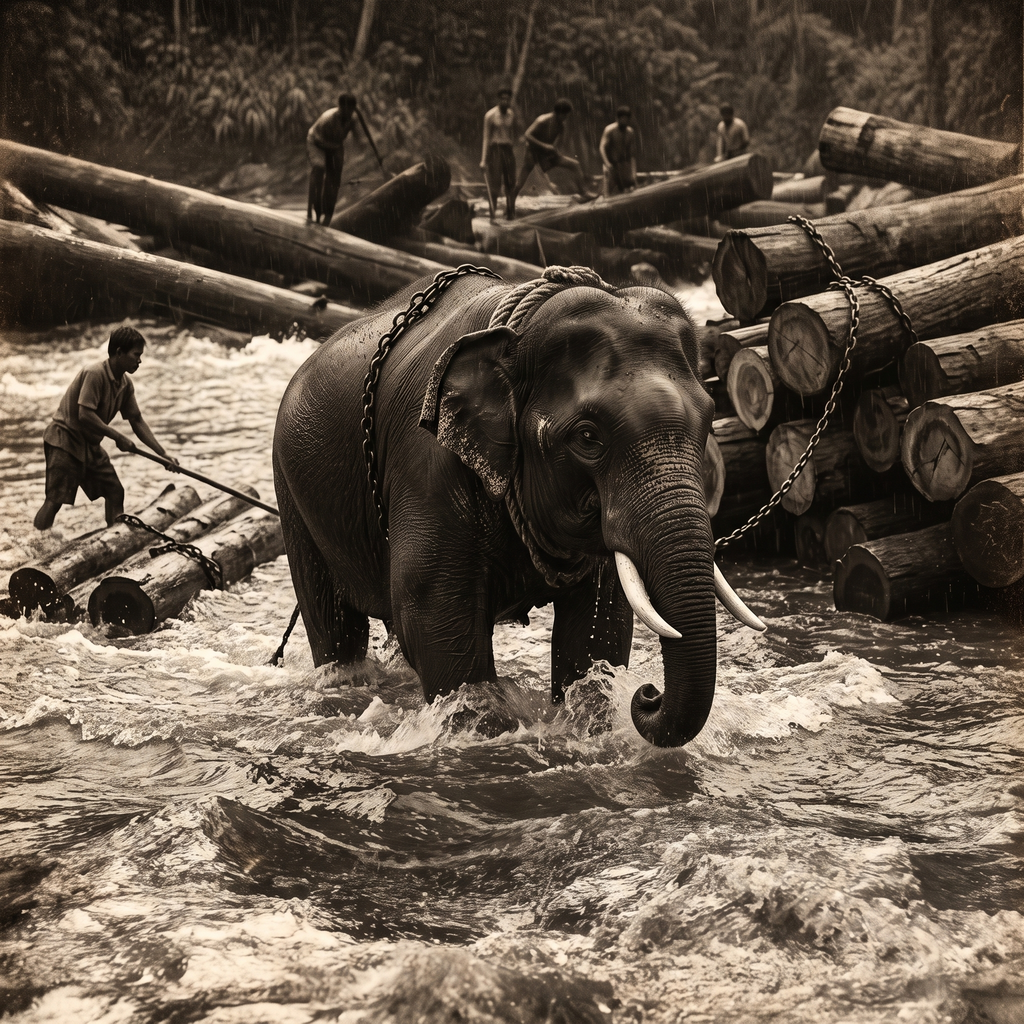
In the surrounding mountain corridors, the itinerary would explore the operational logistics of the trade—how specialised human forestry crews and timber draft animals worked as unified industrial teams to move timber out of steep mountain valleys.
The act concludes with a private bamboo floating drift down a quiet tributary of the Yom or Wang River, paired with a field lecture on neaping – the critical dry-season periods when millions of dollars in timber sat stranded on river sandbars waiting for monsoon floods.
Act 3: Nakhon Sawan – The Industrial Confluence & Floating Barge Finale
The journey culminates at the geographical missing link of Thai cultural tourism: Pak Nam Pho in Nakhon Sawan. This is the industrial bottleneck where single logs, floated individually down the Ping, Wang, Yom, and Nan Rivers, were intercepted by massive chain booms stretched across the water.
Here, forest department inspectors identified owner hammer-marks on each log before lashing thousands of trunks together into giant floating timber rafts. These rafts formed temporary floating villages, complete with shelters and oarsmen who lived on the water for months while navigating the timber down to the sawmills of Bangkok.
To bring the narrative to a stunning crescendo, the trip concludes with a private evening banquet aboard a historic floating timber barge moored at Pak Nam Pho.
Floating directly at the confluence where the clear green Ping meets the reddish-brown Nan to form the Chao Phraya, guests enjoy a curated menu reflecting the culinary crossroads of the river highways – combining Lanna, Hainanese raft-community, and Central Thai flavours. As the sun sets over the birth of the Chao Phraya, the dinner translates the physical scale of the 19th-century timber trade into an unforgettable sensory finale.
4. The B2B Distribution Model: Equipping the Gatekeepers
Because this asset targets UHNWIs, intellectual family offices, and high-end cultural groups, the distribution strategy must remain strictly B2B:
- Turnkey Intellectual Assets for LTAs: Provide luxury advisors with white-label historical briefs, archival photo maps, and architectural guides. Position this route as the definitive solution for well-travelled clients who “have already done Thailand” and want conceptual depth over superficial pampering.
- Alignment with UNESCO & TAT Secondary City Strategies: Leverage the active UNESCO bid and secondary destinations like Phrae to secure local government support, trade grants, and sustainability credentials. Frame the itinerary as a model for ethical, low-impact, high-yield regional tourism.
- High Pricing Power & Margin Potential: By replacing mass-tourist stops with private architectural access, academic field lectures, specialised water charters, and an exclusive floating barge finale at Pak Nam Pho, DMCs remove direct price comparability. The product becomes an exclusive cultural asset rather than a commodity tour.
- Corporate & Leadership Positioning: Market the route to executive boards, family offices, and leadership forums as a physical masterclass in geopolitical supply chains, natural resource diplomacy, and cross-cultural business adaptation.
Conclusion: The Currency of Narrative Depth
The modern luxury traveller no longer measures luxury by thread count alone; they measure it by insight. While the market remains saturated with standard resort stays, repetitive temple tours, and tired city walks, a massive blue-ocean opportunity awaits DMCs willing to map the physical and economic forces of history.
By aligning with Chiang Mai’s UNESCO World Heritage bid, integrating secondary cities like Phrae, and capping the 19th-century timber highway with a floating barge feast at Nakhon Sawan, DMCs can offer their global partners a category-defining product: transforming the landscape of Northern Thailand into a profound, living historical narrative.