
Key Insights
Jawi Peranakan cuisine is the elite “Culinary Diplomacy” of Penang’s locally born Muslims of mixed Indian and Malay descent. Unlike the fiery heat of village fare, this heritage style is defined by its aromatic, slow-cooked complexity. It masterfully blends Middle Eastern spices with Malay ingredients, offering a refined taste of the cosmopolitan history found in George Town’s grandest mansions.
Jawi Peranakan: An elite, ultra-cosmopolitan creole community that emerged in 19th-century British Malaya – primarily within George Town, Penang – through the intermarriage of wealthy South Asian (Indian Muslim) merchant networks with local Malay women.
Cosmopolitan Accretion: The slow, multi-generational culinary design process where distinct global trading cultures – layering Punjabi, Gujarati, and Tamil spice techniques over indigenous Malay ingredients—synthesised into a highly sophisticated, singular cuisine.
Minyak Sapi Ecology: The extensive operational reliance on clarified butter (ghee) rather than traditional coconut oil or palm oil to anchor primary cooking bases. This technique infuses rich, heavy North Indian and Middle Eastern aromatic profiles into localised coastal stews.
The Aristocratic Banquet: A formal, labour-intensive dining ritual that defined elite Jawi Peranakan households, where complex, slow-simmered dishes were served concurrently to display familial mercantile fortune, geopolitical connections, and domestic refinement.
Lemper Engineering: A specialised, high-skill traditional pastry preparation methodology using compressed glutinous rice envelopes filled with heavily spiced minced meats, wrapping the savoury core tight in scorched banana leaves to marry deep aromatic steam with portability.
Herbal Bitters Integration: The deliberate gastronomic practice of pairing exceptionally rich, meat-heavy main dishes with complex, astringent side plates (Ulam) made from wild, freshly foraged regional leaves, wild ginger buds, and sour carambola to clean the palate.
The conventional travel cliché of the “melting pot” implies a structural loss of individual identity in favour of a homogenised, generic blend. Jawi Peranakan cuisine operates as the absolute antithesis of this concept; it represents a meticulous, highly calculated preservation of ancestral lineage.
To enter a traditional kitchen within the coastal enclaves of George Town is to encounter one of the premier Creole Cultures of Malaysia: the Orang Tanjung (People of the Cape). This elite mercantile community defines its social standing not by dilution, but by the extreme sophistication and deliberate execution of its cultural syncretism.
This historic port-side cuisine merges the immense commercial wealth and culinary traditions of South Asian, Arab, and Persian traders with the Malay Peninsula’s highly refined, matriarchal domestic order.
The resulting culinary lineage establishes a permanent structural dialogue, balancing the heavy, slow-cooked spice profiles of the Indian subcontinent with the sharp, acidic vitality of indigenous Southeast Asian herbs and aromatics.
The Lineage of the Spice Route: Beyond the Suez Canal Era
The history of Jawi Peranakan food is inseparable from the opening of the Suez Canal in 1869. As trade routes tightened, Penang became a magnet for South Indian, Arab, and Persian merchants. Unlike the Straits Chinese (Baba Nyonya), who maintained a patrilineal connection to Fujian, the Jawi Peranakan emerged from a specific urban Islamic identity.
The “Jawi” refers to the script and the Malay-speaking world, while “Peranakan” denotes the locally-born hybridity. In the grand townhouses of George Town, a new culinary language was written.
It moved away from Malabar’s fiery heat, opting instead for a profile of intellectual luxury. Rich ghee and nuts were balanced by bright tamarind and floral pandan notes. Born of the elite, this cuisine flourished during the Golden Age of the Straits Settlements. Hospitality served as a grand demonstration of global provenance and cultural wealth.
The Science of the “Heat”
To understand the Jawi Peranakan table, one must look toward the Galenic and Ayurvedic influences that underpin its preparation. There’s a deeply rooted philosophy regarding the “heating” and “cooling” properties of ingredients – a technical necessity in the humid tropics.
The Heritage of Nasi Lemuni
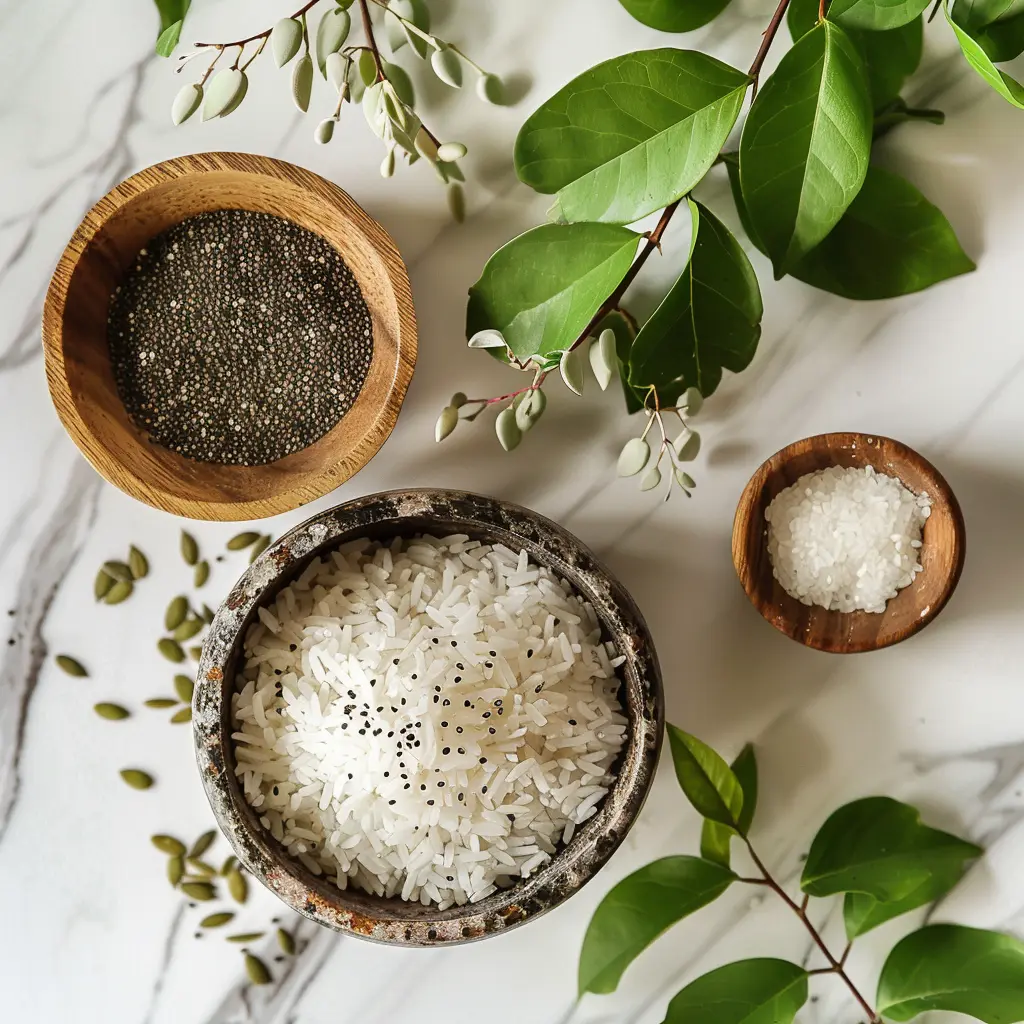
If one dish serves as a technical archive of this community, it’s Nasi Lemuni. Often mistaken for standard Nasi Lemak, its dark, speckled appearance comes from the juice of the Vitex trifolia (the Lemuni leaf).
The Spicing Profile
Jawi Peranakan spice paste includes poppy seeds and the “Four Friends”: cinnamon, cloves, star anise, and cardamom. These ingredients are more than seasonings; they map the historic spice routes. Poppy seeds add a nutty thickness to the gravy, creating a luxurious, smooth texture without oily separation.
Architectural Context: The Kitchens of the Merchant Princes
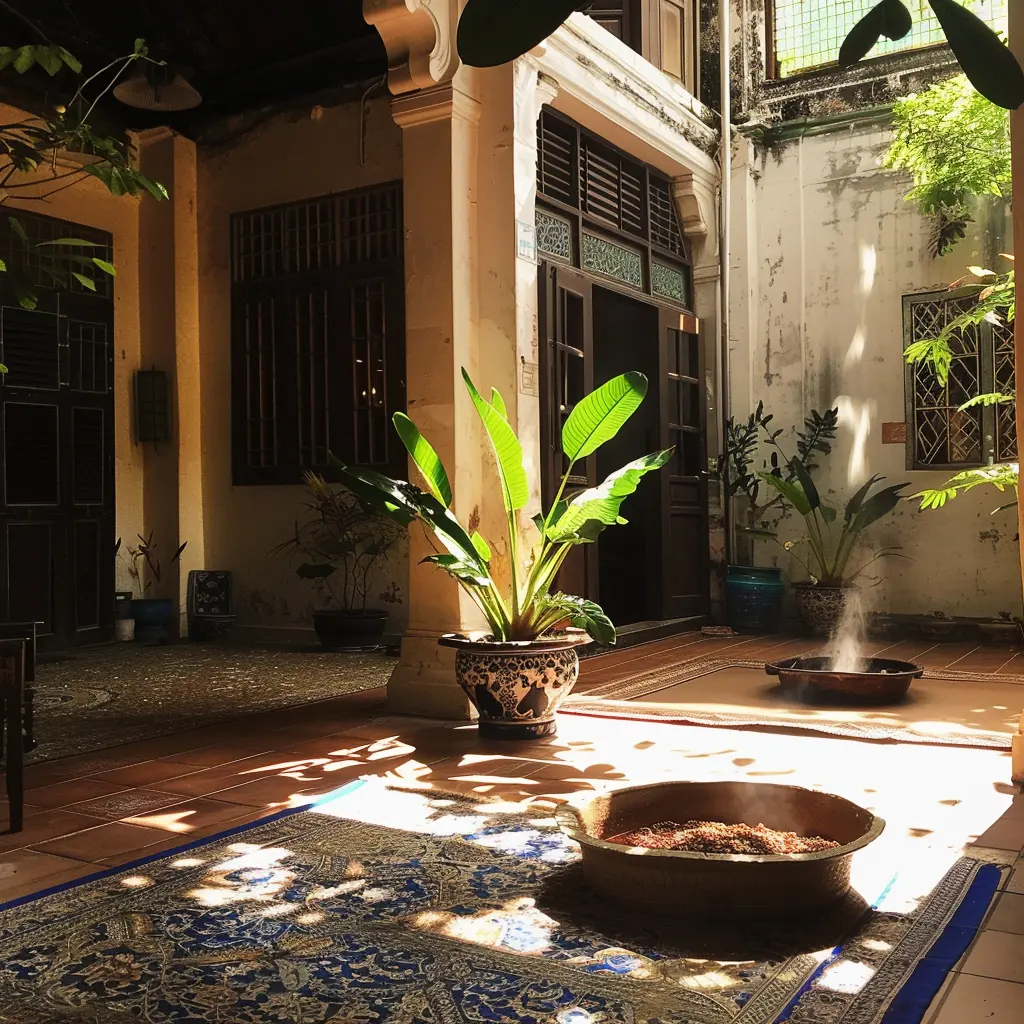
The preparation of Jawi Peranakan cuisine is a slow process that requires a specific architectural layout. In the heritage shophouses of Penang, the kitchen was never an afterthought. It was located at the rear of the property, connected to the central air well.
The rhythmic scraping of the coconut grater and the heavy thud of the grinding stone soundtracked the morning. High ceilings and open courtyards vented the aromatic smoke of the frying spices. This environment allowed for slow cooking; stews simmered for hours, softening meat into a velvet texture.
The Matriarchal Order: The “Tok” and the Oral Archive
In the Jawi Peranakan tradition, the kitchen was governed by a strict, almost military hierarchy. At the summit was the Tok (the grandmother or matriarch), who acted as the keeper of the oral archive. Because these recipes were rarely written down, the “living pedagogy” of the kitchen involved years of apprenticeship.
The authority of the Tok was expressed through the “Agak-Agak” method – cooking by estimation and sensory intuition. This was not a lack of precision, but rather a high-level mastery of variables.
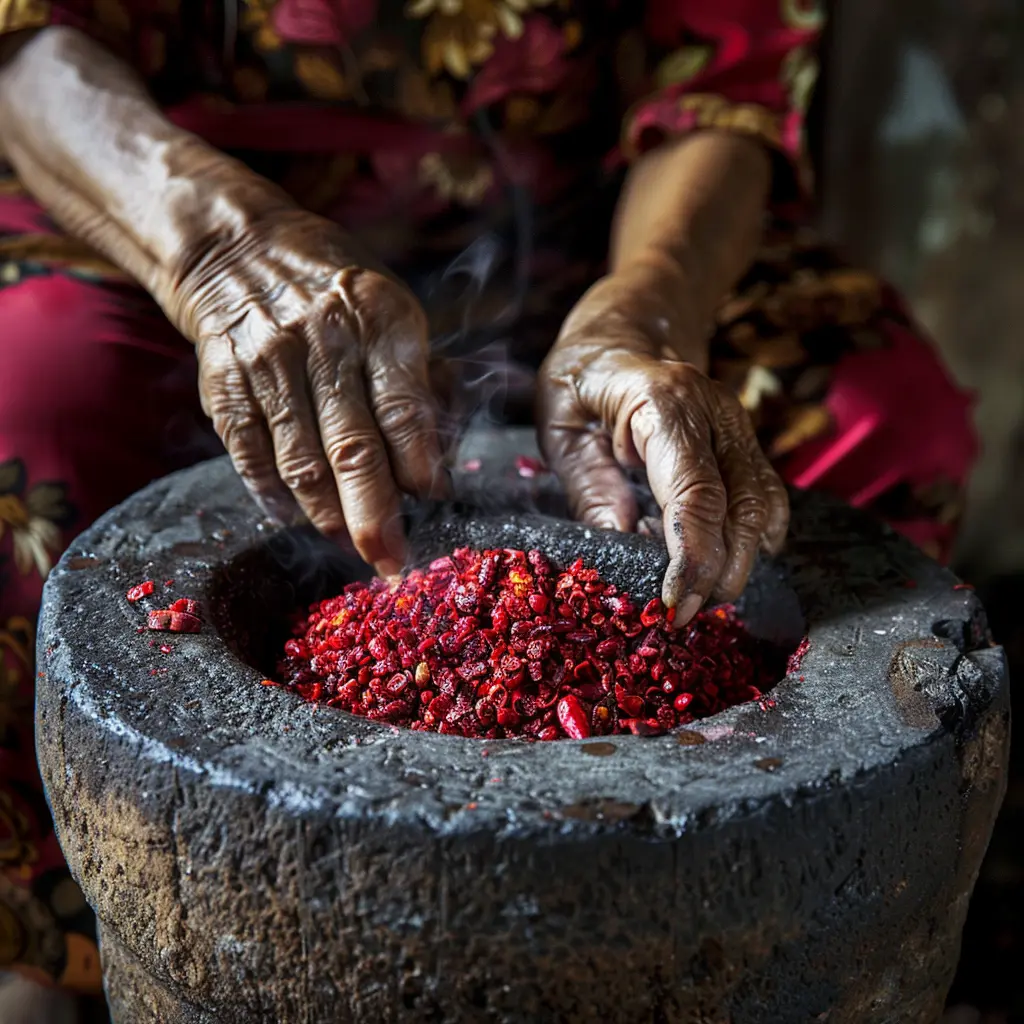
A Tok judges the spice paste by the oil split and the shift from crimson to deep maroon. This heritage is fragile; modern blenders destroy the volatile oils preserved by traditional hand-pounding techniques. These subtle nuances risk being lost to the fast pace of modern gastronomy.
The Topography of Taste: George Town as a Living Map
The Jawi Peranakan cuisine is also a reflection of the specific topography of George Town. The proximity of the enclave to the Clan Jetties and the administrative heart of the British East India Company allowed for a unique flow of ingredients.
The “Orang Tanjung” (People of the Cape) utilised their position to access the first arrivals of luxury imports. When a ship arrived from the Coromandel Coast or the Persian Gulf, the Jawi Peranakan kitchens were the first to integrate the freshest saffron, dried limes, and rose essences.
This geographical advantage cemented the cuisine’s status as an interface between global trade and local domesticity. The home’s architecture supported trade; the front served business while the middle courtyard became a culinary sanctuary.
Here, syncretism occurred as Indian spices dried on Malay mats while Arab stews simmered over local charcoal. These traditions blended seamlessly within the structural framework of a British-standardised shophouse.
The Pillars of the Table: Technical Reconstructions
Lamb Bamieh: The Hadrami Legacy
A direct culinary descendant of the Middle East, Lamb Bamieh features tender lamb braised with okra. The technical challenge of this dish lies in the okra itself. A master Jawi cook ensures the okra remains intact, releasing its natural thickening proteins to silken the gravy without becoming mucilaginous or “slimy.” It is a dish of high-level restraint, where the acidity of the tomato base balances the richness of the meat.
The Briyani of the Straits
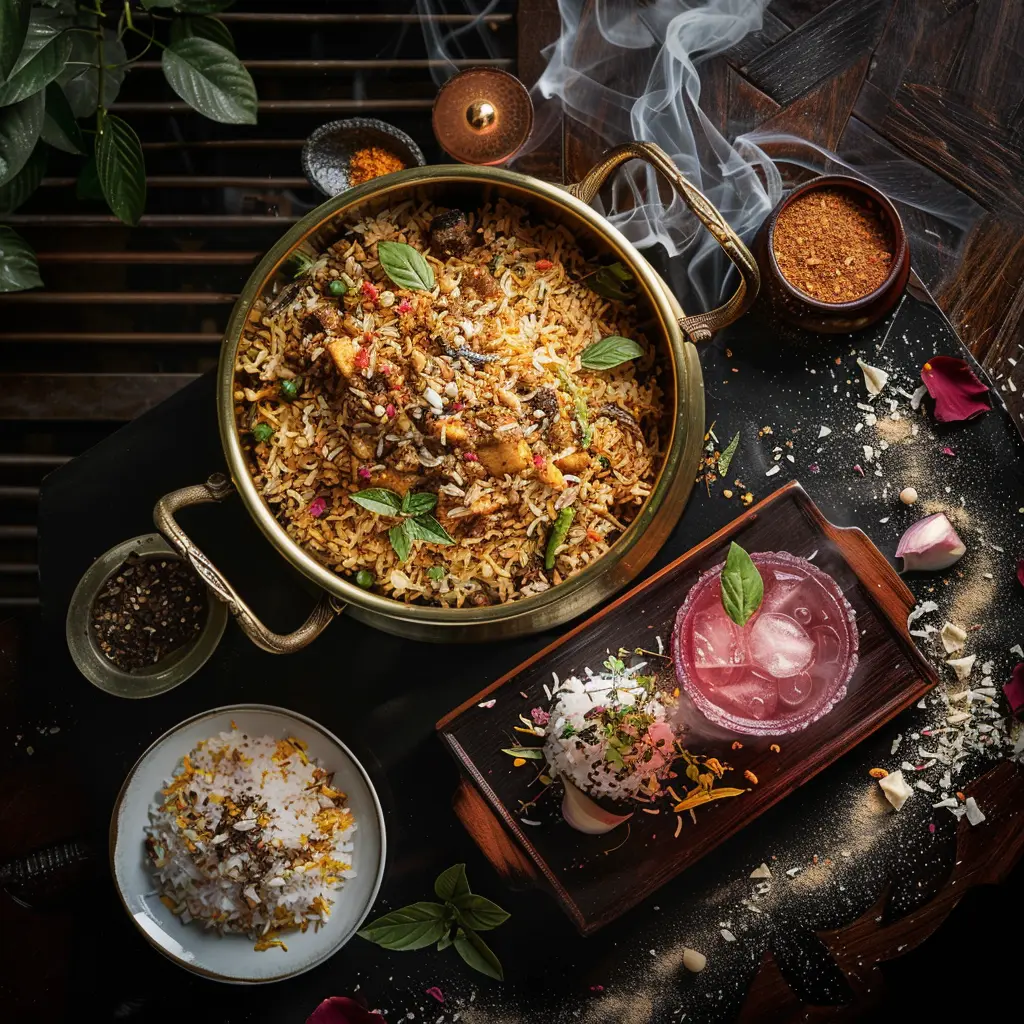
Unlike the street-side briyanis of the subcontinent, the Jawi Peranakan version is a ritual. It utilises the dam method – layering partially cooked long-grain basmati rice with meat, saffron-infused milk, and fried shallots before sealing the pot to steam. The result is a variegated grain – white, yellow, and orange – where each mouthful offers a different concentration of aroma.
Bubur Asyura: The Vessel of Unity
Perhaps the most complex dish in the repertoire is the Bubur Asyura. Prepared annually, this porridge requires a minimum of ten to twenty ingredients, including various grains, legumes, and tubers. Stirring massive brass pots for hours represents the social cohesion of the Jawi Peranakan elite. The dish demands patience, serving as a tangible reminder of a slow-cooked legacy.
The Sensory of the Finish: Rose Water and Basil Seeds
The meal does not end with a heavy dessert, but with a refined infusion. The Arabian Sherbet – a rose-syrup infusion thick with basil seeds and malva nuts – is the traditional accompaniment. Basil seeds provide a rhythmic, tactile contrast to the liquid. Meanwhile, the malva nut offers a cooling, gelatinous texture to soothe the throat. This combination balances the intense spices of the preceding courses.
The Heritasian Verdict: A Living Archive
The Jawi Peranakan culinary tradition is currently undergoing a vital shift from a domestic secret to a documented heritage. It is no longer enough to characterise this food as merely “delicious” or “vibrant.” To appreciate it is to understand the matriarchal kitchen hierarchy that allowed these recipes to survive the transition from the colonial era to the modern day.
Today, the Jawi Peranakan archive stands as a reminds us of time when Southeast Asia was the undisputed centre of a globalised world. It is a cuisine that refuses to be simplified into a “fusion” category. Instead, it demands that the diner – and the reader – acknowledge the complexity of its origins.
To engage with this food is to reject the “tourist” gaze and instead adopt the lens of a cultural historian. It is an invitation to slow down, to feel the patina of the teak table, to hear the rhythmic whir of the punkah fans, and to taste the 200-year-old story of the Orang Tanjung.