
In the contemporary landscape of Southeast Asian travel, few terms have been as routinely diluted as “authentic cultural immersion.” Standard Destination Management Company (DMC) response to a client brief seeking “local culture” has followed a predictable, industrialised script.
A guest is driven to an artisan studio on the outskirts of Chiang Mai or Sukhothai, welcomed with a cold herbal infusion, escorted through a ten-minute observation walk while a master works at a distance, handed a factory-finished souvenir, and promptly steered back to the climate-controlled comfort of a private vehicle.
This transactional model represents the legacy era of cultural tourism: storytelling. It treats living heritage as a museum exhibit and an intellectually curious traveller as an elevated spectator, separated from the craft by an invisible glass wall.
But the modern landscape has moved beyond passive observation. Discerning global travellers no longer desire to be told stories – they seek the agency, intellectual rigour, and physical engagement of story-doing.
This behavioural shift presents both a challenge and an unprecedented commercial opportunity for Thai tour operators and DMCs. It aligns directly with the Tourism Authority of Thailand’s (TAT) overarching strategic mandate: shifting the national tourism benchmark from “Volume to Value.”
Under TAT’s push to elevate Thailand’s designated UNESCO Creative Cities Network (UCCN) routes – spanning traditional crafts in Sukhothai and Chiang Mai to gastronomy in Phetchaburi – there is an urgent need to convert local cultural capital into high-margin experiences.
To bridge the gap between high-level tourism policy and ground-level execution, operations teams must abandon superficial workshop stops. Instead, they need to fundamentally restructure the guest journey: transform a generic $50 studio drop-in into an exclusive, $800+ private masterclass that honours both the artisan’s craft and the client’s time.
Deconstructing the Experience: The Three-Phase Immersion
Re-architecting a standard craft visit into a signature masterclass requires moving away from hourly tour slots in favour of a deliberate, three-phase narrative structure. This framework translates abstract concepts of “cultural exchange” into a tangible operational methodology adaptable across Thailand’s creative provinces.
Phase 1: Context, Materiality, and Archival Access
The first phase addresses a common flaw in cultural product design: rushing directly into creation without establishing intellectual context.
Skill execution without contextual literacy is merely amateur crafting; with literacy, it becomes an act of heritage preservation. This initial stage directly mirrors TAT’s Moment of Miracle framework – grounding the visitor in the deep origins of local wisdom.
The morning begins by deliberately bypassing public retail floors, gift shops, and tourist demonstration zones. Instead, guests are granted exclusive entry into the master artisan’s private home studio, archive, or personal collection vault. Here, away from public view, they study rare historic blueprints, antique heirlooms, or family masterworks.
Crucially, the guest does not start by creating; they start by preparing materials.
Whether this involves harvesting fresh indigo leaves in Sakon Nakhon, hand-sanding raw teak blocks in the Baan Tawai carving enclaves of Chiang Mai, or grinding organic mineral pigments in Chiang Rai, participating in raw material preparation establishes immediate respect for the intense physical labour that precedes the art itself.
Phase 2: Unhurried Co-Creation and Dedicated Bench Time
The middle section of the day represents the core of the immersion, operationalising TAT’s Moment of Memories pillar. The goal here is to abandon the simplistic “take-home souvenir template” in favour of genuine, focused co-creation alongside a recognised master.
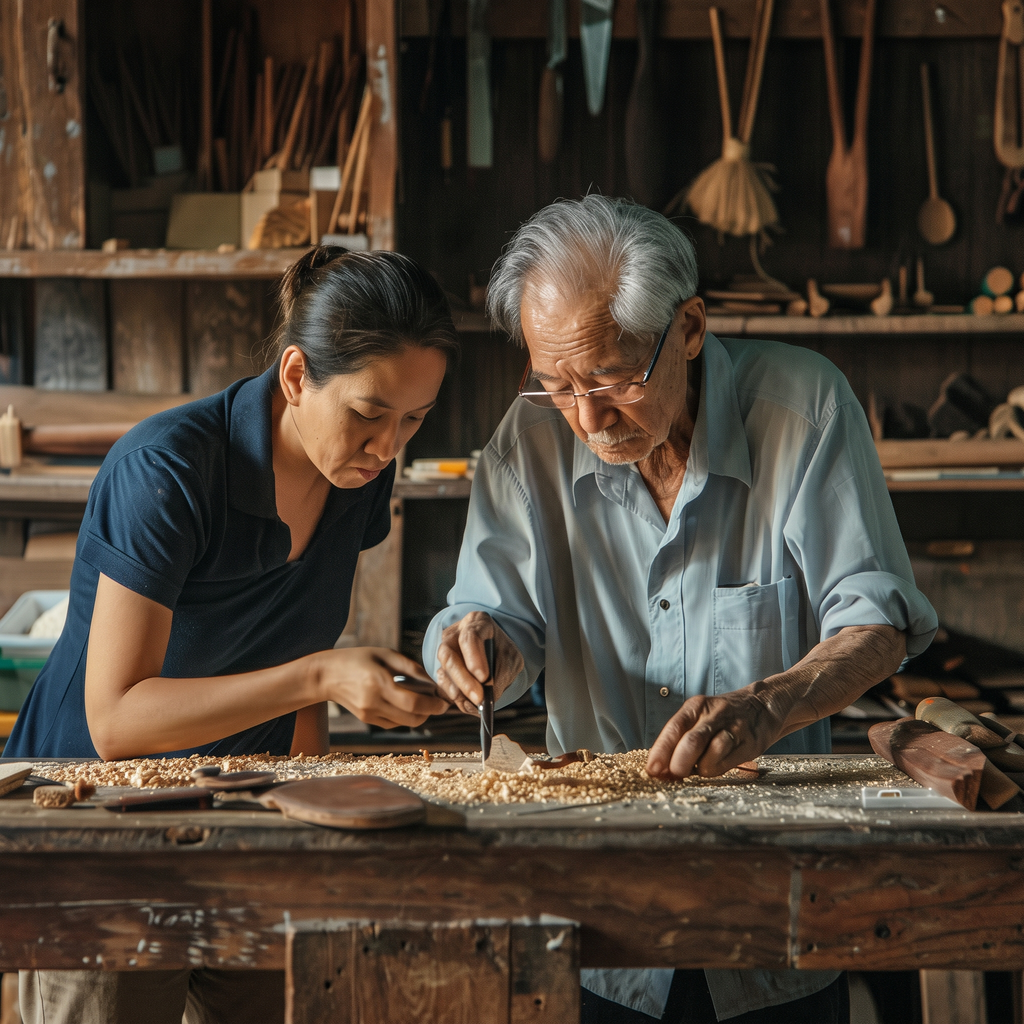
This requires securing an uninterrupted, minimum three-hour block of dedicated bench time. Under the direct, one-on-one tutelage of the master, the guest learns real technique execution – applying hot wax using a traditional brass canting tool on Sukhothai batik, executing delicate filigree in Sukhothai goldsmithing, or manipulating specialised chisels across Lanna hardwood.
This intensive work is punctuated not by a trip to a commercial tourist restaurant, but by a hosted, informal heritage lunch set directly within the workshop studio or an adjoining courtyard.
Joined by the master artisan and supported by a specialised cultural facilitator (rather than a standard, script-bound tour guide), this meal serves as an avenue for organic dialogue surrounding family lineage, structural economic shifts, and the living realities of preserving ancient techniques in modern Thailand.
Phase 3: The Legacy Hand-Off and Provenance
The final phase transforms the physical output of the day from a mere vacation craft project into an authenticated piece of personal legacy, embodying TAT’s Moment of Giving – where value is returned directly to the local community.
As the piece reaches completion, the master artisan applies their official personal seal, chop, or signature directly onto the work, immediately adjacent to the guest’s own signed mark.
The completed work is then encased in custom, locally crafted timber or handloom packaging, accompanied by a signed Certificate of Authenticity that outlines the exact origin and provenance of the materials used.
To complete the narrative, the guest receives a curated digital photo log documenting their step-by-step creation process throughout the day.
Strategic Alignment Across Thailand’s Creative Destinations
The strength of this narrative framework lies in its repeatability across different craft disciplines within Thailand’s creative ecosystem:
The Operational and Commercial Imperative
From a DMC operations perspective, building itineraries around “Story-Doing” requires strict execution discipline. It requires longer lead times – typically 7 to 10 days – to secure full workshop buyouts and prepare materials.
It requires strict group size limits of two to four guests to maintain intimacy and necessitates replacing general tour guides with specialised cultural facilitators fluent in regional dialects and technical artisan terminology.
However, the commercial return far outweighs the operational rigour. Standard, superficial workshop visits are easily bypassed, price-compared, and booked directly by consumers online. In contrast, an architected Master Artisan Immersion is proprietary, un-Googleable, and inherently resistant to price erosion.
When tour operators transition clients from merely viewing Thailand’s cultural heritage to actively participating in its continuation, they cease acting as mere logistical vendors.
They become true curators of cultural capital—delivering exceptional value to high-yield travellers while ensuring that Thailand’s living heritage remains economically viable, deeply respected, and vibrant for generations to come.