

The modern heritage hotel is an exercise in meticulous curation. To walk through its doors is to enter a living narrative, preserved through salvaged architecture, hand-loomed textiles, and an ethos of hospitality refined over decades, if not centuries.
Owners of these properties understand that luxury lives in the details. They will spend six figures restoring a single ballroom fresco or hunting down period-accurate brass hardware for guest room doors.
Yet an alarming paradox arises the moment a prospective guest attempts to engage with this history digitally. The luxury narrative shatters. The bespoke, high-touch experience is replaced by a sterile, sluggish, and fragmented digital ecosystem.
The result? The guest retreats to the frictionless, predictable arms of an Online Travel Agency (OTA) like Booking.com or Expedia. When they do, the hotel pays a hidden, devastating toll: the $100 leak.
For an independent heritage property with an Average Daily Rate (ADR) of $500, a standard 20% OTA commission structural leakage represents exactly $100 evaporated from the bottom line on a single-night stay.
It is an economic hemorrhage that hoteliers accept as a marketing cost, but it is actually a failure of digital infrastructure. Heritage hotels are not losing the direct booking war because their rooms lack charm; they are losing it because they are trying to fight a 2026 data-driven tech war with 2012 digital real estate.
The Anatomy of the Leak: The Real Cost of “Distribution”
To understand why this leakage is fatal, one must look past the profit and loss statement. Many operators view OTA commissions as a necessary evil—the price paid for international visibility, or the cost of leveraging the famous “Billboard Effect.”
The Billboard Effect is a long-standing hospitality industry phenomenon where a hotel gains additional direct bookings simply by being listed on an OTA. The theory posits that travelers discover a hotel on Expedia or Booking.com, use the platform as an aggregate search engine, and then deliberately open a new browser tab to seek out the hotel’s direct website to gather deeper information or find a preferential rate.
For years, hoteliers treated OTAs as a pseudo-marketing channel, assuming a high percentage of users would eventually make that direct jump. But in 2026, the economics of the Billboard Effect have turned predatory. The “billboard” has become a digital cage.
OTAs do not just showcase your property; they actively hijack your brand equity. They bid aggressively on your hotel’s exact name via Google Ads, ensuring that even when a consumer looks for your historic property by name, the OTA link sits above your organic site.
When the user attempts to jump from the billboard to your direct site, the friction they encounter sends them bouncing straight back into the aggregator’s ecosystem.
When that guest books through the aggregator, the $100 loss is only the immediate damage. The long-term costs are far more insidious:
The Narrative Paradox: Preserving the Past, Breaking the Present
Why do heritage hotels suffer from this leak more acutely than modern, cookie-cutter design boutique hotels? It comes down to a fundamental misunderstanding of asset allocation.
Heritage hoteliers are naturally romantic. They invest heavily in the physical manifestation of their brand. However, this romance frequently breeds technological conservatism. The property’s website is often treated as a static digital brochure rather than a high-performance transactional engine.
Consider the typical user journey of a traveller discovering a historic estate. They are captivated by an Instagram reel showcasing the property’s manicured labyrinth or by reading an article about its famous past guests. Intrigued, they click through to the hotel website.
Suddenly, time travel becomes literal—but in the wrong direction.
The site takes 4.5 seconds to load on a mobile device because it is weighed down by unoptimised, high-resolution imagery of oil paintings. The navigation menu is a labyrinthine puzzle of “Our Story,” “Our Lineage,” and “The Archives.” The “Book Now” button is a ghost, hidden beneath the fold.
When the user finally finds the booking engine, they are redirected to a jarring, third-party URL that looks entirely different from the main site. The typography changes, the colour palette shifts to generic grey, and a clinical form demands an exhaustive array of legacy data fields—forcing the user to manually type out redundant contact information, billing addresses, and rigid formatting preferences.
The psychological contract of luxury is instantly broken. The guest experiences cognitive dissonance: If this hotel cannot manage a seamless mobile checkout, how can I trust them to deliver a flawless, five-star stay?
Frustrated, the user opens their Booking.com app. With two taps of a thumb, authenticated via Apple Pay or Google Wallet, the room is secured. The OTA pocketed $100 for simply providing the basic user experience that the hotel refused to build.
The Structural Bottlenecks of Historic Hospitality
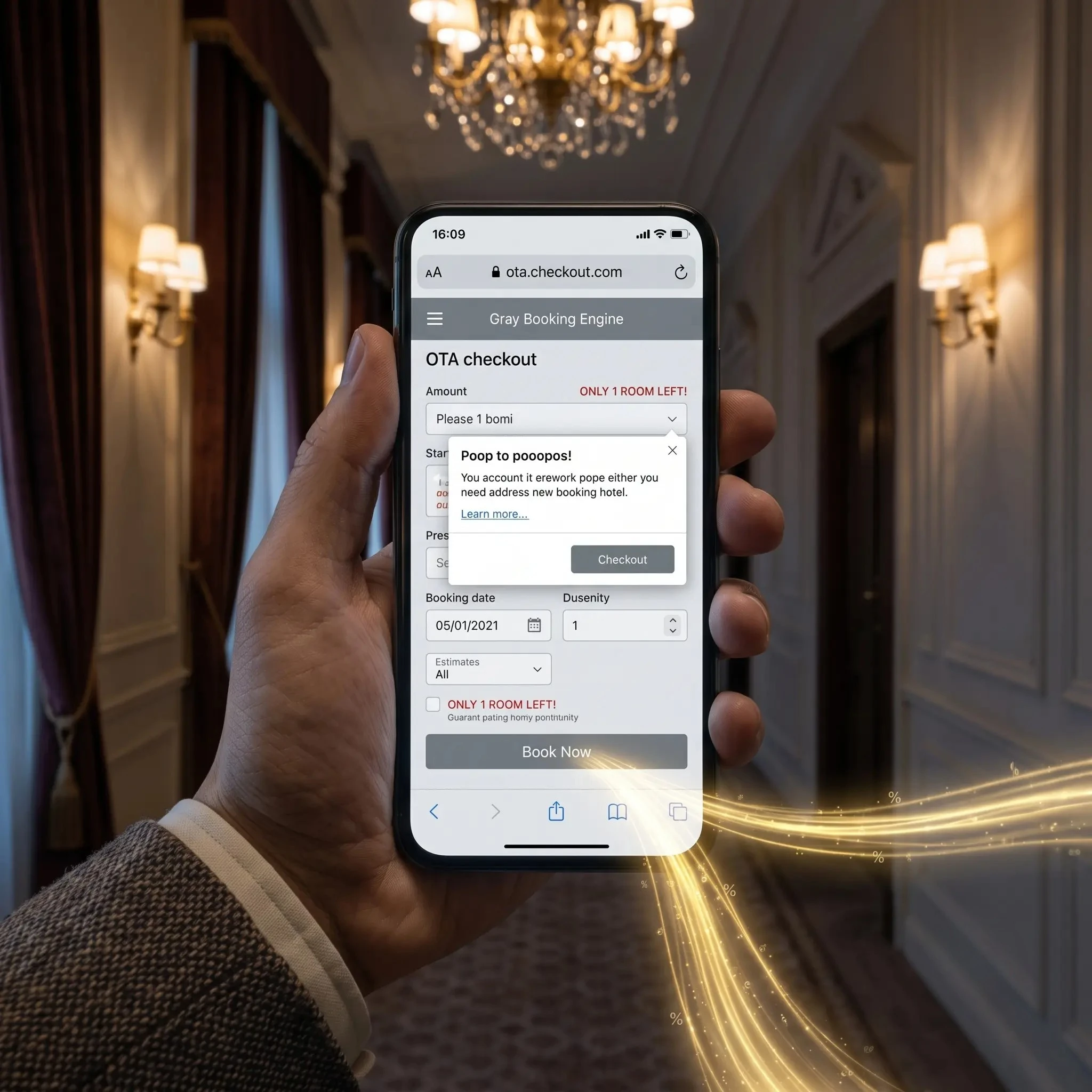
To plug the leak, independent heritage operators must diagnose the specific digital bottlenecks that plague their segment and understand how aggressively the OTAs exploit them:
Plugging the Leak: The Path to Digital Autonomy
Plugging the $100 leak does not require a multi-million dollar tech stack. It requires a philosophical shift: treating your digital checkout with the same reverence as your physical lobby.
First, modern heritage hotels must implement Instant Recognition Value. If rate parity prevents you from offering a lower room rate than Expedia, you must change the currency of the offer.
The checkout screen should explicitly state: “Book Direct Benefits: Guaranteed late check-out, a welcome cocktail in our historic library, and priority access to our dining room.” These are low-marginal-cost, high-perceived-value perks that an OTA cannot duplicate.
Second, hotels must adopt Zero-Friction Checkout Layouts. The modern traveller expects a single-page checkout. Every additional field you force a guest to fill out drops conversion by an estimated 11%. By integrating tokenised payment solutions like Apple Pay, the checkout process can be reduced from several minutes to under twenty seconds.
Finally, the digital narrative must match the physical one. The transition from the inspirational content (reading about the history) to the transactional phase (inputting a credit card) must be seamless. The design language, tone of voice, and elegance of the property must persist all the way through the final “Confirmation” screen.
Conclusion: Reclaiming the Margin
The $100 leak is not a marketing problem; it is an executive oversight. Every time a heritage hotel allows an OTA to capture a booking due to a clumsy direct interface, it is subsidising the tech platforms of Silicon Valley and Amsterdam using the hard-earned equity of its own physical history.
In the luxury and heritage sectors, hospitality cannot stop at the front door. The properties that will thrive over the next decade are those that realise their most important guest touchpoint isn’t the concierge desk—it is the digital checkout interface. It is time for heritage hotels to stop funding their competitors and start investing in themselves.