

Thailand’s inbound operators are caught in an aggressive commercial squeeze. While the Tourism Authority of Thailand (TAT) celebrates gross arrival counts and promises a strategic pivot toward high-yield spending, the operational reality on the ground tells a completely different story.
Net operating margins on standard luxury circuits have compressed by double digits over the last three years. Disintermediation is accelerating as high-net-worth travellers and overseas luxury travel advisors bypass traditional ground operators entirely. The standard five-star itinerary has become commodity inventory that anyone can assemble with a smartphone.
The structural failure lies in treating logistics management as a defensible commercial enterprise. When an inbound operator’s primary revenue model rests on marking up luxury vans, five-star chain suites, and freelance drivers, that business is immediately vulnerable.
Surviving this market shift requires moving away from the role of a passive logistics contractor and stepping into the position of an unindexed supply-chain gatekeeper.
The Anatomy of the Margin Collapse
The traditional inbound business model relied on price opacity and informational friction. An operator contracted net rates with luxury hotels, added a ten to twenty per cent markup on ground logistics, and handled localised billing for overseas agencies.
That model is dead.
Direct-booking engines, dynamic wholesale pricing, and automated concierge platforms have stripped away pricing opacity.
When an outbound travel advisor in London or New York can book a riverside suite at the Mandarin Oriental directly through an internal consortium portal with guaranteed client amenities, the local operator is removed from the accommodation revenue line. Payment processing gateways and rising operational overhead cut into what little margin remains.
What remains for the local operator is the lowest-margin, highest-liability component of the itinerary: ground transit, airport transfers, and standard temple excursions. Competing strictly on fleet quality and transfer fees is a race to zero. A Mercedes-Benz Sprinter isn’t a competitive moat; it’s a depreciating asset that any competitor can lease tomorrow.
At the same time, regional competitors are actively siphoning away market share. Vietnam has mounted an aggressive campaign backed by targeted infrastructure spending.
By constructing modern regional expressways and private international terminals in secondary hubs like Van Don and Phu Quoc, Vietnam allows regional operators to deliver private ground transport, high-end accommodation, and full-service execution at operating costs twenty-five to thirty per cent below Thailand.
On the other side of the ledger, Japan’s sustained currency depreciation has pulled away the ultra-high-net-worth segment that previously viewed Southeast Asia as its default winter retreat. Japan counters Thailand’s chaotic airport bottlenecks with frictionless high-speed rail, immaculate municipal safety, and pristine cultural preservation.
Caught in the middle, Thailand is no longer cheap enough to win on price alone, yet it struggles with localised infrastructure friction that alienates discerning clientele.
The Policy Blind Spot
When confronted with these external pressures, traditional ground operators often retreat into operational silos. The prevailing attitude across Bangkok and Phuket boardrooms has long been dismissive of state policy: operators assume government campaigns are merely bureaucratic noise that bears no impact on private contracts.
That assumption is an expensive commercial error.
State tourism boards command massive public-relations budgets, direct route negotiations, and trade show subsidies. When state campaigns invest heavily in promoting secondary heritage corridors like Nan, Phrae, or Sukhothai, outbound European and American advisors build their upcoming product catalogues around those narratives.
Operators who ignore these shifts forfeit state-subsidised exhibition tables at marquee trade events like ILTM Cannes and ITB Berlin. They miss out on cash subventions from convention bureaus for group movements, and they fail to capitalise on newly negotiated regional air routes before domestic flight costs spike.
Tracking public policy isn’t about endorsing political slogans; it is about reading a macro-economic cheat sheet to capture co-op marketing capital and anticipate where infrastructure access will open next.
Moving from Logistics to Proprietary Provenance
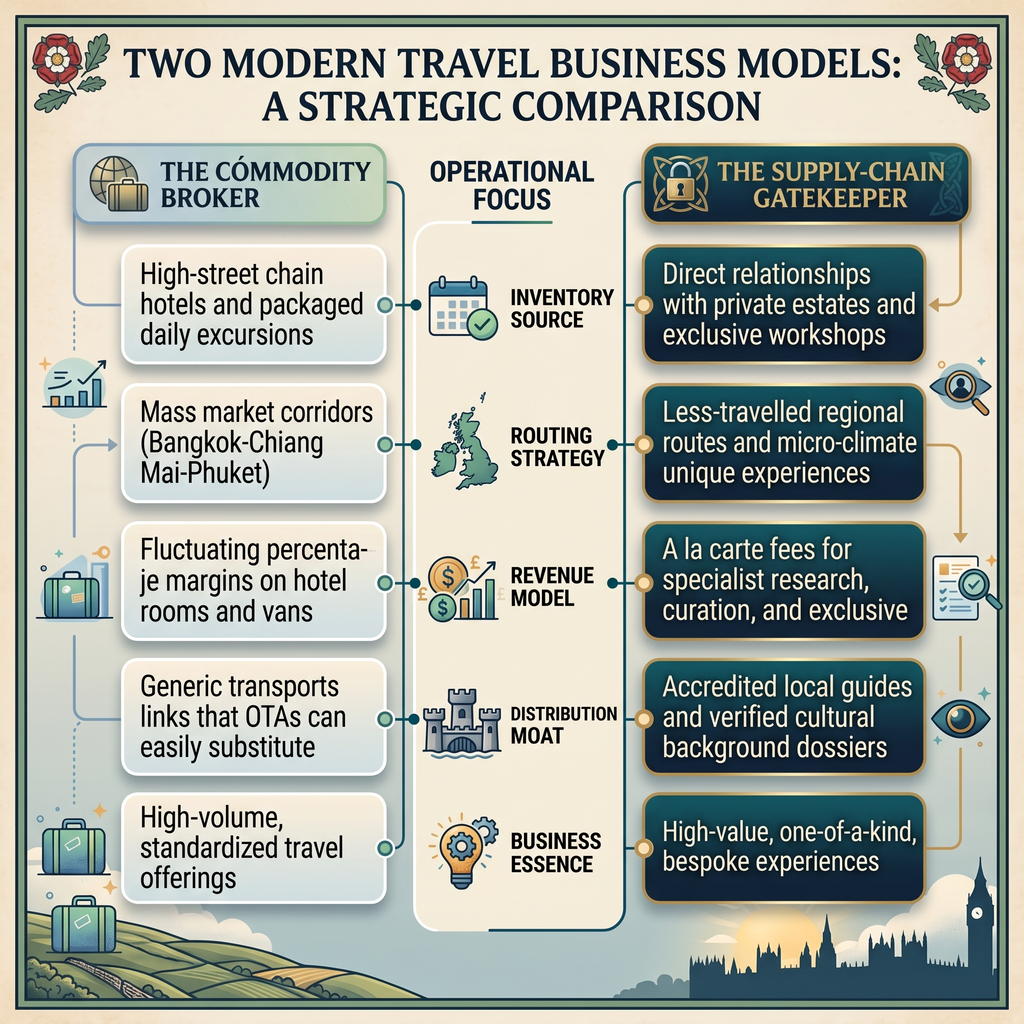
To escape the commodity trap, ground operators must execute a fundamental restructuring of their product catalogue. Every itinerary line that can be cross-referenced, price-checked, or booked via an open digital channel must be treated as vulnerable margin.
Defensible pricing power requires contracting physical, proprietary inventory that remains entirely unindexed by digital search engines.
In practice, this means building direct commercial retainers with private family estates, unlisted historical teak compounds, and master artisan guilds that refuse walk-in commercial traffic.
An inbound operator should control direct access to third-generation lacquerware masters, lost-wax bronze casters, and vernacular restoration architects who do not maintain public websites or answer cold inquiries.
When your itinerary hinges on closed-door access governed by personal trust and direct operational agreements, no online travel platform can index your product. An overseas advisor cannot book around you, because the operational contact does not exist on a public server.
This shift in inventory directly alters how an operator approaches geographic routing. The standard circuit linking Bangkok, Chiang Mai, and Phuket has reached severe cultural and environmental saturation. Operating high-end tours through gridlocked island corridors or overcrowded temple complexes damages an operator’s reputation with premium clients.
Instead, high-margin itinerary design relies on intelligent spatial dispersion. Operators must link primary transit gateways directly to secondary cultural engines. An itinerary that connects Bangkok to Sukhothai or Nan via private charter or regional rail, anchored by vetted historical specialists, delivers genuine exclusivity.
Furthermore, mastering regional micro-climates eliminates the annual cash-flow collapse associated with the monsoon season. Educating overseas buyers that the Gulf islands and inland river valleys experience workable weather while the Andaman coast faces heavy swells allows an operator to monetise the green season at full margin rather than offering desperate off-peak discounts.
Structuring the Transition: The Four-Phase Audit
Transitioning an established inbound agency from an open logistics vendor to a protected access gatekeeper requires a methodical operational audit.
The process begins with an inventory vulnerability audit. Product directors must review their existing itineraries and categorise every component. Any hotel, restaurant, or activity that can be booked directly online with an overseas credit card is flagged as unprotected revenue.
The goal is to ensure that at least forty per cent of the total itinerary spend is tied directly to proprietary access points that the agency controls outright.
The second phase demands restructuring supplier relationships. Operators must redirect procurement capital away from generic excursion brokers and into direct family and artisan retainers.
Establishing exclusive access protocols with private workshop owners requires patience, fair compensation structures, and a clear understanding of the artisan’s operational boundaries. You are not buying a tour; you are formalising a commercial partnership based on structural rarity.
The third phase addresses talent acquisition and field execution. The traditional practice of hiring freelance tour guides who recite standardised scripts must be abandoned.
Operators must build a dedicated network of paid academic specialists, architectural preservationists, and local community leaders on retainer. High-net-worth travellers don’t pay premium fees for someone to hold a clipboard and point out landmarks; they pay for intellectual context, nuanced conversation, and direct translation of living cultural practices.
The final phase changes the invoicing architecture. Ground operators must stop hiding their intellectual value inside a blended vehicle markup or hotel commission.
The industry must unbundle its pricing: invoice directly for customised itinerary development, proprietary field dossiers, and exclusive access clearances. When an inbound agency presents its intellectual property as a distinct, billable asset, overseas travel advisors recognise that they are paying for risk mitigation, deep research, and access that cannot be duplicated.
The inbound operators that thrive over the next decade will not be the ones with the largest vehicle fleets or the deepest hotel discounts.
They will be the firms that recognise logistics is a baseline utility, not a competitive advantage. Sustainable enterprise value in luxury travel belongs entirely to the architects who control the physical supply chain, preserve proprietary cultural relationships, and build access barriers that algorithms cannot breach.