

Key Insights
The Legend of Mahsuri is Langkawi’s spiritual cornerstone, telling of an innocent woman executed 200 years ago. Proven by her flowing white blood, her dying curse condemned the island to seven generations of barrenness and hardship.
This powerful myth remains a vital piece of Malay folklore, explaining Langkawi’s turbulent past and its eventual rebirth as a flourishing UNESCO Geopark.
Adat (Customary Law): The syncretic system of traditional rules, ethics, and legal frameworks that governed social order and jurisprudence in the classical Malay world.
Batin (The Inner Sphere): In Southeast Asian mysticism, the hidden, spiritual, and moral reality of an individual or landscape, contrasting with zahir, the outward, physical manifestation.
Darah Putih (White Blood): A powerful regional motif symbolising absolute moral innocence, spiritual cleanliness, and divine or royal legitimacy.
Derhaka (Cosmic Treason): The ultimate crime of treason or betrayal against a rightful authority, an innocent soul, or established cosmic justice, believed to trigger supernatural retribution.
Orang Dagang (Resident Alien): The historical legal designation for foreign-born merchants or travellers who possessed economic mobility within a kingdom but lacked ancestral clan protections.
Tulah (Divine Retribution): A devastating calamity, curse, or spiritual affliction visited upon an entire community or geography as punishment for violating sacred laws or committing derhaka.
The air of Padang Matsirat carries a metallic stillness, distinct from the coastal breeze rustling the nearby fronds. It’s here, in 1819, that a single execution irreversibly altered the geography of the Langkawi archipelago.
As the expansionist Siamese Kingdom of Rattanakosin pressured the Sultanate of Kedah from the north, a localised tribunal sentenced an orang dagang (foreign resident) named Mahsuri to death.
While the resulting folklore – a curse condemning the island to seven generations of barrenness – is frequently dismissed as a generic travel brochure fable of village jealousy, a historical examination reveals a deeper truth.
Mahsuri’s execution marks the precise, volatile intersection of wartime nativism, shifting Indian Ocean maritime commerce, and the severe application of customary law (adat). This chronicle moves beyond the standard folklore to recover a profound narrative of regional geopolitical and cultural trauma
The Geopolitical Outpost and the Arrival of the Orang Dagang
In the early 19th century, Langkawi functioned as a precarious maritime frontier at the northern neck of the Malacca Straits. The island’s strategic value was caught between regional forces.
The Chakri Dynasty of Siam demanded the bunga mas (tribute trees of gold and silver) from Kedah. Meanwhile, the British East India Company established its trading presence just south of Penang.
Into this volatile environment arrived Pandak Mayah and Andaman, Thai-Muslim traders migrating from Phuket (Ujung Salang). Their daughter, Mahsuri, grew up as an orang dagang (resident alien). In traditional Malay statecraft, this status allowed for commercial mobility. However, it lacked the protective, deep-rooted lineage of the native clans (kaum).
The family’s presence coincided with an unusual period of economic prosperity. Pandak Mayah mastered the Andaman trade routes. His efforts yielded bountiful wet-rice (padi) harvests and an unprecedented abundance of coastal ikan bilis (anchovies). This sudden influx of wealth generated deep anxieties among the native elites. Their isolated agrarian society was governed by seasonal scarcity.
To bridge this social divide, a marital alliance was struck. Mahsuri married Wan Darus, a celebrated panglima (military commander). He was the brother of the island’s ruling representative, Datuk Seri Kemboja.
While intended to anchor the foreign family to local authority, the union placed an orang dagang at the apex. This shift disrupted Langkawi’s political hierarchy, setting a fragile internal power balance.
The Anatomy of Malice: Tribalism in a Power Vacuum
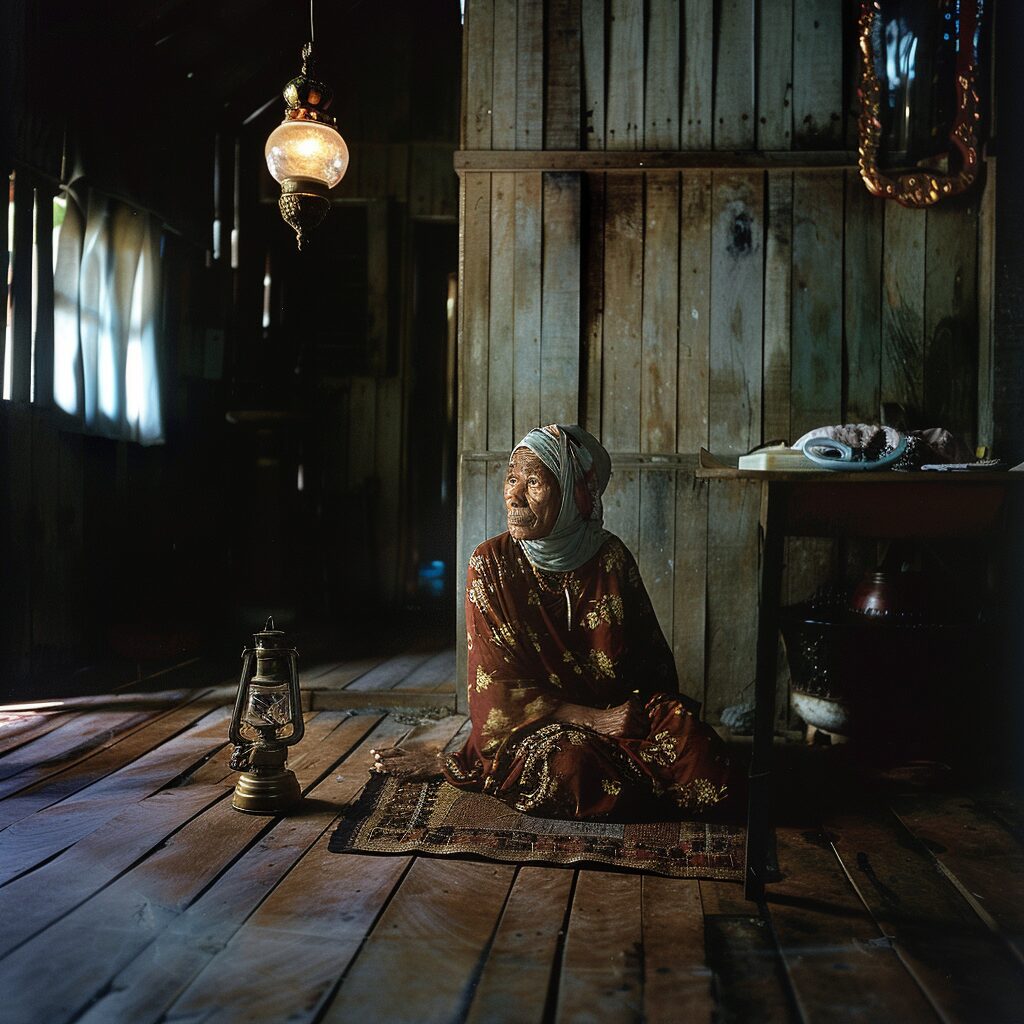
The traditional retelling of Mahsuri’s downfall centres on the personal malice of Wan Zaleha, the wife of the village chief. To understand the gravity of the event, one must view Wan Zaleha not as a stereotyped jealous antagonist, but as a political actor protecting her clan’s hereditary status.
Mahsuri’s immense local popularity, combined with the birth of her son, Wan Hakim, threatened to divert lineage prestige and economic inheritance away from the established ruling tree.
The catalysts for tragedy were the structural shifts of wartime:
Without a localised clan to champion her honour, Mahsuri faced a swift kangaroo court. The chief opted for political expedience over thorough jurisprudence. He sacrificed the foreign-born woman to consolidate internal tribal solidarity. This choice occurred on the eve of an impending foreign invasion.
Heritage Highlight: The Semiotics of the Keris and Darah Putih
In classical Malay statecraft and spiritual philosophy, executing an elite figure was never a merely mechanical act. It was a deeply ritualised event loaded with cosmic consequence.
This violent disruption of the island’s spiritual equilibrium underscores a deeper reality of the classical Malay world: landscapes were never merely physical terrain, but active moral arenas.
The sudden alignment of a violent death, structural adat violations, and immediate environmental collapse reflects an entire regional cosmology where geography mirrors human righteousness.
To understand how early Southeast Asian societies mapped these invisible spiritual networks across their territories, examine our comprehensive archive on myths, rituals, and sacred geography, which traces the animist and metaphysical foundations that governed ancient regional statecraft.
According to oral history, conventional iron blades and spears repeatedly deflected off Mahsuri’s skin. Within the tradition of silat and kebal (invulnerability) mysticism, such resistance indicated an exceptional spiritual purity (kesucian) or divine intervention.
Mahsuri ultimately directed her executioners to her family’s own heirloom keris. The keris was not merely a weapon but a sacred repository of a lineage’s semangat (life force). It required an instrument bound to her own provenance to end her life.
When the blade finally pierced her flesh, the substance that emerged was not red, but darah putih (white blood). In Southeast Asian cultural taxonomy, white blood is the ultimate physical manifestation of absolute moral innocence and spiritual cleanliness (batin).
The sudden appearance of darah putih instantly flipped the psychological dynamics of the crowd. The executioners realised they had committed derhaka, a grave sin against cosmic justice. This act invited tulah, a devastating supernatural retribution, upon the island’s geography.

The Seven Generations: Scorched Earth and Demographic Collapse
The “curse” of seven generations of barrenness manifested almost immediately, matching historical events with startling precision. In November 1821, a mere two years after Mahsuri’s death, the Raja of Ligor launched a brutal Siamese naval invasion of Langkawi.
The myth of the land turning instantly sterile reflects a severe scorched-earth military strategy. Datuk Seri Kemboja realised defence was impossible against the superior Siamese fleet. Therefore, he ordered his remaining villagers to collect the island’s entire wet-rice harvest.
They dumped it into a central clay pit at Padang Matsirat. Then, they set it ablaze to deny sustenance to the invaders. The local wells were simultaneously poisoned.
This site, preserved today as Beras Terbakar (The Burnt Rice), resulted in immediate, devastating famine. The Siamese forces slaughtered or enslaved the surviving population, triggering a massive demographic collapse.
For roughly 160 years – the mathematical equivalent of seven generations – Langkawi remained an isolated backwater. The island was largely bypassed by mainstream global trade, populated only by subsistence fishermen and pirate syndicates who utilised the jagged limestone karsts for cover.
The Modern Experience and the Lifting of the Curse
The long shadow over the archipelago began to shift in 1987, when the Malaysian government declared Langkawi a duty-free port, initiating a major phase of infrastructure development.
This economic revival synchronised perfectly with a fascinating cultural resolution. In the late 1990s, researchers traced Mahsuri’s direct lineage to Phuket, locating her seventh-generation descendant, Sirintra Yayee (Wan Aishah). Her highly publicised return to Langkawi in May 2000 served as a profound psychological milestone for the islanders, providing a sense of cultural closure.

Today, the Makam Mahsuri (Mahsuri’s Tomb) complex in Padang Matsirat stands as a carefully maintained heritage site. For the discerning heritage traveller, the optimal time to visit is during the early morning hours, when the soft sunlight filters through the surrounding trees and illuminates the stone façades without the distraction of mid-day crowds.
The complex features a reconstruction of a traditional timber rumah panggung (stilt house), built utilising classic mortise-and-tenon joints without a single iron nail. This architectural preservation offers a tangible connection to the domestic spaces of the 19th-century Kedah Sultanate.
When walking through the grounds, visitors are encouraged to maintain a quiet, respectful demeanour, as the site remains an active place of local remembrance rather than a simple tourist attraction.
The site leaves an indelible impression. The tomb is not merely an exhibit of a tragic folklore tale; it stands as an enduring monument to the high costs of wartime xenophobia, the fragility of justice when manipulated by local elites, and the remarkable power of oral history to survive empires.