
Key Insights
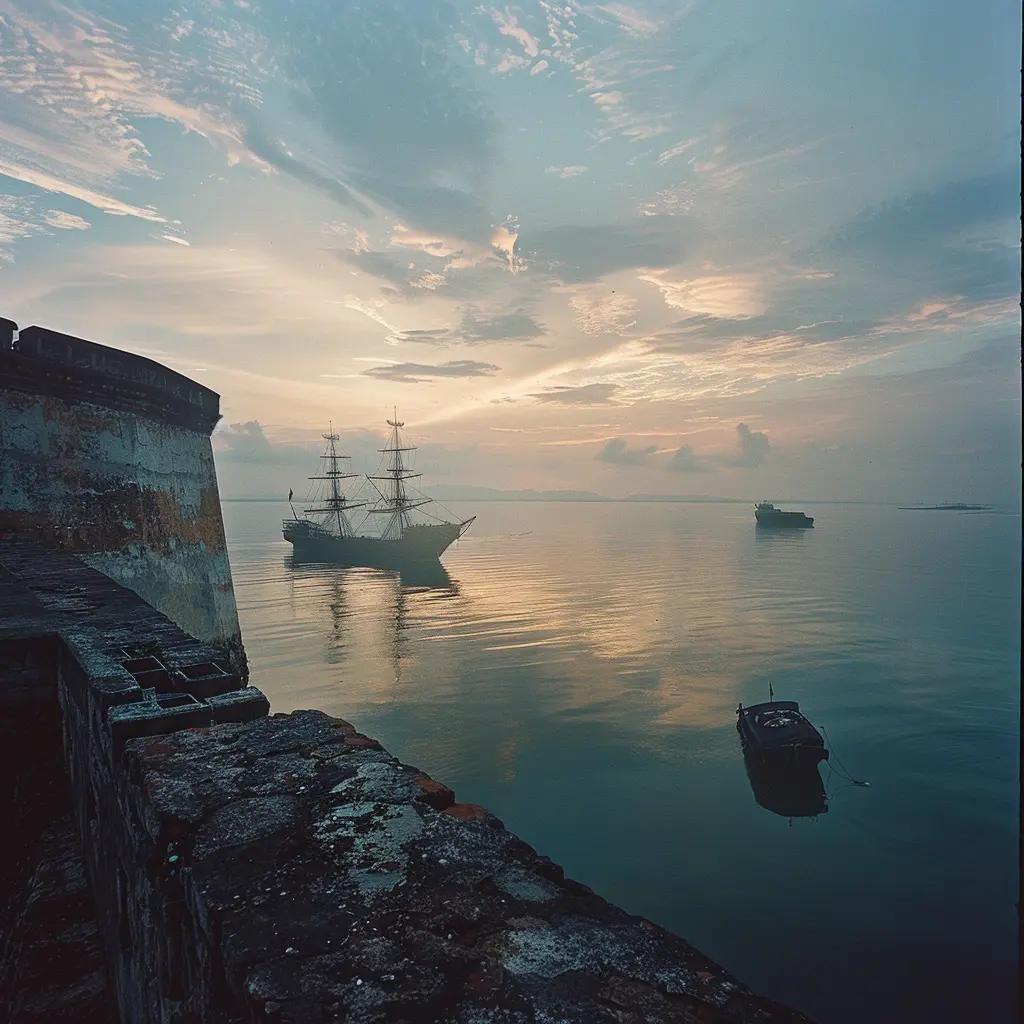
The Strait of Malacca is more than a shipping lane; it is a 2,000-year-old “Heritage Highway” where empires and fortunes rose on the monsoon winds. From the ancient Buddhist centre of Palembang to the strategic “Free Port” defiance of Sir Stamford Raffles, this channel forged a human legacy of cultural blending.
Today, its waters link the UNESCO lanes of George Town and Melaka with the modern skyline of Singapore, offering a living map of global power and Peranakan fusion.
Explore the complete Geopolitical Chessboard topic.
Monsoon Wind Regime: The seasonal weather system that dictated historical maritime trade across the Indian Ocean and South China Sea. Trans-oceanic merchants relied on the alternating patterns of the Southwest Monsoon (May to September) and Northeast Monsoon (November to March) to carry their vessels into the Straits, forcing ships to anchor for months at a time and driving the growth of permanent cosmopolitan port enclaves.
Choke-Point Geopolitics: The strategic mastery over a narrow, globally critical waterway. Measuring less than 1.7 miles wide at its narrowest point (the Phillips Channel), the Straits allowed historical polities – from the Srivijaya Empire to the British Straits Settlements – to exact taxes, enforce trade monopolies, and project absolute naval authority.
Entrepôt Trade Model: A commercial port network optimised for transhipment. Rather than relying solely on domestic production, ports like historic Malacca, Penang, and Singapore functioned as tax-sheltered, centralised basins where international merchants exchanged regional commodities (such as cloves, nutmeg, and tin) for manufactured global goods (like Indian textiles and Chinese porcelain).
Syahbandar (Master of the Port): The powerful, multi-ethnic administrative office in the Malacca Sultanate responsible for governing port logistics, managing customs duties, and resolving disputes among foreign trading factions. To maintain order, a sultanate often deployed four separate Syahbandars simultaneously to oversee specific merchant diasporas (such as Gujarati, Chinese, Javanese, and Churliah traders).
Cultural Syncretism: The deep blending of disparate artistic, linguistic, and structural traditions that occurs when foreign merchant populations integrate with native communities over centuries. Along the Straits, this phenomenon birthed highly specialised, localised identities – such as the Peranakan (Straits Chinese), Jawi Peranakan, and Chitty communities – each leaving a distinct imprint on the region’s culinary and architectural heritage.
Straits Settlements Legal Framework: The 1826 administrative unification of Penang, Malacca, and Singapore under British East India Company rule. This structural consolidation formalised free-port capitalism across the maritime corridor, fundamentally transforming the traditional indigenous trade networks of the channel into an institutionalised, Western-dominated corporate landscape.
The atmosphere over the Malacca Strait remains defined by its geographic positioning. It carries the distinct environmental intersection of brackish coastal waters and regional spice trade routes. In the year 1400, the Sumatran prince Parameswara sought strategic refuge along these shores.
According to regional historical chronicles, he witnessed a tiny native mousedeer turn and kick a hunting dog into the river. This display of localised defiance against a superior force convinced him that this specific ground was destined for geopolitical greatness.
This foundational moment marked the birth of the Malacca Sultanate. Operating as a brilliant medieval maritime startup, the kingdom systematically transformed a narrow natural bottleneck into what global traders would soon call the “Venice of the East.”
For the contemporary heritage traveller, the Strait represents far more than a physical body of water. It operates as a sophisticated global processing unit – a massive, historic machine designed for moving wealth, blending cultural DNA, and concentrating regional political power.
The Monsoon Machine: Engineering the Global Hub
The Straits of Malacca didn’t become a global hub by force. Instead, they were engineered by the monsoons’ rhythmic whir. To understand this region’s history is to understand the physics of the wind. Before steam, the weather was the supreme architect of commerce. It dictated the arrival and departure of every soul.
The Seasonal “Waiting Room”
The predictable winds acted as a giant, seasonal piston. Ships from the Coromandel Coast and the Arabian Peninsula were pushed eastward by one monsoon, while vessels from the Ming Dynasty were carried southward by the next. These two flows met in the Malacca Strait, but they did not meet simultaneously.
This “forced residency” birthed a sophisticated logistical API where warehousing the Gudang became the essential service of the era.
Traders were stuck for months, creating a “Waiting Room” culture that necessitated the world’s first truly cosmopolitan port cities. This wasn’t a “tapestry” of cultures. It was a high-pressure environment where foreign merchants had to learn Straits Malay protocol to survive. They required translators and money changers who understood the weight of silver. Brokers were also needed to navigate the complexities of local sultanate law.
The Srivijayan Architecture of Control
Long before Malacca rose, the Srivijaya Empire (7th–13th century) established the blueprint for maritime dominance. Based in Palembang, Sumatra, Srivijaya wasn’t a kingdom with fixed land borders. Instead, it was a maritime network that controlled the “flow.” They were the first to realise that in a 500-mile stretch of water, power is measured by the ability to tax the movement of goods.
The Orang Laut Enforcers

The Srivijayan navy was composed largely of the Orang Laut, or Sea People. These sea nomads were the kingmakers of the Straits, serving as mercenaries who “escorted” ships to Srivijayan ports at the point of a spear.
If a captain attempted to bypass the tax collectors of Sumatra by hugging the coastline, the Orang Laut would intercept them. This was the original “protection service” – a centralised monopoly that turned the Strait into a private toll road.
Beyond the military aspect, Srivijaya also held an intellectual monopoly. By funding massive Buddhist universities, they ensured that any monk or scholar travelling between China and India had to stop there. They didn’t just control the spice; they controlled the intellectual property of the 7th-century world.
This network of naval enforcement extended far beyond the southern bottleneck of the channel.
How did the early empires of the Straits secure the vast northern approaches from rival regional powers?
The answer lay in the militarisation of tactical island nodes that stood as sentinels at the entryway to the Andaman Sea. Chief among these was the Langkawi Archipelago, a sovereign, highly fortified stronghold that weaponised its Paleozoic karst topography to control shipping lanes long before colonial powers carved up the frontier.
To discover how this strategic gateway transformed from a volatile naval choke point into a state-engineered modern commercial space, explore our full analysis on the true geopolitical provenance and history of Langkawi.
The European System Crash
In 1511, the arrival of Afonso de Albuquerque signalled a fundamental shift in the Straits’ operating system. The Portuguese brought a land-based logic to a water-based world. They believed that by building A Famosa – a massive stone fortress – they could “own” the spice trade.
The Failure of the Fortress Logic
The Portuguese misunderstood the liquidity of the region. They owned the stone walls, but they lost the market. Trade is like water; when the Portuguese tried to dam it with heavy taxes and religious intolerance, the flow simply shifted.
Rivals like Aceh on the tip of Sumatra and the Sultanate of Johor rose to prominence by offering the “open-source” trade environment that Malacca had abandoned.
The Dutch East India Company (VOC) eventually seized the port in 1641 after a brutal siege. Their strategy was different but equally disruptive: they attempted to “delete” Malacca’s importance by shifting the centre of gravity to Batavia (modern-day Jakarta).
Yet, the geography of the Straits was too potent to ignore. The British eventually entered the fray, leading to the 1824 Anglo-Dutch Treaty. This agreement was essentially a “Geographic Hard Drive Partition,” drawing an invisible line down the centre of the water. It permanently severed cultural ties that had existed for a millennium, creating the modern bifurcation of the Malay world.
The Peranakan Synthesis: Cultural Hacking
As the empires fought over the water, a new social class was emerging on the land: the Baba Nyonya. These individuals were the ultimate “cultural hackers” of the Golden Age of Travel.
The Peranakan identity was a survivalist fusion. Chinese traders (Baba) marrying local Malay women (Nyonya) was a strategic maneuver. It allowed them to gain local land rights and linguistic fluency while maintaining their global trade links to the Fujian province. This was not mere assimilation; it was a synthesis.
Sensory Specificity of the Nyonya Kitchen
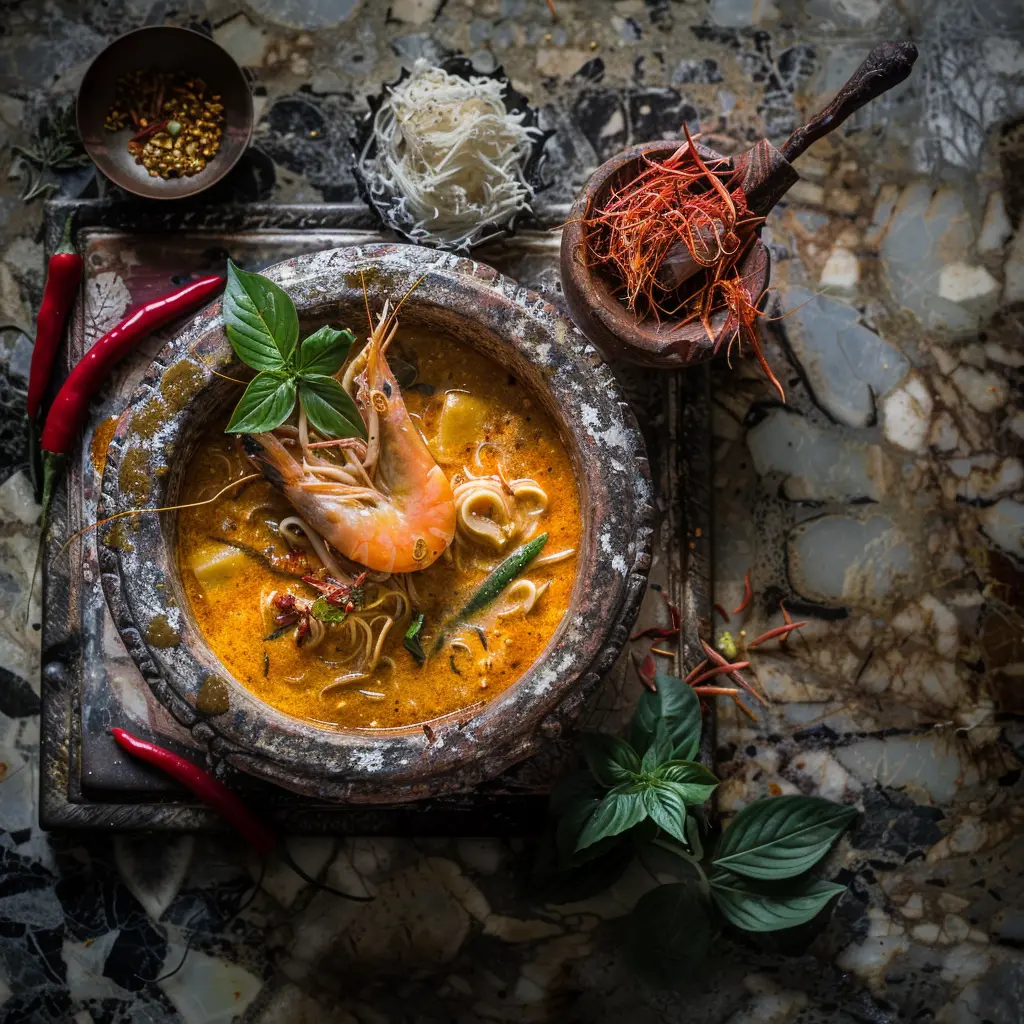
In the kitchens of the shophouses, this synthesis became edible. The laksa of the Straits carries a sharp, tamarind-forward acidity that cuts through the richness of coconut milk – a culinary metaphor for the sharp tension between the two cultures.
To walk through Heeren Street (Millionaires’ Row) in Malacca today is to see this “flex” in physical form. The houses use British Minton floor tiles, Chinese porcelain inserts, and Malay fretwork on the shutters. It was a visual statement: “I am connected to every empire simultaneously.”
Heritage Highlight: The Sino-Portuguese Patina
The architectural vestige of Malacca is most visible in its “Straits Eclectic” shophouses. These structures represent a syncretic blend of Hokkien tradition and European order. Look specifically for the 1920s lime-wash patina on the façades – a chalky, breathable finish that allowed the masonry to survive the 100% humidity of the tropics.
Inside, the scale of the teak pillars induces a sudden silence, while the rhythmic whir of overhead punkah fans once cooled the brows of rubber magnates and spice brokers. These weren’t just homes, but fortresses of trade designed to handle high-density commerce.
The Modern “Malacca Dilemma”
The Straits of Malacca are now the most dangerous “single point of failure” in the global economy. If the Srivijayans used spears to control the flow, modern superpowers use naval destroyers and satellite surveillance.
The Energy Jugular
Roughly 80% of China’s oil imports pass through the Phillips Channel, a passage near Singapore that is so narrow it creates a permanent maritime traffic jam. This has created what strategists call the “Malacca Dilemma.” If a hostile power were to blockade the Straits, the lights would go out in Shanghai in a matter of weeks.
This strategic anxiety is driving the construction of multi-billion-dollar pipelines across Myanmar and rail links across the Isthmus of Kra – all in an attempt to “bypass” the 500-mile stretch of water that Parameswara first claimed.
The Ghost of the Sea Nomad
Despite the presence of high-tech radar and the Singaporean Navy, the “Wild West” element of the Straits has never truly vanished. Modern piracy in these waters is an exercise in industrial-scale theft. These are not the pirates of fiction; they are coordinated syndicates using high-speed boats and GPS jamming to hijack tankers.
They repaint the hulls at sea, rename the vessels, and sell the siphoned oil on the black market. It serves as a reminder that the Straits remain as untamable and lawless as they were in the year 700.
Conclusion: The Heritasian Verdict
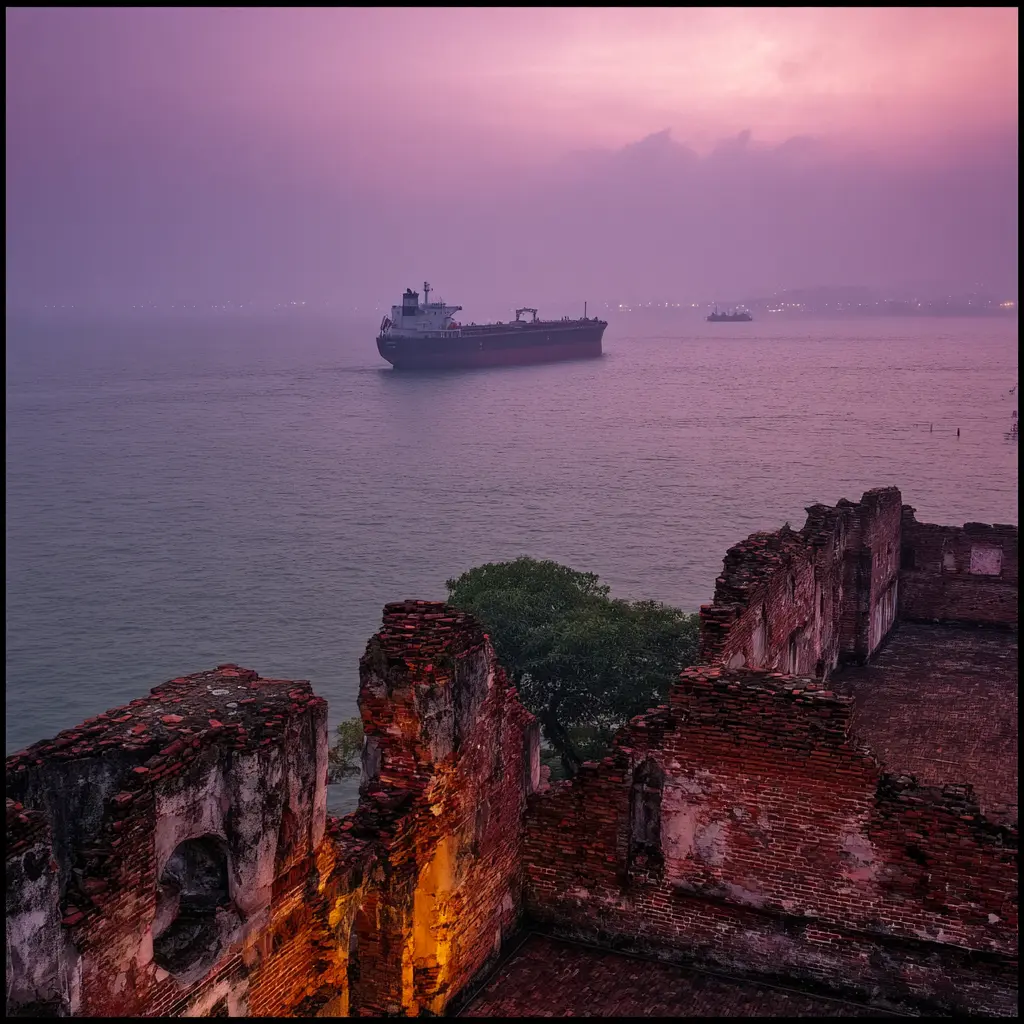
The Straits of Malacca are far from a museum piece. They are a living, breathing machine that demands our attention. For the discerning heritage traveller, the allure lies in the friction – the clash between the ancient Orang Laut traditions and the massive VLCC (Very Large Crude Carriers) that now dwarf the horizon.
When you stand on St. Paul’s Hill and look out toward the water, you aren’t just looking at a shipping lane. You’re looking at the site of a thousand-year-old negotiation. The air still hums with the same tension that defined the Sultanate: the knowledge that whoever controls this narrow ribbon of blue controls the heartbeat of the world.
Visitor Insights for the Discerning Traveller
For those seeking the unhurried “Slow Travel” experience, avoid the “Jonker Walk” weekend crowds. Instead, visit during the mid-week “golden hour.” Observe the quiet dignity of Cheng Hoon Teng Temple. Here, incense-heavy air contrasts with nearby Art Deco apartments. Cultural etiquette remains paramount. Move slowly, speak softly, and let the city’s historical archive reveal itself through patina.
If you are compelled by the maritime legacy of the Srivijaya, explore our archive on the Sarkies Brothers’ hotels or the evolution of Penang’s Clan Jetties.