
Key Insights
Baan Tawai is Northern Thailand’s premier woodcarving and handicraft village, renowned for transforming raw teak and monkey pod wood into intricate sculptures, sacred motifs, and fine furniture.
Born of ancestral Lanna traditions, local artisans combine time-honoured techniques – such as natural lacquering and gold-leaf gilding – with modern interior decor, establishing Chiang Mai’s Hang Dong district as a world-class centre for artisan heritage.
Lanna Woodworking: The traditional Northern Thai woodworking discipline rooted in the historic Lanna Kingdom, characterised by deep-relief carving, architectural timber joinery, and sacred Buddhist and animist iconography.
Rak (Lacquer): A natural, resinous sap tapped from the Gluta usitata tree (black lacquer tree), used by artisans as a durable, waterproof sealant, a deep-black adhesive base, and a primer for gilded embellishments.
Lai Rod Nam: A traditional Thai gold-leaf gilding technique literally meaning “patterns washed with water,” where gold foil is applied over a lacquer base and unmasked with a water rinse to reveal fine, contrast-rich decorative motifs.
Singha (Sing): A mythical guardian lion originating from Hindu-Buddhist mythology and widely sculpted in Lanna temple architecture and wooden statuary to symbolise strength, nobility, and spiritual protection.
OTOP (One Tambon One Product): A nationwide Thai government stimulus and certification program designed to support, standardise, and globally market high-value village-level handicrafts and indigenous micro-industries.
Pre-Industrial Cluster: An economic manufacturing ecosystem where decentralised, small-scale workshops and independent family artisans collaborate across specialised production phases without relying on heavy industrial assembly lines.
Baan Tawai is an industrial ecosystem scaled to the village grid. Behind the showroom facades along the Hang Dong canal sits a decentralised manufacturing terminal where seasoned tropical hardwoods are converted into high-relief architectural panels and monumental statuary.
The technical baseline depends on salvaged timber stocks—principally dense, oil-rich heartwoods of reclaimed teak (Tectona grandis), heavy Burmese padauk, and fast-growing rain tree milled for mass-volume blocking.
Workshop compounds operate without assembly lines. Instead, production moves through a tight spatial circuit: open-sided pole barns where timbers season over charcoal trenches, sawdust-floored yards where carvers rough out profiles with curved adzes, and shaded domestic verandas where specialists chase fine detail with V-shaped gouges.
The final links are immediate. Within five hundred meters of the carving benches sit specialised timber brokers, custom crating sheds using rough-sawn pine, and logistics handlers packing forty-foot maritime containers bound for Bangkok’s deep-water ports. It is an intact pre-industrial guild network wired directly to global freight lines.
The Three Pioneers of the Rice Fields
Before the timber shops arrived, Baan Tawai was trapped in the Ping River flood basin’s agrarian calendar. Once the monsoon wet-rice harvest was gathered into the granaries, the dry season brought four months of forced unemployment, mounting merchant debts, and subsistence foraging.
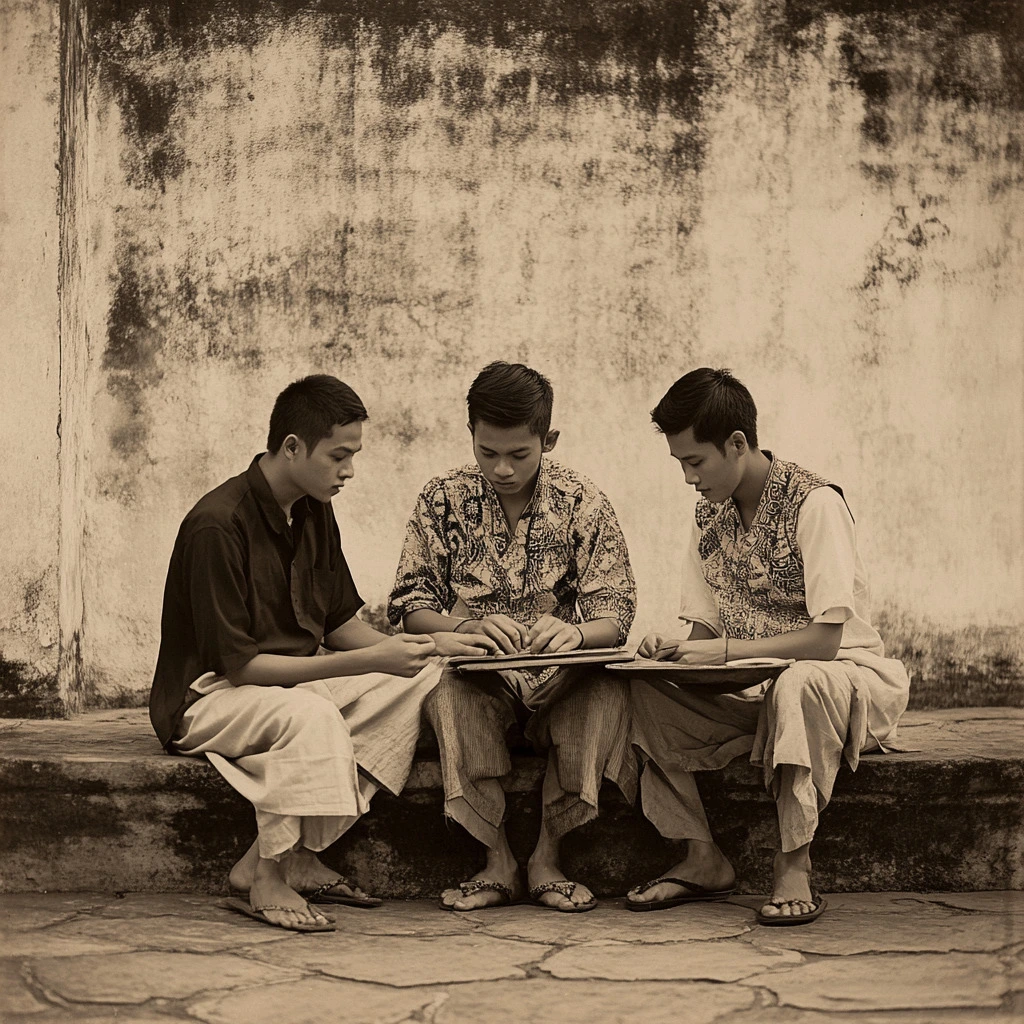
In the late 1950s, three young villagers—Pho Naan Daeng, Pho Jaima, and Pho Huen—walked fifteen kilometres north to the southern brick gates of Chiang Mai. They apprenticed themselves to the hereditary master carvers of the old city workshops, trading manual labour for entry into a closely guarded urban craft monopoly.
The Chiang Mai Gate artisans held the royal Lanna timber tradition: a dense decorative discipline marked by deep undercuts, Mandalay-influenced floral scrolls, and rigid Buddhist spatial iconometry. The three spent years working from rough mallet work to fine blade work, mastering tool-steel tempering and learning to anticipate tension splits along green heartwood grain.
When they returned south to Hang Dong, they carried that metropolitan technical knowledge directly into their family compounds. They built timber trestles in the shaded clearings beneath their raised rice barns and began training neighbours between seasonal field rotations.
By decentralising what had been a centralised urban trade into a network of domestic family workshops, they converted seasonal peasant labour into a durable cottage manufacturing base.
The Alchemy of the Lacquer Tree

The finishing chemistry of Lai Rod Nam (water-gilded lacquerware) relies on an organic polymer derived from the sap of Gluta usitata, the wild black lacquer tree. In its raw state, the sap carries high concentrations of urushiols—the same toxic phenols found in poison ivy—which cause severe blistering dermatitis on contact.
Once refined and filtered through porous mulberry paper, it yields an impenetrable natural sealant that resists rot, timber-boring insects, and the high ambient acidity of tropical air.
Curing the lacquer requires a counterintuitive atmospheric balance. Urushiol does not dry through heat or evaporation; it polymerises via enzymatic oxidation that activates only in cold, saturated air.
To achieve this, artisans seal coated timber panels inside subterranean brick pits or double-walled chambers draped in dripping burlap sacks. In this controlled cellar climate, held at eighty per cent relative humidity and shut off from sunlight, the resin cures slowly over weeks into a lustrous, pitch-black enamel.
The gilding stage operates as an exact negative-resist process. The artisan paints the negative spaces of the composition using an opaque resist paste ground from chalk, realgar, and the fermented sap of roasted tamarind pods. Once dry, the entire board is brushed with an ultra-thin adhesive layer of boiled lacquer and covered with tissue-backed sheets of beaten twenty-four-karat gold leaf.
The reveal is mechanical. The artisan sponges the surface with cold water, dissolving the water-soluble tamarind paste beneath. The gold resting on the chalk washes away in loose flakes, while the foil pressed onto the tack-cured resin bonds permanently to the wood.
What remains is a hard-edged, micro-thin filigree of raw gold sealed against an obsidian ground—an archival finish that can withstand centuries of monsoon cycles without lifting from the grain.
The Spiritual Language of the Grain
Timber selection in Baan Tawai is an exercise in material diagnostics. Carvers do not treat logs as uniform stock; they grade every slab by moisture content, heartwood ratio, fibre density, and the predictable shrinkage stresses that threaten to split complex joinery across seasonal humidity swings.
The King of the Forest: Teak
Golden teak (Tectona grandis, or Mai Sak) anchors the top tier of Baan Tawai’s material hierarchy. Its dominance is purely mechanical: high concentrations of natural tectoquinones and silica render the heartwood toxic to subterranean termites, impervious to fungal rot, and dimensionally stable across extreme wet-and-dry seasonal shifts.
Because dense, slow-grown teak moves minimally along its tangential axes once seasoned, intricate deep-relief mortises hold their tolerance for centuries, weathering down to an ash-grey patina without checking or blowing out structural joints.
The Luck of the Jackfruit
Where teak handles architectural scale and weather exposure, jackfruit wood (Artocarpus heterophyllus, or Mai Khanoon) is reserved for interior sacral statuary. The timber carries immediate symbolic weight: khanoon acts as a direct phonetic pun for nun—to shore up, support, or provide structural and spiritual patronage.
That symbolism is matched by the timber’s behaviour on the bench. Freshly planed jackfruit yields a bright, sulphur-yellow heartwood that oxidises into a rich amber closely matching the dye of aged monastic robes.
Its interlocked grain resists tear-out and splintering under acute-angle undercutting, making it the preferred medium for ancestral effigies and small-scale Buddha images—where the dense wood functions as a physical talisman of endurance and domestic support.
The Flame of the Kranok
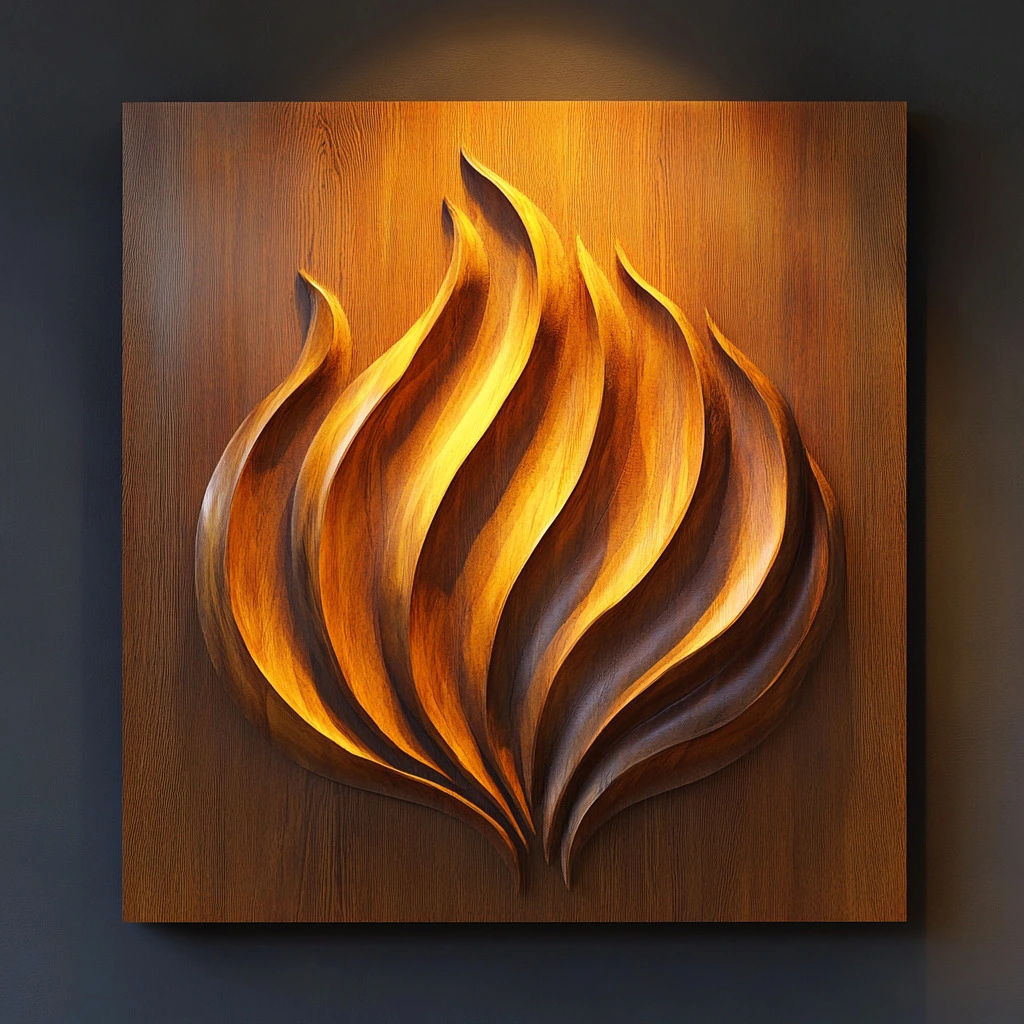
The structural signature of Lanna timber relief is the kranok, a dynamic, trailing foliar flame that organises traditional surface compositions. Rather than a purely decorative flourish, the pattern operates as a formal geometry of stylised nature, abstracting the unfurling of young plant tendrils, the tips of lotus petals, and the sinuous crests of mythical naga into a unified, repeating rhythm.
In the Baan Tawai workshops, carvers use the kranok to establish depth and optical movement across solid timber planes.
By graduating the blade angle—stepping from shallow perimeter scoring to steep, hollowed undercuts along the inner curls—artisans release the relief from the backing board, generating undulating shadows that give static architectural panels the illusion of kinetic, windblown energy.
The Tourist Experience: The High-Value Souvenir
Recent shifts in regional tourism strategy emphasise high-value cultural heritage over mass-market trinkets. In this commercial transition, Baan Tawai serves as a key proving ground: shifting the village’s revenue model away from cheap, low-margin souvenirs toward high-value, bespoke craftsmanship that relies on documented manual skill.
The Bespoke Commission
The upper tier of Baan Tawai’s current trade bypasses off-the-shelf decorative statuary in favour of bespoke architectural commissions. International clients and design firms work directly with master workshops to develop custom installations—from monumental entry portals to coffered ceiling panels—engineered from scale drawings and CAD drafts.
To sustain this direct-to-client pipeline, the village has formalised an end-to-end export corridor. Within a few hundred meters of the carving benches, dedicated forwarding agents manage fumigation, timber provenance paperwork, custom palletising, and maritime container freight, ensuring multi-ton teak assemblies move directly from Hang Dong sawdust floors to overseas job sites.
This logistics layer is what turns artisanal time into high-yield export capital, underwriting the entire localised pyramid of master gougers, apprentices, and finishers.
The Gold Leaf Challenge
Alongside architectural commissions, a secondary market caters to participatory workshops focused on water-gilding techniques. Participants sit at low benches with pre-lacquered trial blocks and beaten twenty-four-karat gold leaf, attempting to lay foil across narrow detail lines without tearing.
The initial failure rate is near total. Beaten to fractions of a micron, raw leaf responds instantly to the slightest draft or skin moisture, curling into ruined static fragments at the touch of a warm finger.
Gaining purchase requires complete breath control and the steady, dry lift of a badger-hair brush. The exercise demystifies the material: the value of the finished lacquerware is revealed not as decorative surplus, but as the physical cost of managing an unforgiving, electrostatic foil that tolerates zero manual error.
The Guardian Spirits of the Workshop
Each workshop maintains a wai khru altar dedicated to the lineage of ancestral teachers. Before an artisan makes the opening cut into a raw teak trunk, they lay out offerings—incense, marigold garlands, and bottles of red Fanta—to ask the timber’s resident spirit for leave to alter its form.
The Legend of the Waking Lion
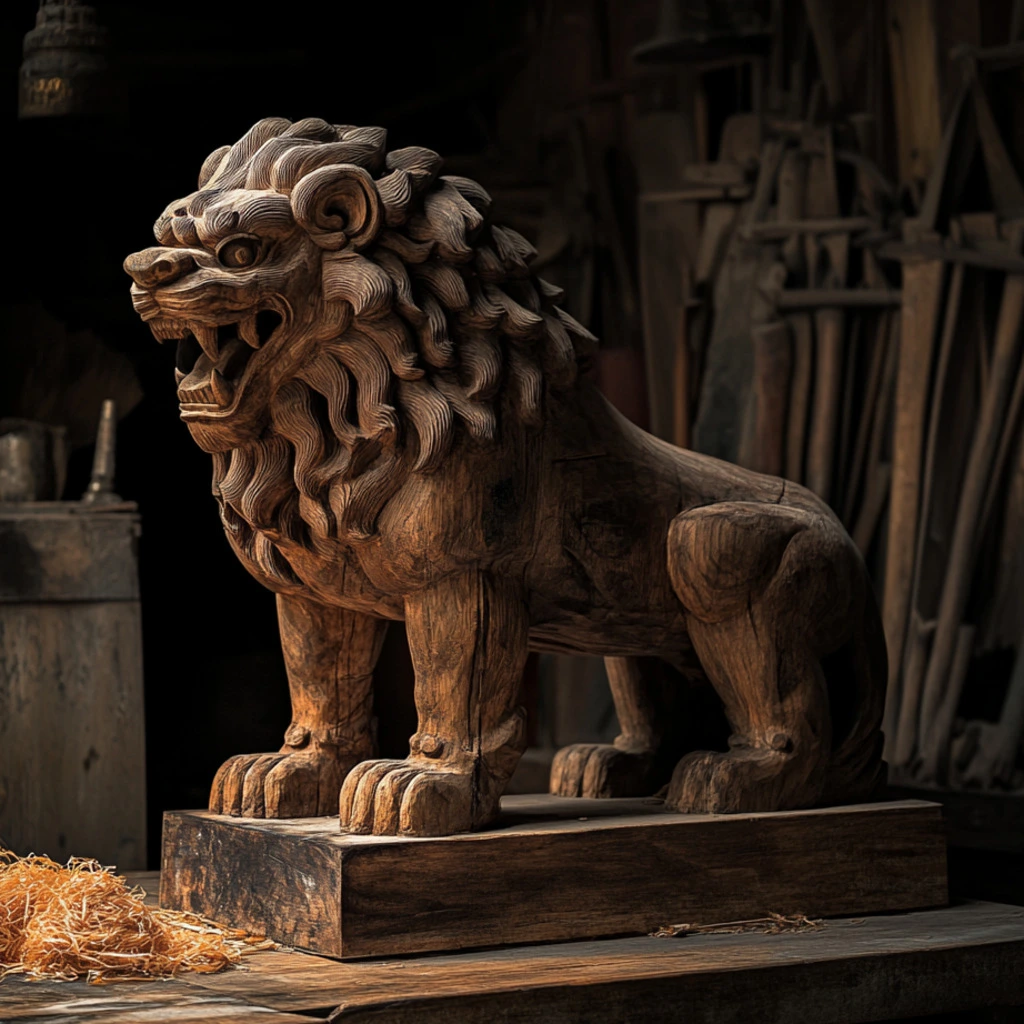
A persistent workshop legend recounts an artisan commissioned to carve a monumental singha (mythical lion). Working in complete isolation for three months, he rendered the musculature and gaze with such hyper-realistic tension that the village dogs refused to pass the shop door, gathering at the threshold to bay at the finished timber.
The carver ultimately draped the lion’s head in consecrated red cloth, keeping the form blindfolded until transport arrived. Within the guild, the story circulates among apprentices as an object lesson in manual execution: pushed to its technical extreme, sculpted form commands the physical presence of a living beast.
Survival in the Digital Age
The primary economic challenge confronting Baan Tawai is the regional influx of automated timber production. High-volume overseas facilities flood the wholesale market with computer numerical control (CNC) woodwork—geometrically uniform, mass-milled panels that undercut hand-hewn pieces on price while eliminating the micro-irregularities of chisel work.
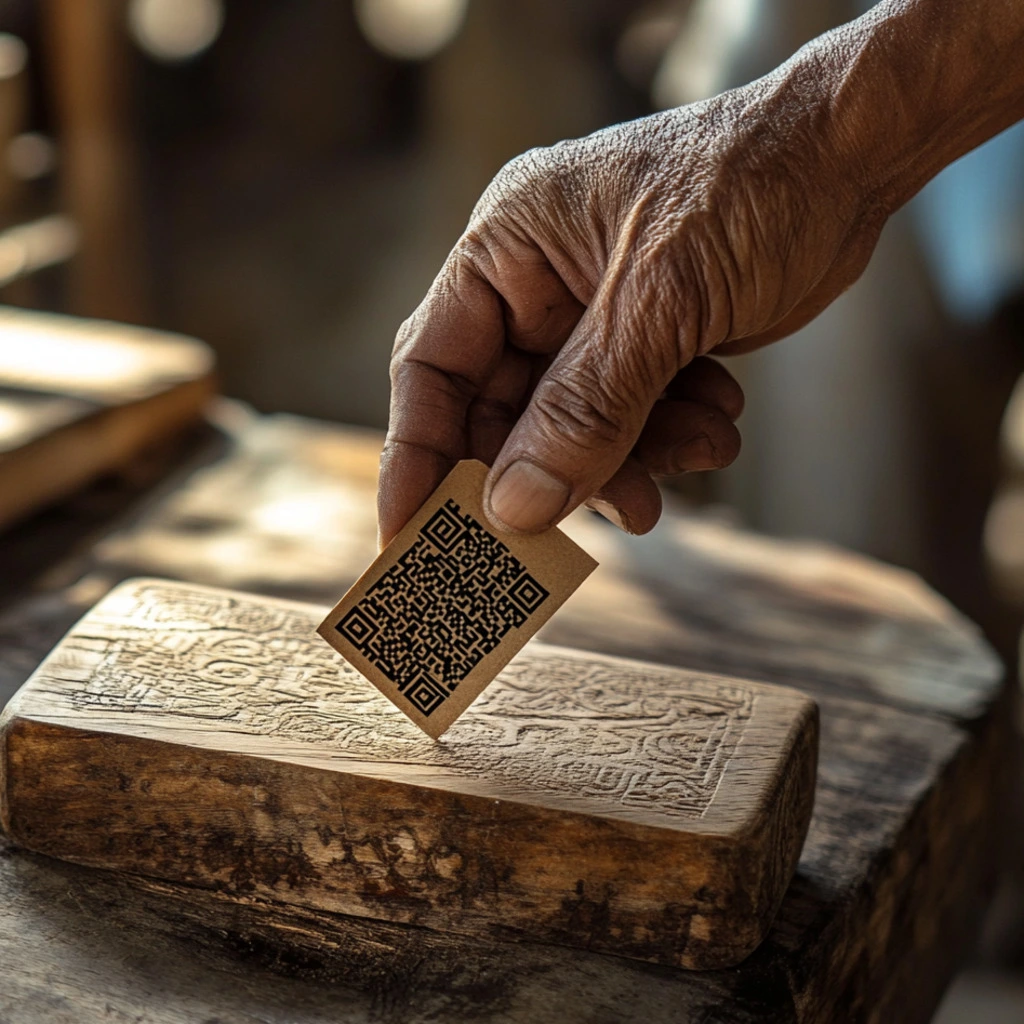
To defend their margins, several village workshops have integrated digital authentication directly into their physical output. By embedding scannable QR codes onto finished panels, studios link buyers to archival footage documenting the individual artisan, the bench tools used, and the progressive hand-carving sequence.
In a market saturated with automated replicas, this verifiable chain of fabrication serves as proof of provenance, converting documented manual labour into commercial defence.
The Ethical Wood Trail
Timber sourcing in Baan Tawai is governed by rigid provenance mandates enforced by regional trade authorities and the local guild. Under current regulatory frameworks, all working teak must carry verification tracing it either to certified commercial plantations or to reclaimed architectural stock salvaged from dismantled rural houses.
In the workshops, this material discipline is visible on the benches. Carvers routinely bypass fresh-cut logs to mill structural lumber from century-old domestic outbuildings.
Though the exterior face is weathered down to an oxidised grey skin, the interior heartwood remains saturated with protective resins. Deep gouge work strips away the brittle surface layer to expose the dense, amber grain beneath, converting structural salvage into high-relief decorative panels engineered to hold their joint tolerances for another century.
Conclusion: The Eternal Shine
The survival of Baan Tawai rests on these operational balances: toxic urushiol sap cured in lightless subterranean moisture to yield mirror-grade lacquer; seasonal rice farmers who transformed an urban craft monopoly into a village manufacturing base; and water washes that reveal gold foil through negative space.
The district is neither an untouched sanctuary nor a conventional curio market. It is an enduring industrial network operating by the strict metrics of blade speed, wood moisture, and manual precision. In the finished work—from gilded spirit houses to deep-relief teak panels—the value remains entirely material: a hard, resilient finish and an exact geometry that persist long after the timber leaves the bench.