
Key Insights
Central Thai cuisine is a cerebral pursuit of balance across sweet, salty, sour, and spicy profiles. Shaped by the fertile Chao Phraya basin and refined within royal palaces, it demands structural symmetry. Ingredients like toasted shrimp paste, lemongrass, and lime are crafted with mechanical perfection, transforming fresh river bounty into a harmonious tradition where no single flavour dominates.
Kin khao: Literally “eat rice”; the Thai phrase for eating a meal.
Ahan Chao Wang: Royal cuisine, characterised by extreme precision and intricate preparation.
U Khao U Nam: “Rice bowl and water basin,” describing Central Thailand’s fertile heartland.
Wan, Kem, Preaw, Phed: The four essential flavour axes: sweet, salty, sour, and spicy.
Ruan phae: Traditional floating houseboats found along Thailand’s historic river networks.
Massaman: A rich, relatively mild Thai curry heavily influenced by dry, roasted spices.
In the humid air of the Chao Phraya River basin, the scent of toasted shrimp paste mingles. It blends with the sharp, clean zest of bruised lemongrass and the perfume of torn kaffir lime leaves.
This is the sensory baseline of the U Khao U Nam. This phrase means the “rice bowl and water basin” of Central Thailand. For centuries, the annual monsoon floods have deposited nutrient-rich silt onto these flat plains. This created a hyper-fertile delta. Here, wild freshwater fish, river prawns, and floating gardens dictate the seasonal menu.
Far from a chaotic explosion of heat, authentic Central Thai cuisine is a highly cerebral pursuit. It demands structural symmetry. The cuisine functions as a precise tightrope walk where four distinct axes must be held in perfect equilibrium. These are wan (sweet), kem (salty), preaw (sour), and phet (spicy).
No single profile is permitted to dominate. Dominance represents a failure of craftsmanship. To understand this culinary discipline, one must trace its evolution. This journey goes from the rigorous demands of the royal court to its modern communal survival.
Historical Context: The Architectural Kitchen of the Royal Courts
While neighbouring provinces rely on bold, singular strokes, Central Thai cuisine was codified within aristocratic palace kitchens. These belonged to the Ayutthaya and Rattanakosin kingdoms.
Here, the kitchen functioned as an extension of statecraft and diplomacy. Cooking for the monarch required a devotion to mechanical perfection and invisible labour. This process created a distinct tradition known as Ahan Chao Wang.
This courtly discipline imposed rigorous rules on the preparation of food, driven entirely by palace etiquette:
The Central Plains operated as a cultural sponge, absorbing foreign ingredients through trade and migration. They stripped these ingredients of their alien identity. This process created something uniquely Thai.
The Portuguese maritime arrivals of the 16th and 17th centuries introduced the South American chilli pepper to the region. Before this, the Siamese larder relied on local black peppercorns (prik Thai) and long pepper for warmth.
Wave after wave of Teochew and Hokkien migration introduced the carbon-steel wok and high-heat stir-frying. These immigrants also brought fermented soybean paste and rice noodle culture. These culinary traditions eventually transformed the urban streetscape.
Heritage Highlight: The Synthesis of Royal Confectionery
In the late 17th century, the Ayutthaya court welcomed Maria Guyomar de Pinha, a woman of mixed Portuguese, Bengali, and Japanese descent. Appointed as the director of the royal dessert kitchen, she fundamentally altered the trajectory of Thai confectionery (Khanom).
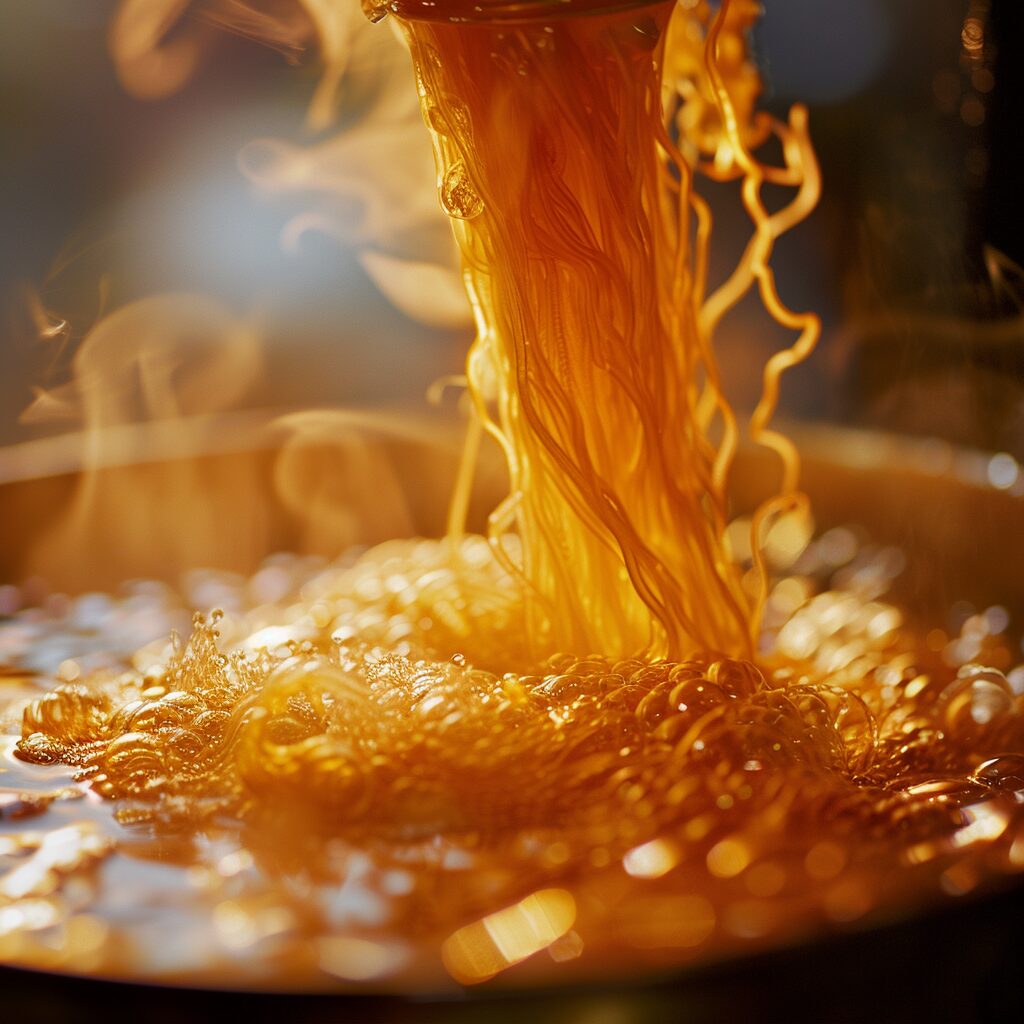
Before her arrival, Siamese desserts relied almost exclusively on rice flour, coconut milk, and palm sugar. Utilising European techniques, she introduced egg yolks and refined sugar syrups to the royal larder. This synthesis birthed a suite of golden, yolk-heavy delicacies designed to mimic auspicious symbols of wealth and longevity:
* Thong Yip (Pinched Gold Flakes) * Thong Yod (Golden Drops) * Foi Thong (Golden Angel Hair)
These delicate creations require precise temperature control to thread egg yolks into boiling sugar syrup without curdling, leaving a smooth, glossy patina that remains a fixture of traditional Thai ceremonies today.
The Analytical Guide to the Central Table
To understand the mechanics of the Central Table, we examine the true structural design behind its most misunderstood staples:
1. Tom Yum Gung (Nam Sai)
Often dismissed as merely a fiery shrimp soup, the traditional clear version (nam sai) is a calculated exercise in volatile aromatics. The core architecture relies on the bruising – not chopping – of the acoustic trinity: lemongrass, galangal, and kaffir lime leaves.
Bruising ruptures the plant walls to release essential oils directly into a clean, simmering broth. This stock uses river fish or poultry. The intense sour profile comes from fresh lime juice. Add it only after removing the broth from the flame. This preserves the heat-sensitive acidity and prevents the juice from turning bitter.
2. Pad Thai
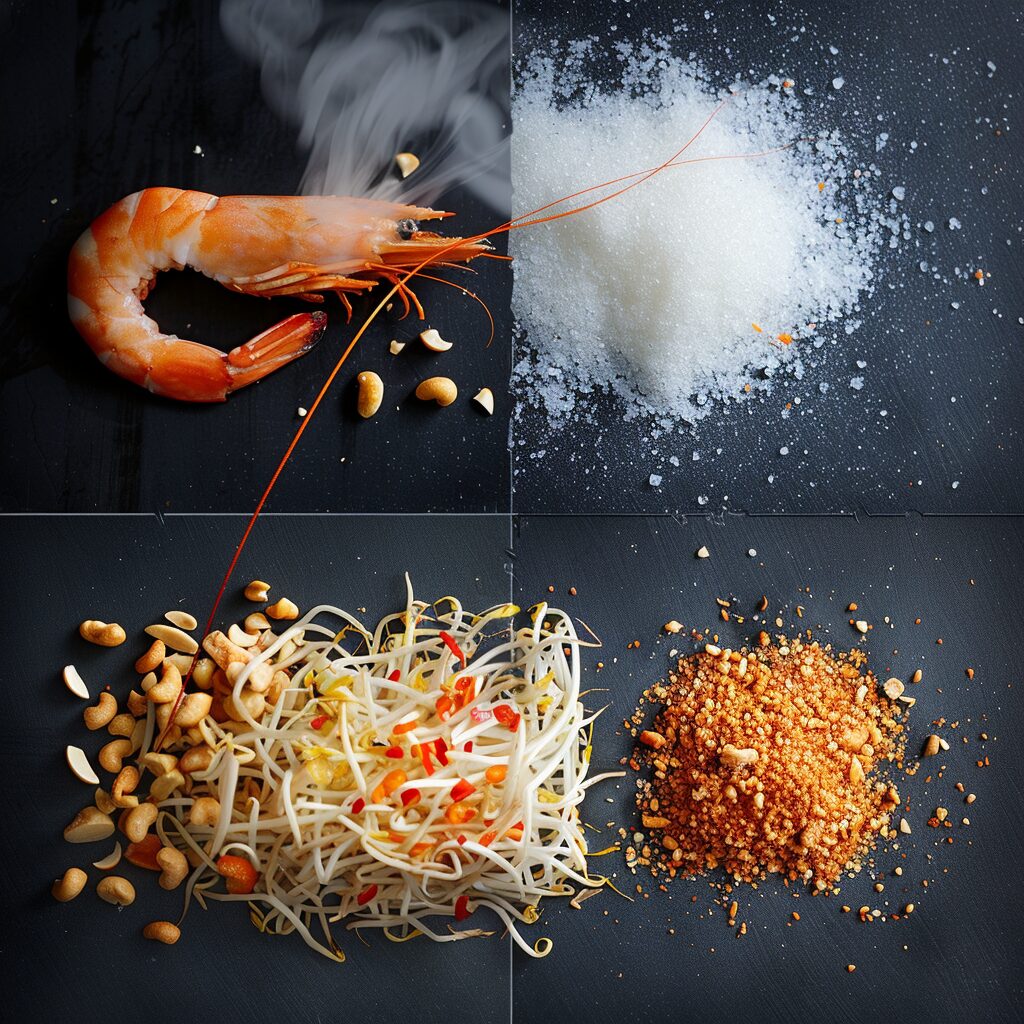
Far from an ancient folk dish, Pad Thai was an artificial invention of the mid-20th century, conceptualised by Prime Minister Plaek Phibunsongkhram’s government to forge a unified national identity and reduce domestic rice consumption during post-war shortages.
The dish represents a direct assimilation of Chinese rice noodles into the Central Thai flavour profile. The distinct sweet-sour-salty paste relies on dry tamarind pulp, palm sugar, and fish sauce (nam pla), punctuated by dried shrimp, preserved radish, and hard tofu.
3. Massaman Curry
The name itself is a historical evolution of the word Mussulman (Muslim), pointing directly to the Middle Eastern and Indian merchants who frequented the cosmopolitan ports of Ayutthaya.
Unlike the region’s herbaceous green or red curries, Massaman is dominated by dry, roasted spices. It features cardamom, cinnamon, cloves, and nutmeg. The dish holds a revered place in literary history. King Rama II dedicated a 19th-century poem to the intoxicating aroma of his lover’s preparation. This poem cemented Massaman as a peak expression of refined domesticity.
The Modern Experience: The River Culture of Nakhon Sawan
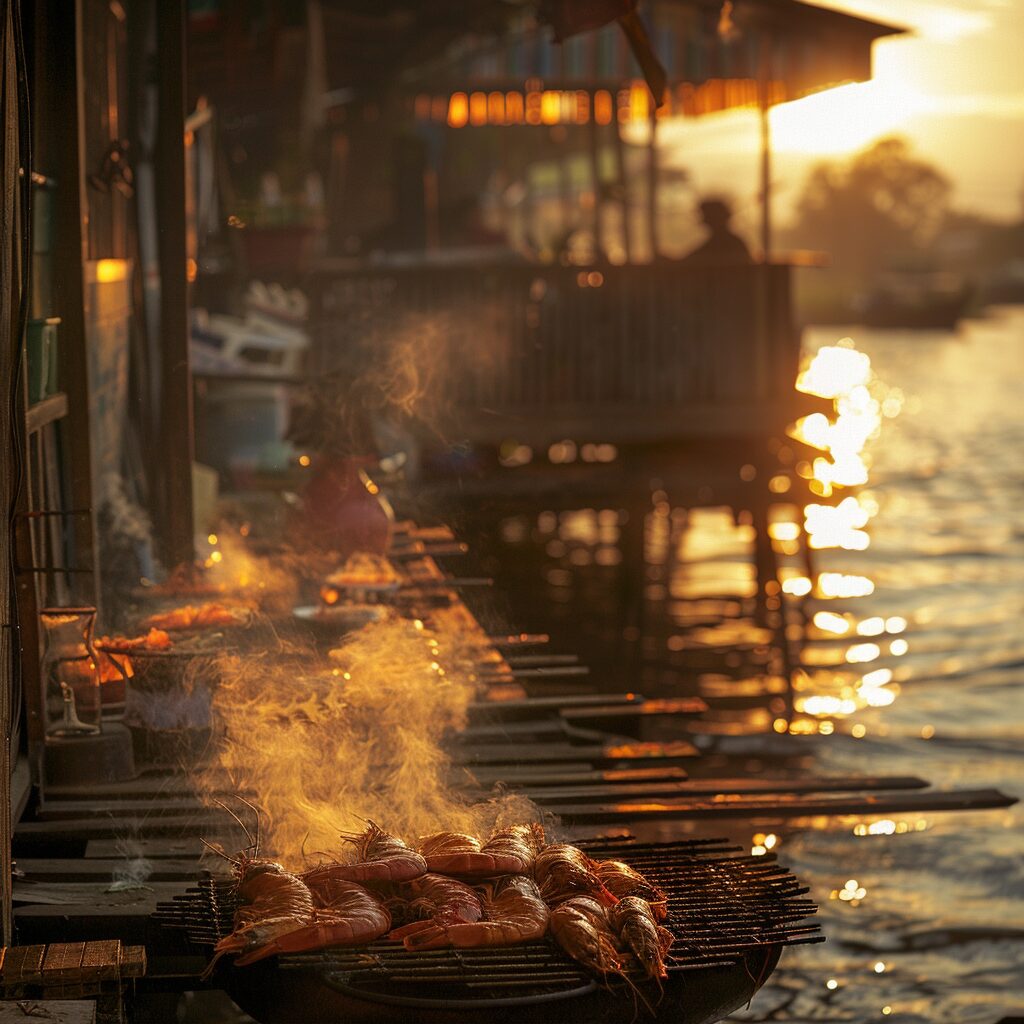
To observe this cuisine outside Bangkok’s urban density, the culinary historian must travel upriver to Nakhon Sawan. Here, the Ping and Nan rivers merge to form the Chao Phraya. At this precise confluence, the traditional ruan phae lifestyle persists.
The optimal time to explore the upper Chao Phraya’s floating kitchens is from November to February. Arrive late in the afternoon. The setting sun hits the lime-washed wooden facades of the old riverfront structures perfectly. This offers clear conditions for documenting traditional preservation methods.
The Philosophy of the Share
In the Thai language, the phrase used to signify eating a meal is kin khao. This translates literally to “eat rice.” Rice – specifically the long-grain, aromatic Jasmine variety – is not a side dish. It is the physical and philosophical centre of the meal. Everything else served at the table is designated as kap khao (“with rice” or “accessories to rice”).
This structural linguistic reality shapes how a meal is experienced. Western dining often favours a linear, isolated progression of courses. The Central Thai table demands simultaneous presentation. A balanced meal must feature a soup, a curry, a stir-fry, and a pungent dip (nam phrik) accompanied by raw vegetables.
Diners take small portions of one dish at a time, mixing it carefully with their central mound of rice. It is an exercise in communal harmony, where the final composition of the dish happens not in the kitchen, but on the individual plate. As the old idiom goes, “Eating alone is not tasty.”