
When Martin Sarkies left New Julfa, Isfahan, to establish himself as an engineer in Penang, he could not have foreseen the architectural empire his family would construct. He was the vanguard. Soon after, his brothers Tigran, Aviet, and Arshak followed him to the booming port city.
They integrated quickly into the influential, tight-knit Armenian diaspora, anchoring George Town – a community that left its permanent mark on the city’s topography through Armenian Street.
The brothers were not trained hoteliers, nor did they possess vast capital. Yet, within decades, they fundamentally redefined the geography of luxury hospitality across the Straits of Malacca.
Their success was not a matter of luck or mere opulent hospitality. The Sarkies brothers succeeded because they were the first to understand that a true luxury property must operate as a destination node – a permanent anchor point for global trade, culture, and governance.
The Suez Catalyst and Infrastructure Gaps
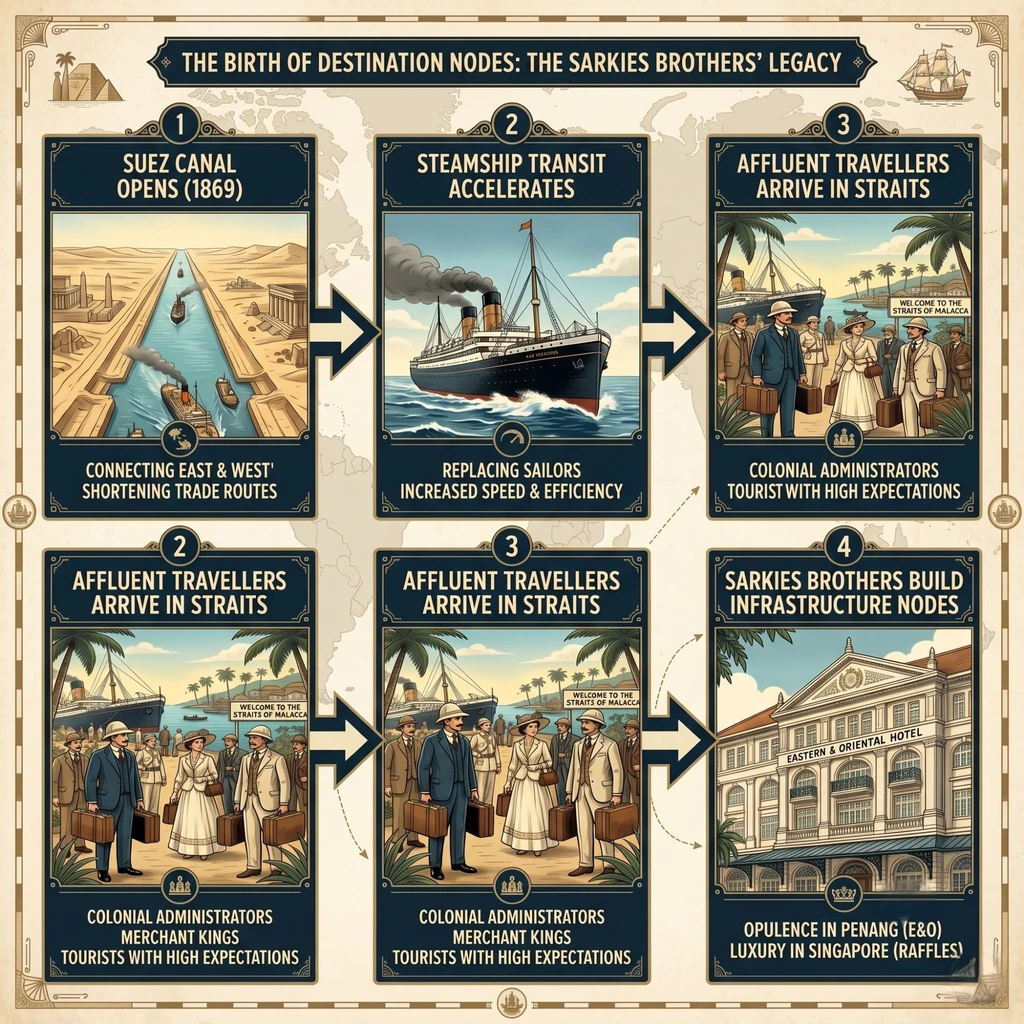
The opening of the Suez Canal in 1869 fundamentally altered global trade routes. Steamships replaced sailing vessels, drastically cutting transit times between Europe and Asia.
This maritime acceleration brought a new class of travellers to the Straits of Malacca: colonial administrators, global merchants, and wealthy industrialists. Southeast Asia’s ports grew rapidly to handle the trade cargo, but the physical infrastructure on land lagged. The region completely lacked accommodations that matched the expectations of this affluent, transient demographic.
The Sarkies brothers recognised this critical gap. Backed by the commercial networks of the local Armenian community, they did not view hospitality as a passive service industry. They viewed it as civic infrastructure.
Engineering the Node
When Tigran and Martin opened the Eastern Hotel on Light Street in 1884, followed by the Oriental on Farquhar Street in 1885, they selected strategic maritime touchpoints. These properties sat directly on the shipping corridors, serving as the first major landmarks visible from arriving steamers.
By the time they consolidated these properties into the Eastern & Oriental (E&O) and launched Raffles in Singapore in 1887, they had established a repeatable blueprint.
A successful destination node requires three distinct structural elements:
The Sarkies hotels became the default town halls of the British Empire in the East. Viscounts, authors, and tycoons did not just sleep there; they negotiated rubber prices, drafted administrative policies, and established social hierarchies. The hotel was the destination. The city grew around it.
The Endurance of Intellectual Luxury
Empires inevitably collapse. Trade routes shift, and colonial governance fades into history. Yet, the grand dames outlasted the political structures that birthed them.
When power shifted, these properties did not lose their purpose. Because they were engineered as the core nodes of their urban landscapes, they simply transitioned into the ultimate symbols of national heritage. They hold the monopoly on provenance.
A modern five-star hotel can buy premium marble, but it cannot buy the room where Rudyard Kipling wrote, or where global trade treaties were informally signed.
This is the foundation of intellectual luxury. True luxury is not defined by the thickness of a carpet or the brand of a coffee maker. It is defined by authenticity and historical weight.
Modern hospitality brands often try to manufacture a sense of place through superficial design cues. The Sarkies brothers achieved it by making their hotels indispensable to the geography they occupied. The grand dames remain relevant because they are not just hotels. They are the permanent anchors of Southeast Asia’s historical narrative.
At Heritasian.com, we reject the interchangeable monotony of modern luxury hotels. We believe true brand longevity belongs to the “destination node”—heritage properties permanently anchored to geography, macroeconomics, and historical provenance.
By analysing these enduring cultural assets, we decode how a hotel transitions from a passive hospitality business into an indispensable, unassailable pillar of a region’s identity.