
For twenty years, I’ve watched the sunset dip behind the silhouette of Doi Suthep. To the casual observer, the mountain is a scenic backdrop, a place to escape the heat, or perhaps a weekend pilgrimage.
But as Chiang Mai approaches its 2026 UNESCO World Heritage inspection, we must stop seeing the mountain as a “view” and start seeing it for what it truly is: the anchor of a Vertical Kingdom.
When we talk about the UNESCO bid, many local stakeholders and property owners focus on the “square”—the famous moat and the crumbling red-brick gates of the Old City.
But the bid currently before the ICOMOS inspectors is far more ambitious. It is a Serial Nomination, a sophisticated cosmic grid that connects the mountain’s peak to the valley floor along a single, sacred axis.
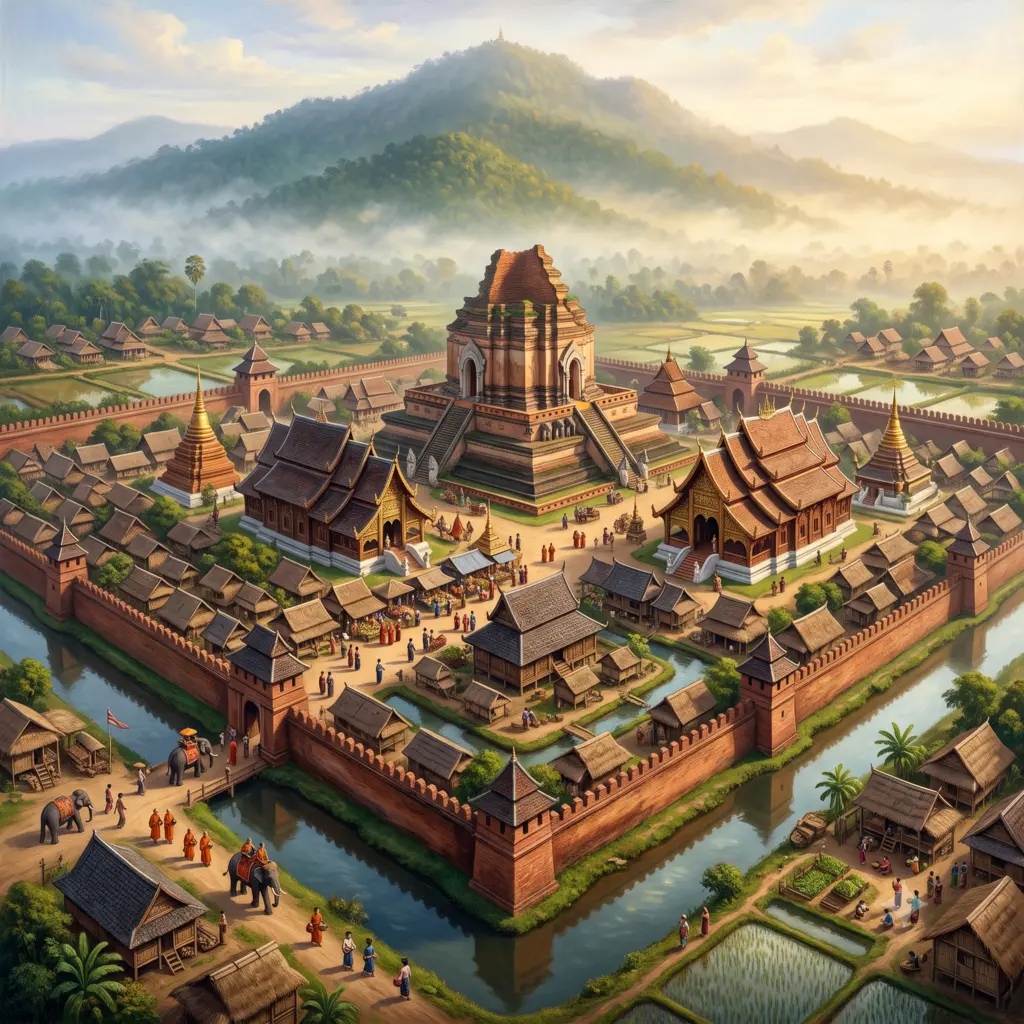
To understand the 2026 bid is to understand that Chiang Mai was never just a city. It was designed as a “Mandala” – a living, breathing map of the Lanna universe.
The Sacred Axis: From Peak to Pillar
In traditional Lanna cosmology, the landscape is not random. It is hierarchical. The bid focuses on this “Serial” nature because the city cannot be separated from the mountain.
I remember a conversation with a local historian who described the city’s layout as a “spiritual machine.” The mountain, Doi Suthep, represents the centre of the Buddhist universe, Mount Meru. The city below was built to align with it.
When King Mangrai founded the city in 1296, he didn’t just look for fertile soil; he looked for a site that could facilitate a conversation between the heavens and the earth.
This is the Vertical Kingdom.
The nomination includes Doi Suthep, not just for its natural beauty, but as the spiritual protector. If you remove the mountain, the city loses its “soul” in UNESCO’s eyes. This is a vital point for developers to understand: the “Buffer Zones” aren’t just about preventing high-rises; they are about protecting the “viewshed” that has defined Lanna identity for seven centuries.
The Oxford of the East: A Global Heritage
Perhaps the most overlooked “pillar” in this bid is Wat Chet Yot. Located outside the moat, this temple is often bypassed by the “tuk-tuk tour” crowd, but for the heritage strategist, it’s the crown jewel.
In the 15th century, Chiang Mai was the “Oxford of the East.” Under the reign of King Tilokaraj, Wat Chet Yot hosted the 8th World Buddhist Council. Think about that for a moment: while Europe was in the midst of the Renaissance, Chiang Mai was hosting an international summit of scholars to standardise the Tripitaka.
The architecture of Chet Yot itself – with its distinct Indian Mahabodhi influence – is the “smoking gun” of Lanna’s historical globalism. It proves that this was never a secluded mountain outpost. It was a sophisticated, intellectual hub that absorbed and refined global influences. This is exactly the kind of “Outstanding Universal Value” (OUV) that UNESCO inspectors are looking for.
The Teak Trail: Where Commerce Meets Conservation
While the spiritual axis is the heart, the Teak Trail is the muscle. One cannot talk about Chiang Mai’s heritage without acknowledging the 19th-century timber boom.
I’ve spent countless afternoons exploring the remaining teak mansions along the Ping River – structures that tell the story of the British Borneo Company and the Louis T. Leonowens era. This period transformed the city from a sacred mandala into a global economic player.
The UNESCO bid acknowledges this evolution. It recognises that heritage isn’t a static snapshot of the 13th century; it’s a layered history of how we traded, how we built, and how we adapted. For hospitality brands looking to tap into “Intellectual Luxury,” these teak-era stories provide a provenance that no modern five-star build can replicate.
The 2026 Reality: Management, Not Just Monuments
As we count down to the June 2026 technical visits, the conversation among stakeholders must shift. UNESCO status is not a “Lifetime Achievement Award”—it is a management contract.
I often hear property owners in the Old City express fear. “Can I still paint my shutters?” “Will I be allowed to put an AC unit in my guest house?”
The reality of managing a property in the UNESCO Core Zone is actually more nuanced than the myths suggest. UNESCO doesn’t want a museum; they want a “Living Heritage” city. They want the 12-meter height restrictions to be respected so the “Sacred Axis” to Doi Suthep remains visible. They want the vernacular Lanna architecture to be preserved because it’s the “DNA” of the brand.
For the B2B community – investors, architects, and hotel operators – this is a strategic pivot. UNESCO status is the ultimate “Stamp of Quality.” It signals to the world that Chiang Mai is a destination for the “High-Value, Low-Impact” traveller. It is a move toward a model of tourism that values depth over density.
The Path Forward
The 2026 UNESCO Bid Hub is more than just a collection of historical data. It is a roadmap for the city’s next century.
Whether we are talking about the cosmic geometry of the City Walls or the intellectual legacy of Chet Yot, the goal remains the same: to protect the “Lanna Creative Renaissance.”
We are not just curators of the past; we are the strategists of the future. By understanding the “Vertical Kingdom,” we ensure that when the UNESCO inspectors arrive, they don’t just see a beautiful city – they see a civilisation that knows exactly where it came from, and exactly where it is going.