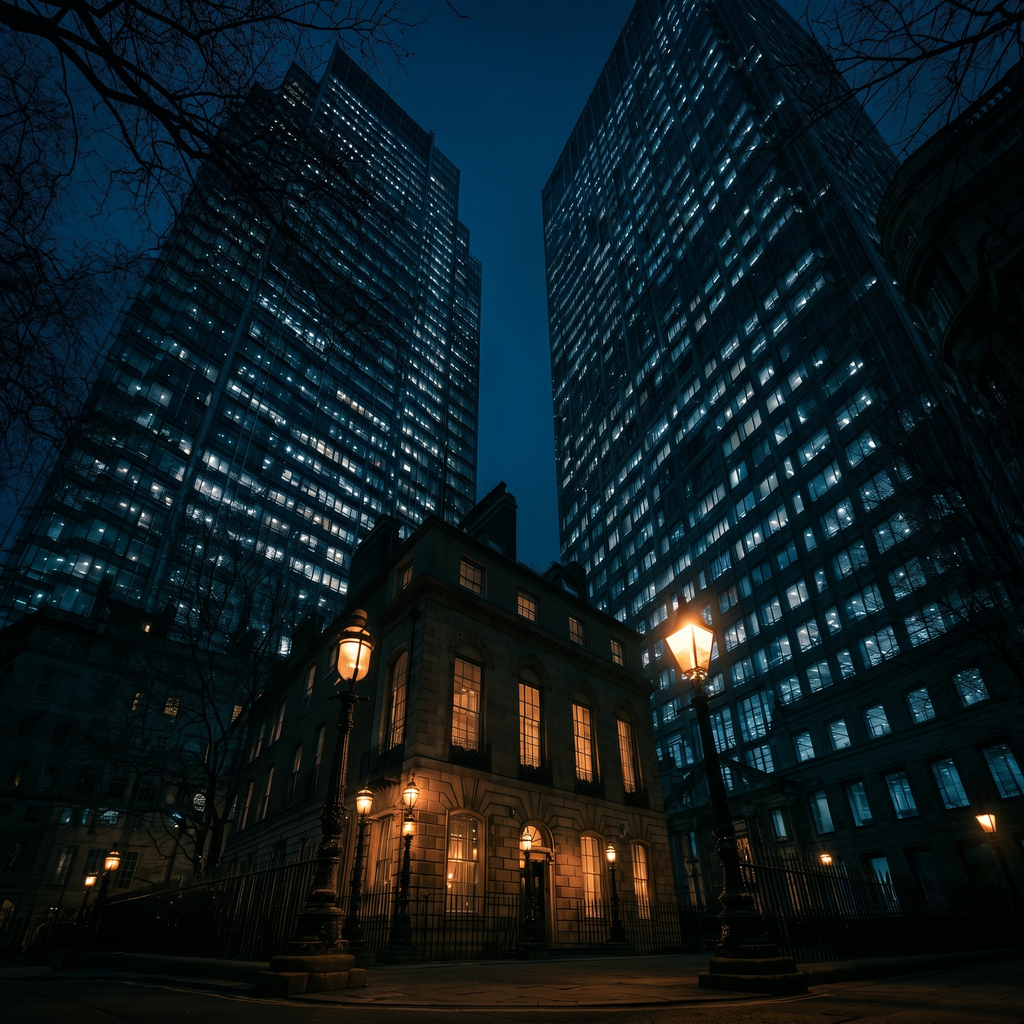

Walk through London, Singapore, or Dubai, and you’ll notice a paradox unfolding in prime real estate market dynamics.
A newly constructed glass-and-steel super-tower – boasting floor-to-ceiling smart glass, automated valet systems, and imported Carrara marble – often struggles to command the same long-term scarcity premium per square foot as a restored 19th-century conservation shophouse on Singapore’s Amoy Street or a restored Georgian estate in Mayfair.
Why? Because in ultra-high-net-worth (UHNW) wealth circles, material luxury has been democratised.
If anyone with $50 million can replicate a penthouse interior using the same interior designers, sub-zero appliances, and infinity pool mechanics, then modern physical luxury ceases to function as a positional asset. It becomes commoditised efficiency.
What cannot be manufactured, bought off a spec sheet, or replicated by a competitor is Architectural Provenance.
In real estate economics, provenance is the value generated by irreversible time, structural scarcity, and historical narrative. It is the difference between buying a square foot of shelter and owning an unrepeatable piece of cultural heritage.
For luxury travel advisors and itinerary designers, this real estate dynamic is a direct mirror of our own industry.
The Three Lessons of Property Provenance for Travel Designers
Property developers specialising in heritage restoration do not sell square footage; they sell custodianship. They understand three core financial and psychological levers that luxury travel advisors must adopt:
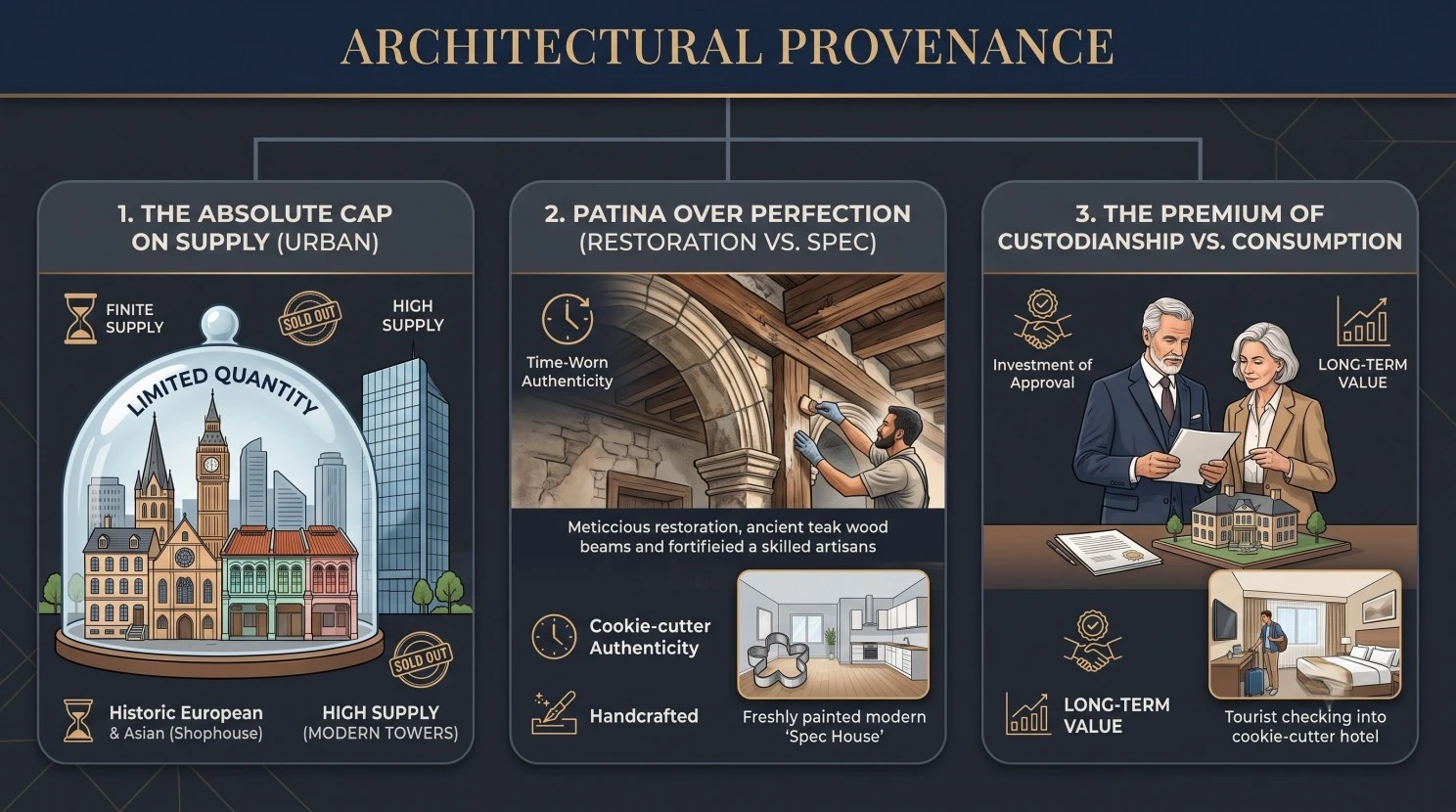
1. The Absolute Cap on Supply
In real estate, central banks can print currency, and developers can construct denser towers, but urban planning authorities will never grant permits for new 1890s Heritage Shophouses. Supply is permanently fixed.
The Travel Translation: Stop selling high-inventory “5-star luxury” that can be booked on any online portal. A standard deluxe suite in a 400-room luxury hotel chain has high elasticity and zero supply cap.
Travel designers must pivot toward assets with hard physical caps – private buyout access to a 16th-century Chianti palazzo, exclusive after-hours access to historical landmarks, or accommodations with true architectural pedigree.
2. Patina Over Perfection
When real estate developers restore a pre-war estate in George Town, Penang, they don’t attempt to make the original lime-wash brick look brand new. They highlight the imperfections – the hand-carved teak beams, the wear on the original tile, the architectural quirks. The “imperfection” is precisely what proves authenticity.
UHNW clients are exhausted by homogenised, sanitised luxury. A modern hotel room that looks identical in Tokyo, Paris, or New York offers zero positional narrative. Advisors must market the patina of place – highlighting the sensory, imperfect, and deeply contextual elements of a historic estate or a localised private journey rather than formulaic white-glove uniformity.
3. The Premium of Custodianship vs. Consumption
A high-net-worth buyer acquiring a Grade II-listed property in London views themselves as a temporary custodian, not just an owner. They derive social capital from preserving history.
The Travel Translation: Position your high-net-worth clients not as tourists consuming a destination, but as patrons supporting provenance. Frame an itinerary around how their stay contributes to local heritage conservation, private architectural restoration, or traditional craftsmanship.
Micro-Market Dynamics: The Lessons of Adaptive Reuse
Look closely at the urban playbooks of heritage capitals like Singapore, George Town, or London’s historic boroughs. The properties commanding the most eye-watering valuation multiples are rarely untouched museum pieces; they are masterclasses in adaptive reuse.
A conserved 19th-century timber-and-brick shophouse in Penang or a restored mansion on Singapore’s Mount Sophia retains its historical shell while seamlessly integrating modern engineering under the hood.
The market does not penalise these structures for their modern plumbing or climate control – it rewards the friction required to merge structural legacy with contemporary comfort. The friction is the barrier to entry.
The Experiential Yield: Beyond “Boutique” Marketing
For luxury travel advisors, this distinction is critical. The market is saturated with brand-new “boutique” properties that attempt to manufacture character through interior styling and artisanal amenities. But UHNW travellers, much like institutional heritage investors, can instantly spot the difference between styled decor and structural pedigree.
When an itinerary is anchored around living history – staying in a private estate where every hand-carved teak beam or worn lime-wash wall holds a documented lineage – the traveller’s yield transitions from passive consumption to active cultural participation. You aren’t merely booking a key; you are brokering temporary access to an irreplaceable asset.
How to Value and Pitch Provenance: A Framework for Travel Advisors
To shift your client conversations away from hotel room rates and toward positional value, apply this comparison framework when curating accommodations and private access:
Practical Application: Re-Architecting the Itinerary
How do you turn this economic concept into actionable travel design?
- Stop Selling Amenities: Start Auditing Provenance.
- Leverage the “Behind-Closed-Doors” Factor.
- Reframe Premium Pricing.
The Bottom Line
In real estate, modern glass towers age into irrelevance as newer towers are built to replace them. Heritage architecture, conversely, compounds in positional value as time moves forward.
As luxury travel designers, our job is not to connect clients with standard comfort – comfort is a baseline expectation. Our job is to trade in scarcity, narrative, and historical provenance. When you sell living history, price resistance disappears.