
If you look at the standard marketing collateral for Northern Thailand, you will find yourself drifting through the most comfortable, risk-averse district of Banalistan.
In this particular zone, corporate hospitality agencies and lifestyle strategists flatten the ancient highlands into a sterile checklist of lifestyle commodities: “misty valleys,” “instagrammable tea plantations,” and “serene mountain escapes.”
The marketing treats the landscape like an empty, passive backdrop designed solely for Western wellness retreats, luxury glamping, and digital nomads seeking a pretty place to drink matcha lattes.
But Northern Thailand is not passive. Its landscape is heavy with a collective psychology, living animism, and a raw sovereign history that demands absolute reverence.
True destination strategy requires deep, uncompromising provenance rather than superficial adjectives. It requires understanding the psychological geography of a place. Take Doi Nang Non—the Mountain of the Sleeping Lady.
Long before it became the backdrop for a global rescue operation, this mountain range was a living character with a history forged in royal tragedy and sovereign borders.
The Myth: A Princess Bleeding Into the Periphery
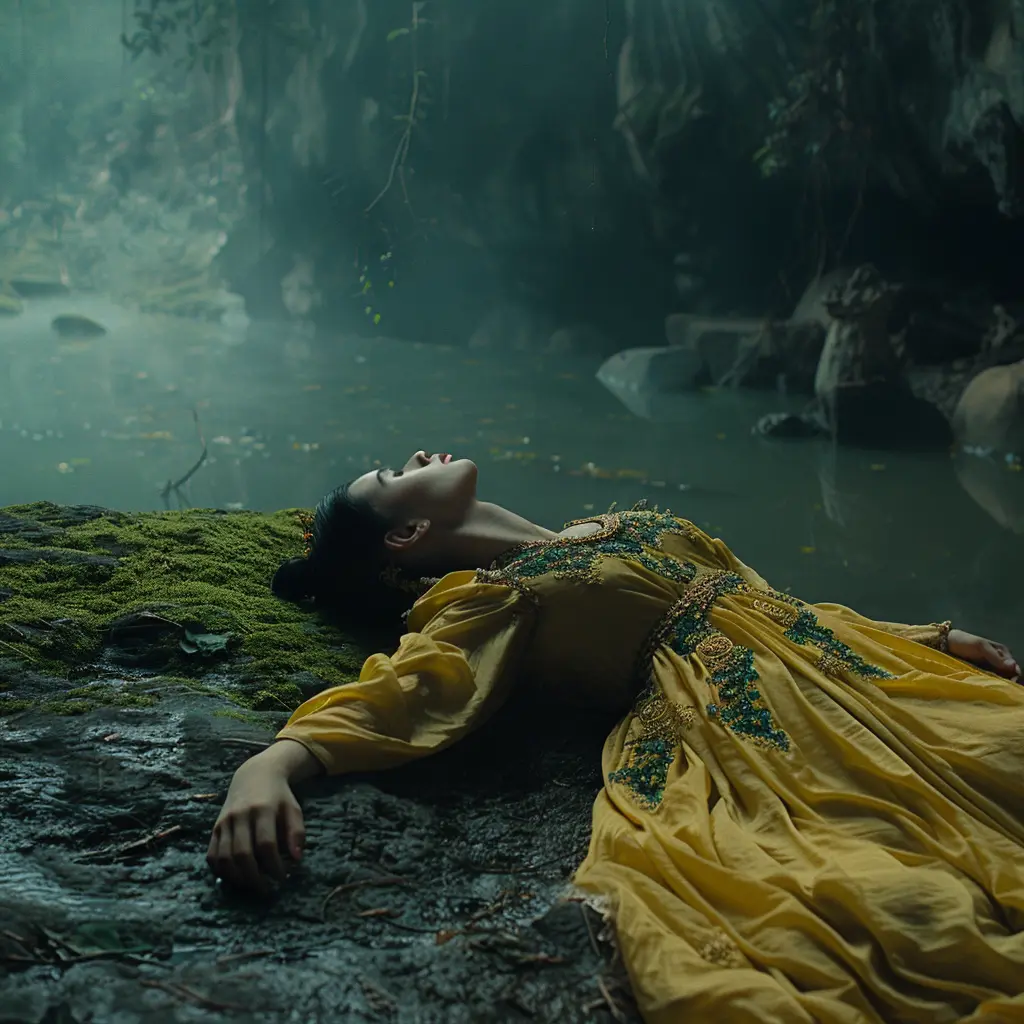
If you stand in Chiang Rai and look toward the border of Myanmar, the silhouette of the mountain range is unmistakable. It is not an abstract geological formation; it takes the precise shape of a pregnant woman lying on her back, her head to the north, her belly rising toward the sky.
The story behind it isn’t a sanitised fairytale. It’s a classic, brutal tragedy about class, borders, and state violence.
Long ago, a beautiful princess of the ancient, sovereign Tai kingdom of Chiang Rung (southern Yunnan) fell in love with a humble woodsman. It was a deeply forbidden romance, made complex when she became pregnant.
To escape the wrath of her royal father, the lovers fled south, seeking refuge in the rugged, ungoverned highlands of what is now northern Thailand.
They rested in a deep valley while her lover went out to forage for food. But her father’s royal guards were hunting them. They ambushed the woodsman in the forest and slaughtered him.
Waiting for days, driven by absolute despair and realising her lover was never coming back, the princess took a royal hairpin, drove it into her own skull, and bled to death on the valley floor.
As her life slipped away, her body transformed into the mountain range itself. Her torso became the peaks, her pregnant belly became the ridges of Doi Tung, and her blood became the treacherous, subterranean water system winding through the limestone strata—the 10-kilometre labyrinth known as Tham Luang.
The Modern Convergence: When Myth Swallowed Global Logistics
For centuries, local communities treated Doi Nang Non with immense caution. To the indigenous people, the mountain was not “scenery”; it was a living animist entity – the spirit of a vengeful, heartbroken matriarch who fiercely guarded her domain.
You did not disrespect her, and you certainly did not venture into her womb during the monsoon.
Then came June 2018.
When a youth football team and their coach were trapped kilometres deep inside the flooded tunnels of Tham Luang, the world saw a modern engineering crisis. Bureaucrats from Bangkok and elite international dive teams arrived with high-tech pumps, industrial drills, and military logistics.
But on the ground, a completely different strategic negotiation was happening.
While the international media focused entirely on tech, the local community, the families, and even state officials were quietly building shrines at the cave mouth. Monks and animist masters performed intricate rituals, begging the spirit of the Sleeping Lady to release the children she had swallowed.
When the central state tried to dismiss the local folklore as mere “superstition,” it hit a wall. They realised that to manage the crisis, they had to respect the local geography.
The survival of those boys required a masterclass in modern science, but to the people of Chiang Rai, it also required an explicit apology to an ancient princess. The myth wasn’t a historical footnote; it was the dominant psychological landscape of the entire rescue.
The Destination Strategy Takeaway
Banalistan sells a destination as a static asset. Real storytelling reveals that a destination is a living character with a temperament, a history, and an identity that outlasts any marketing campaign.
The next time you are tempted to approve a marketing deck filled with words like “serene escape” or “picturesque vista,” reject it. Dig deeper. Find out who died there, who guards it, and why the locals look at the landscape with a quiet, enduring sense of awe.