
Key Insights
Doi Suthep serves as “Component 2” of the 2026 UNESCO nomination, linking Chiang Mai’s “Living Grid” to its sacred highlands. Beyond the 14th-century White Elephant legend, the mountain acts as a hydraulic sponge, filtering monsoon rains that feed the city’s ancient moat. Key heritage sites include the 306-step Naga staircase, the golden chedi wrapped in Thong Changko, and the subterranean tunnels of Wat Umong.
Wat Phra That Doi Suthep: Founded in 1383, this foundational Lanna mountaintop temple serves as the spiritual anchor of Chiang Mai, housing a sacred relic of the Buddha within its central gilded bell-shaped stupa.
Chedi: A Buddhist monument or stupa. The central chedi at Doi Suthep showcases classic Lanna design elements, blending a stylised octagonal base with an umbrella-crowned, gold-plated spire.
Pu Sae Ya Sae: The ancestral guardian spirits of the Lawa people, deeply integrated into Chiang Mai’s belief system, who are said to reside in the forests flanking Doi Suthep and require annual animist rituals to ensure the city’s protection.
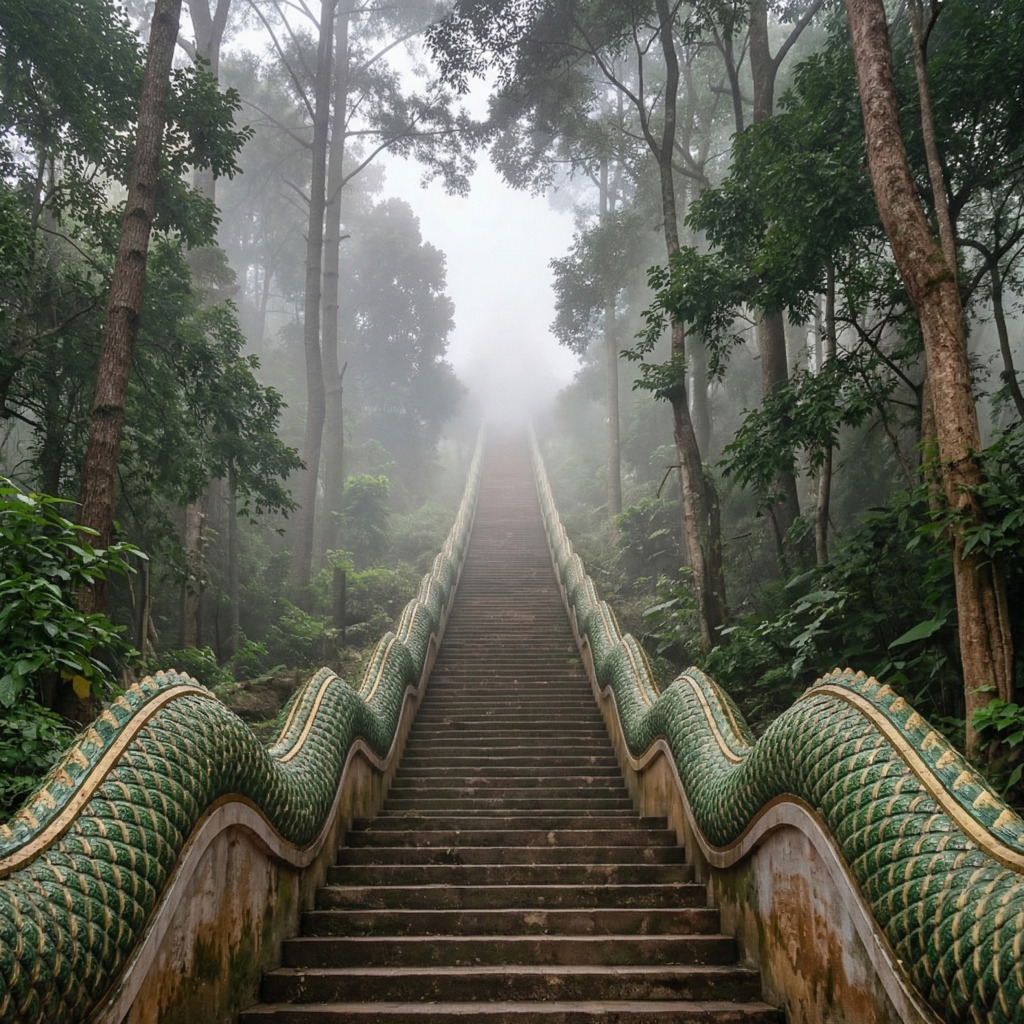
Naga Staircase: A monumental 306-step staircase flanked by serpentine stone Nagas (mythical water serpents), symbolising the physical and psychological transition from the mundane earthly realm to the sacred mountain peak.
Kruba Srivichai: A revered 20th-century Lanna monk and cultural icon who mobilised thousands of local volunteers in 1935 to construct the first drivable road up Doi Suthep, bypassing weeks of hazardous mountain trekking.
Sacred Axis: An urban design principle used by the founders of Chiang Mai, positioning the capital city in alignment with Doi Suthep to draw protective spiritual energy from the mountain down into the royal citadel.
As part of the 2026 Chiang Mai UNESCO World Heritage nomination dossier, the sacred mountain of Doi Suthep is formally designated as “Component 2” of “Chiang Mai, the Capital of Lanna.” It serves as the definitive environmental and spiritual link between the city’s man-made “Living Grid”, the historic, moated 1.6-square-kilometre urban core, and the wild, protected highlands.
Within the framework of a UNESCO Cultural Landscape, this relationship is vital. Without the sacred topography of the mountain, Chiang Mai’s footprint would be indexed as a flat, secular grid in a forest valley.
With it, the landscape transforms into a profound vertical kingdom, mapping Theravada Buddhist cosmology directly onto the physical terrain by positioning the earthly city at the base and the celestial realm (Wat Phra That Doi Suthep) at the apex.
The Trial of the White Elephant
The story of Doi Suthep Chiang Mai temple begins with a miracle in the 14th century. A monk named Sumana Thera arrived from Sukhothai bearing a bone relic of the Buddha. Legend says the relic self-replicated in front of King Nu Naone. The King possessed two relics but only one palace. He needed a sign to place the second one.
He strapped the relic to the back of a sacred white elephant and released it from the White Elephant Gate (Chang Phuak). The elephant did not head for the fertile river banks. Instead, it turned toward the dense jungle of the mountain. It climbed for days through the teak and bamboo.
Upon reaching the summit, the elephant trumpeted three times, circled the peak, and took its final breath. The golden chedi stands today on the exact spot where that elephant fell. It turned a physical tragedy into a spiritual anchor. This elephant is still honoured today; you can find its statue near the temple entrance, draped in garlands and marigolds.
The Naga Ascent: Architecture of Transition
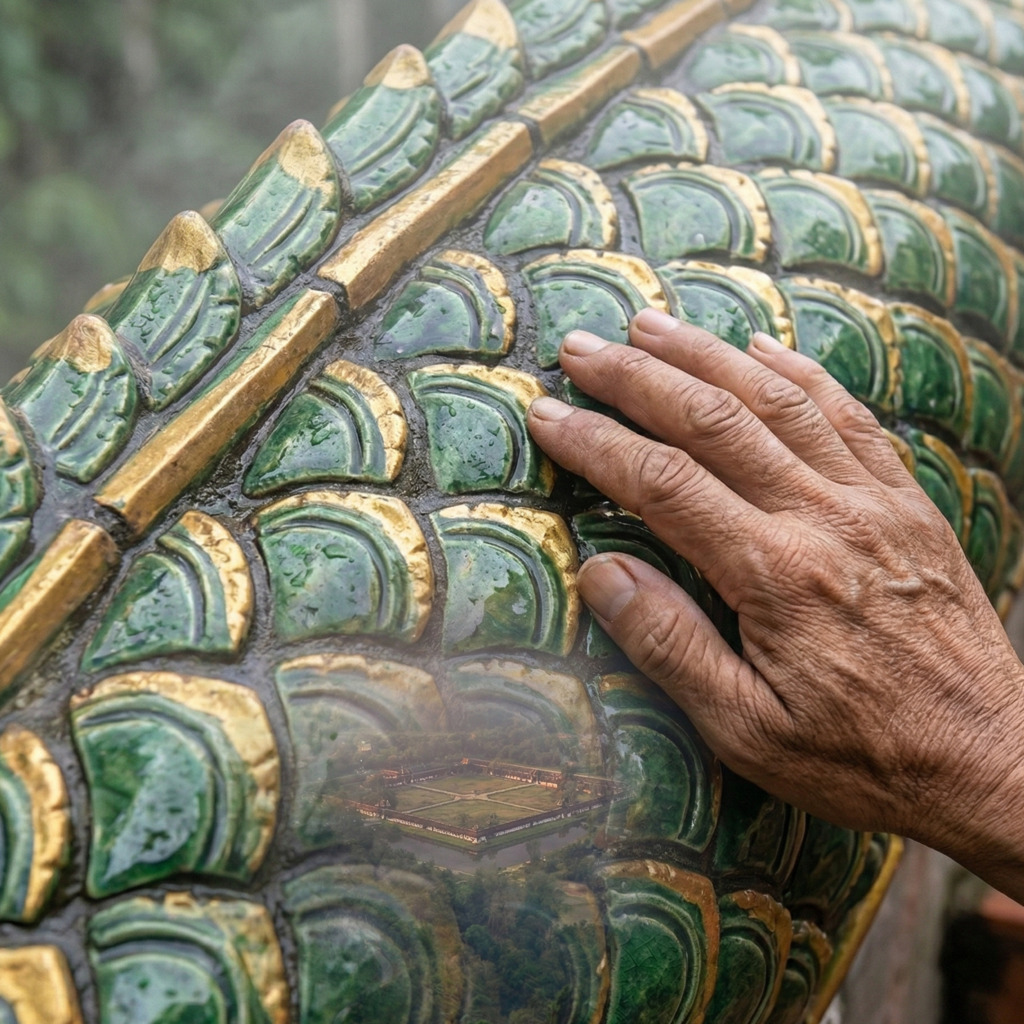
To reach the relic today, you must face the 306-step Naga staircase. This is the longest serpent staircase in Thailand. It is a masterpiece of green-and-gold ceramic craftsmanship. The Nagas represent the underworld, their long bodies forming the handrails that lead you toward the celestial realm.
As you climb, the air changes. The humidity of the valley floor gives way to a sharp, pine-scented cool. This ascent is a ritual of transition. You leave the commerce of the “Living Grid” behind and enter the “Cloud Kingdom.”
Each step is designed to slow your heart rate and prepare your mind for the golden silence at the top. Notice the “scales” on the Naga—each one is a hand-pressed tile, a testament to the thousands of hours of merit-making labour that built this ascent.
The Golden Lighthouse: A Technical Autopsy
At the summit sits Wat Phra That Doi Suthep. The central chedi is a marvel of Lanna engineering. Unlike the brick ruins in the city, this stupa is wrapped in Thong Changko—heavy, hammered brass plates. These plates protect the structure from the mountain’s fierce monsoon rains.
The chedi sits on an octagonal base, a hallmark of the Lanna “Classic” style. At the four corners stand five-tiered gold umbrellas. These represent the five Buddhas of our current era. They provide “royal shade” to the relic hidden deep within the brick core. From the viewpoint nearby, you can look down at the “Living Grid.”
You see the perfect square of the moat 700 meters below. From this height, the city looks like a mandala laid out on a green velvet carpet.
The cloister surrounding the chedi is a gallery of Lanna history. Look for the murals depicting the life of the Buddha, but also pay attention to the bells. There are dozens of them, ranging from tiny bronze trinkets to massive iron giants. Pilgrims ring them to spread the “vibration” of their prayers across the valley. It is a sonic ritual that has echoed here for centuries.
Wat Umong: The Subterranean Silence
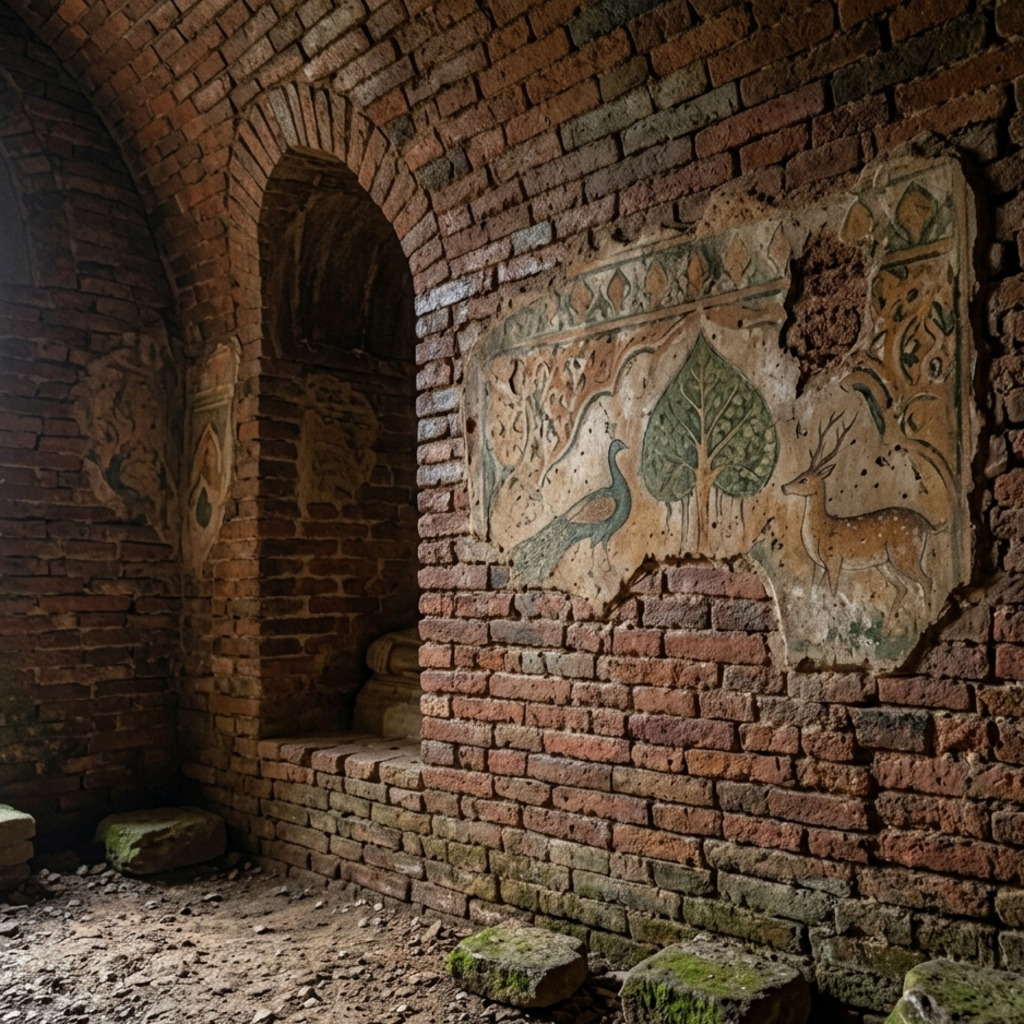
At the foot of the mountain lies a complete contrast to the golden peak. Wat Umong, the “Tunnel Temple,” dates back to the 14th century. It was built for a monk named Phra Mahathera Chan. Locals called him the “Mad Monk” because of his erratic, deep meditations. The King ordered tunnels carved into the hillside to keep the monk from wandering lost into the deep forest.
Inside, the atmosphere is heavy and cool. The tunnels are lined with some of the oldest surviving Lanna paintings. You can still see faded outlines of birds, deer, and flowers. These are not royal icons; they are celebrations of the forest.
This temple represents the “Forest Sect” (Aranyawasi) of Buddhism. It reminds us that Lanna’s faith was as much about the earth and the roots as it was about the gold and the stars.
The “Talking Trees” of Wat Umong are a more modern addition. Propped against the ancient trunks are signs with Buddhist proverbs. “Detach from the result,” one says. It is a reminder that the mountain’s wisdom isn’t just in its heights, but in its shadows.
The Monk’s Trail: The Path of Pha Lat
Before the road existed, there was the Palaad Trail. This is the historic walking route used by pilgrims and monks for seven centuries. It starts at the edge of the city and winds through the dry dipterocarp forest.
Halfway up, you encounter Wat Pha Lat. This is perhaps the most “Heritasian” site on the mountain. It is a hidden temple carved into a waterfall. Here, the architecture is almost invisible, blended into the rocks and vines.
You will find stone lions covered in moss and small shrines tucked into the roots of ancient Banyan trees. This was the resting point for the white elephant on its final journey. It remains a place of profound silence, far from the crowds of the summit.
Kru Ba Srivichai: The Saint’s Road
Before 1935, the climb to the top was a five-hour ordeal. This changed when Kru Ba Srivichai, the “Saint of Lanna,” took action. He refused government funding, which he saw as a form of centralised control from Bangkok. Instead, he called on the local people.
Thousands of volunteers arrived from every corner of Northern Thailand. They didn’t have bulldozers; they had wicker baskets and hand hoes. Different villages took turns building 10-meter sections of the road. They fueled themselves on faith and baskets of sticky rice.
They completed the 11-kilometre mountain road in just five months and 22 days. This road is more than asphalt; it is a monument to the collective will. At the base of the mountain, his statue remains the most visited shrine in the province.
The Hydrology of Holiness

The connection between Doi Suthep and the Old City is not merely spiritual; it is hydraulic. The mountain serves as a massive granite sponge. During the monsoon, the dense dipterocarp forests catch the rain, filtering it through layers of ancient root systems. This water emerges as the “Huay” (streams) that feed the city’s moat.
In Lanna cosmology, water is the carrier of Barami (merit). When you stand at Wat Pha Lat, you are seeing the city’s lifeblood in its purest form. Historically, the health of these mountain streams was a direct reflection of the King’s righteousness. If the streams ran dry, it was believed the “Spirit of the City” was offended.
By including the mountain in the UNESCO bid, Thailand is acknowledging that you cannot protect a 13th-century brick wall without also protecting the 10-million-year-old watershed that keeps its moat full.
The Invisible Pilgrims
Beyond the monks and the tourists, the mountain is home to the “Invisible Lanna”—the Hmong communities who have lived on these slopes for generations. Their relationship with the peak adds a layer of high-altitude heritage.
They are the traditional guardians of the “Opium-to-Peach” transition, a Royal Project success that turned hillsides once scarred by poppies into thriving orchards. Their presence reminds us that the “Vertical Kingdom” is a multi-ethnic tapestry. To walk the mountain is to cross through different climate zones and different cultures, all held together by the gravity of the peak.
The Guardian of the Grid
Today, the mountain faces new challenges. Encroaching development and climate shifts threaten the watershed. This is why the UNESCO nomination is vital. It treats the mountain as a biosphere, not just a tourist stop. Doi Suthep is home to 160 species of birds and rare orchids found nowhere else.
The “Capital of Lanna” is a story of two halves. The Old City is the heart, but the mountain is the soul. By preserving the forests of Doi Suthep, we preserve the water in the city moat. We preserve the “Spirit of Place” that King Mangrai sought 700 years ago. The mountain is the ultimate “Buffer Zone” for the city. It limits urban sprawl and forces the “Living Grid” to remain humble.
Conclusion: The Eternal Ascent
Heritage isn’t a static object. It’s the act of walking a trail that your ancestors walked. It is the smell of incense on a humid morning and the sound of temple bells competing with the wind. The 2026 UNESCO bid confirms what locals already know. This mountain is a living presence.
By looking up from the city square, we see seven centuries of faith. By climbing the Naga stairs, we participate in the same transition as the 14th-century kings. Chiang Mai reminds us that we can grow without forgetting our roots—as long as we remember to look toward the peak. The “Vertical Kingdom” is not just a place; it is a perspective.
Heritasian Takeaway
To truly feel the mountain, skip the cable car. Walk the Monk’s Trail. Start at 6:00 AM to see the sunrise filter through the bamboo. Take a small offering of flowers to Wat Pha Lat. It is here, in the sound of falling water and rustling leaves, that you realise why the elephant stopped. The mountain isn’t just a destination; it is a teacher.