
Key Insights
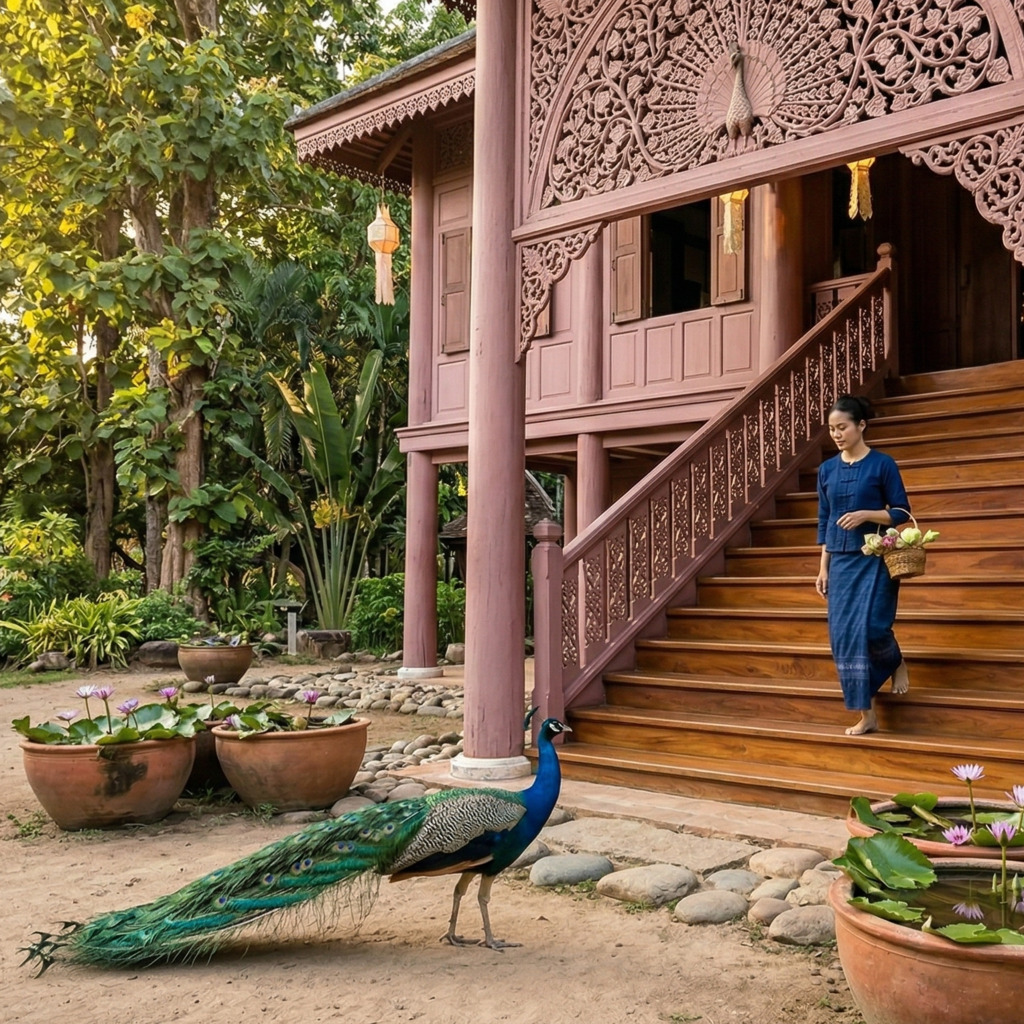
Phrae is Northern Thailand’s overlooked “Teak Capital,” a serene Lanna city defined by 19th-century timber wealth. Famous for its pink “Gingerbread” mansions, intricate fretwork, and indigo-dye traditions, it offers a slow-paced journey through colonial-era history. From royal palaces to pillar-filled museums, Phrae preserves an authentic, aristocratic soul untouched by mass tourism.
Explore the complete Lanna Teak Trail topic.
Ruan Saranai (Salanai): The regional architectural archetype that married Victorian gingerbread layouts with local Lanna timber carpentry, typically featuring a half-wood, half-concrete structure with fully opening folding front doors on the ground floor.
Filigree Fretwork: The defining feature of the style; thin, intricately perforated or sawn teakwood panels used along eaves, gables, and air passages above doors to provide vital cross-ventilation while casting patterned shadows inside the structure.
Chao Luang / Khum: Terms denoting the local Lanna royalty and their official residential compounds (such as Khum Vongburi or Khum Chao Luang in Phrae), which served as the primary incubators for this high-status, Western-influenced teak architecture.
Lathed Finials: The sharp-ended, vertically spun wooden elements attached to the tips of gables and roof apexes, replacing traditional Lanna Galae (crossed horns) with a Victorian silhouette adapted for local timber templates.
Phrae’s urban fabric represents an intact architectural record of the late-nineteenth-century northern Thai timber rush, catalysed when British extraction syndicates—principally the Bombay Burmah Trading Corporation and the Borneo Company Limited—shifted capital into Siam following the depletion of lower Burmese teak concessions.
The resulting domestic vernacular, formalised under King Rama V as Reuan Khanom Pang Khing (Gingerbread style), synthesised Victorian fretwork ornamentation with indigenous Lanna environmental engineering.
To withstand the violent humidity and thermal loads of the northern monsoon, local master joiners executed these estates entirely in heartwood Tectona grandis (golden teak)—a naturally hydrophobic, silica-rich timber impervious to rot and subterranean termites.
Rather than enclosing structures with solid timber plank walls that trapped radiant heat, builders installed perforated, hand-sawn fretwork transoms (Chong Lom) to generate passive convective cross-breezes, resting the entire superstructure atop massive, unanchored teak log piles capable of absorbing seismic shifts without structural failure.
From the aristocratic dualities of Khum Chao Luang to the private commercial archives of Vongburi House, these compounds stand as complex engineering solutions where colonial extraction capital, royal Siamese diplomacy, and Shan timber-guild mechanics physically converge.
The Teak Concession Regime: Extraction Capital and the Yom River Corridor
Phrae’s late-nineteenth-century architectural boom was driven by an acute supply crisis in British Burma. By the 1880s, over-harvesting across the Irrawaddy and Salween basins forced British extraction syndicates—led by the Bombay Burmah Trading Corporation and the Borneo Company Limited—to secure long-term logging leases across the dense Tectona grandis (golden teak) watersheds of Northern Siam.
Positioned directly along the Yom River, Phrae functioned as a primary extraction and log-sorting node. Timber felled in the surrounding uplands was girdled, seasoned for two years to reduce buoyancy weight, hauled by elephant teams to tributary streams, and floated down the Yom into the Chao Phraya river system toward Bangkok sawmills and European shipyards.
This extraction economy concentrated British capital, Burmese and Shan (Tai Yai) foresters, and Lanna hereditary rulers (Chao Mueang) within a single riverine trading post.
Surplus concession capital flowed directly into monumental domestic construction. Before Bangkok’s establishment of the Royal Forest Department in 1896 centralized timber taxation—a fiscal intervention that stripped local aristocracy of forest royalties and catalysed the 1902 Shan Rebellion—Phrae’s ruling elite and timber contractors converted untaxed hardwood stockpiles into sprawling residential compounds.
Utilising massive, old-growth heartwood logs reserved by royal prerogative, these estates served as tangible balance sheets demonstrating direct control over timber concessions, elephant transport fleets, and corvée carpentry labour.
Structural Adaptation: Reuan Khanom Pang Khing and Monsoon Engineering
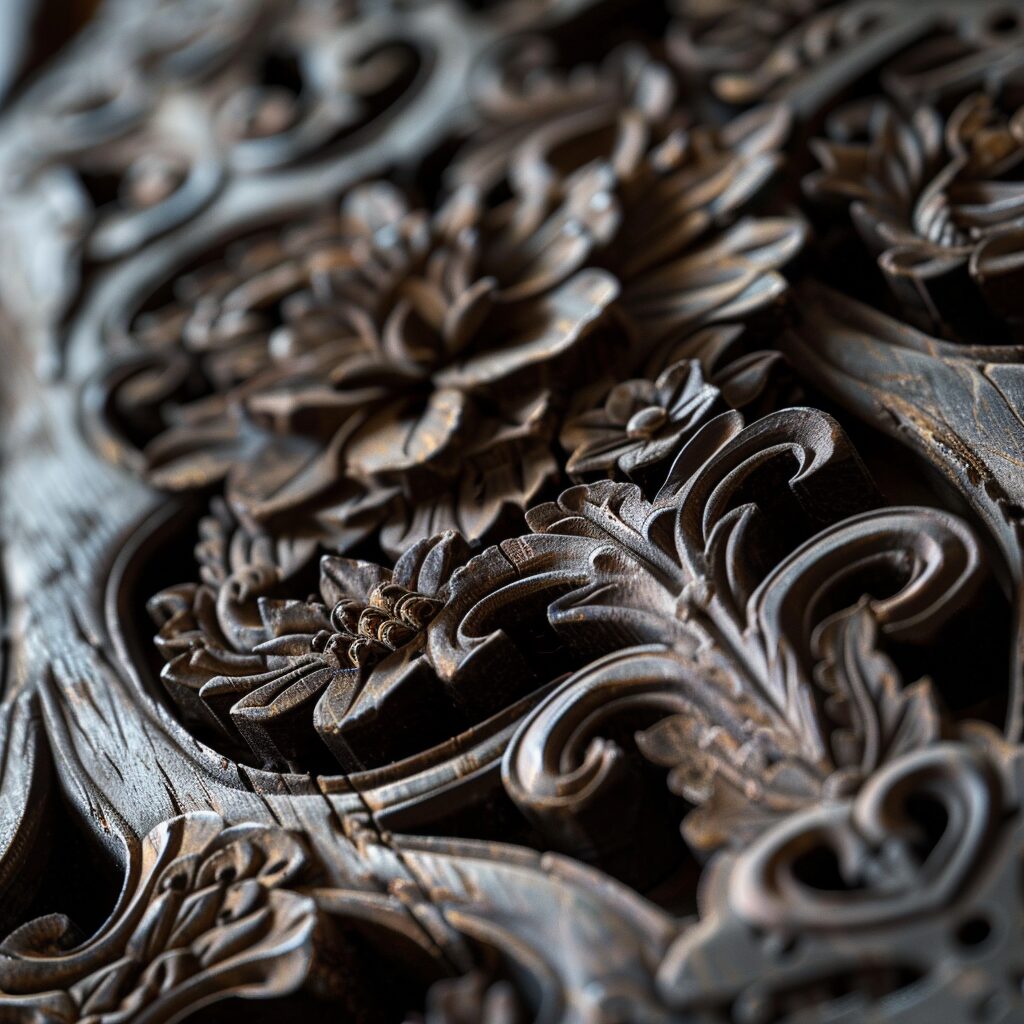
Popularised during the reign of King Chulalongkorn (Rama V, r. 1868–1910), Phrae’s Reuan Khanom Pang Khing (Gingerbread) vernacular emerged from a calculated diplomatic synthesis.
To project administrative parity with European colonial powers operating across mainland Southeast Asia, Siamese and Lanna elites grafted Victorian Carpenter Gothic ornamentation—sawn bargeboards, turned balustrades, and louvred verandas—onto indigenous northern timber framing. Local master joiners converted these imported decorative motifs into functional environmental engineering calibrated for the northern monsoon basin:
Vongburi House: Commercial Capital and Manumission Archives
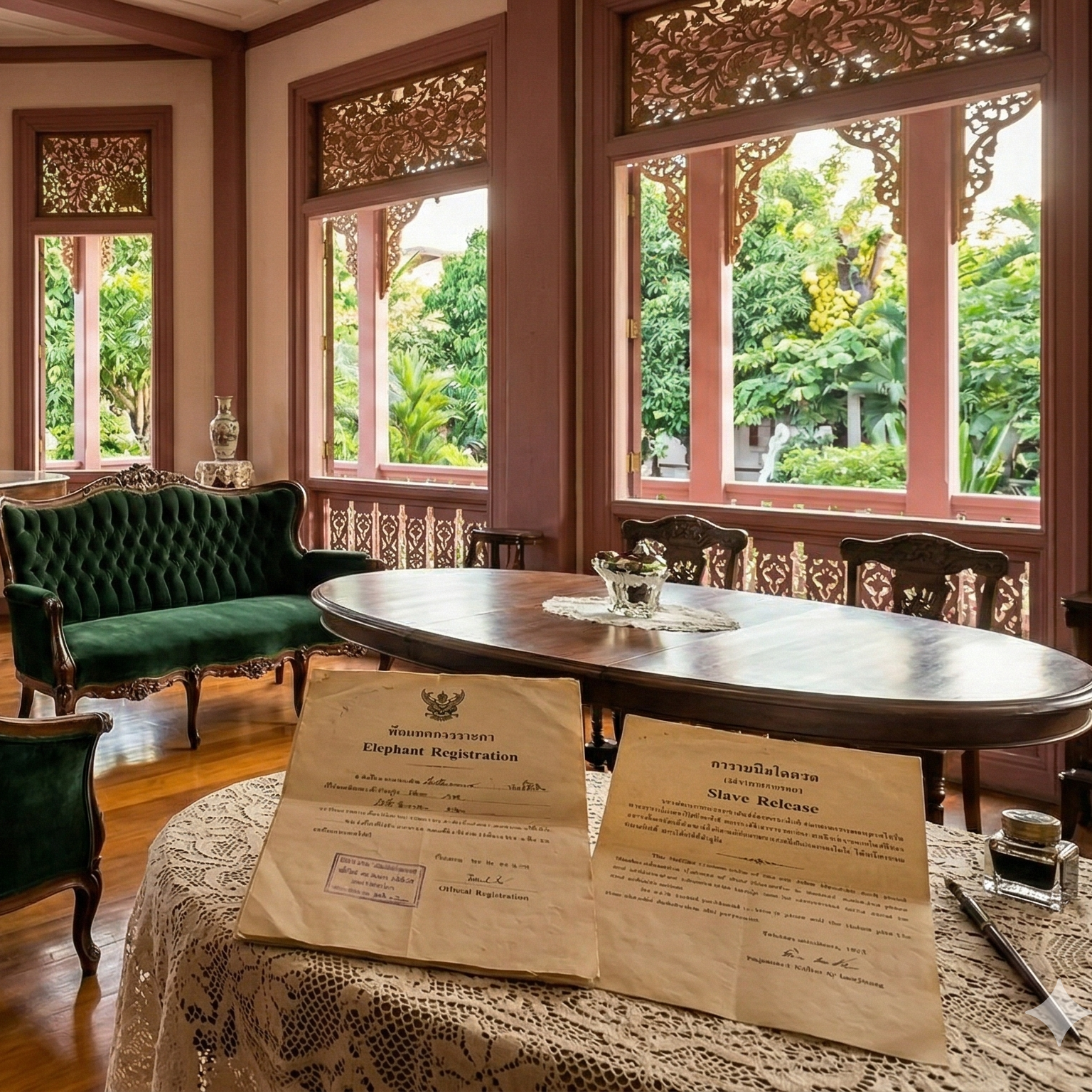
Constructed in 1897 by Luang Phongphibun (Chao Phrom Vongburi) and Mae Chao Sunantha—adopted daughter of Phrae’s last ruling prince, Chao Piriyathepwong—Vongburi House stands as the primary surviving record of the northern aristocracy’s transition from feudal tributary rule to commercial timber capitalism.
Finished in lime-washed rose-terracotta plaster over an all-teak structural frame executed by Cantonese and Shan master carpenters, the two-storey compound avoided confiscation after the 1902 Shan Rebellion because its collateral branch maintained commercial alignment with Bangkok’s Royal Forest Department.
Unlike state-restored monuments stripped of domestic context, Vongburi House remains under continuous private family stewardship, preserving the material logistics and legal documentation of a late-nineteenth-century logging dynasty:
Khum Chao Luang: Tributary Sovereignty and Coercive Architecture
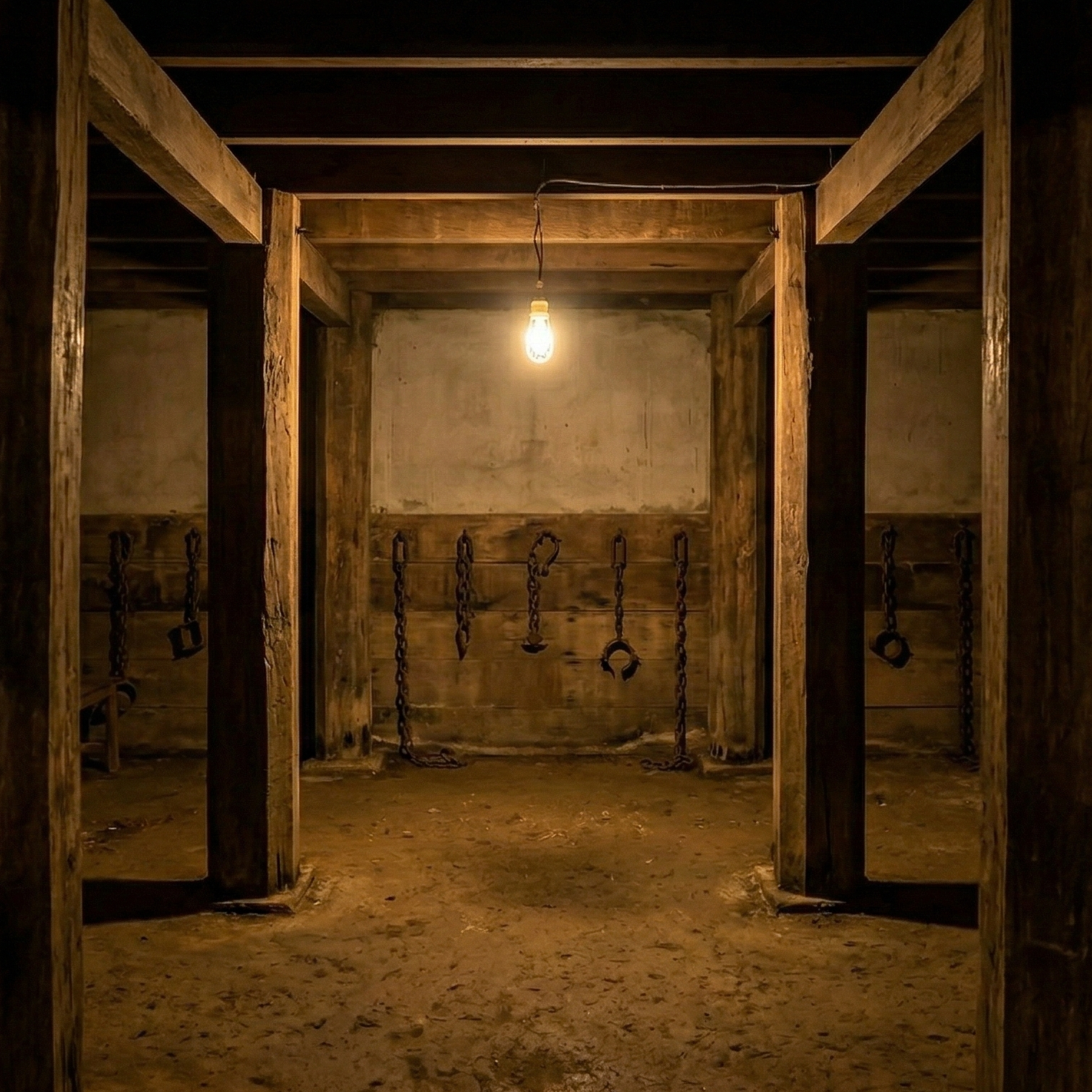
Constructed in 1892 as the official executive seat of Chao Piriyathepwong—the final hereditary ruler (Chao Mueang) of Phrae—Khum Chao Luang exemplifies the fusion of European colonial masonry-and-timber aesthetics with absolute Lanna judicial authority.
Recognised by the Association of Siamese Architects in 1993 for structural conservation, the two-storey compound projects state power through an expansive symmetrical façade punctuated by 72 shuttered bays, each crowned with radiating sunburst fretwork transoms (Chong Lom).
Following the 1902 Shan Rebellion and Chao Piriyathepwong’s exile to French Laos, Bangkok confiscated the estate and converted it into the official governor’s residence, physically repurposing the dynastic seat as an instrument of centralised Siamese administration.
The spatial division of the compound reflects a vertical hierarchy of tributary governance, separating ceremonial statecraft on the upper timber deck from penal coercion in the masonry sub-structure:
Timber Capital, Shan Guild Joinery, and Mo Hom Reduction Chemistry
Beyond the primary dynastic compounds, Phrae’s extraction economy generated specialised architectural and industrial craft infrastructures across three distinct urban and peri-urban sites:
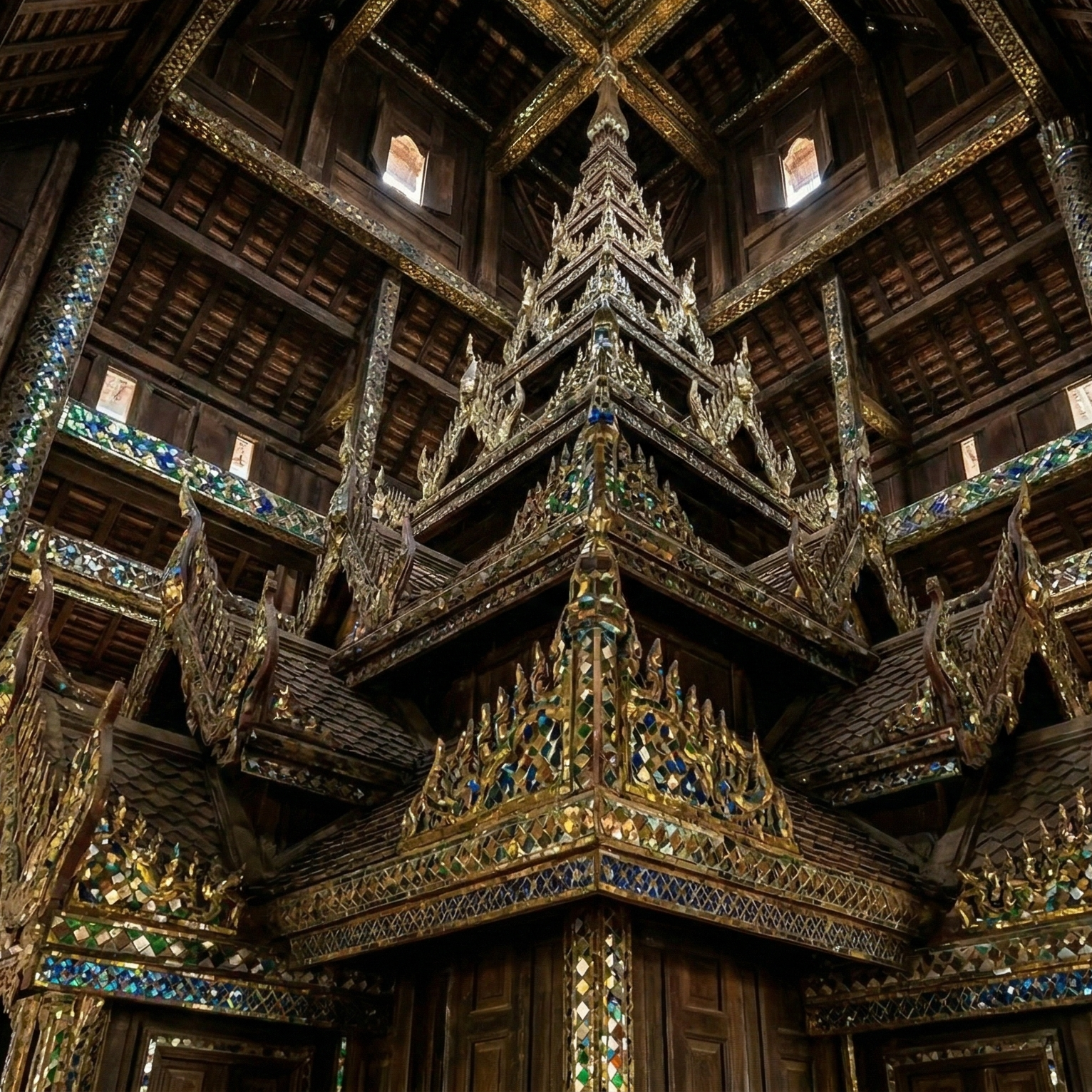
Monumental Timber Stockpiling (Ban Sao Roi Ton)
Erected in 1907 by timber merchant Chao Noi Sathan, the “House of 100 Pillars” rests on 130 massive, uncut heartwood Tectona grandis trunks arranged in a dense grid.
Beyond structural load distribution, this hyper-dense forest of monolithic columns functioned as a physical bullion reserve—allowing local concessionaires to stockpile high-grade, unmilled timber assets beneath a residential deck long before Thailand’s 1989 nationwide commercial logging ban halted extraction.
Shan Diaspora Monastic Joinery (Wat Chom Sawan)
British timber firms relied heavily on skilled Tai Yai (Shan) foresters and carpenters recruited from British Burma.
Constructed in 1894 by this diaspora community, Wat Chom Sawan adapts Burmese Konbaung-era monastic architecture into local heartwood teak, crowned by overlapping Pyatthat tiered roofs engineered to shed monsoon rainfall.
Inside, Shan artisans executed intricate Thayo (moulded lacquer putty) reliefs inlaid with Hman-zi-shwe-cha (gilded mirror mosaic), housing Mandalay marble Buddha images and Shan-script palm-leaf manuscripts carried overland along cross-border forestry trails.
Botanical Indigo Reduction (Ban Thung Hong)
Located four kilometres northeast of the old town, Ban Thung Hong is settled primarily by Tai Phuan communities resettled from Xiangkhouang (Laos) during nineteenth-century Siamese campaigns.
The village’s signature indigo (Mo Hom) workwear—historically worn by upland timber crews—relies on Hom (Strobilanthes cusia, Assam indigo) rather than dry-cake Indigofera.
Artisans reduce wet Hom paste (Hom Piak) in alkaline vats charged with wood-ash lye (Nam Dang) and slaked lime (Pun Khao), frequently over-dyeing with crushed ebony fruit (Makluea, Diospyros mollis) for UV-resistant blue-black fastness.
For itinerary designers, vetting workshops here requires separating authentic multi-dip botanical reduction vats—which oxidise visibly from emerald green to matte navy upon air exposure—from mass-market synthetic aniline dye baths.
Operational Routing: Integrating Phrae into Northern Circuits
Because Phrae lacks ultra-luxury resort inventory, private client advisors achieve optimal results by structuring the Yom River basin as an overland architectural corridor linking Chiang Mai, Lampang, and Nan rather than an extended multi-night base:
For itinerary designers, Phrae supplies the missing economic and structural link in upper Northern Thailand’s historical narrative. Moving beyond generic temple circuits, these timber compounds demonstrate how British extraction capital, Bangkok’s centralisation of forest royalties, Shan guild joinery, and passive monsoon engineering physically shaped the modern Lanna frontier.