
Key Insights
Thailand’s food heritage is a vibrant tapestry woven from royal court refinement and ethnic diversity. From the aromatic “Straits” influences of the South to the herb-heavy traditions of the Lanna North, the cuisine reflects centuries of trade and migration. It is a profound “Intellectual Luxury,” where every dish tells a story of cultural fusion and agrarian resilience.
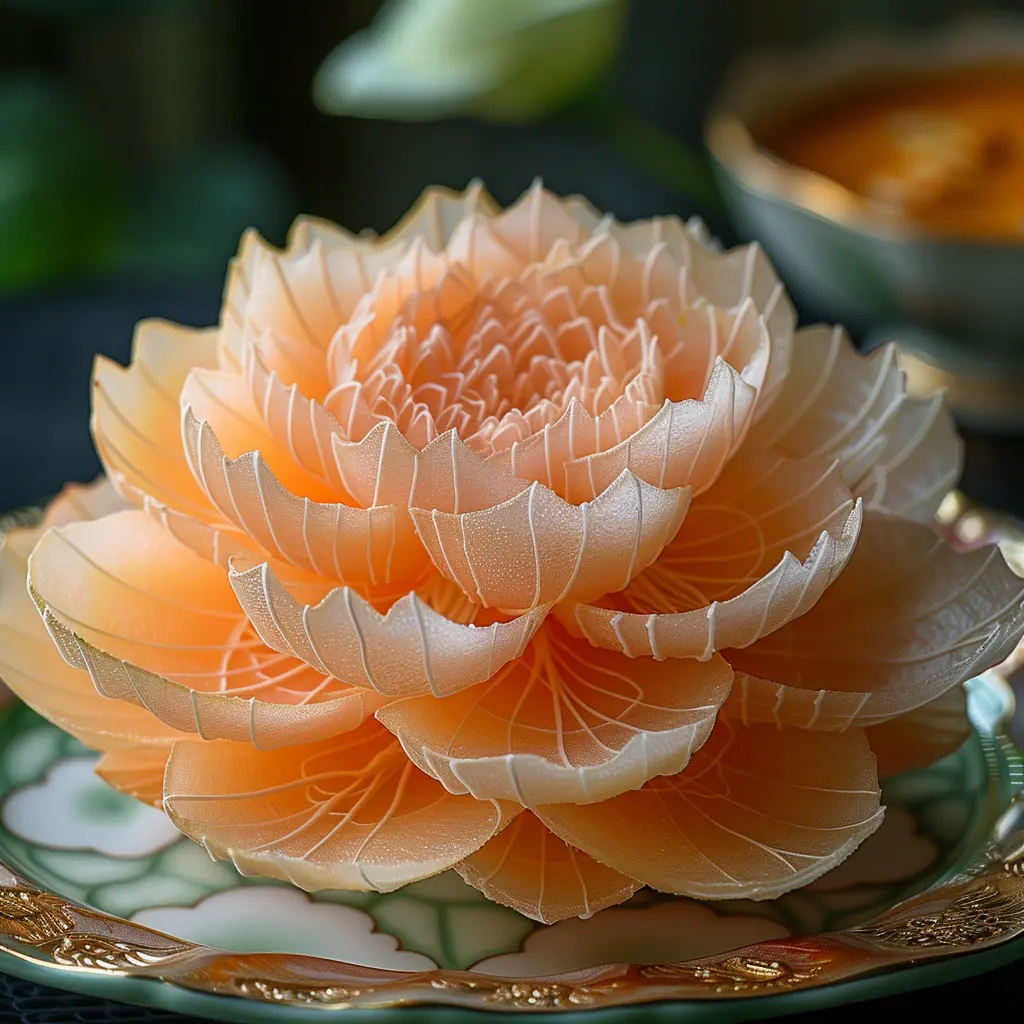
Kae Sa Luk (แกะสลัก): The traditional Thai art of intricate fruit and vegetable carving. Originating in the royal courts of the Sukhothai dynasty, this meticulous craft transforms humble produce—like melons, pumpkins, and ginger roots—into delicate, edible sculptures resembling lotus blossoms, leaves, and mythical patterns.
Aharn Chao Wang (อาหารชาววัง): Literally translating to “food of the palace people,” this term refers to Royal Thai Cuisine. Developed over centuries within the inner courts of Siam, it is a highly codified culinary style characterised by absolute flavour balance, uniform and bite-sized ingredients, and artistic presentation designed to demonstrate cultural sophistication.
Pla Ra (ปลาร้า): A traditional, highly pungent seasoning made by fermenting fish with rice bran or roasted rice powder and salt. Serving as a foundational flavour profile of Northeast Thailand (Isan), it delivers a deep, rustic, and complex umami kick to everyday regional dishes like papaya salad (Som Tum).
Benjarong (เบญจรงค์): A classic hand-painted Thai porcelain utilising a unique five-colour enamel technique (traditionally red, yellow, blue, green, and white). Famously adorned with intricate gold trims and floral patterns, these luxury vessels were historically reserved for royal feasts and continue to anchor the presentation of elite Thai dining.
Prik Thai (พริกไทย): Translating to “Thai pepper,” this refers specifically to black peppercorns. Before Portuguese traders introduced South American chilli peppers to Siamese ports in the 16th century, prik thai was the primary source of sharp, medicinal heat in traditional Siamese cooking.
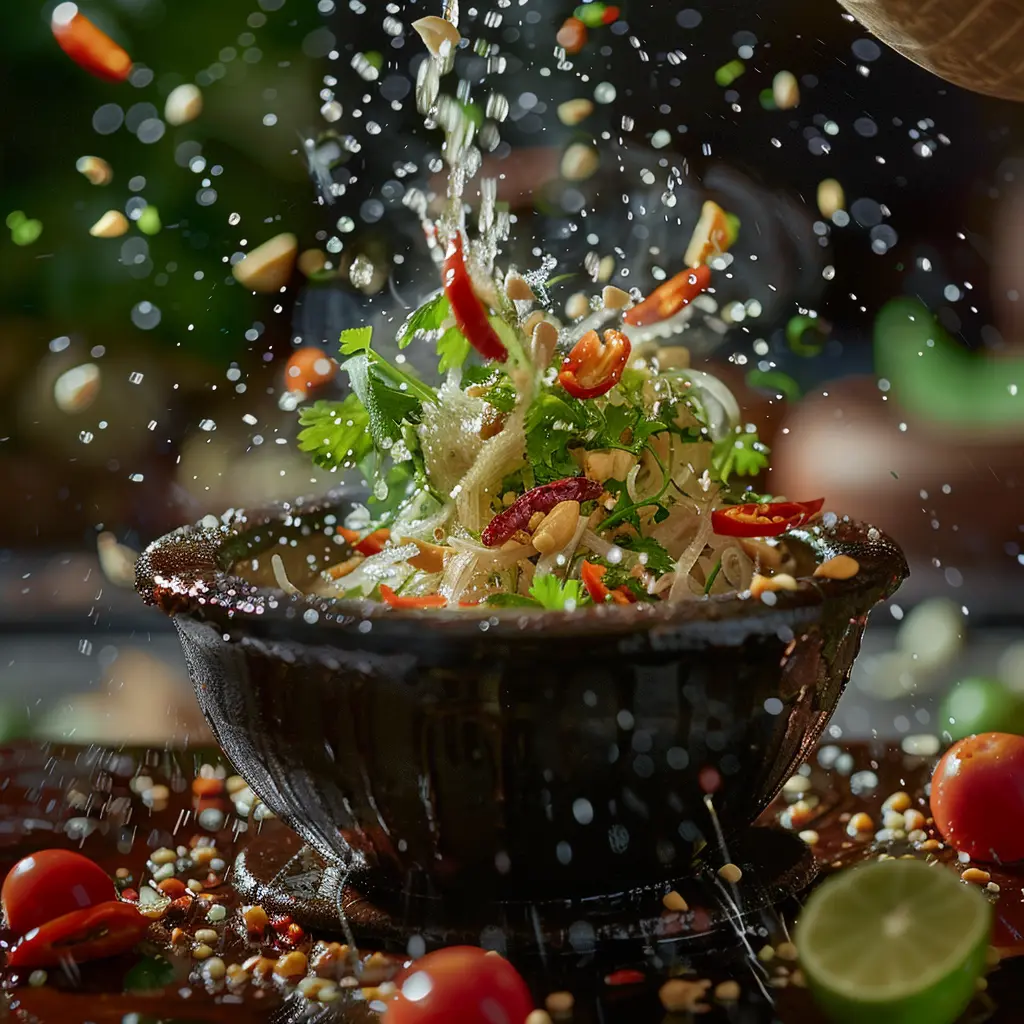
Som Tum (ส้มตำ): A vibrant, raw green papaya salad representing the quintessential soul of everyday Thai street food. Traditionally pounded in a heavy clay or stone mortar, it violently bruises garlic, chillies, tomatoes, lime, and fish sauce into the crisp fruit fibres to deliver a fierce, uncompromised clash of sensory textures.
Thai cuisine preserves an active archive of regional identity, trade migrations, and cultural survival.
Global marketing frequently reduces the Thai culinary ecosystem to commercialised staples like Pad Thai or Green Curry. However, authentic foodways remain fluid, fiercely localised, and deeply rooted in regional topography.
Initial childhood experiences with Thai food are rarely subtle. A searing, uncompromised bowl of Tom Yum soup often establishes a fiery baseline for early spice tolerance.
True culinary appreciation, however, requires moving past casual consumption. Insiders must understand how regional geography, royal courtly diplomacy, and maritime trade routes shaped the nation’s culinary soul.
I. Topography & Taste: The Four Culinary Kingdoms
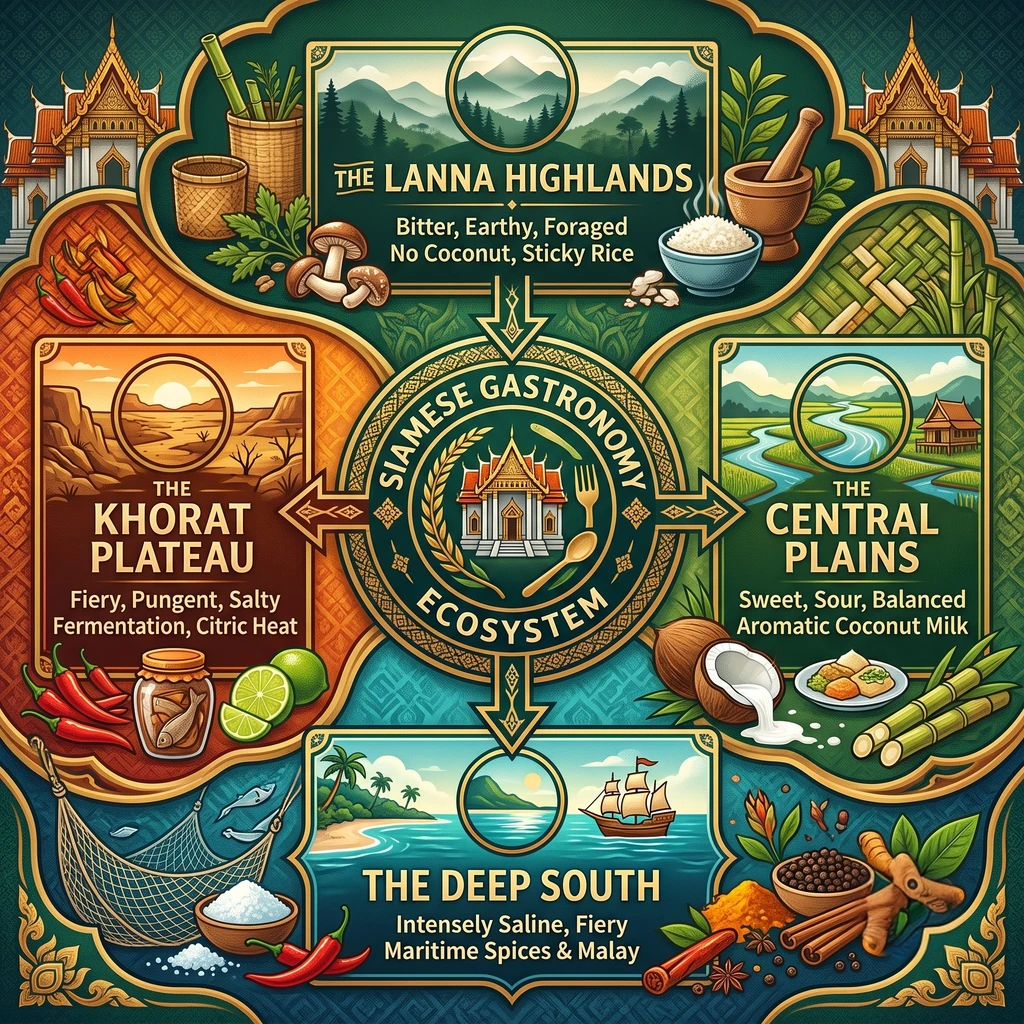
The true magic of Thai cuisine lies in its deep-seated diversity. Thailand’s main regions have each cultivated an independent culinary landscape shaped by climate, isolation, and cross-border contact.
The Central Plains: Royal Hegemony and Hydrological Abundance
The heartland of Central Thailand boasts a network of winding rivers and fertile rice paddies. This hydrological abundance naturally shaped the region’s culinary history.
Meanwhile, the proximity of the royal court at Bangkok refined it into an exercise in elegance and meticulous balance. Here, dishes achieve a complex interplay. Sweet, sour, salty, and spicy elements hold each other in perfect, intentional tension.
Consider Tom Yum Goong, the quintessential central Thai soup. While variations exist nationwide, the definitive central version showcases a clear, highly aromatic broth. Fresh river prawns are anchored by a sharp, medicinal trinity of galangal, lemongrass, and kaffir lime leaves. Royal kitchens honed the balance of these flavours over centuries, pioneering an uncompromising attention to detail and a reliance on premium seasonal ingredients.
The North: Lanna Sovereignty and Highland Trade Caravan Imprints
Cross the historic boundaries of the ancient Lanna Kingdom into the northern highlands, and the culinary lexicon shifts dramatically. Coconut milk recedes entirely from traditional local dishes, replaced by the earthy bitterness of forest foraging, mountain herbs, and a reliance on steamed sticky rice served in woven bamboo baskets (thip khao).
Khao Soi, the region’s famous rich curry noodle soup, perfectly sums up this highland identity. This northern staple features tender egg noodles in a deeply aromatic, coconut-milk-infused broth, topped with crispy fried noodles and sour mustard greens. The dish owes its lineage to the Chin Haw—Hui Muslim merchants whose mule caravans traversed the rugged trade routes between Yunnan, Burma, and Chiang Mai.
Similarly, the iconic Gaeng Hung Lay—a rich, slow-simmered pork belly curry laced with ginger, turmeric, and tamarind—stands as a direct, physical legacy of centuries of Burmese courtly administration over the north.
Isan: The Khorat Plateau’s Fire, Fermentation, and Resilience
Across the semi-arid Khorat Plateau, Isan food is a masterclass in culinary minimalism and maximum flavor Extraction. Driven by a historic need to preserve food in harsh conditions, the cuisine relies on fiery bird’s-eye chillies, sharp lime juice, and pla ra (a highly pungent, deeply umami-rich paste made from fermented mud fish).
Isan is the true birthplace of Som Tum. In this dish, tart green papaya is violently pounded in a heavy mortar. Garlic, chillies, and tomatoes join the mix to bruise the fibres. This process allows them to absorb a dressing of pla ra, lime, and dried shrimp.
Texture and protein are utilised fully in Larb, a dish of minced meat seasoned with fish sauce, lime, and fresh mint. It is bound together by khao khua (toasted, ground sticky rice), which adds a distinct, nutty crunch. No Isan meal is complete without Kai Yang—spatchcocked chicken marinated in coriander root, garlic, and white pepper, then slow-grilled over charcoal.
The Deep South: Maritime Monsoons and the Malay Boundary
In the southern peninsula, the menu mirrors the maritime monsoons and fluid borders shared with the Malay Peninsula. Southern cuisine is unapologetic. It is defined by intense salinity, sharp citrus, and a fierce, creeping heat. This bold combination catches unprepared travellers completely off guard.
Massaman curry traces its roots directly to 17th-century Persian and Indian merchants. These traders arrived in cosmopolitan southern ports like Phuket and Songkhla. The dish weaves dry, warming spices into local coconut creams. Cardamom, cinnamon, cumin, and cloves blend beautifully with tender cuts of beef or chicken.
Conversely, Gaeng Tai Pla is a dish that actively filters out casual tourists. This intensely spicy, dark curry is built on a base of fermented fish entrails (tai pla) and local bamboo shoots. Frequently cited as a polarising challenge for foreigners, it remains a beloved, unvarnished symbol of southern survival and coastal resourcefulness.
II. Aharn Chao Wang: The Architectural Precision of Royal Cuisine
Aharn Chao Wang—Royal Thai cuisine—is an exercise in architectural precision and sensory diplomacy. Nurtured within the inner courts of the Siamese kingdoms, this style transcends basic sustenance. It became a highly codified, elite art form. This practice demonstrated both political prestige and cultural sophistication.
Everyday Thai Cuisine
Royal Thai Cuisine (Aharn Chao Wang)
The apex of this culinary discipline is observed during the intense heat of April during Songkran (the Thai New Year). While the streets dissolve into water fights, heritage kitchens prepare Khao Chae. This elaborate dish consists of pristine jasmine rice soaked in chilled, naturally perfumed water.
Fresh jasmine blossoms and smoke from a traditional scented dessert candle provide the aroma. The rice is served alongside a complex suite of accompaniments. These include crispy shrimp paste balls, sweet shredded pork, and stuffed bell peppers enclosed in a delicate egg lace net.
Presentation is paramount. Chefs spend years mastering Kae Sa Luk, the art of fruit and vegetable carving. They transform humble pumpkins, ginger roots, and cucumbers into edible sculptures. Every bone is meticulously extracted. Every seed is removed so court members can dine without breaking posture or composure.
III. Street Food Ecosystems: Canals, Carts, and Transitory Spaces
Thai street food is not merely a cheap dining alternative; it is a vital urban institution. From corporate executives to construction workers, the street food stall acts as a great social equaliser. These micro-businesses operate in transitory spaces, turning pavements, canal banks, and night markets into dynamic culinary hubs.
IV. The Alimentary Timeline: Spices, Sovereignty, and Sacred Rituals
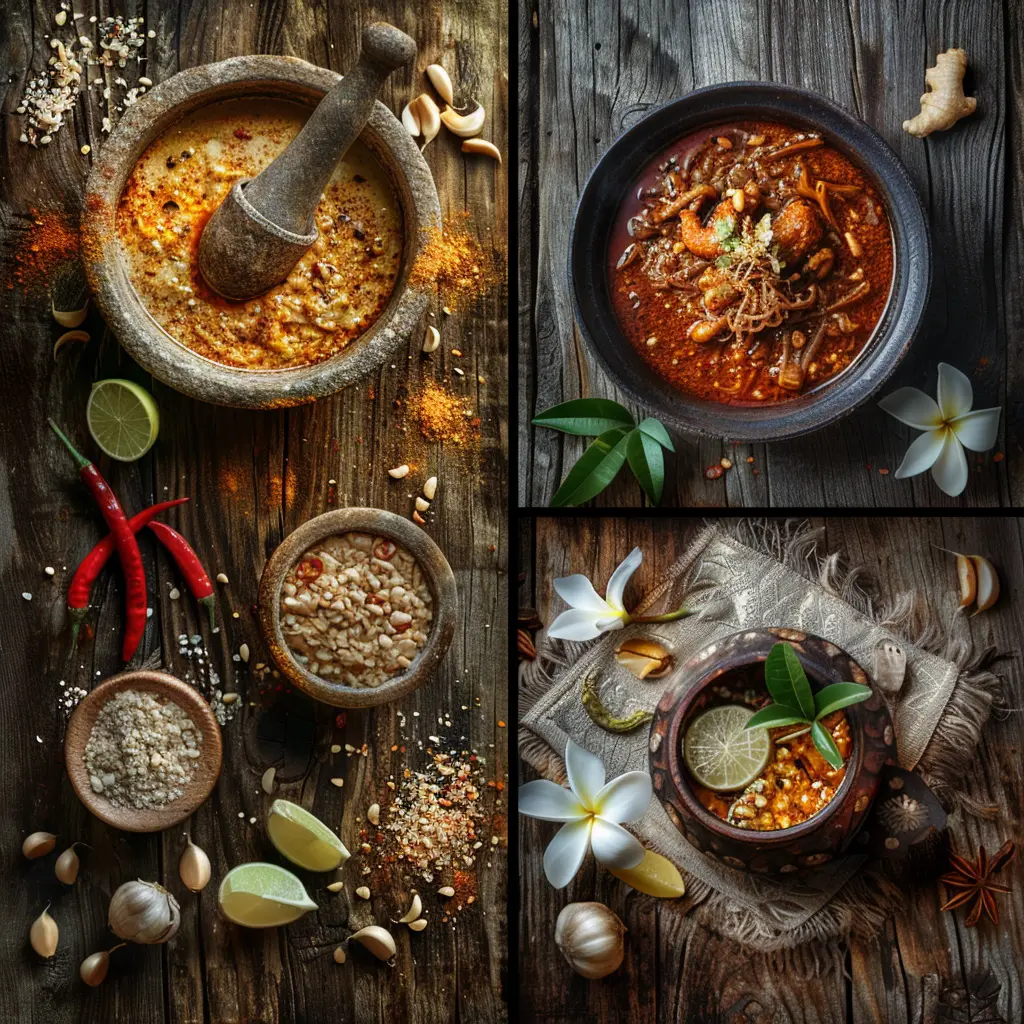
The history of Thai food is a timeline of adaptation. For centuries, rice has been the lifeblood of the nation, acting as both currency and cultural foundation. Similarly, the structural backbone of Thai cooking rests on a rustic medicinal trinity: galangal (used historically for digestive health), lemongrass (an ancestral insect repellent), and kaffir lime leaves.
[Pre-16th Century] ──────► Black pepper dominates; heat is purely herbal and medicinal.
[1511: Portuguese] ──────► Introduction of the chili pepper; entirely restructures the national palate.
[Modern Era] ──────► The delicate balance of trade-route integration and heritage preservation.
Surprisingly, the iconic fiery heat of the Thai chilli is a relatively recent addition. Before Portuguese traders introduced chilli peppers in the 16th century, the primary source of heat in Siamese cooking was black pepper. The nation quickly integrated the chilli into its agricultural and culinary identity. This speed proves the fluid, adaptive nature of Thai food culture.
The Alimentary Ritual
Food in Thailand functions as a bridge to the sacred. During major festivals like Buddhist Lent (Khao Phansa) or Loy Krathong, the act of sharing food is elevated to a spiritual merit-making practice (tham bun).
Families wake before dawn to prepare pristine tiers of food for the morning alms rounds. They offer the finest portions to the local monks. At local temple fairs, food stalls line the monastery walls. This reinforces the idea that community survival, religious devotion, and culinary heritage are completely inseparable.
V. Preserving the Legacy: The New Culinary Horizon
In a rapidly modernising world, global commercial homogenisation poses a distinct threat to traditional foodways. Fortunately, a new wave of cultural preservationists, historians, and heritage chefs are pushing back. They actively reject the oversimplified, automated corporate menus that dominate global tourism.
By championing small-scale sustainable agriculture, these culinary advocates ensure future generations do not lose vital historical skills. They source hyper-local ingredients from indigenous foraging communities. They also decode ancient family recipe manuscripts.
Preserving Thai food heritage is ultimately an act of safeguarding national identity. It invites the intentional traveller to look beyond the surface. In doing so, they discover a brilliant world of regional history written entirely in flavour.